
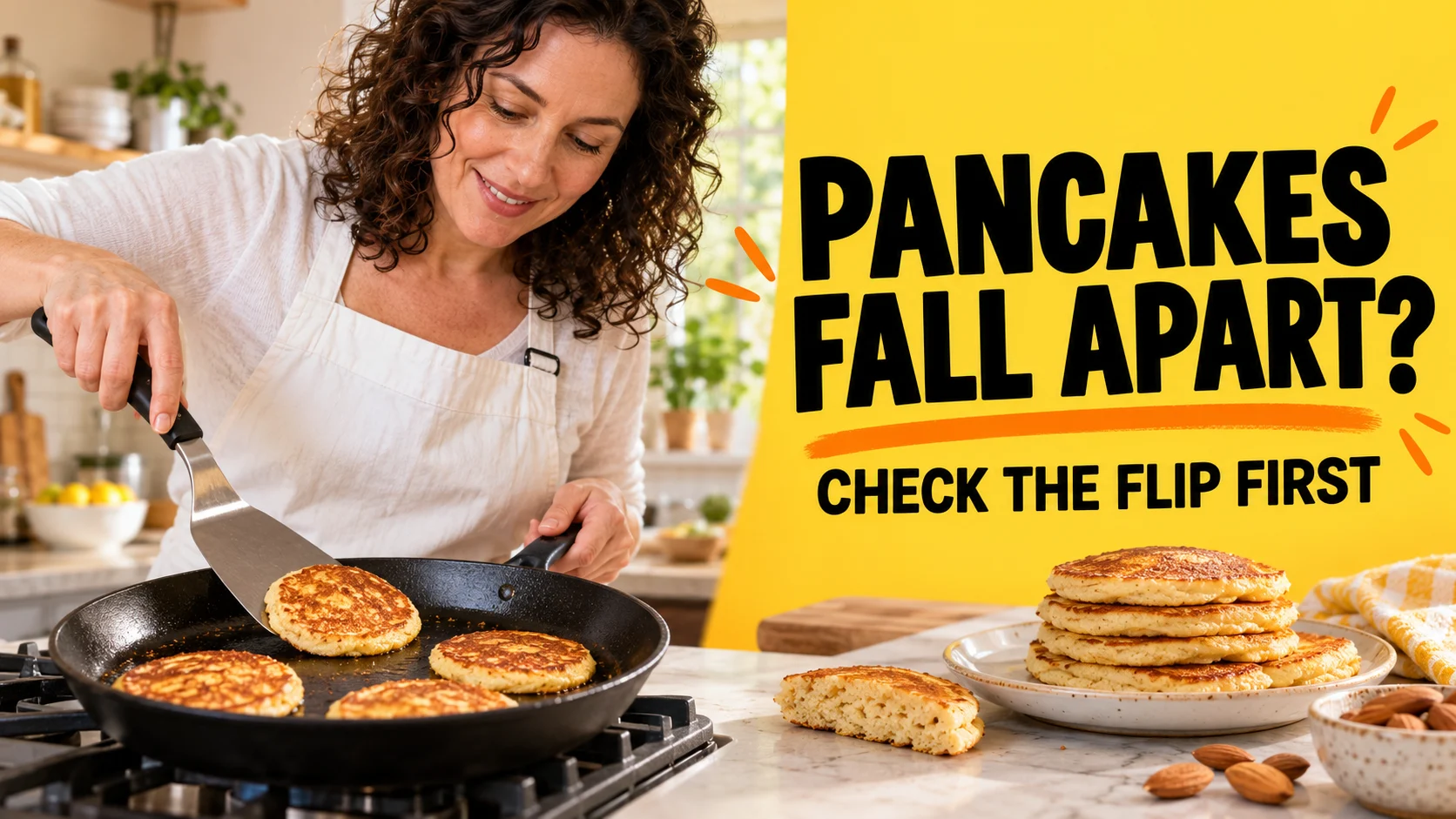

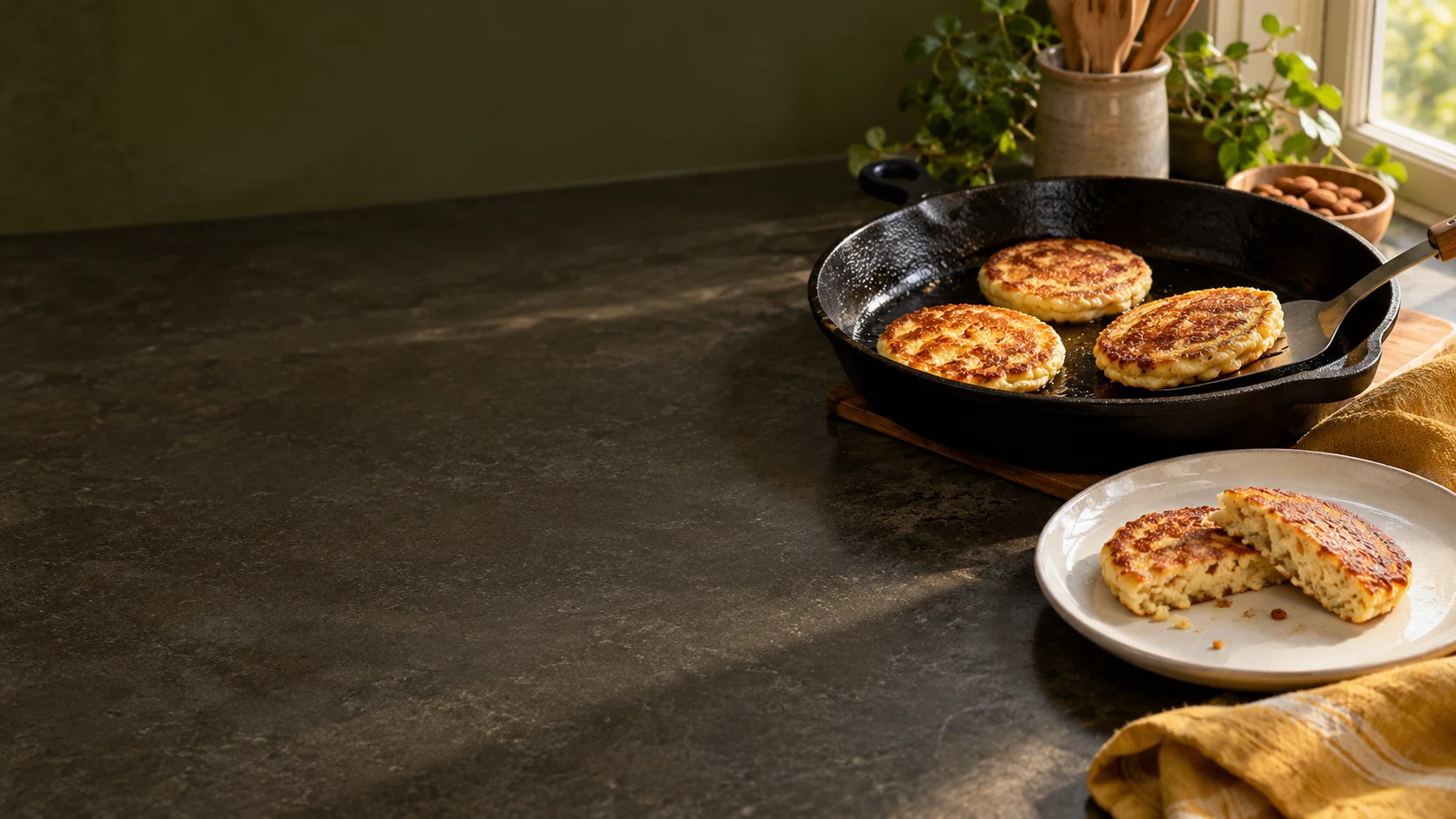
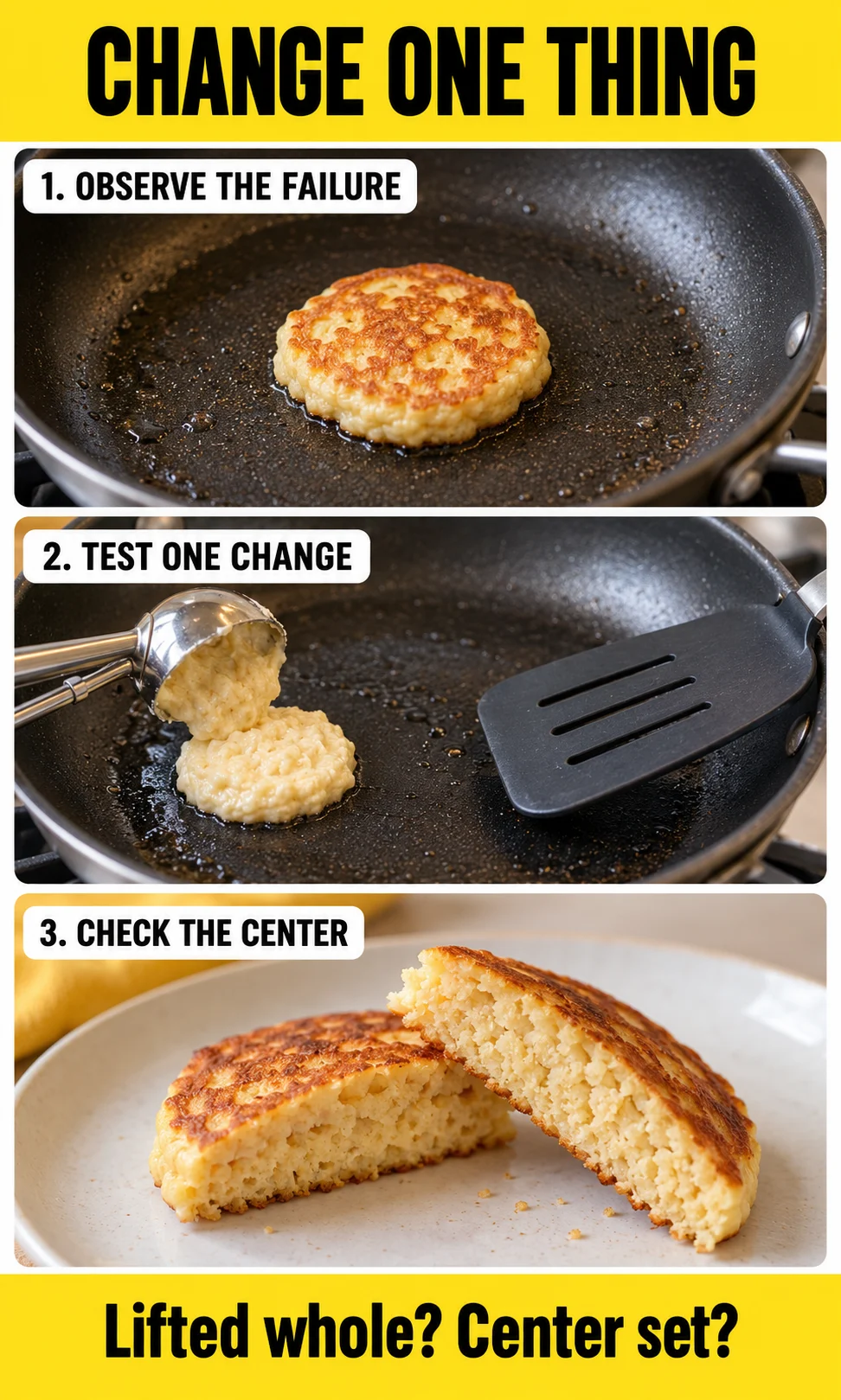
Almond-flour pancakes can fall apart when you flip them before they have set, when they stick to the pan, or when the batter cannot support the scoop size. Start by checking the edge and underside of one small pancake before adding anything to the bowl. Change one thing for the next attempt so you can tell whether it helped.
Why almond-flour pancakes tear on the flip
Almond flour does not form the stretchy gluten network that helps wheat pancakes hold together. In an egg-based recipe, setting egg proteins supply an important part of the structure; other formulas may use additional binders. A golden underside can appear before the whole pancake is strong enough to turn.
That makes the moment of failure useful evidence. A pancake that smears while you lift it suggests something different from a cooked pancake that breaks into dry crumbs. Look at the piece left in the pan before deciding the batter needs more flour or another egg.
No, overmixing does not develop gluten here
Stirring almond flour cannot create gluten-forming proteins that are absent from the ingredient. The technical profile of almond flour describes that absence and the role of protein setting in baking. Follow the recipe’s mixing method, but investigate timing, release and ingredient balance rather than blaming a wheat-style gluten problem.
Watch the edge, then check the release
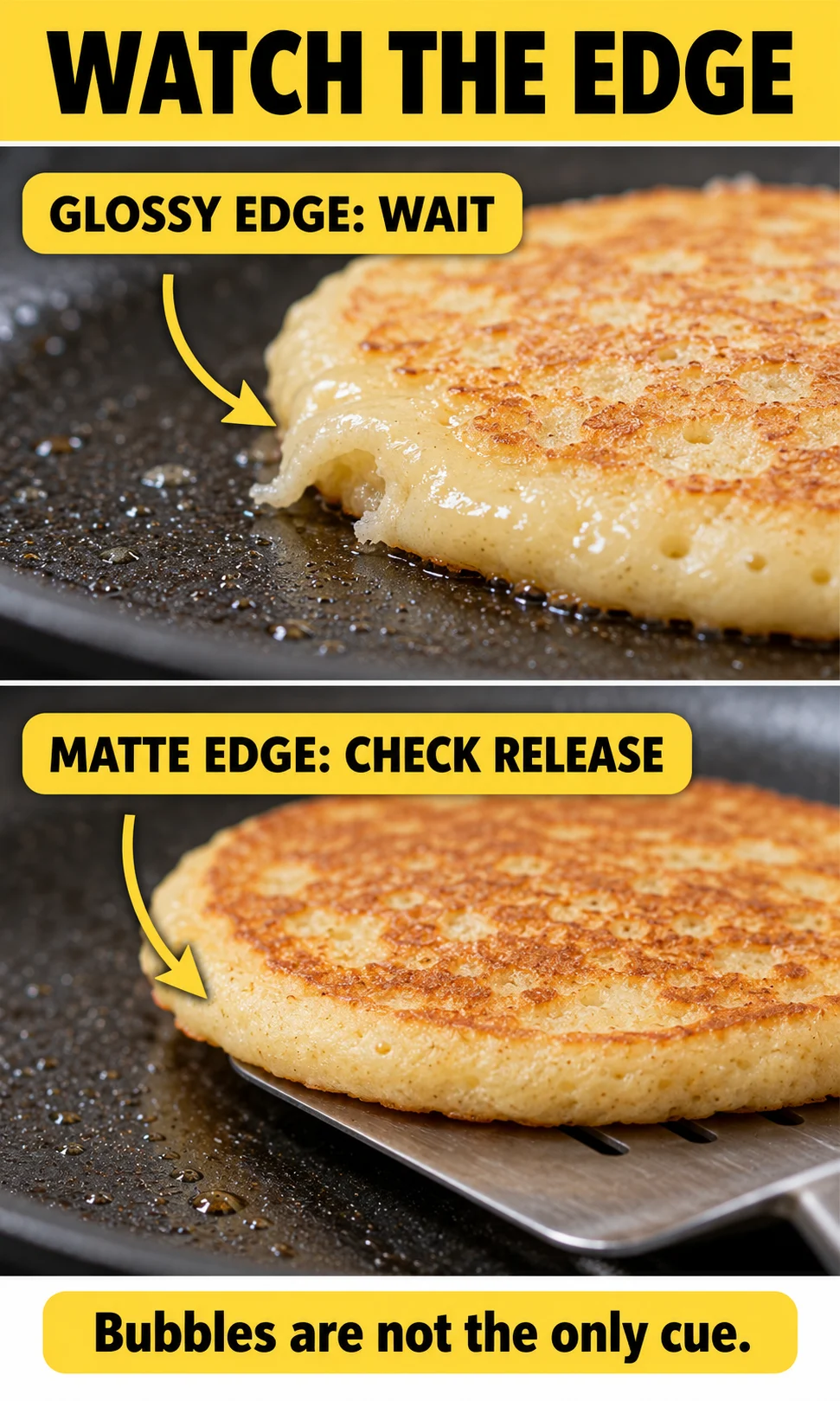
A perimeter that still looks glossy and moves like wet batter may not support a turn. A matte, firmer edge is a useful cue to check whether a wide spatula can slide underneath without pulling the pancake apart. It is a flipping cue, not proof that the center is safely cooked.
What to check before changing the batter
Start with the recipe you actually followed, including the flour description and any substitutions. A formula developed for almond flour is a better baseline than a wheat pancake recipe with one ingredient replaced. If the recipe gives gram weights, use those weights rather than borrowing a cup-to-gram conversion from a different flour.
Flour grind and scoop size
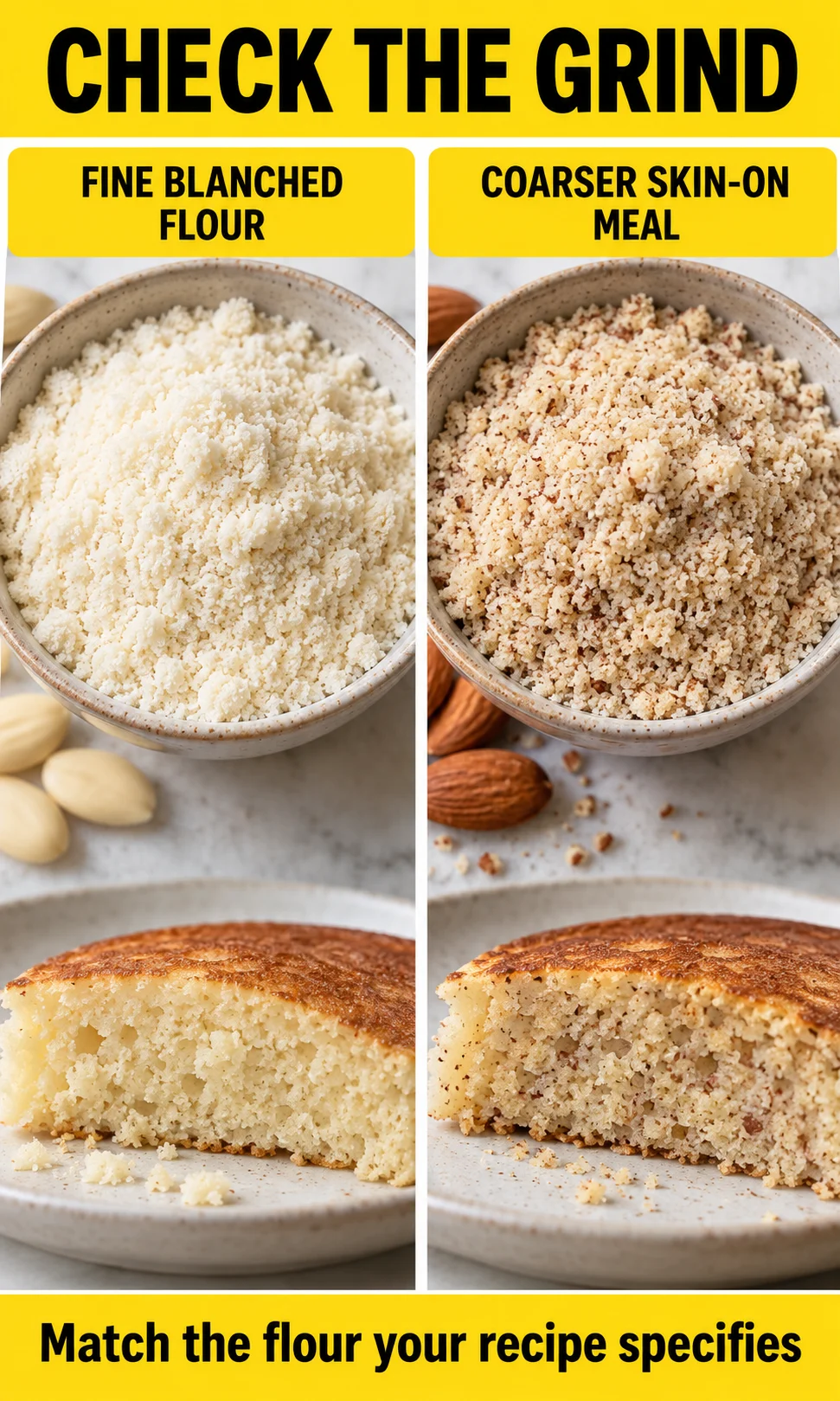
Check whether the bag matches the grind specified in the recipe. Fine blanched flour and a coarser skin-on meal can produce different textures, although the words flour and meal are not used consistently by every manufacturer. Inspect the ingredient and grind description instead of assuming all dark flour is coarse.
A large pancake is harder to support because part of it can hang beyond the spatula. For a size-only trial, use about two tablespoons of batter and keep the round modest rather than making a thick mound. Treat that as a practical test size, not a guaranteed measure for every formula.
A brief rest can help some batters settle, especially when a recipe includes a moisture-absorbing binder. Use the rest specified by your recipe; five minutes is not a universal cure for an unbalanced mix. Do not change rest time, scoop size and ingredients together and then credit only one change for the result.
- Check the formula: note any wheat-flour swap, missing binder or extra liquid.
- Check the pancake: record the edge appearance and underside color before turning.
- Choose one trial: longer first-side cooking, gentler heat, better release or a smaller scoop.
- Keep a record: write what changed and whether the pancake lifted whole and had a set center.
Heat matters more than a bubble count
Almond-flour batters do not all show the familiar bubble pattern of wheat pancakes. A quiet surface therefore does not automatically mean the pancake needs more leavener. Follow the recipe’s cues and check the edge and underside instead of waiting indefinitely for bubbles.
A dark underside with a wet center means that waiting longer at the same heat may simply make the outside worse. Turn the heat down for the next trial and let the pan lose some heat before adding more batter. Medium-low is a useful starting setting, but stove labels do not measure the temperature of your pan.
Choose one change for the next pancake
Use Pancake Flip Rescue to select the symptom, edge condition, underside color and any recipe changes. It returns a starting test and tells you what to hold steady. The result is a troubleshooting suggestion, not a confirmed cause, nutrition assessment or new pancake formula.
ALMOND-FLOUR BREAKFAST
Pancake Flip Rescue
Find the next check before you change the whole batter.
Separate an early flip, sticking, an oversized scoop and a recipe mismatch. This gives a starting test, not a confirmed diagnosis or a replacement recipe.
STARTING POINT
Choose what happened in the pan
Your next test will appear here. Keep the other ingredients and cooking conditions unchanged.
Record one test pancake
These checks record your observation; they do not certify food safety.
Notes stay in this page and clear when you reload.
Do not taste raw batter or serve a wet center. Do not use ingredients with signs of spoilage. Photos are illustrative; no kitchen experiment is claimed.
If the edge is still wet
Give the next pancake more time on its first side while keeping the scoop and heat unchanged. Check whether its edge firms up and the spatula supports it without smearing. If the underside becomes dark before that happens, stop the timing trial and test gentler heat instead.
If it sticks and then tears
A set pancake can still break if its underside remains attached to the pan. For the next trial, refresh the thin cooking-fat film specified by the recipe and use a wide spatula to check release gently. Do not add another egg to solve a pan problem or keep scraping a damaged cooking surface.
If it crumbles after a patient flip
Dry breakup after cooking deserves a recipe check rather than an automatic instruction to wait longer. Confirm the flour grind, measured quantities, egg size and any binder substitution against the original formula. If you changed an ingredient, restore that one specified ingredient in a small new batch before experimenting with several additions.
| What you see | What it suggests | First test |
|---|---|---|
| Wet edge; pale underside | Possibly too early to turn | Wait longer on the first side; check release again. |
| Dark underside; wet center | Pan heat is a priority check | Lower heat; let the pan cool slightly before the next pancake. |
| Set edge; underside stuck | Pan release is a priority check | Refresh the recipe’s thin fat film before the next pancake. |
| Large round breaks across spatula | The scoop may be hard to support | Try about two tablespoons; keep the batter and heat unchanged. |
| Small, released pancake still crumbles | Flour or formula mismatch remains possible | Check the written recipe and restore a confirmed mismatch in a new batch. |
Swipe horizontally to compare. These clues suggest a first test; they do not establish a single cause.
Why a 1:1 wheat-flour swap may not work
Replacing wheat flour with the same volume of almond flour changes more than the flavor. The batter loses wheat’s gluten-forming capacity and gains an ingredient with different fat, starch and moisture behavior. There is no reliable universal instruction to add one egg or one spoonful of flour and restore the original balance.
If that substitution created the problem, use a complete almond-flour pancake formula for the next batch. Choose one that specifies ingredients, quantities and cooking cues, such as this almond-flour pancake recipe. It supplies a baseline; it does not prove that your current bowl can be rescued.
Dense, eggy or bitter pancakes need different checks
A dense but cooked crumb and a wet, gummy center are different problems. First cut a finished test pancake so you know which texture you are dealing with. A fully cooked but heavy result calls for checking measurements and recipe expectations, while a wet center returns you to heat, thickness and formula balance.
An eggy flavor may tempt you to remove the very ingredient helping the pancake hold together. Check the written ratio before changing it, and use the flavoring specified by the recipe rather than inventing a new binder balance. If you need an egg-free breakfast, start with a recipe developed for that purpose.
A bitter or soapy taste can follow a leavener error, but an unusual stale or paint-like smell raises a flour-freshness concern. Check whether you used baking soda where the recipe called for baking powder, and inspect the flour without tasting raw batter. Discard suspect ingredients rather than masking the smell or trying to neutralize an unknown amount of soda.
Do not use a browned outside as a safety check
Never serve a pancake with wet batter in the center or taste uncooked egg-containing batter during troubleshooting. For dishes containing eggs, USDA guidance specifies 160°F (71°C); a thin-tip food thermometer can check a sufficiently thick pancake from the side. Visual flipping cues help with handling, but they do not verify that temperature.
Frequently asked questions
Why do my almond-flour pancakes fall apart when I flip them?
They may be insufficiently set, stuck underneath, too large to support, or made with an unsuitable ingredient balance. Check the edge and underside before changing the batter. Test one likely cause at a time rather than adding flour, liquid and another egg together.
Why do they burn outside and stay raw in the middle?
The pan may be cooking the surface faster than the center can set. Lower the heat for the next pancake and allow the pan to cool slightly first. If a small pancake still stays wet at gentler heat, review the recipe rather than serving it.
Why do my almond-flour pancakes not bubble?
Some almond-flour batters show few surface bubbles, so bubble counting is an unreliable universal flipping rule. Check the recipe’s instructions, the firming edge and gentle spatula release instead. These cues indicate handling readiness and do not establish food safety.
Can I use almond meal instead of almond flour?
Use the product and grind specified by the recipe, because labels are inconsistent and texture varies. A coarser meal may give a grittier, more fragile result in a formula developed for fine blanched flour. A recipe designed for almond meal can work, but that does not make the substitution universal.
Why do they taste eggy?
The balance of egg and other ingredients can make egg flavor prominent. Check that you followed the recipe before reducing the binder. Choose a different developed formula if the flavor still does not suit you.
How long do leftover almond-flour pancakes keep in the fridge?
Use the recipe’s shorter storage limit when it gives one; general USDA leftover guidance allows three to four refrigerated days. Refrigerate promptly within two hours, or one hour when the surroundings exceed 90°F (32°C), at 40°F (4°C) or colder. Reheat leftovers to 165°F (74°C), and discard pancakes whose safe storage history is uncertain.
Decide what to change, then stop changing everything
Choose the first test from the failure you actually saw: timing for a wet edge, gentler heat for early darkening, release for sticking, or a smaller scoop for a round that breaks across the spatula. If a small pancake releases cleanly with a set edge and still fails, return to the formula. A successful rescue means a pancake you can handle and cook through, not a promise of wheat-style fluffiness.