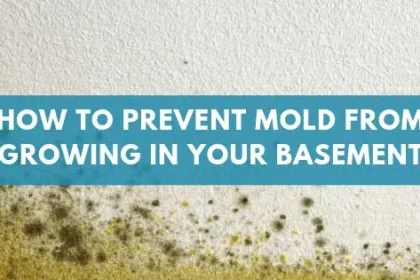
Basement mold prevention starts with controlling moisture, and a short checking routine can help you notice when that control has failed. It cannot prove that a basement is mold-free or turn a leak, contaminated flood or hidden damp wall into a two-minute repair.
Begin only from dry, stable ground. Standing water near electrical equipment, sewage, a sagging finish, an unstable stair or extensive visible growth changes the task from routine observation to getting appropriate help. Do not enter the water, move powered equipment through it or open a wall to satisfy a checklist. A useful check ends early when continuing would be unsafe; completing every observation is never the priority.
This page owns the brief return visit: what to look at after rain, during humid weather, or when a dehumidifier has been left running. The broader basement moisture-prevention guide explains source control and longer-term solutions. Here the emphasis is on detecting a changed condition and understanding what a reassuring observation might miss, rather than repeating a complete drainage or mold-cleanup manual.
Treat “two minutes” as a reminder to look, not a validated inspection duration. A familiar, accessible basement might take very little time to revisit; an unfamiliar finished basement might need a longer assessment. There is no evidence-based rule that looking for exactly two minutes prevents growth. The practical benefit comes from noticing something early enough to respond, not from how quickly you finish the round.
Use the equipment you already understand: adequate room lighting or a flashlight, a standalone room hygrometer if available, and the operating instructions for a dehumidifier. You do not need a mold-testing kit, a thermal camera or a new monitoring subscription for this observation task. Keep your hands off unfamiliar wiring, concealed pipes and suspect materials. If access or mobility is difficult, ask a suitable person to observe the same accessible points instead of climbing or stretching.
Decide in advance what would count as a change: new wetness at a known wall-floor joint, a persistent musty smell, humidity that stays high, or equipment that has stopped collecting water when humidity remains elevated. These observations do not have equal causes. The endpoint is either “no new accessible clue noticed” or a specific problem needing follow-up. Neither endpoint is a certificate about the hidden parts of the building.
Make one short round from the safe access route. Look at the accessible locations that have caused trouble before, read representative room humidity rather than the appliance’s warm exhaust, and check the appliance’s external status indicators. Do not dismantle anything. If you find new wetness or a stopped machine, let that finding determine the next action instead of continuing as though the routine itself has solved the problem.

What should change after rain or humid weather?
A rain event and a humid afternoon ask different questions. After rain, a new wet line at the wall-floor joint or dampness below a window makes a water-entry route worth investigating. During humid weather, droplets on a cold pipe may be condensation. The same basement can have both. This distinction is an observation aid, not permission to choose a waterproofing product from the shape of a stain.
The University of Minnesota Extension basement guidance separates liquid water, indoor vapor sources and humid outdoor air. Its source-first approach matters during a return visit: a dehumidifier may improve room air while water continues entering elsewhere. If a patch gets wet after storms despite comfortable air, the change deserves attention even when the appliance has been working normally.
Room relative humidity and material moisture are different measurements. A hygrometer describes water vapor relative to air temperature; it cannot tell you whether a hidden sill, wall cavity or cardboard box is dry. Conversely, a building-material meter is not a room-humidity gauge. The guide to interpreting moisture-meter readings after water damage explains the scale and material issues. Avoid transferring a number from one instrument to the other.
Give the hygrometer time to respond according to its instructions. A sensor just carried in from another room, placed directly in a discharge stream or briefly held against a cold wall may not represent the room condition you intended to check. Use a repeatable, accessible position in representative air. A deliberate reading at an appropriate location is more useful than several hurried readings that appear precise but describe different conditions.
Use a low-humidity target as one part of prevention. The EPA household mold guide recommends keeping indoor relative humidity below 60%, ideally around 30–50% when possible. A recurring reading outside the working range is a reason to investigate moisture load and equipment performance. It is not a countdown to growth, and a reading inside the range does not erase a wet material or recurring leak.
Look at the timing as well as the display. A favorable reading immediately beside a working dehumidifier can coexist with a poorly ventilated storage corner, and a brief door opening can produce a temporary change. You are trying to understand a recurring condition, not catch a particular number. If a machine shows a lower value than the separate room instrument, check placement and instructions before assuming that one device is accurate and the other is defective.
The table below pairs a finding with what remains unresolved. Reading only its first column turns a clue into an answer too quickly. Reading across helps distinguish an appliance problem, a humidity problem and a water-entry problem. Where a finding repeats, the unresolved question matters more than whether the floor looks better during today’s visit.
| Finding | Question still open | Appropriate direction |
|---|---|---|
| New wet patch after rain | Where is the water entering? | Assess the water route; air drying alone is insufficient. |
| High room RH | Is the load high, the equipment stopped, or the reading unrepresentative? | Check conditions and normal operation. |
| Droplets on a cold pipe | Condensation, leakage, or both? | Compare the surrounding conditions; avoid disturbing insulation. |
| Musty smell without a visible cause | Could moisture or growth be concealed? | Arrange assessment rather than opening finishes casually. |
Why can opening a window make a cool basement wetter?
An outdoor relative-humidity percentage does not, by itself, tell you whether the incoming air will help dry a basement. Relative humidity changes with temperature. Warm air at one percentage can contain more water vapor than cooler air at the same percentage. Comparing two percentages without their temperatures can therefore reverse the conclusion you meant to draw. A breeze is a sensation of air movement, not evidence that the incoming air is dry enough.
Dew point offers a different piece of information: the temperature at which air becomes saturated when cooled. The National Weather Service explanation of dew point and humidity explains why dew point is more informative about the amount of moisture in the air than a relative-humidity percentage alone. A cool basement surface can be below the incoming air’s dew point even while the outdoor air feels pleasant to someone standing upstairs.
Consider an illustrative condition, not a measurement from your home: outdoor air has a dew point of 20°C, while an exposed basement surface is 15°C. That incoming air can condense on the colder surface. The example does not determine your wall temperature or prove that a particular wet patch is condensation. It shows why “the outdoor humidity number is lower” is an incomplete reason to open a basement window.

This is also why a central room reading cannot describe every cold surface. A pipe, a cool foundation corner and the middle of the room are different locations. Avoid touching pipes or moving insulation to investigate casually; observation from a safe position may be enough to identify a need for closer assessment. Persistent surface moisture deserves a response even when a room instrument looks acceptable, because the instrument was never measuring the surface itself.
Do not replace “always open the windows” with “never ventilate.” Outdoor conditions, indoor pollutant sources, weather, security, combustion equipment and the building’s designed ventilation all matter. The point is narrower: do not use warm, humid outdoor air as an automatic basement-drying strategy. If the ventilation or moisture problem persists, the appropriate service should evaluate the building rather than relying on an improvised seasonal rule.
Before changing the window habit, check the reasoning you are using. These questions are not a calculation that certifies a dry wall; they identify missing information. You do not need to measure every surface to recognize that a humid summer day may be the wrong time to flush a cool basement with outside air.
- What was compared? Outdoor and indoor percentages at different temperatures are not a complete moisture comparison.
- What is cold? The vulnerable surface may be cooler than the room air.
- What is the outcome? Fewer droplets or a lower room reading still does not repair a leak or remove existing growth.
Is the dehumidifier actually controlling the room?
A machine can be present, plugged in and quiet for several different reasons. It may have reached its setting, its bucket may be full, it may be outside its operating conditions or there may be a fault. An external status check should therefore connect the indicator with the room condition. Do not treat silence as success, and do not treat a running fan sound as proof that water is being removed.
Portable units commonly stop when the bucket is full. ENERGY STAR dehumidifier guidance explains bucket warnings, automatic shutoff and drainage options. Read the actual indicator and manual rather than repeatedly lowering the setting. Emptying and reseating a bucket, when the manual directs it and the area is safe, is ordinary operation; dismantling an interlock or bypassing a shutoff is not a sensible way to keep a basement dry.
For a continuous-drain installation, look at the accessible hose route without detaching it. A kink, a disconnected end or a route that no longer matches the installation instructions can interrupt disposal. A gravity hose and a pump-assisted system have different requirements, so do not assume every hose must behave the same way. Keep hoses and water away from electrical connections, and arrange suitable help for a drain or pump fault you cannot identify safely.
Cold operating conditions also matter. A portable unit’s rated performance and low-temperature features are product-specific; a device suited to a warm room may not behave the same way in a cold basement. Frost, repeated cycling or an error message belongs in a manual-led check. Do not apply an improvised heat source, remove guards or keep forcing the machine to run. The correct response follows the product’s operating and service instructions.
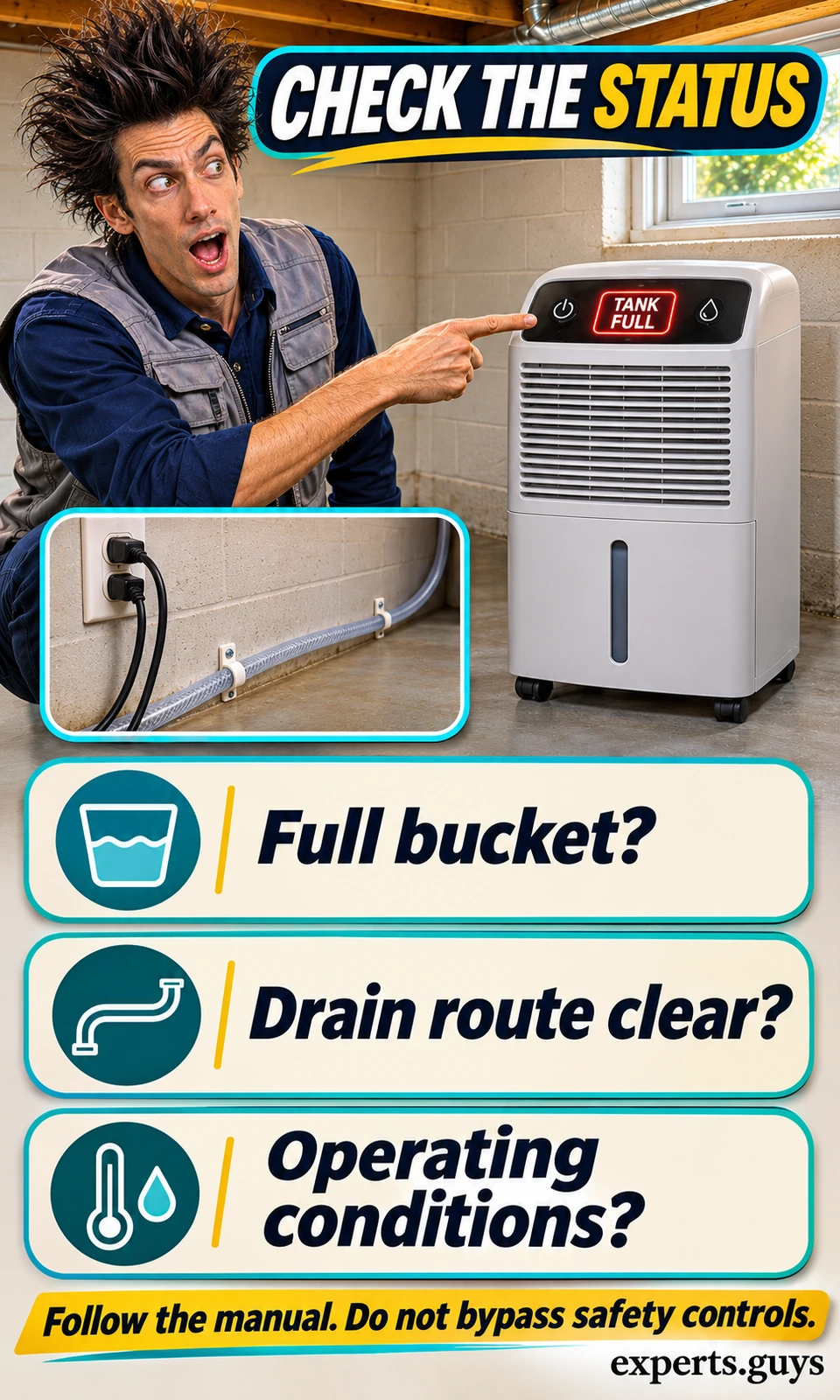
A bucket that fills often can mean the appliance is removing moisture, but it does not reveal where that moisture came from. A bucket that remains empty can mean the air is already dry, but it can also mean the machine is not removing moisture. Interpret the observation alongside room conditions and indicators. This small distinction prevents the familiar mistake of judging performance by one satisfying sign, such as collected water, without asking whether the original damp area has changed.
If humidity remains high despite normal operation, investigate the load rather than assuming a lower setting is the only answer. An open exterior door, indoor laundry drying or ongoing seepage can exceed what the existing setup can manage. Capacity and installation questions may need professional advice, but buying a larger machine is not a substitute for stopping unwanted water. Do not use a humidity appliance to postpone a leaking-pipe repair or an assessment of recurring rain entry.
An unattended basement needs an arrangement that can keep operating safely, not merely a good setting on departure day. Consider who will notice a full bucket, a power interruption or an error. Follow the equipment’s instructions for drainage, cleaning and restart behavior. A connected sensor can be useful if someone will respond to it; it is not essential for this routine and does not remove the need for a functioning water-disposal route.
Choose an alert or checking arrangement for the failure it actually detects. A water alarm can signal contact with water at its location; a humidity sensor reports air conditions where it sits. Neither surveys an entire building or identifies mold. Position and maintain devices according to their instructions, and keep access clear. The useful outcome is a known person receiving a meaningful signal, rather than collecting more notifications that nobody is able to act on.
What should you do with a new finding?
Separate an immediate source problem from a finishing problem. A dripping accessible fitting calls for stopping or repairing the leak through the appropriate safe route. Fresh rain-related wetness calls for evaluation of the entry and drainage path. A new appliance error calls for the product’s operating or service process. None of those findings is solved by painting the nearby trim, adding fragrance or wiping the floor once and returning everything to its previous place.
If previously clean belongings have become wet, avoid letting them sit against a damp wall or floor. Move only what you can handle safely into an appropriate clean, dry location, keeping the walking route clear. Do not carry visibly moldy items through the house as part of a casual routine. Wet contaminated materials, heavy storage and extensive damage need a different plan. The brief check is not permission to turn a developing problem into an unprotected cleanup project.
For a persistent musty smell without an accessible cause, do not open paneling or insulation just to locate the source. Growth can be hidden, and disturbing a concealed area may release material into the room. The EPA advice on hidden moisture and biological contamination emphasizes moisture control and not enclosing wet materials. The separate hidden wall-water-damage guide explains why a normal-looking surface does not settle the condition behind it.
A patch’s color is not a species test. White deposits on masonry may be mineral residue, while a dark mark may be staining, dirt or growth; appearance alone does not establish the cause. Avoid rubbing, scraping, sniffing closely or spraying a sample to investigate. Report what you observed and the conditions around it. A modest, accurate description is more useful than telling a contractor the exact organism based on a photograph.
Act promptly when clean-water wetting occurs. Drying within roughly 24–48 hours is a widely used prevention aim, not a guarantee or a reason to wait until the second day. Materials, hidden layers, water contamination and the extent of damage change what can be recovered. The CDC cleanup guidance distinguishes cleaning, drying and removing unsalvageable materials. This article’s short observation round is not a substitute for those separate tasks.
Decide what follow-up would test the actual concern. After a repair, look again under comparable relevant conditions, such as the next suitable rain event, and confirm that affected materials have been appropriately assessed before covering them. After correcting a full bucket, confirm that the machine resumes normal operation and the room condition responds. A follow-up should answer the question raised by the finding, not simply produce another reassuring glance.

The common error is confusing an action with an endpoint. “I emptied the bucket” describes an action. “The machine resumed its expected operation, the room reading improved, and the separate wet patch was investigated” describes several outcomes with different meanings. None is a universal mold-clearance test. Keeping them separate makes it harder for a small successful task to conceal the unresolved part of the problem.
How do you avoid false reassurance between visits?
Recheck the same accessible location when it is relevant, rather than shifting attention to the driest-looking part of the room. If safe, an existing phone photograph can help show a new wet edge or equipment message, but you do not need a diary or a collection of images to request help. Do not repeat a leak, run extra water or wait through another storm merely to produce a more convincing photograph.
State the limitation when you hand over the finding. “This corner became wet after the last rain; I have not opened the wall” is more useful than “the foundation has failed.” “The full-tank light was on while the room remained humid” is more useful than “the dehumidifier is broken.” These examples keep observed facts distinct from a diagnosis and give the next person a concrete starting question without asking you to become an inspector.
A contractor’s first task should fit the problem. Plumbing, drainage, appliance service and mold remediation are different scopes, although more than one may be needed. Ask which source the proposed work addresses and how the result will be checked. You do not need a generic ranking score or a list of every possible trade. A clear explanation of the water route and the remaining uncertainty is more useful than a promise to make the room smell fresh.
If you rent, report new leaks, persistent dampness or equipment problems to the responsible owner or manager promptly and follow the property’s emergency process where needed. Do not remove finishes or modify drainage without authorization. If access is restricted, describe that limitation. You can make a useful report without proving a hidden cause, and a property responsibility question should not delay an emergency response to water near electricity or another immediate hazard.
Before enclosing or redecorating a basement, resolve the moisture problem and establish that affected materials are ready for the proposed finish. A dry-looking afternoon is not enough to justify hiding a recurring damp joint behind new panels. Product installation requirements and the building condition still apply. Cosmetic work can make future changes harder to notice, so the observation route should remain part of the plan rather than disappear when the room looks finished.
Three return visits with different conclusions
Consider an illustrative basement where the room hygrometer reads 45% RH and the dehumidifier bucket contains water, yet a fresh line appears at the foundation joint after rain. The favorable air reading and collected water do not contradict the wet line. They describe different things. The useful next step is to investigate the new water-entry clue while maintaining appropriate air control. Calling the room “dry” because two observations look encouraging would discard the observation that actually changed.
In a second illustrative visit, there is no visible new wet patch, the room remains around 65% RH and the full-tank light is on. The immediate operating question is whether the unit has stopped because its bucket needs normal attention. Follow the product instructions in safe conditions, then confirm what happens after it resumes. If the room condition does not improve, the full bucket may have been only one part of the problem. Do not let correcting an obvious cause prevent you from noticing another one.
A third visit has no fresh rain, a comfortable central reading and a recurring odor beside a finished storage wall. The absence of a visible water line does not establish that the concealed area is sound. The appropriate conclusion is that the source remains unexplained. Opening the panel to demonstrate hidden growth would change an observation task into a potentially disruptive investigation. Leave that boundary intact and ask for an assessment that fits the persistent finding rather than making a reassurance claim.
These are teaching examples, not reported inspections. Their value is the different question each leaves open. They do not assign a diagnosis from a reading or prescribe a repair for a particular building. If your observations do not fit one example, do not force the situation into its conclusion. State the mismatch and the access limits. A professional may need to compare several moisture routes or inspect layers that a brief, noninvasive visit cannot evaluate.
For an infrequently used basement, also decide who will respond between visits. A device that sends an alert to an ignored account does not provide a practical response. A friend checking the house needs to know which safe indicator to look at and whom to contact, rather than being expected to troubleshoot machinery. Keep the request bounded: report a changed condition, avoid unsafe access and use the agreed contact route. The arrangement should fit the person’s availability and ability to act.
Compare Local Home Specialists Near You
Tell us what kind of help you need, then compare nearby businesses by location, Google rating, review volume and contact options.
HomeFix Local Match
Turn a home problem into a practical local hiring decision. Check the clues, see the specialist types that fit, open focused surrounding-location searches, then compare the strongest three before you call.
 YOUR PROBLEM
YOUR AREA
COMPARE 3
✓ Ready to compare
What is happening?
Choose the closest problem type, then check every clue that applies. Your selections change the specialist order.
Where should the search focus?
Use Google’s “near me” context or enter the area you actually want a specialist to serve.
Simple local search: open nearby Google results, choose the businesses that look suitable, then compare your best three here before you call.
Problem snapshot
Who should you call first?
These are the specialist types most likely to fit the clues you selected.
Search around your location
Compare your top three
Use the same factors for each option so a high star rating does not hide a weak scope, poor diagnosis, missing credentials or unclear aftercare.
Comparison result
Your result combines the Google signals you entered with the practical hiring checks you completed.
Questions to ask every finalist
Use the same questions with each shortlisted business so the comparison stays consistent.
Frequently asked questions
Can I do a useful check without buying another instrument?
Yes. You can notice new wetness, an equipment warning or an inaccessible problem from a safe position. You cannot claim a relative-humidity value without a suitable instrument, and you should not guess it from how the air feels. Start with the observation available to you and name its limit; buying a device is not a prerequisite for reporting a leak.
Why can relative humidity rise when the air cools?
Relative humidity is temperature-dependent. The same amount of water vapor can represent a higher relative humidity at a lower air temperature. A changed percentage therefore needs context, especially when comparing different rooms or outdoor air. It does not automatically mean new liquid water entered, although a separate leak can also be present.
Does a dry spell rule out a basement moisture problem?
No. Rain is only one possible source. Plumbing, appliance condensate, indoor moisture generation, ground moisture and condensation can still matter. Previously wet layers can also remain damp. A dry-weather visit is useful information, but it cannot substitute for checking a problem that appears under different conditions or for assessing materials already affected.
Should I restart a dehumidifier after water reaches the electrical area?
Do not use a normal restart as a test of electrical safety. Keep clear of water and affected equipment, and arrange appropriate qualified or emergency help. The appliance’s ordinary bucket instructions are for safe operating conditions; they are not permission to handle a plug, switch or machine that may have been exposed to flooding or unsafe wiring.
Is a basement clear once the smell disappears?
A change in odor is not a clearance test. Air treatment, ventilation and drying can change what you notice without resolving every concealed or material problem. Use the original finding and its actual follow-up requirements. If a persistent odor or recurring wetness has not been explained, do not treat a temporarily fresher room as the final answer.
Does finishing the short round mean no further maintenance is needed?
No. The round is a way to notice change between the building’s normal maintenance and any necessary repairs. It does not replace product cleaning, safe drainage maintenance, leak repairs or investigation of recurring dampness. Its value is a specific next action when something changes, not a promise that a short visit can prevent every future moisture event.
Next steps
Use the short round to find a changed condition, then follow the problem it identifies. Keep weather, room air, cold surfaces and equipment status separate in your reasoning. Where the existing prevention guide already explains a source-control task, use it for that work; this page’s role is to stop a quick glance becoming false reassurance.
After a repair or operating correction, confirm the relevant outcome without claiming more than it shows. The aim is not to become faster at declaring the basement dry. It is to notice when the usual arrangement is no longer controlling moisture, respond safely, and keep unresolved water or material problems visible until they have actually been addressed.
A useful handover identifies the specific place, the condition that brought the problem to attention and the outcome still needed. For example, “the wall-floor joint became wet after the afternoon storm, and the water route has not been established” gives a repair assessor more to work with than “the basement failed its check.” Describe only what you observed. That distinction keeps a short maintenance habit from turning into an unsupported diagnosis or an assurance that concealed layers are dry.