Quick coping skills for depression work best when you choose one small action that fits the difficulty in front of you. Try the steps below, use the easier option when needed, and count practice as completion even if your mood has not changed. These skills can support treatment, but persistent, worsening or disabling symptoms need professional care.
Choose the skill that fits this moment
| What is difficult? | First skill to try |
|---|---|
| Starting a chore feels overwhelming. | Start one tiny task |
| You feel caught in a swirl of thoughts. | Reconnect with the room |
| Self-criticism turns one setback into a judgment about your whole life. | Check a harsh thought |
| Inactivity is growing, but a workout feels out of reach. | Move within your limits |
| You want connection but feel unable to explain everything. | Send one simple message |
| Low energy or appetite is making meals difficult. | Make eating easier |
| Your wake-up routine has drifted and the day feels unstructured. | Choose a morning anchor |
| You have stopped doing things you once liked. | Try a familiar activity |
| A solvable problem keeps circling in your head. | Find one practical next step |
| You blame yourself for struggling or needing rest. | Respond with kindness |
You do not need to try all ten skills today. Choose one, reduce its size if needed, and pause if it is making things harder. The examples and short timings here are illustrative adaptations of established self-help guidance, not patient stories or a validated treatment programme.
One-Step Coping Studio
Choose a difficulty and whether you need the smallest version. The studio returns one action, an example and an appropriate next step without asking you to rate your mood. The full methods below remain available if the interactive component does not load.
One-Step Coping Studio
Choose a difficulty. Try one manageable action.
Educational support, not diagnosis or treatment. Your choices stay in this page; nothing is saved or sent by this component.
Start one tiny task
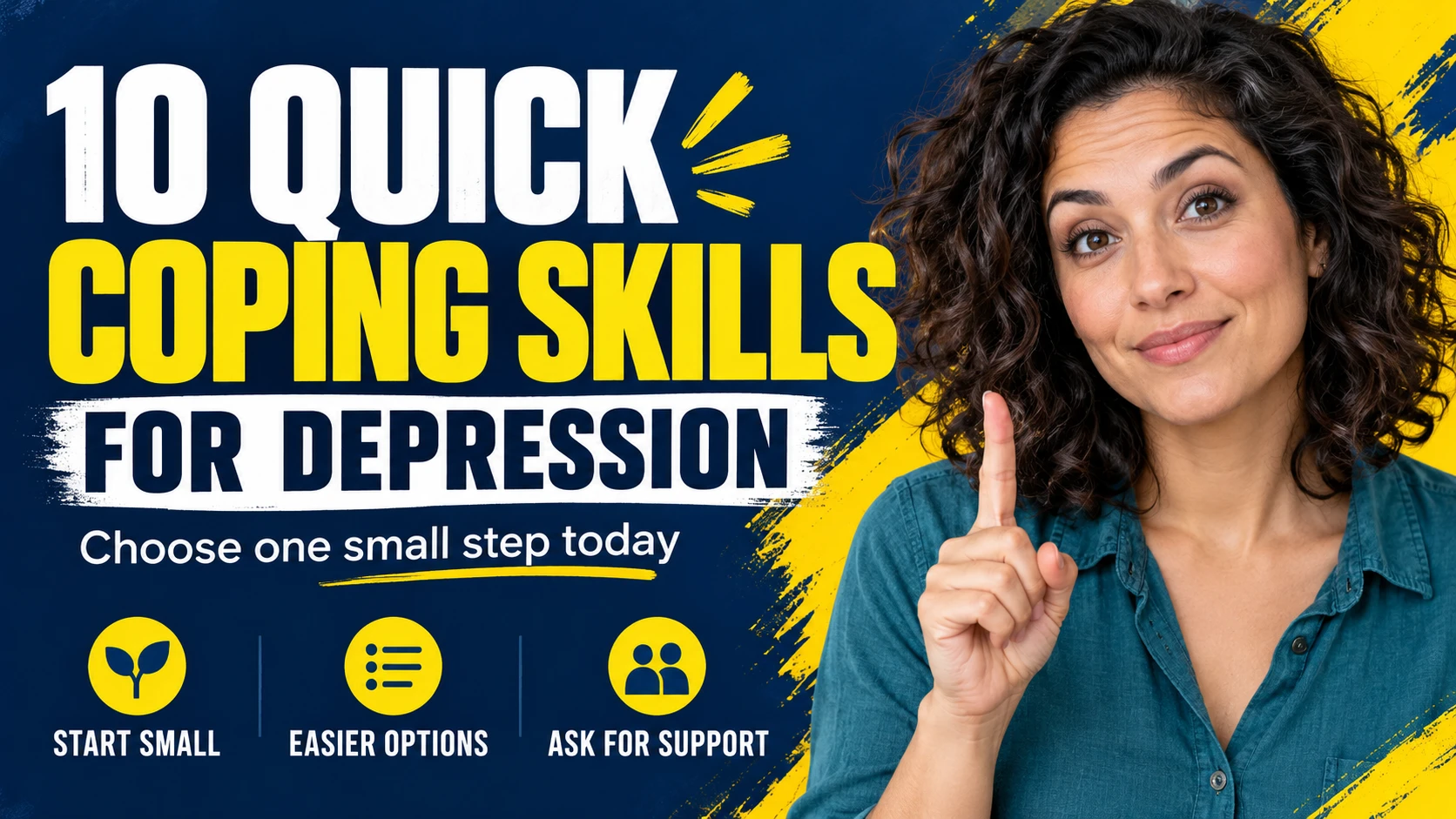
Starting a chore feels overwhelming. Short timers can lower the barrier to starting. This one-cup example is an editorial application of NHS guidance, not a prescribed treatment dose. Read the supporting NHS self-help guidance.
- Choose one visible action, such as washing a cup, and put what you need within reach.
- Set a timer for five minutes and begin only that action.
- When the timer ends, stop or continue by choice; the whole chore does not have to be finished.
Illustrative example: The dishes are piled up. You choose one cup, wash it during the timer, and leave the rest for another attempt. Easier option: Place the cup by the sink without washing it. Completion: You practised beginning the chosen action.
Next action: Repeat the same size next time, or make it smaller if starting was too demanding.
Reconnect with the room
You feel caught in a swirl of thoughts. Grounding is a stress-management skill described by WHO. This brief room-based sequence supports attention; it is not a treatment for depression by itself. Read the supporting WHO stress-management guidance.
- Sit or stand in a safe position and notice where your feet or body are supported.
- Look around and name three things you can see; then notice a sound nearby.
- Bring your attention back to one action in front of you, such as picking up your cup.
Illustrative example: Before replying to a message, you feel the floor, notice the curtain, chair and cup, listen to a nearby sound, and return to the phone. Easier option: Notice one object, with your eyes open if that feels more comfortable. Completion: You redirected attention to the present environment.
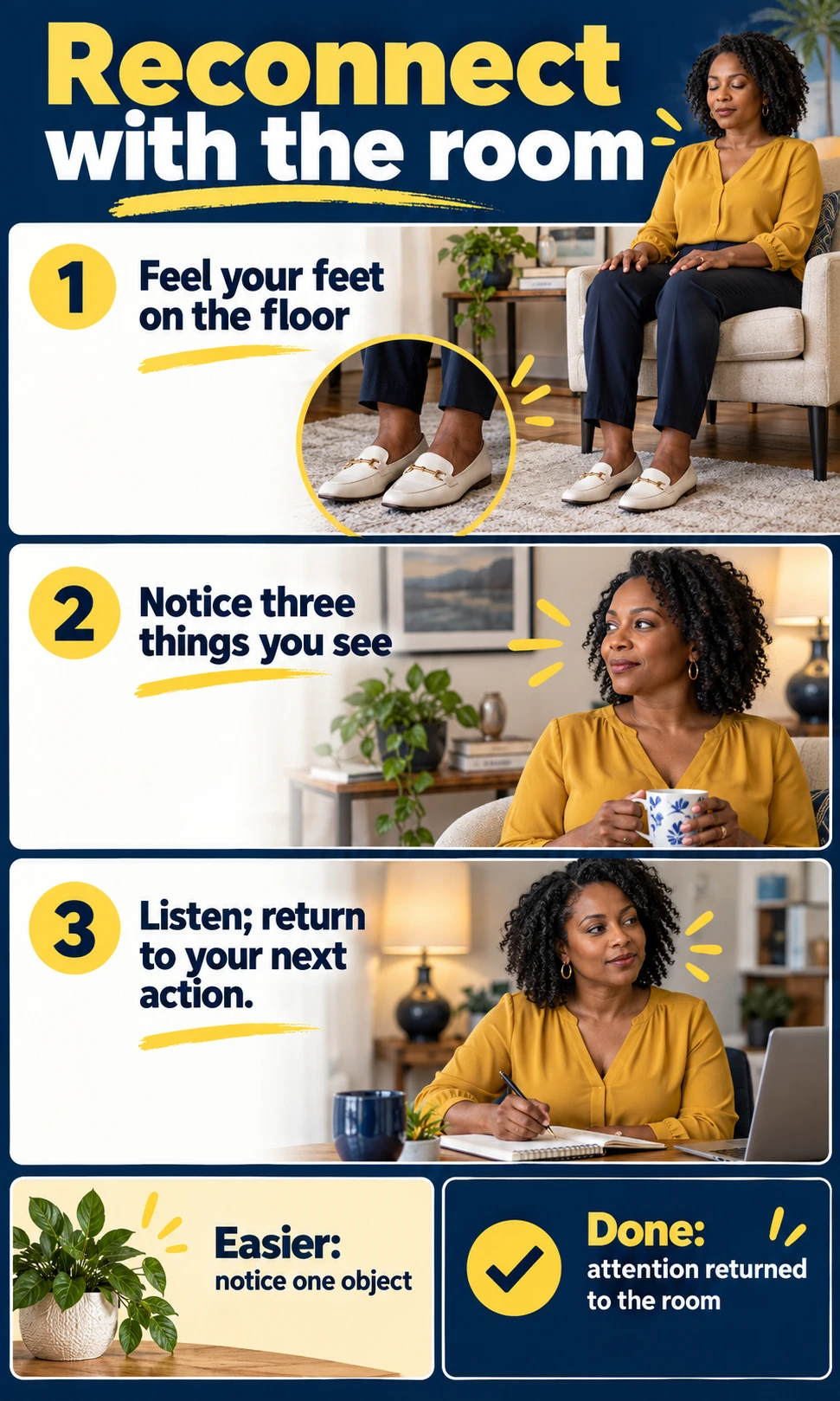
Next action: Return to the task if ready; stop the exercise if focusing inward increases distress.
Check a harsh thought
Self-criticism turns one setback into a judgment about your whole life. The aim is accuracy and flexibility, not forced positivity. A thought does not have to disappear for you to respond differently. Read the supporting NHS self-help guidance.
- Name the thought without treating it as a fact: "I always fail."
- Ask what actually happened and whether anything contradicts the word "always."
- Try a fairer response: "I missed one task. I can try one small part."
Illustrative example: You did not finish the laundry. You remember another task you completed and replace “I always fail” with a specific description of today. Easier option: Ask what you would say to a friend in the same situation. Completion: You considered a more balanced interpretation.
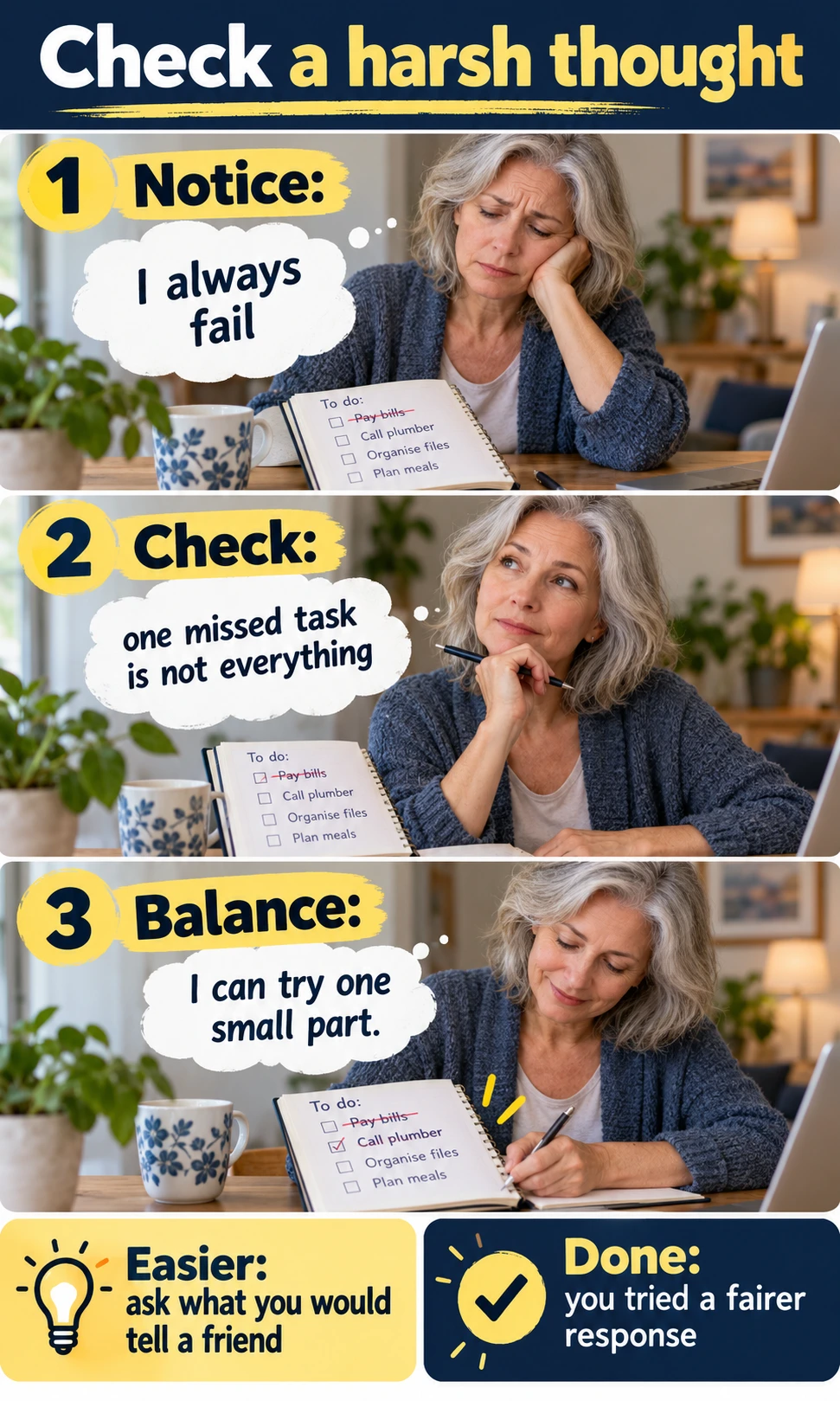
Next action: Use the fairer sentence to choose a small next action; do not keep arguing with the thought.
Move within your limits
Inactivity is growing, but a workout feels out of reach. Regular activity can support mood. Two minutes is an illustrative starting option, not the amount shown to treat depression, and mobility needs differ. Read the supporting NHS self-help guidance.
- Choose a safe, level short route and footwear suitable for you.
- If comfortable and appropriate for your health, walk gently for about two minutes.
- Stop and check your limits; do not push through pain, dizziness, chest discomfort or significant exhaustion.
Illustrative example: Instead of a gym session, you walk to the end of a familiar path and back at an easy pace. You stop when you need to. Easier option: Try a comfortable seated movement, or ask for help selecting movement that suits your condition. Completion: You attempted a manageable movement within your limits.
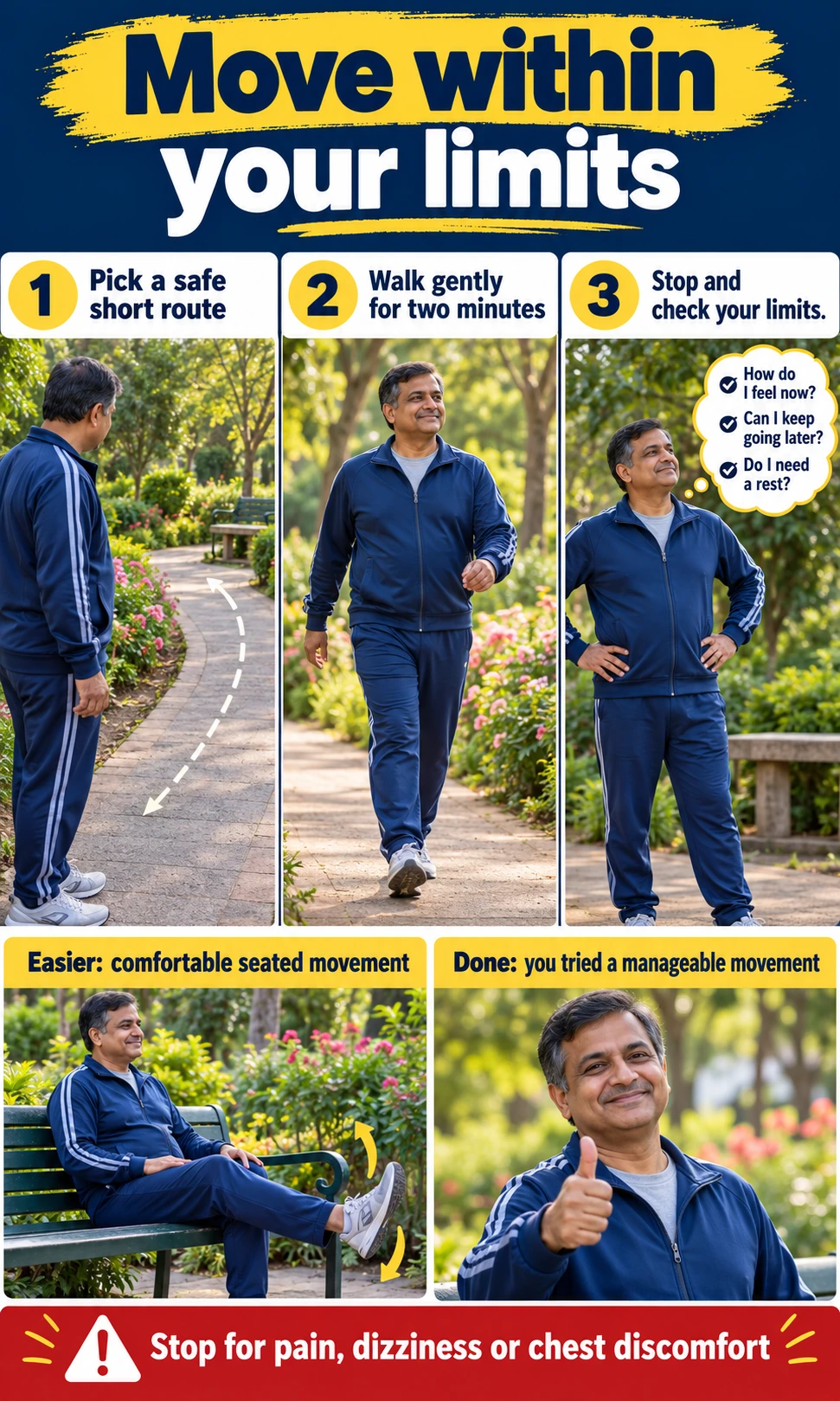
Next action: Repeat a tolerable amount; get advice about new symptoms or conditions that affect safe activity.
Send one simple message
You want connection but feel unable to explain everything. Social contact can offer support. Choose safe people; this script is an illustrative aid, not a guarantee that a conversation will change your mood. Read the supporting NHS self-help guidance.
- Choose a trusted person who usually responds respectfully.
- Send a short request: "I have had a hard day. Could we talk for five minutes?"
- Suggest a time or format that feels manageable; a text exchange also counts.
Illustrative example: You message a friend after work and ask whether a short call tomorrow would suit them. You do not have to tell your whole story. Easier option: Send “Thinking of you” or ask someone to help you make contact. Completion: You made one contact attempt, even if the person has not replied.
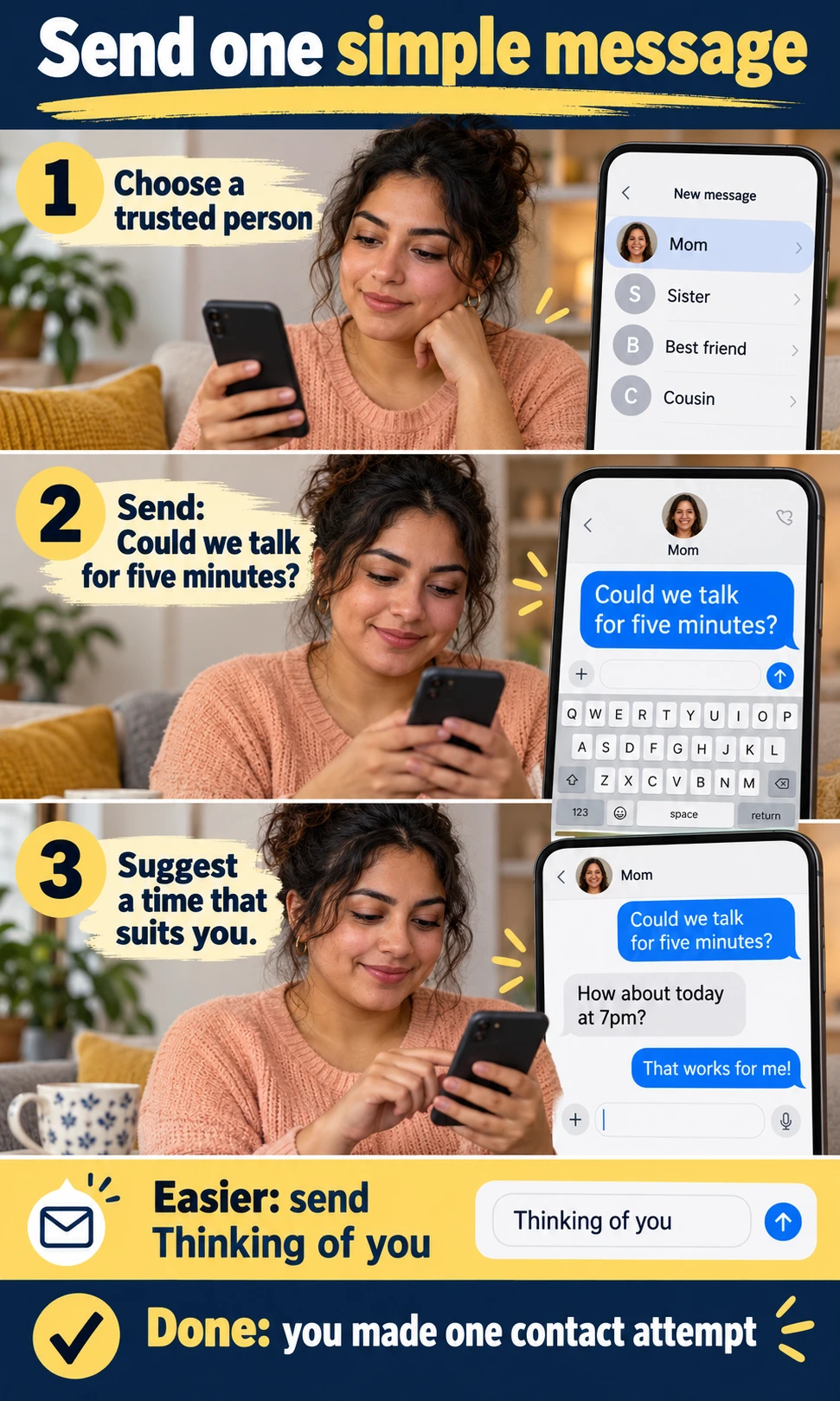
Next action: If there is no reply, try another trusted person when ready; lack of an immediate response is not a verdict on your worth.
Make eating easier
Low energy or appetite is making meals difficult. Eating regularly supports basic care; no single food treats depression. Examples need adapting for allergies, medical diets and eating-disorder care. Read the supporting NHS self-help guidance.
- Choose a familiar, easy food that fits your needs and any prescribed dietary restrictions.
- Put it within reach or ask someone to prepare it.
- Eat what you can and decide how the next meal will be available.
Illustrative example: Cooking feels too hard, so you choose toast and yogurt that suit your diet, eat some, and ask a housemate to help with dinner. Easier option: Ask someone to bring a suitable ready-to-eat food. Completion: You completed one step toward eating.
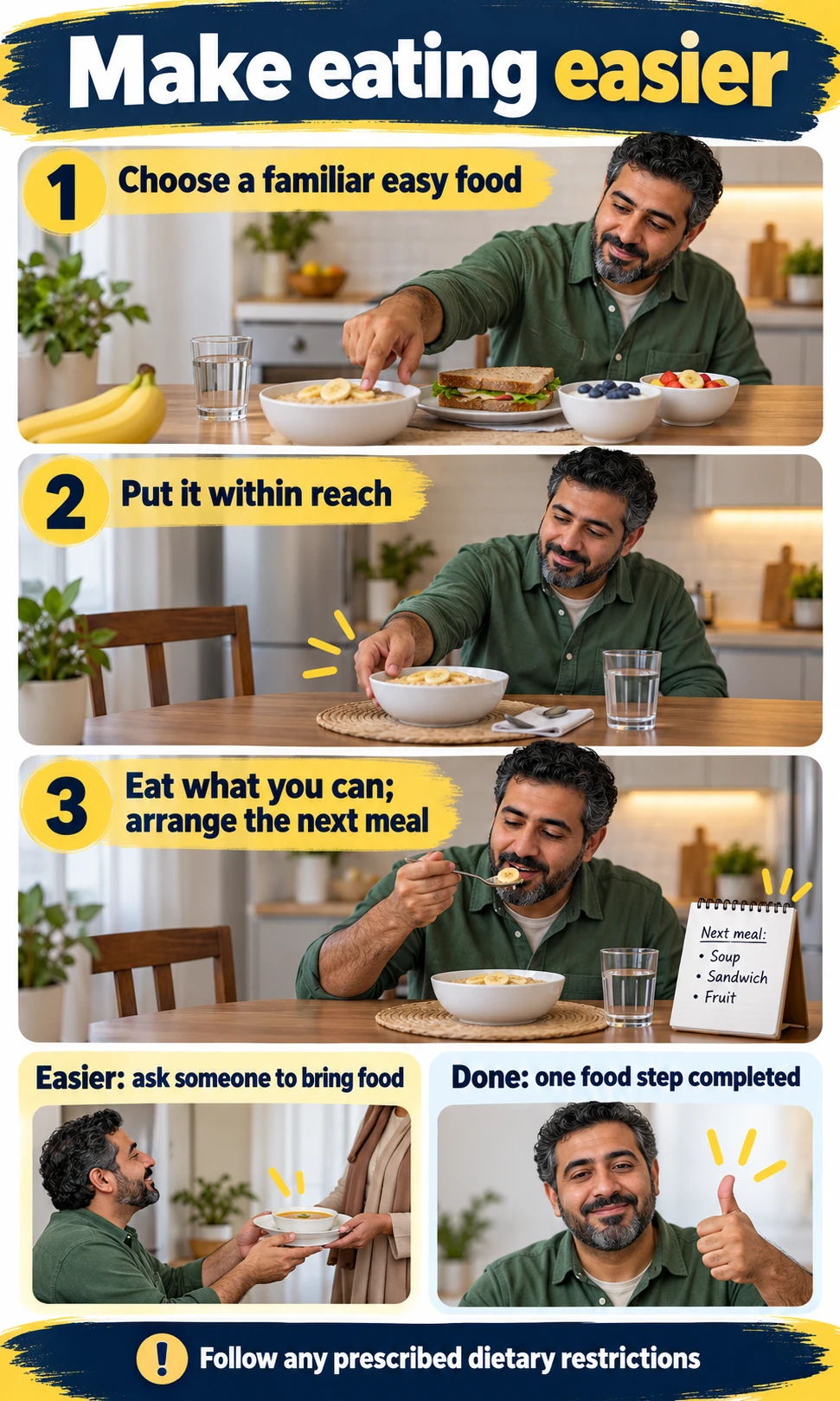
Next action: Arrange help if eating remains difficult; seek medical advice for persistent poor intake, unintentional weight change or difficulty swallowing.
Choose a morning anchor
Your wake-up routine has drifted and the day feels unstructured. A routine can support daily functioning. Do not deliberately restrict needed sleep or assume that a routine alone resolves a sleep disorder. Read the supporting NHS self-help guidance.
- Choose a realistic wake-up time that allows for your sleep needs and responsibilities.
- Set one gentle reminder and prepare an easy breakfast or other morning cue.
- At that time, sit up and begin the morning step when able.
Illustrative example: You choose a wake-up time that fits your workday, leave breakfast ready, and begin by sitting up rather than planning the whole day. Easier option: Sit up with support, or arrange help with the first morning task. Completion: You practised one routine anchor.
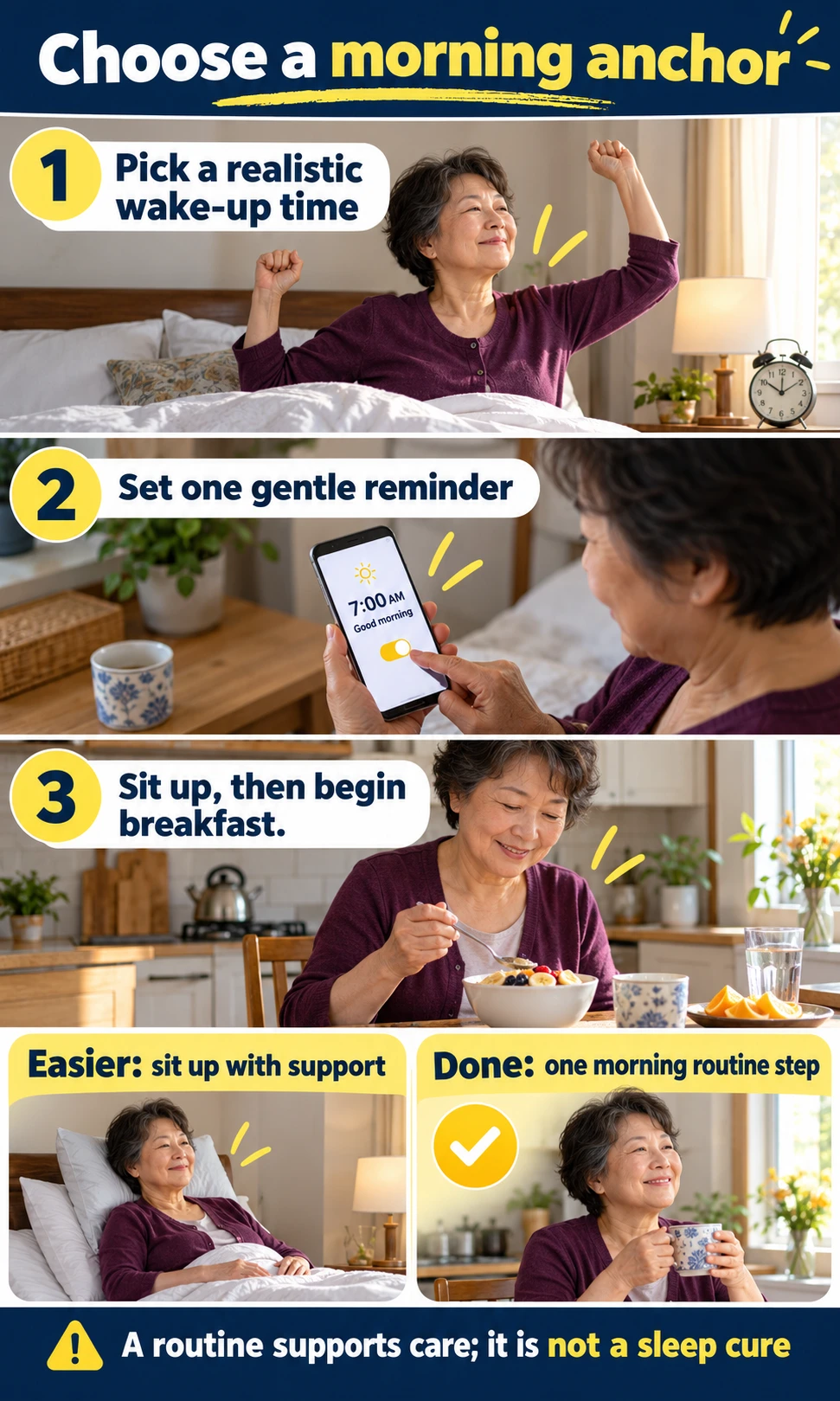
Next action: Try the same cue again if useful; discuss persistent insomnia, oversleeping or excessive sleepiness with a clinician.
Try a familiar activity
You have stopped doing things you once liked. Reintroducing enjoyable activities is part of activity-based self-help. This tiny music example is an adaptation; immediate pleasure is not the completion test. Read the supporting NHS self-help guidance.
- Pick a familiar activity with little setup, such as listening to one song.
- Try a short portion without waiting to feel motivated or demanding enjoyment.
- Stop or continue by choice; notice whether the size was manageable.
Illustrative example: Music used to matter to you. You listen to part of one familiar song, then stop; participation counts even if it feels flat. Easier option: Listen to the opening seconds or have someone set it up. Completion: You participated in a chosen activity.
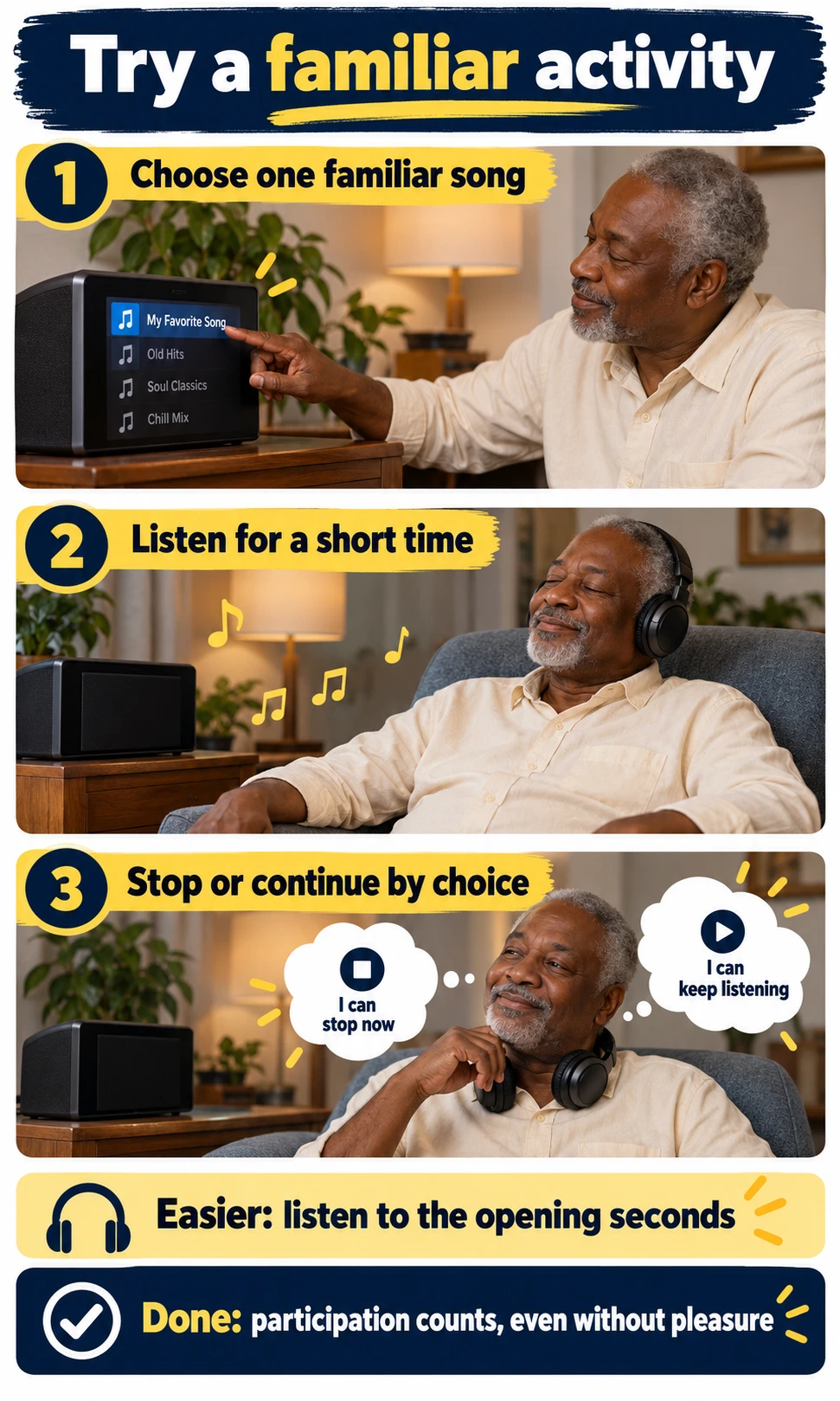
Next action: Repeat if manageable, try a different activity if it feels unhelpful, and seek care for persistent loss of interest.
Find one practical next step
A solvable problem keeps circling in your head. Problem-solving fits situations with an actionable part. It cannot guarantee another person’s response or change an event that has already happened. Read the supporting NHS self-help guidance.
- Name one specific problem and ask what part is within your control.
- Compare a few realistic options, including their costs and whether help is needed.
- Choose one feasible action and when to try it; after trying it, decide whether to keep or change the approach.
Illustrative example: A bill is unaffordable. You compare asking for a payment plan with getting free advice, then choose to call the provider tomorrow. Easier option: Find the contact number or ask someone to sit with you during the call. Completion: You selected one feasible action rather than solving everything.
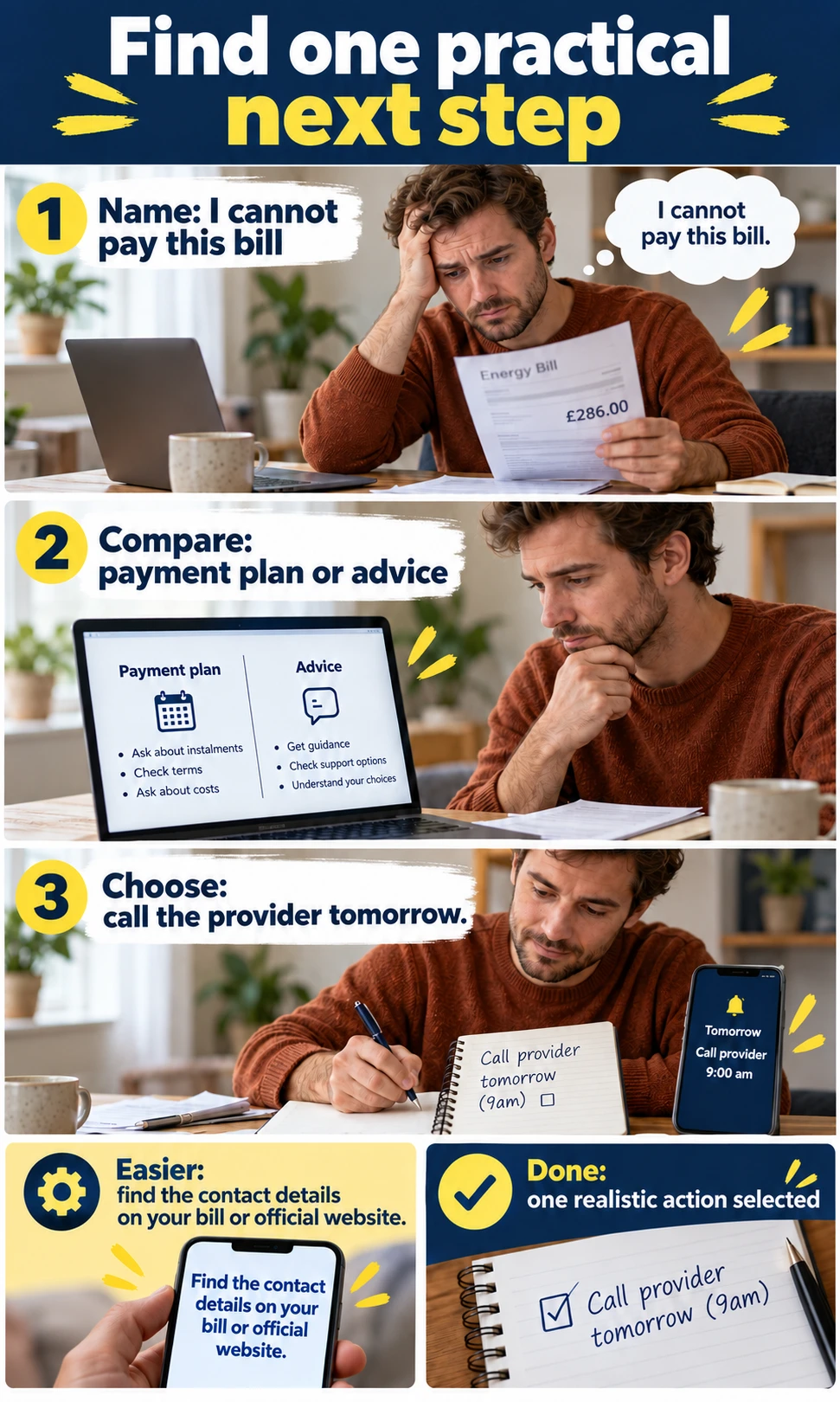
Next action: Try the action, then adjust it if it does not help; use support for problems that are too large to handle alone.
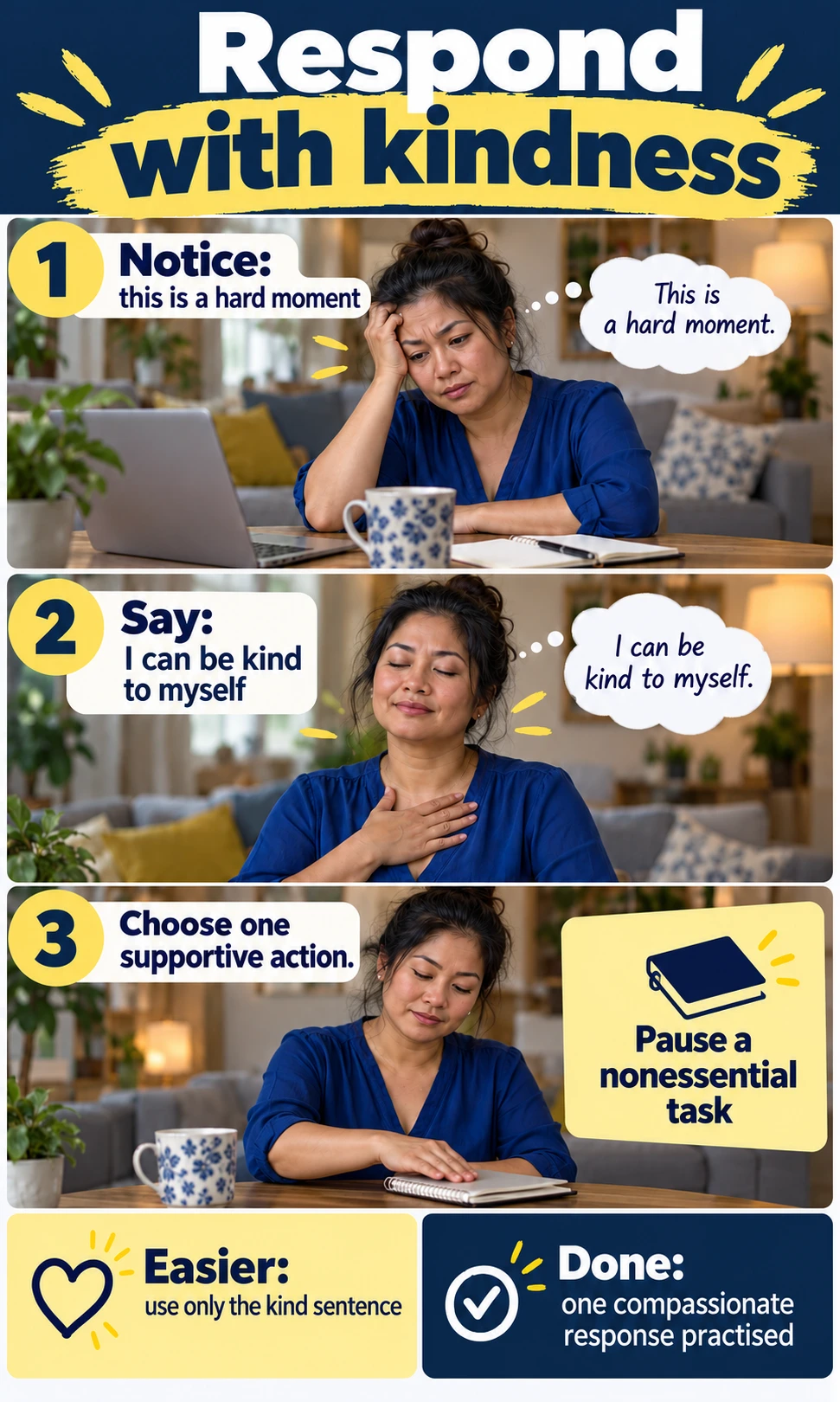
Respond with kindness
You blame yourself for struggling or needing rest. Kindness is included in WHO stress-management guidance. It does not excuse harm or remove responsibilities; it changes how you respond to difficulty. Read the supporting WHO stress-management guidance.
- Name the difficulty: "This is a hard moment."
- Try a supportive sentence you could say to a friend: "I can be kind to myself while I struggle."
- Choose one supportive action, such as pausing a nonessential task or asking for help.
Illustrative example: You are exhausted and call yourself lazy. You name the exhaustion, use a kinder sentence, and postpone a nonessential chore. Easier option: Use only the kind sentence; no extra action is required right now. Completion: You practised one compassionate response.
Next action: Repeat the response when self-blame returns; ask for support if it becomes difficult to keep yourself safe.
Why a small action can help when motivation is low
Depression can affect energy, concentration, sleep and interest, which can make ordinary tasks feel unusually demanding. Waiting for motivation may leave fewer chances for routine, contact or meaningful activity. A smaller action reduces the immediate demand; it does not establish that symptoms are mild or that effort alone determines recovery.
Thought-based skills change how you respond to a thought, while grounding redirects attention and activity-based skills support participation. None guarantees instant relief, and a calm moment does not establish recovery. Use the approach that fits the actual difficulty, rather than treating every low day as a problem to solve in the same way.
What to change when a skill feels unhelpful
| What happens | Useful adjustment |
|---|---|
| The steps feel too big | Use the easier option or ask for practical help. |
| You complete the step but still feel low | Count the practice; do not increase the task just to force a mood change. |
| A thought exercise becomes an argument | Pause it and choose a concrete activity or external grounding instead. |
| Movement causes pain or concerning symptoms | Stop and get appropriate medical advice. |
| Daily functioning is worsening | Arrange professional assessment rather than adding more exercises. |
When coping skills need support from treatment
Arrange an assessment if symptoms persist for about two weeks, worsen, or interfere with eating, sleeping, work, relationships or basic care. You do not have to wait two weeks when symptoms are severe or you are worried about safety. NIMH’s depression guidance explains that assessment can also check for other conditions or medicines that may contribute to symptoms.
Talking therapies and medication are treatment options discussed with a clinician. Take prescribed medicines as directed and speak with the prescriber about side effects or missed doses; do not change or stop treatment on your own. Alcohol is not a reliable coping strategy, and someone who may be dependent should get medical advice before stopping because withdrawal can be dangerous.
Go deeper on the difficulty you recognise
For the reasoning behind smaller activities, read behavioral activation for depression. If starting remains the main barrier, why depression makes simple tasks feel hard explains that difficulty. If activities still feel flat, anhedonia in depression covers loss of interest and pleasure.
Frequently asked questions
What is the quickest coping skill for depression?
There is no single best skill for everyone. Pick the skill matching the immediate difficulty, such as grounding for getting caught in thoughts or a tiny task for difficulty starting. Quick refers to a manageable first action, not a promise of quick recovery.
Do I need to feel better for the exercise to count?
No. Completing or attempting the chosen step counts as practice. Mood improvement is not the completion requirement, and practice does not prove that treatment has worked.
What if I cannot do the smallest version?
Pause and ask for support with the task or with getting care. Depression can make basic actions difficult. Being unable to practise an exercise is not a personal failure.
Can coping skills replace depression treatment?
They can support daily functioning and may be part of guided care, but they do not automatically replace treatment. Seek professional assessment for persistent, worsening or disabling symptoms. Get urgent help if you may harm yourself or cannot stay safe.
Should I keep a mood diary?
Only if it has a clear purpose, such as preparing for an appointment or helping a clinician review treatment. A diary is not required to try these skills. Use any record to inform a specific next decision rather than repeatedly checking a score.
Choose your next small step
Pick the difficulty that matters most now and try its easier version if your energy is low. Decide afterward whether the size was manageable, whether you need practical help, or whether care is the next step. You can build from a completed action without demanding a particular feeling from yourself.