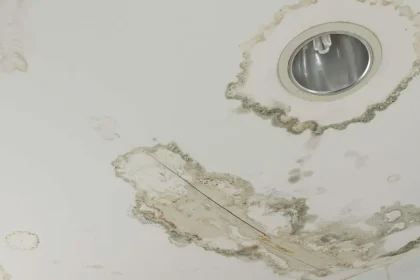
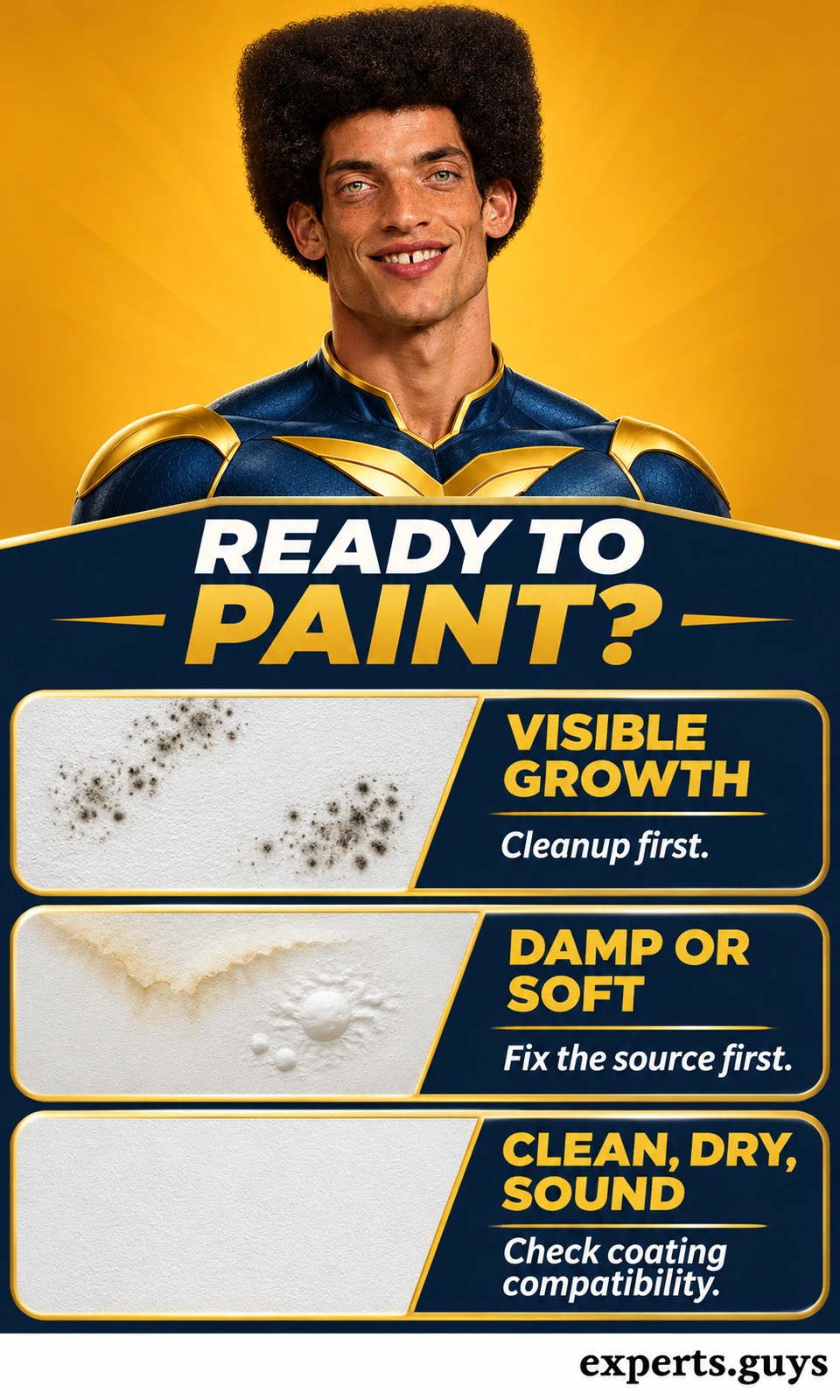
For bathroom walls and ceilings outside the shower, look for an interior paint that explicitly suits humid rooms, lists your surface, and describes mold or mildew resistance of the dried coating. If the wall is damp, soft, or visibly moldy, postpone the repaint and deal with the moisture and cleanup first. The strongest claim on the can cannot make an unsuitable surface ready.
A bathroom can require several finishes even when you want one color throughout. The wall behind the vanity faces occasional splashes and regular wiping. The ceiling may collect condensation. The inside of a shower faces repeated direct water exposure. Those are three different buying decisions, and sheen alone cannot settle any of them.
Which parts of the bathroom can take bathroom paint?
Think about where the water goes during a normal shower and during ordinary cleaning. The same wall can change from a humid-room surface to a direct-spray surface where a curtain ends or where a handheld shower reaches it. A product’s bathroom rating is useful only within its stated exposure limits. Check each disputed strip before buying enough paint for the room.
- For a painted ceiling or wall beyond direct spray, check that the exact finish is rated for humid interiors and approved for the surface.
- For occasional splash near a basin, prioritize a washable finish and check the manufacturer’s cleaning directions.
- For surfaces inside the shower or exposed to persistent wetting, use a finish or assembly designed for that exposure. Confirm what the whole system requires.

| Location or condition | What qualifies | When to pause |
|---|---|---|
| Sound ceiling outside direct spray | Approved interior humid-room coating for the ceiling material | Widespread condensation persists or a stain grows |
| Sound wall beyond the shower | Compatible bathroom finish with film-resistance claim if appropriate | A handheld shower or gap regularly wets the painted wall |
| Vanity area with occasional splash | Washable finish compatible with the surface and cleaning products | Persistent wet seams or swelling at the basin edge |
| Shower wall or tub surround receiving direct water | Finish or assembly explicitly specified for that wet exposure | A general bathroom paint lists prolonged contact as excluded |
| Wet, soft or moldy surface | Moisture investigation, repair and cleanup before any coating | A stain cover or paint claim is the only proposed solution |
A vanity wall offers a useful test case. On one side of the room, the painted surface behind a basin may receive a few drops while someone washes their hands. A second painted surface, close to the edge of an open shower, may stay visibly wet after each use. Both can look equally clean when the room is photographed dry. Once the room is in use, the two locations reveal different loads. A washable wall paint may suit the first, while the second needs someone to assess how the shower contains water and what surface is suitable there.
The ceiling can present the reverse problem. It may never receive spray yet still develop persistent beads of condensation on its coolest area. A finish rated for a humid room can be appropriate after the ceiling is dry and the source is resolved. If water repeatedly forms or a stain keeps spreading, the painting decision should wait. If condensation is the recurring problem, see how to prevent mold in your bathroom for practical steps to clear humid air and dry wet surfaces. Follow the site’s guide to early signs of mold damage for the combination of material changes and recurring dampness that deserves investigation.
Make the wall pass a readiness check first
Look for visible growth, an expanding stain, soft material or peeling around a recurring wet spot. Any one of those can justify a pause. A faded mark left by a resolved event on an otherwise sound, dry wall leads to a different paint decision than a darker patch that grows after each shower. When the cause is unclear, a can of stain blocking primer adds color coverage without answering whether the surface is ready.
A surface can feel dry before the material behind it is dry. If a leak has affected plasterboard, timber or a ceiling cavity, a finish coating is the last part of the work. The guide to interpreting moisture meter readings after water damage explains why a comparative reading depends on material and meter mode. That is a separate assessment from checking the outside of an intact wall before buying paint.
The EPA household mold guide advises correcting the water problem, cleaning up mold and drying surfaces before painting. A small visible spot also deserves care if growth keeps returning, porous materials have deteriorated or you suspect the affected area is hidden. Follow the cleanup guidance before reaching the coating decision. The paint selection process below starts after that work.
What should a mold-resistant paint label tell you?
Find the technical data sheet for the exact product, finish and country where you will buy it. Product families can have similar names across different finishes or formulations. In a shop, the front label helps you make a shortlist. The data sheet tells you what surfaces the coating can go on, where it should stay off, and how long the bathroom needs to be out of use.
Look up use, claims and limits
Start with recommended uses and substrates. A line for interior plaster or drywall supports a decision about the wall outside the shower. A bathroom recommendation tells you the product is intended for certain humid conditions. A separate limitation on prolonged water contact overrides a broad impression that the word “bathroom” covers the entire room. If a retailer’s listing and the manufacturer’s instructions differ, resolve that before purchasing.
Then read precisely what gets protection. A claim about the dried paint film describes the coating. It does not establish what happens behind it or show that the product removes existing growth. A warranty, where the brand offers one, has separate conditions and scope. Treat an advertised period as a statement to check against those terms and instructions, rather than a promise about the entire wall assembly.
Finally look for coverage per coat, number of coats, primer requirements, permitted application conditions, cleaning restrictions and return to service. An apparently cheaper can can cost more for the job if the approved system needs another coat or a separate primer. Equally, an expensive coating may be a poor fit if its return to service conflicts with the household’s only available shower.

Two manufacturer documents show how different details can coexist. The Benjamin Moore Aura Bath & Spa Matte 532 technical sheet describes a matte interior coating formulated for humid rooms and recommends two coats for best performance. This establishes that a purpose-formulated matte can be a legitimate bathroom choice. It gives no reason to choose an ordinary flat wall paint simply because it looks similar.
The Rust-Oleum Zinsser Perma-White interior technical sheet calls for two coats and excludes surfaces with prolonged water contact, including shower enclosures. Its limitations are as relevant as its product name. These two products illustrate how to read a data sheet. They are not ranked, and the examples rely on manufacturer documentation rather than firsthand tests.
Choose sheen after the coating qualifies
A matte finish can reduce glare from a vanity light or soften the appearance of a ceiling with minor texture variation. On a wall that is wiped frequently, an approved washable satin can be a sensible alternative. Either decision starts with a bathroom-suitable formulation. Sheen describes how the coated surface reflects light. It cannot independently demonstrate mold resistance, safe water exposure or a particular level of scrub resistance.
Compare the use and care instructions before choosing between the two. If the satin is easier to maintain with the cleaner you already use and you like its reflection, you have a reason to choose it. If both qualify and reflected light makes repaired areas stand out, a bath-rated matte can be a better visual fit. Avoid broad rules like “every ceiling must be flat” or “every bathroom must be semi-gloss.” An old repair under strong grazing light may remain visible through either finish if the surface is uneven.

Compare the cost of finishing the whole surface
A shelf price covers a container. Your cost also includes the required coats, necessary primer, and whether the bathroom has to stay out of use while the coating reaches the stated service condition. Compare products for the same wall or ceiling and the same approved application. A can advertising generous coverage on a smooth surface may cover less on a textured ceiling or a porous repair. The manufacturer’s stated range is a better buying input than a promise from a photograph of a finished room.
A half-finished ceiling illustrates the consequence. If a household buys only enough for one coat of a product whose instructions require two, the apparent saving assumes a different coating system from the one the manufacturer describes. It may also mean another trip for the same tint. Conversely, if the paint is approved over an intact existing coating with no separate primer, adding a primer merely out of habit increases material and downtime. The comparison is between two over-the-counter options used as directed and in the same part of the room.
Start with the surfaces you can describe confidently. Give a store or manufacturer the room conditions, whether the surface is wall or ceiling, the material if known, the previous finish, and whether the area gets direct spray. A supplier can answer a question about a coating over sound drywall much more precisely than a request for “the strongest mold paint.” If one corner is repeatedly wet and the other walls are sound, treat that corner as a separate unresolved condition when deciding the job scope.
Know when two bathroom paints are solving different problems
A lower-glare bathroom matte addresses a visual concern on a surface for which that product has clearance. A washable finish addresses the repeated care a wall actually receives. Both can be reasonable purchases where their technical sheets agree with the exposure and surface. A premium coating cannot pay for itself through a durability claim alone if the part of the room getting repainted is a dry powder room with little splash and gentle cleaning. In a full bathroom, limiting the comparison to color can miss the reason a certain wall needs a different finish.
For example, in a powder room without a shower, the deciding exposure may be the occasional splash directly behind the tap. A finish intended for washable interior walls may suit the surrounding wall if the sheet allows it. Near the basin, a tiled or otherwise compatible backsplash can be a separate surface choice. This lets the rest of the room use a color and sheen that fit the lighting without assuming the same treatment belongs everywhere.
In a full bathroom that is already dry and sound, the ceiling may be a good place to consider a lower-glare bathroom matte, while a more frequently wiped wall may benefit from a compatible washable finish. This is a way to set priorities for each surface. Match the intended cleaning method to the manufacturer’s label, even if the two paints are tinted the same shade.
Which primer does the wall actually need?
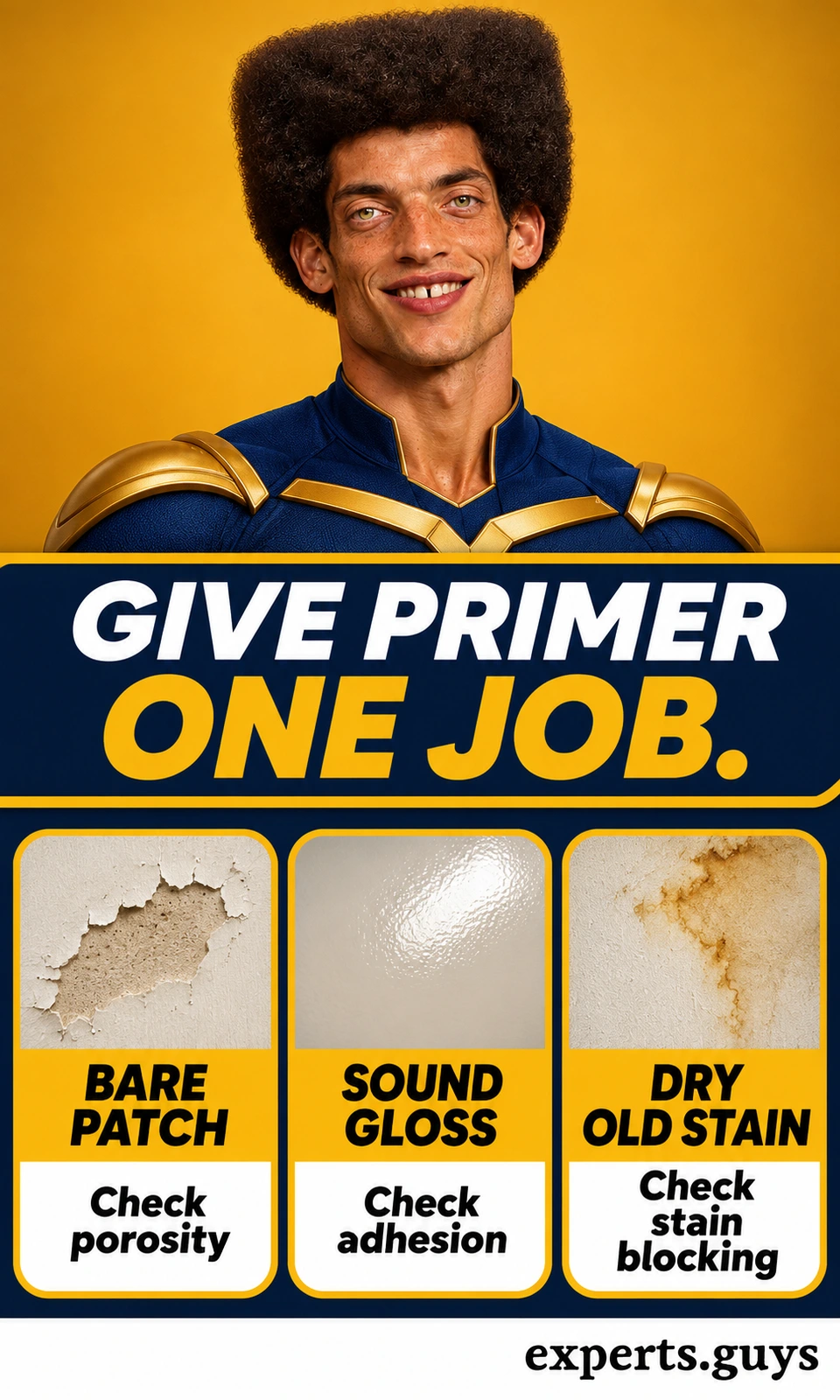
Primer selection begins with what would otherwise fail. In a dry, sound room, one patch can be porous while the surrounding coating is glossy. An old stain may still show after drying. These are three separate requirements: even absorption, adhesion and stain blocking. Check the topcoat maker’s approved system and pick a primer intended for the job you actually have.
A bare repair can draw a finish coat differently from the surrounding paint. Even if the color matches, a patch may appear flatter because it absorbs differently. Check whether the exact topcoat can go directly onto that repaired material or whether a specified primer should equalize it. “Self-priming” can apply to some approved surfaces while the same sheet gives different instructions for others.
A sound glossy wall raises an adhesion question. Identify the existing coating if possible and look up the finish maker’s preparation and primer requirements for it. If the existing finish has begun to lift, diagnose the cause before adding another layer. An expensive bonding primer depends on the old layers underneath it remaining attached. For older coatings that may contain lead, use applicable lead-safe guidance before disturbing the surface.
With an old water stain, first confirm that the leak is corrected, the material is sound and the area is dry. Only then choose a compatible stain blocker if the mark still bleeds through. A dried brown ring and a fresh enlarging ring can look nearly identical at a glance. They belong on different sides of the paint decision. One is a cosmetic problem after repair. The other is evidence to investigate.
| Surface | What to check | Reason |
|---|---|---|
| Sound bare repair | Approved primer or direct-coat instruction for the specific patch material | A porous repair can absorb paint differently |
| Intact glossy paint | Current coating compatibility and the specified adhesion preparation | A shiny finish may require particular preparation and primer |
| Old dry stain from a resolved event | Compatible stain-blocking primer if needed | An old stain can show through after the original moisture is gone |
| Uniform, sound previously painted wall | Check if direct coating is permitted | A separate primer may be unnecessary |
| Widespread lifting, swollen material or recurring wetness | Investigate the underlying condition before shopping for coatings | Primer cannot stabilize or dry a failing assembly |
Avoid stacking multiple specialty products merely because each can mentions bathrooms. Look for an approved primer and topcoat combination and check what the manufacturer specifies for the existing material. When the surface is intact and the maker permits direct coating, there is no automatic benefit to adding another product. If the proposed primer has instructions that conflict with the finish coat, settle the system before scheduling any work.
When can the shower be used after painting?
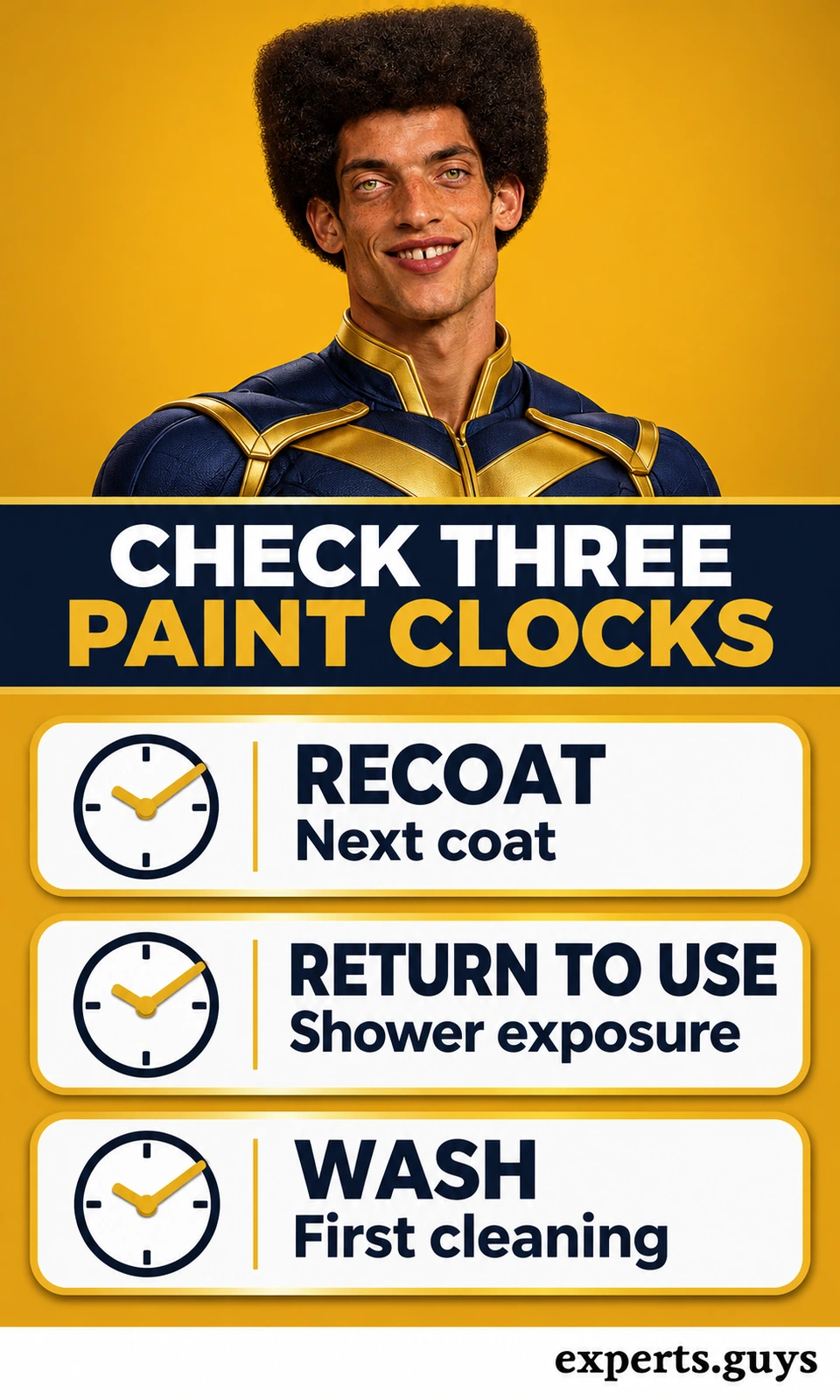
Plan around three events: the next coat, normal bathroom use and the first cleaning. Manufacturers can give separate times for each, and they may describe a full cure as another milestone. Touch dry is often listed because it matters for handling or dust pickup. It says little about when the coating is ready for steam, splashes or rubbing with a cloth. If the sheet omits shower exposure, ask the manufacturer about that specific use.
The schedules depend on conditions. For example, a manufacturer can state a recoat time under standard temperature and humidity, then warn that cool or humid conditions extend it. Compare the actual room to the stated range. Give the last coat its own return-to-service interval and check which event the clock starts from. If you can only paint in a room that needs to be used every evening, a weekend plan based on the shortest number in the data sheet can fail before the job starts.
A one-bathroom household may be choosing between two approved products whose appearance is equally acceptable. The more practical difference might be whether the product maker can confirm when the shower may be used in the household’s conditions. A guest bathroom with predictable downtime offers a different choice. This is also the point to arrange required ventilation while work is under way and during drying, following the manufacturer’s instructions for the specific materials used.
If a finish later develops a stain or the same patch peels again, compare it with the original condition before buying more paint. Repeating failure in a small location after cleaning or repainting can send you back to the moisture assessment. Broader surface damage immediately after early washing can instead raise a return-to-service or product-care question. Appearance alone cannot settle the cause, but the pattern can help you ask the right question of an installer or manufacturer.
Check the finish under the two lights you use most
For finishes that already pass the exposure, substrate and timing checks, compare manufacturer swatches under daytime light and the vanity light. Look at them near the intended surface, ideally from the usual doorway and mirror positions. A sample beside the sink on a horizontal counter reflects differently from the same sample held vertically on the wall. If comparing paint samples rather than printed chips, check that the sample’s sheen matches the finish you intend to purchase.
Use the comparison to answer a specific question. A bright ceiling bulb can make glossy patches stand out near the mirror, while the same test surface may look subdued in daylight. A matte sample may read more uniformly over a repaired patch, but a paper card cannot predict how the whole ceiling will look after coating. Treat the sample as a check of color and glare in that location, subject to the substrate and coating system you already selected.

Three purchase decisions that look alike from the aisle
Consider a ceiling in a bathroom where the previous finish is intact. The household wants to repaint because a bright vanity fixture casts glare across the ceiling. There are no recurring marks or signs of damp material. In that case, compare a humid-room matte whose sheet covers the ceiling substrate with another compatible paint. Under the expected lighting, the matte might solve the appearance problem without requiring a different product for every wall. Check if the existing finish is compatible and decide whether the approved system needs an adhesion step. The cheapest plausible option is the one that meets all of those conditions, including the number of coats.
Now consider a ceiling with a stain close to a pipe route from the floor above. The homeowner may initially be drawn to a paint promising better coverage in humid rooms. But the stain is darkening, and its location suggests a different investigation. Paying more for hiding power would make it harder to compare changes while the underlying issue remains unresolved. Once the source is repaired and material is sound and dry, the coating question becomes whether the old stain needs compatible blocking before the chosen humid-room finish goes on. The stages help prevent a repair budget from being spent on cosmetics prematurely.
A third household likes the look of a continuous painted wall from basin to shower. During ordinary use, the part next to the shower’s open edge repeatedly gets wet. The decision in that strip is about water exposure and the suitability of the assembly. If the intended coating cannot handle prolonged contact, a sheen change within that product family provides no basis for assuming the strip is covered. The household can investigate the enclosure or an appropriate wet-area finish while using an eligible bathroom paint elsewhere. A coordinated color can still tie those surfaces together.
Explain the room to a painter before asking for a quote
A useful quote states which areas are included and what they are made of. If it lists walls and ceiling together, clarify whether those surfaces get the same coating and preparation. A quote can be internally consistent while excluding the shower interior entirely, or it may include a vanity splash zone that another quote treats separately. Scope differences can matter more than the headline cost. Ask which finish and primer are proposed and what the quote assumes about the condition of the old paint.
Separate the proposed coating from work that may discover or fix water damage. A quote that assumes sound plasterboard cannot also be relied on to price replacing material if a recurrent leak turns out to be involved. If the condition is uncertain, ask what evidence would change the proposed scope. The decision may be to investigate first and quote painting when the repair is defined. That gives the household a better basis for comparing two bids than treating every “bathroom paint” line item as interchangeable.
Discuss access after the final coat as part of the same agreement. For a second bathroom you may have flexibility. For an only bathroom a contractor should know that shower downtime matters before selecting the system or scheduling work. Make sure the proposed timings apply to the exact products and conditions, especially if the room is cool or humid. When a quoted completion date means the painter is finished, ask when the household can resume showering and then cleaning. Those are separate commitments and can materially change how practical the job is.
Compare Local Home Specialists Near You
Tell us what kind of help you need, then compare nearby businesses by location, Google rating, review volume and contact options.
HomeFix Local Match
Turn a home problem into a practical local hiring decision. Check the clues, see the specialist types that fit, open focused surrounding-location searches, then compare the strongest three before you call.
 YOUR PROBLEM
YOUR AREA
COMPARE 3
✓ Ready to compare
What is happening?
Choose the closest problem type, then check every clue that applies. Your selections change the specialist order.
Where should the search focus?
Use Google’s “near me” context or enter the area you actually want a specialist to serve.
Simple local search: open nearby Google results, choose the businesses that look suitable, then compare your best three here before you call.
Problem snapshot
Who should you call first?
These are the specialist types most likely to fit the clues you selected.
Search around your location
Compare your top three
Use the same factors for each option so a high star rating does not hide a weak scope, poor diagnosis, missing credentials or unclear aftercare.
Comparison result
Your result combines the Google signals you entered with the practical hiring checks you completed.
Questions to ask every finalist
Use the same questions with each shortlisted business so the comparison stays consistent.
Frequently asked questions
Will mold-resistant paint eliminate mold already on a wall?
A dried-film resistance claim concerns the paint layer. Resolve the moisture problem and complete the appropriate cleanup before painting. If the area has softened or stayed wet, the material itself may need attention. A clean appearance after applying a coat does not establish that the underlying problem has been corrected.
Can I use bathroom paint on the wall inside a shower?
Use a product or assembly whose instructions explicitly approve the direct wet exposure and substrate. An interior coating intended for humid bathrooms can exclude shower enclosures or prolonged water contact. Confirm the finished assembly as well as the exposed coating. A tile or panel finish does not by itself establish what waterproofing sits behind it.
Is semi-gloss always more mold resistant than matte?
Sheen measures reflected light. A bath-rated matte and an ordinary flat paint can look similar while having different use instructions. Likewise, a shiny finish can be unsuitable for the room or the exposure. Read the exact coating’s intended uses and film protection first, then use sheen to decide between compatible choices.
Does a water stain always need a separate primer?
After the source has been corrected and the wall is sound and dry, check the finish maker’s system for that stain and substrate. An older stain may need compatible stain blocking. A fresh or expanding stain calls for source investigation. A primer’s ability to cover discoloration cannot tell you whether the material behind it is ready.
Can I shower as soon as the bathroom paint feels dry?
Check the return-to-service instructions for steam and splash exposure. Touch dry, ready for another coat, safe to use the shower and ready to wash may be different milestones. Temperature and humidity may affect the schedule. Ask the paint maker when the sheet does not answer your actual shower-use question.
Should I use the same paint on walls, ceilings and trim?
Use the same paint only where its instructions cover each substrate and expected use. An existing trim finish can need different adhesion preparation from drywall, while a frequently wiped wall may call for different cleaning properties from a ceiling. You can coordinate the color across locations even when the approved products are different.
Can I use exterior paint indoors for stronger protection?
Choose a coating explicitly approved for the interior application and follow its ventilation and safety instructions. A weather-resistance claim refers to the product’s intended conditions and provides no general approval for indoor use. Check the correct version of the manufacturer’s data sheet rather than reasoning from the product name alone.
What if the same patch peels again after repainting?
Recheck the location and history before trying a different sheen. A patch near a recurring drip, a cold damp ceiling edge and a glossy area that never bonded can point to different problems. Persistent wetness or soft material moves the decision back to repair. A dry sound surface with an adhesion problem still needs a compatible coating system.
Does a washable paint let me clean with any bathroom product?
Follow the paint maker’s approved cleaning methods and wait until the first-cleaning interval has passed. Strong cleaners and abrasive pads may affect a finish even if it is sold as washable. Where a wall needs repeated aggressive cleaning, revisit how much water or residue reaches the surface and whether a different approved finish would suit it.
Make the paint decision in this order
Check whether the area is fit to coat. Match the product to the exposure and the surface, then decide whether a primer solves a specific problem. Confirm the recoat, return-to-use and cleaning windows before you schedule the job. Choose the sheen and color from the products that pass all those checks.