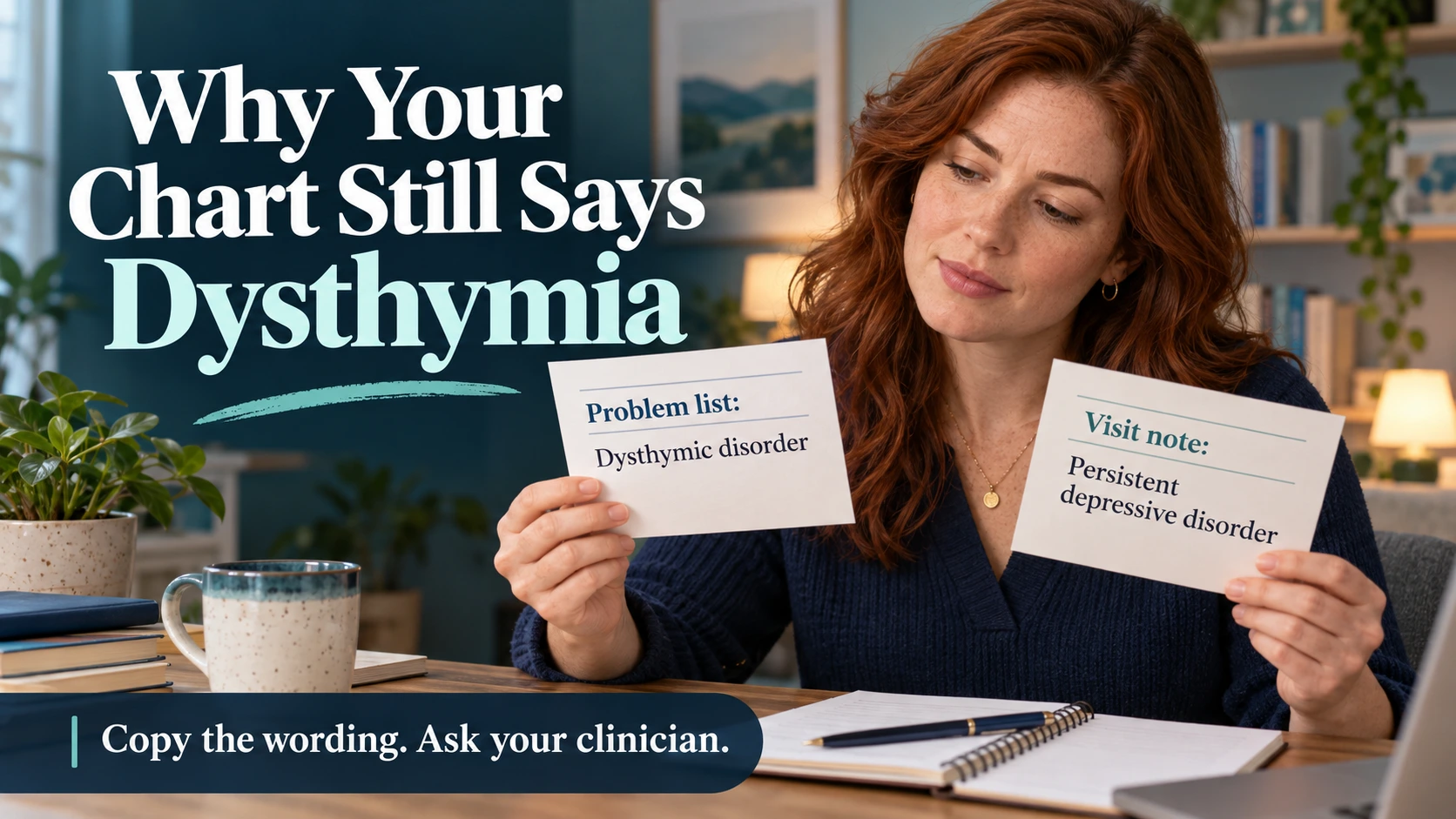

Your chart can say “dysthymia” or “dysthymic disorder” while a visit note says “persistent depressive disorder” because the fields may draw on different naming systems or different dates. That mismatch alone does not prove that your diagnosis changed or that the record is wrong. Copy both entries and ask your clinician which diagnosis is current and how the wording fits your record.
Start with the location of the words, not just the words themselves. A problem-list entry, a visit diagnosis and a narrative assessment serve different documentation purposes, and a portal may display them separately. This guide helps you prepare a records question; it cannot interpret your diagnosis, choose a billing code or recommend treatment.
Swipe horizontally to compare on small screens.
| Record field | What to copy | What to clarify |
|---|---|---|
| Problem list | Exact label, displayed code and entry date. | Is this entry current, historical or awaiting review? |
| After-visit summary | Diagnosis wording and visit date. | Does this wording come from the code description or the clinician’s assessment? |
| Visit note | The relevant assessment phrase and note date. | Which diagnosis is being described here? |
Why a chart still says dysthymia
One possible explanation is a difference between the clinical name and a code-linked display label. In U.S. ICD-10-CM, F34.1 is titled “Dysthymic disorder,” and persistent depressive disorder is one of its inclusion terms. A portal that displays that title can therefore use older-looking words without telling you why the entry was selected for your particular record.
Another possibility is that the problem list contains an older entry while the visit note records a newer assessment. That is a question to check, rather than an error to assume. Compare the dates and ask whether the clinician intended both entries to remain active.
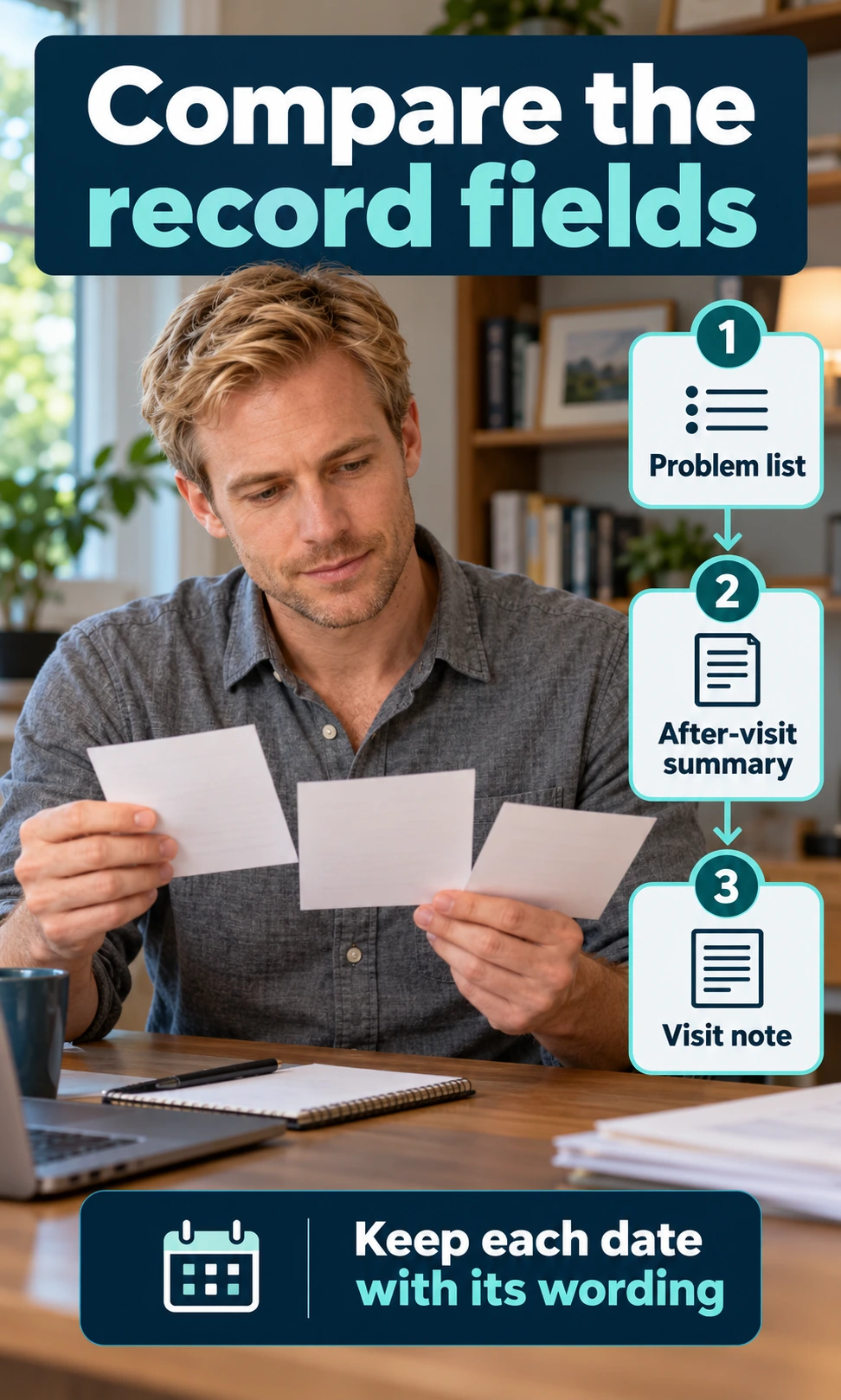
- Open the problem list and copy the label exactly.
- Open the after-visit summary for the relevant appointment.
- Read the assessment section of the visit note, if available.
- Keep the date and source field beside each copied phrase.
What changed in the diagnostic name
The DSM-5 consolidation brought the former dysthymic disorder and chronic major depressive disorder concepts into persistent depressive disorder. DSM-5-TR later removed the parenthetical “dysthymia” from the name. Those are changes in diagnostic terminology, rather than instructions to replace every older word in every patient record.
The distinction matters because the older and newer concepts are not completely interchangeable in every case. The APA explanation of the name change notes that the newer category includes presentations that would not have met the former dysthymic-disorder definition. A simple “it was renamed” answer therefore leaves out information that may matter when a clinician reads an older assessment.
An old note remains a record of what was documented at that time. Its wording does not necessarily establish the diagnosis being used at a later visit. Ask how the historical entry relates to the current assessment instead of translating it yourself.
What F34.1 still prints in U.S. records
The CMS FY 2027 ICD-10-CM tabular files, effective from October 1, 2026, retain “Dysthymic disorder” as the F34.1 title. The inclusion terms include dysthymia, persistent depressive disorder, depressive neurosis and neurotic depression. These are classification terms you may encounter in a record, not a menu from which to choose your own diagnosis.
If F34.1 is visible, copy it beside the field where it appears. If no code is visible, write “not shown” rather than adding one from an internet search. A code’s official description explains the classification entry, but it does not tell you whether that code is appropriate for you.
This code explanation is specifically about the U.S. clinical modification, ICD-10-CM. Records elsewhere may use another classification, local terminology or different software labels. Ask which system your service uses before applying a U.S. explanation to a non-U.S. chart.
What the label does not tell you
A label alone does not measure how much depression affects your life. It cannot tell you whether the entry is active, whether symptoms have worsened or whether a separate diagnosis is also being assessed. Those questions require the history and clinical assessment behind the record.
| What you see | What it does not establish |
|---|---|
| “Dysthymia” | That your current symptoms are mild or need no attention. |
| Two different depression terms | That you definitely have two separate illnesses. |
| F34.1 | That the code is correct for your individual case. |
| A second depression code | That you can infer a combined diagnosis or change the entries yourself. |
| A better stretch in your mood | That a historical diagnosis has ended or the record should be removed. |
Duration is part of a clinical assessment, but it is not a diagnosis by itself. The adult persistent-depressive-disorder framework includes a long course and limits on symptom-free intervals, alongside other requirements and exclusions. Counting years or better stretches cannot settle the meaning of a chart entry, and this page deliberately does not turn those criteria into a self-test.
Copy a short record sheet before the visit
You do not need to reproduce your whole medical record to ask a useful question. Keep the exact wording from the relevant fields, the displayed code if there is one, and the date of each entry. Avoid patient identifiers, account numbers and unrelated private details when using the sheet below.
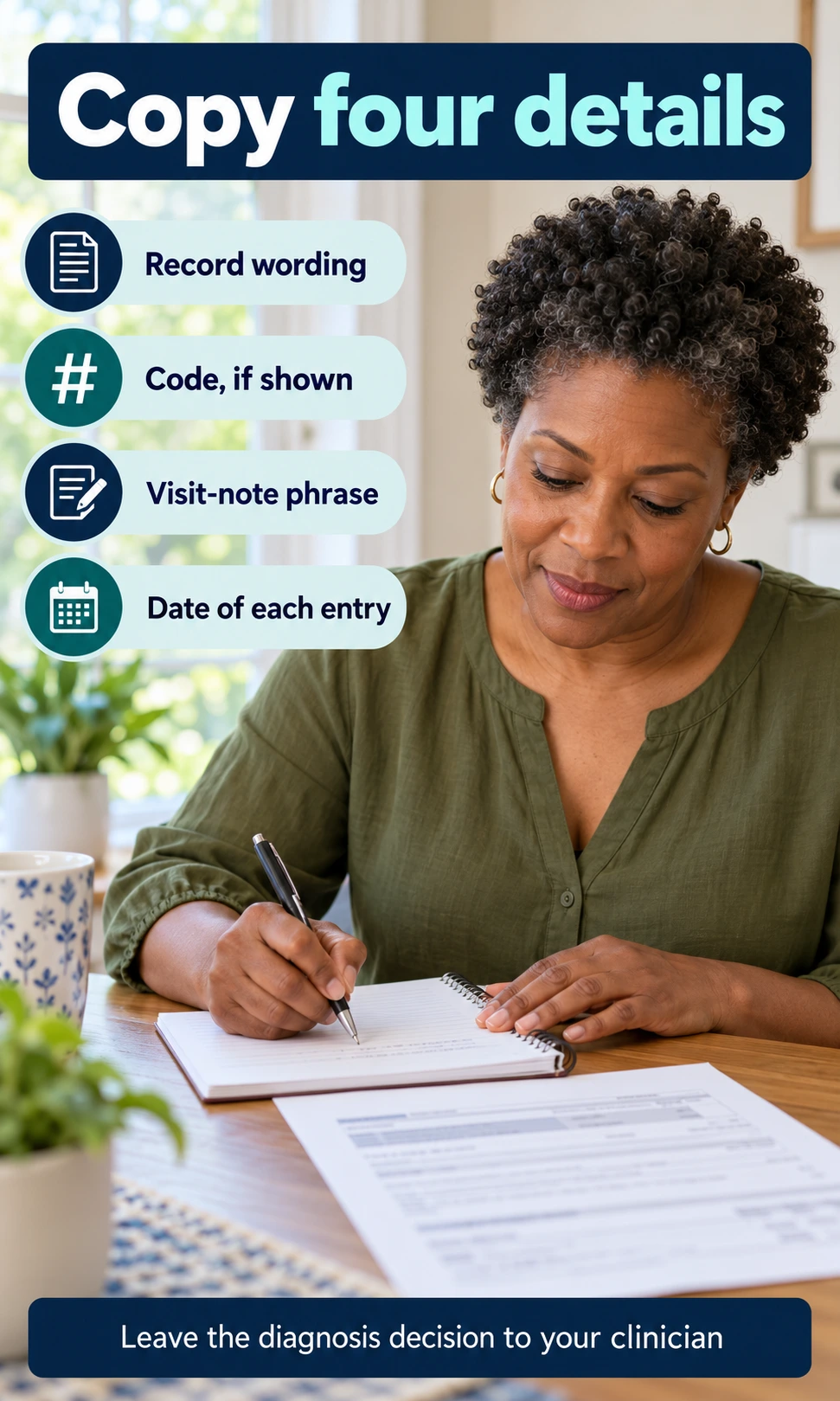
Record Clarity Studio arranges those details into a question sheet without interpreting them. You can leave a missing entry blank and identify it as unavailable, rather than guessing what the note says. Check the result against your original record before copying or printing it.
Documentation before the claim
Record Clarity
Find the next check when a note and a code do not match.
Educational reference only. This check does not diagnose, assign a final code, validate a claim, or establish coverage. Use the full record, applicable code year and qualified coding review. Do not enter patient information.
Depression NOS and major depression NOS have different reference entries. A copied label, a conflicting assessment or the wrong code year needs review before any correction.
Choose all four inputs to see the next documentation check.
Method and limits
Reference entries were checked in the official FY2027 Index and Tabular List on 7 October 2026. Branches prioritize record conflicts and unverified code years. Matching labels are not proof that a diagnosis is reportable. No symptom scores, patient text, browser storage, analytics or external API requests are used.
Ask for a name check, not a self-selected code change
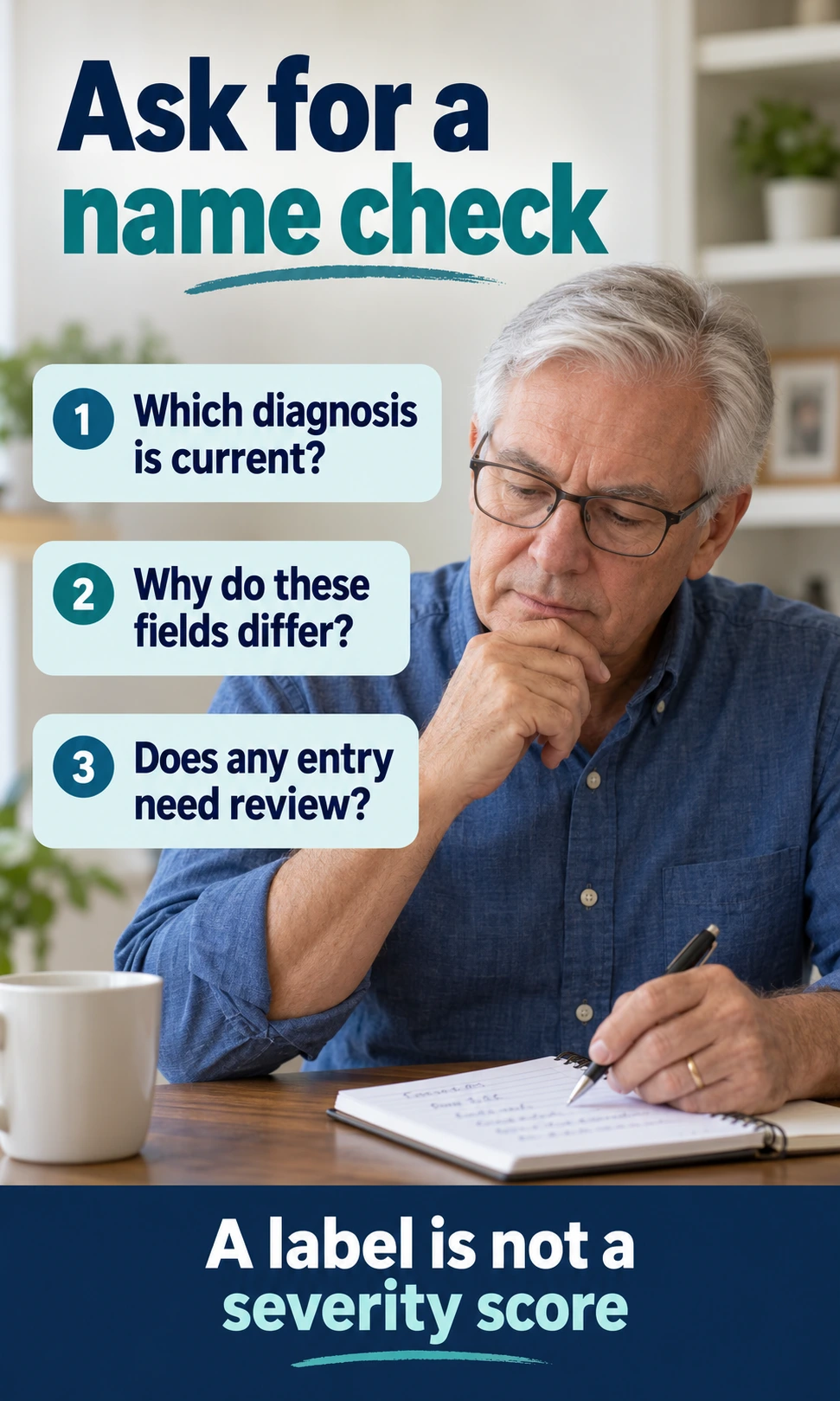
A useful request is specific: “My problem list says dysthymic disorder, but this visit note says persistent depressive disorder. Which diagnosis is current, and why are the words different?” That invites the clinician to check both the assessment and the record display.
- Which diagnosis is being used for my current care?
- Are these two entries describing the same assessment in my case?
- Is the problem-list entry current or historical?
- Does any entry need review, and who handles that process?
If you think there is an error, ask how the service handles a records review or correction request. Administrative staff may explain that process, while a clinical question may need to go back to the clinician. Do not ask someone to substitute a code solely because another label looks newer.
When the wording mismatch is not the main issue
If your real concern is how long low mood has lasted, prepare a separate account of the timeline and its impact. The persistent depressive disorder guide is the relevant continuation for that duration question. Keep that history distinct from a request to explain the words on the portal.
If the record instead says unspecified depression or depression NOS, the naming question belongs in a different records discussion. Read the unspecified depression terminology guide for that separate topic. Do not apply an F34.1 explanation to an unrelated code.
Changes in symptoms or daily functioning deserve attention even if the label stays the same. The NIMH depression guide explains why notes about onset, duration and everyday impact can help at a visit. If fatigue is part of the concern, the anemia and depression article covers that separate overlap; fatigue alone does not identify its cause.
Do not wait for a portal correction if you are struggling or having thoughts of suicide or self-harm. In the United States, call or text 988; in a life-threatening emergency, call 911. Outside the United States, contact your local crisis service or emergency number.
Frequently asked questions
Is dysthymia the same as persistent depressive disorder?
The terms overlap, but their meaning depends on the classification and the date of the assessment. Persistent depressive disorder has a broader DSM meaning than the former dysthymic disorder category. Ask your clinician how the wording applies to your record.
Why does my after-visit summary say dysthymic disorder?
It may be displaying a code-linked title rather than the exact phrase used in the visit. U.S. ICD-10-CM still titles F34.1 “Dysthymic disorder.” Your service can explain which field supplied the wording on your summary.
What is ICD-10-CM F34.1 in plain language?
F34.1 is a U.S. diagnosis-classification entry titled “Dysthymic disorder,” with persistent depressive disorder among its inclusion terms. Seeing it helps you identify the entry being displayed. It does not establish that the code is correct for your individual case.
Did DSM-5-TR drop the word dysthymia?
DSM-5-TR removed “dysthymia” from the parenthetical part of the persistent depressive disorder name. The term can still appear in older notes and in other classification or display contexts. Its presence alone does not prove a record error.
Can a chart list both dysthymia and major depression?
A record can contain more than one depression entry, including entries from different dates. Their presence alone does not show whether both are current or how they relate clinically. Ask the clinician to explain the assessment behind each entry.
Does a dysthymia label mean the low mood is mild?
The label alone cannot grade your current distress or daily functioning. Describe what has changed and how you are affected, even if the entry has been there for years. A wording question should not delay seeking help for worsening symptoms.
Bring the wording and one clear question
The most useful outcome is a clinician-confirmed explanation of the entries, rather than a diagnosis inferred from their names. Bring the exact wording, its source field and its date, then ask which assessment is current. Keep any record-review request separate from decisions about ongoing care.