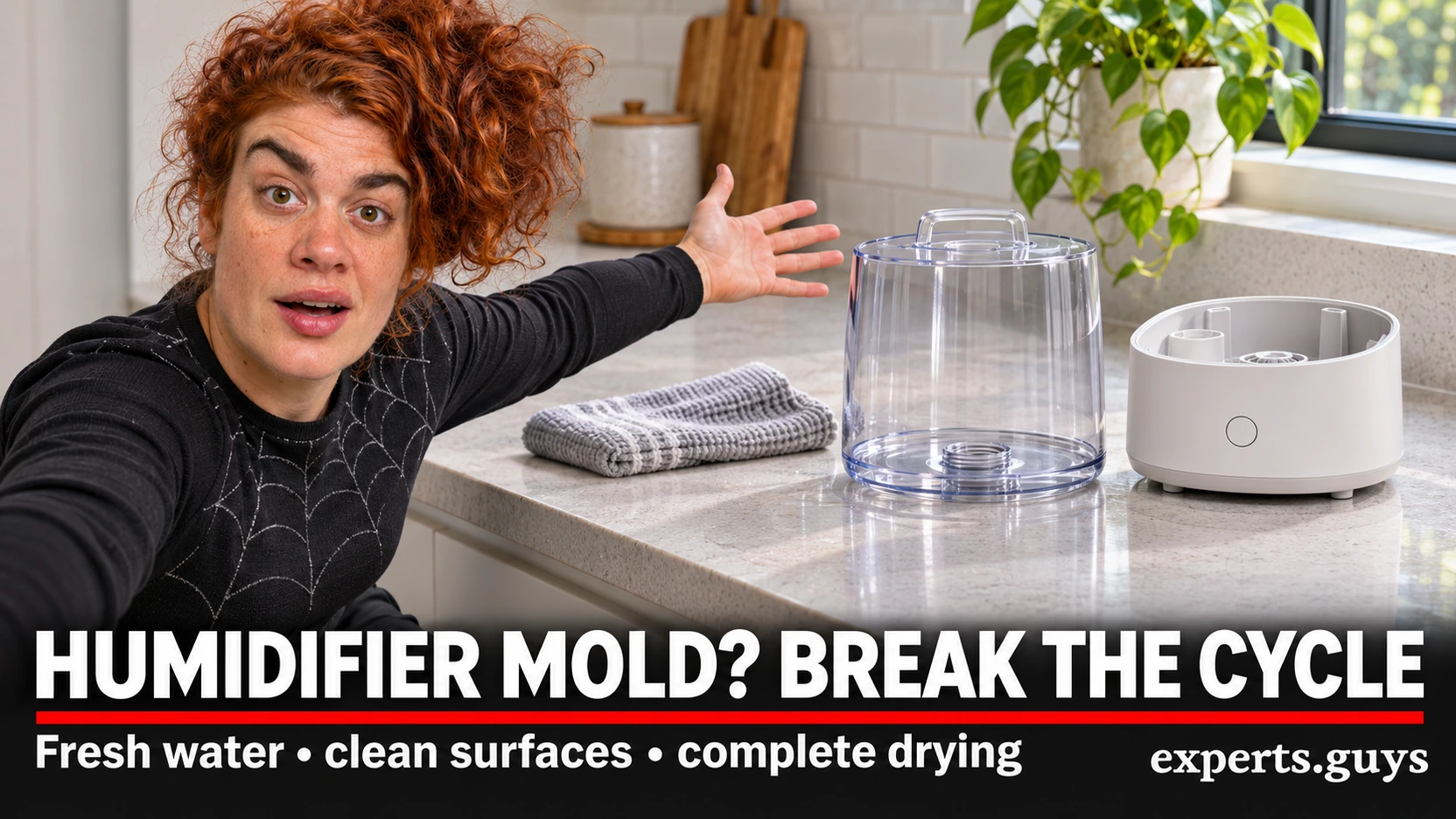
A humidifier can look clean from across the room while the water-contact surfaces need attention. The useful question is not whether a product promises to prevent mold. It is whether yesterday’s water, deposits and inaccessible damp parts are being carried into today’s operation. Fresh water is only one part of that decision. A tank that is repeatedly topped up can keep the same neglected surfaces in service even when the water level looks reassuring.
This guide follows the appliance’s water cycle: the daily reset, the model’s cleaning sequence, the point at which parts are ready to return to service and the room conditions that determine whether humidification belongs there at all. It does not identify organisms by color or claim that an experiment established a mold-free interval. Photographic teaching scenes illustrate the process; they are not photographs of a tested appliance or laboratory results.
The old idea of adding something to the tank and forgetting the maintenance is especially unhelpful. A treated water supply does not make the tank, seal, mist outlet and reservoir disappear. Equally, removing white scale and disinfecting are different jobs. Confusing those jobs encourages a familiar failure: a person spends time on one visible surface and assumes every other part of the unit has received the same treatment.
Start with the unit you actually own
Find the model identification on the appliance or purchase record and use the manufacturer’s instructions for that exact model. A familiar brand name is not enough. The same maker can sell ultrasonic, evaporative and warm-mist products with different water paths and serviceable parts. A detachable tank in one illustration does not establish that your electrical base can be washed under a tap.
The method of producing moisture affects what deserves attention. The EPA's humidifier care guidance highlights dispersal of microorganisms and minerals from ultrasonic and impeller units, and recommends daily water changes and regular cleaning. It also advises against raising indoor humidity above 50 percent. For portable units, its regular cleaning guidance is every third day, alongside daily water changes; also follow the model’s prescribed care and respond sooner to visible problems. Those are reasons to manage both the appliance and the room, not reasons to label every humidifier dangerous or assume a different type needs no care.
Before choosing a cleaner, identify the surfaces the manual tells you to clean, the parts it permits you to remove and the treatments it permits for each one. The difference between a water reservoir and a powered base matters more than whether a bottle is described as natural. A cleaning plan should still make sense when the bottle is put away: what needs deposits removed, what needs a specified disinfecting step and what must remain dry?
| State | What remains unresolved | Useful next action |
|---|---|---|
| Old water remains | The water cycle has not been reset | Empty and care for the specified parts. |
| Mineral deposits | Deposits need the permitted removal method | Use the model’s descaling directions. |
| Cleaning solution remains | Treatment is not finished | Complete the prescribed rinse. |
| Part damaged or inaccessible | Serviceability is uncertain | Pause and obtain model-specific service advice. |
| Room damp or condensing | Moisture addition may be inappropriate | Stop adding moisture and assess conditions. |
Make the daily reset a complete action
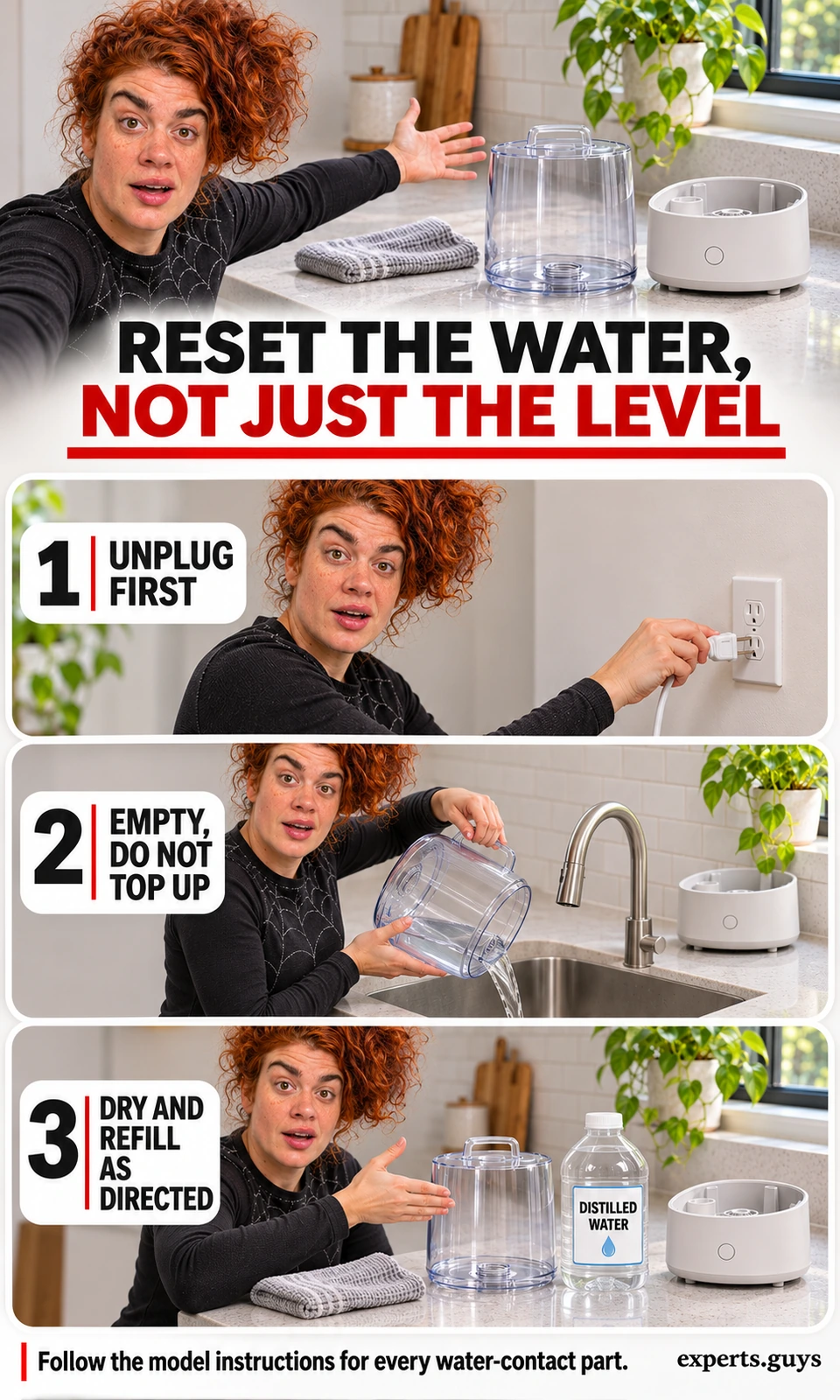
Begin in safe conditions with dry hands. Switch off and unplug as the instructions require; warm-mist units may also need time to cool. Move only the detachable parts that are intended to be carried to the sink. Keep the electrical section on a stable dry surface. If the cord, plug or appliance is damaged or has become unexpectedly wet, do not use an ordinary refill as a test of electrical safety.
Empty the old water rather than pouring fresh water on top of it. The CPSC humidifier safety guidance distinguishes fresh daily water from leaving standing water and describes film, scum and deposits as maintenance concerns. Color alone does not tell you what is present. Treat a visible change as a reason to stop and address the unit, rather than as an identification of a particular species.
Attend to the water-contact areas specified by the model, not just the large transparent container. A small reservoir can be overlooked because it stays attached to the machine. The relevant instruction might involve emptying, wiping or another prescribed action; it is not permission to tip a powered assembly into the sink. If the instructions are unclear, establish the correct procedure before carrying the unit around full of water.
Refill with the water type and quantity the manufacturer allows, after the required care is complete. Low-mineral water can reduce mineral buildup in appropriate units; it does not replace cleaning. Avoid treating the phrase distilled water as a promise that a used tank remains sterile. The daily reset is successful when the old-water cycle has actually been interrupted and the unit has been prepared according to its instructions.
Do not invent one cleaning recipe for every humidifier
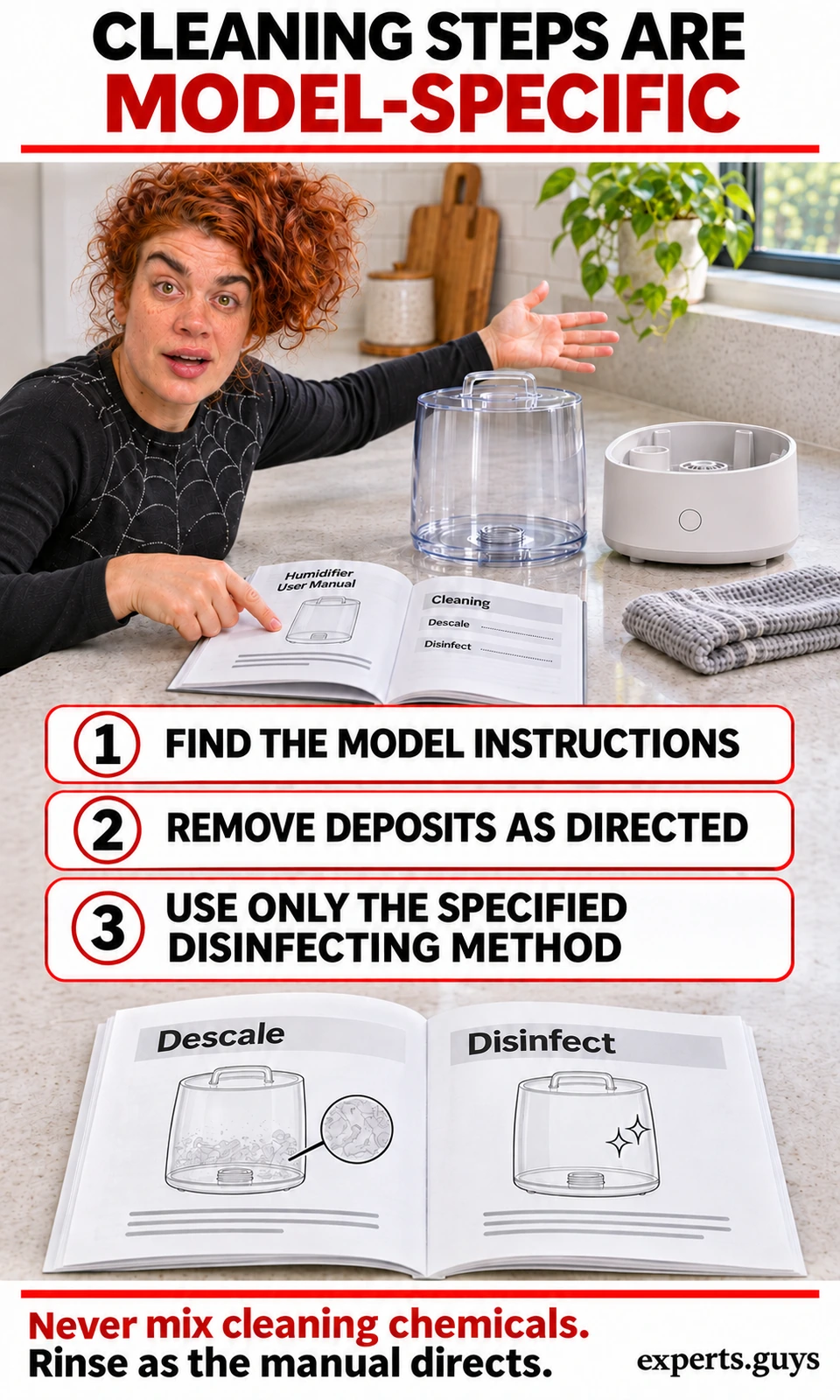
A search result that gives one universal combination of vinegar, bleach or peroxide skips the most consequential detail: the appliance. Concentrations, contact times, compatible materials and rinsing requirements belong to the actual product instructions. This guide deliberately supplies no generic chemical recipe. A reader should be able to follow the manufacturer’s complete sequence rather than assemble a new one from fragments of several unrelated guides.
A useful example is the Honeywell HWM705 owner's manual. Its directions distinguish scale removal from disinfecting and give model-specific handling and rinsing steps. That example illustrates why a care sequence has separate stages; it does not transfer that model’s products, quantities or instructions to another machine. Use your own manual, including any updated directions supplied by its manufacturer.
Descaling addresses accumulated mineral deposits. Disinfecting, when specified, is a separate treatment with its own directions. Cleaning also includes removing the material that can be physically removed as directed. A surface can look less chalky without every other maintenance requirement being complete. Conversely, adding a disinfectant to a dirty tank does not establish that inaccessible deposits or damaged components have been dealt with.
Keep chemical stages separate and never mix cleaning chemicals. Do not improvise a stronger treatment because the first one did not remove a stain. In particular, changing from one product to another without the prescribed emptying and rinsing steps can create a situation that neither set of instructions intended. A difficult deposit calls for the maker’s troubleshooting or a replacement decision, not a homemade mixture.
The correct endpoint is not a dramatic smell or a certain color of water. It is completion of the prescribed process on the prescribed parts, including rinsing and any required drying. An attractive before-and-after photo cannot verify contact time, concentration, compatibility or residue removal. Those missing details are why a short social-media cleaning clip should not take the place of the model’s written directions.
If a manual includes a regular service interval, regard it as part of the product’s care plan, not as an excuse to ignore an earlier visible problem. Likewise, do not wait for a calendar reminder when film, unexpected odor or abnormal operation has already appeared. A routine interval and a stop-use condition answer different questions: when normal care is due, and when continued operation needs to pause.
Check the parts that make cleaning fail
A wide opening can make a tank easy to refill yet leave a narrow outlet or cap assembly inconvenient to inspect. Look at the parts the maker describes as user-serviceable. The practical question is whether you can complete their care without forcing a brush into a passage, damaging a seal or opening a housing that was never intended for routine access. Accessibility is a maintenance requirement, not simply a convenience.
- Identify the exact model and current care instructions.
- Separate detachable water parts from the electrical base.
- Complete each permitted cleaning stage, including its rinsing requirements.
- Replace parts that the maker says are spent or unserviceable.
- Resume only when both the unit and room conditions are suitable.
A soft seal, wick, filter or cartridge can have different care instructions from a hard tank. A filter is not automatically washable because another component is. Follow the replacement schedule and condition checks for that specific consumable. If a component has lost its shape, no longer fits or cannot be cared for by the permitted method, do not assume extra soaking will restore it.
A persistent stain also creates a decision, but not an organism identification. You may be looking at mineral discoloration, a material change or remaining contamination. A photograph cannot reliably resolve that distinction. What you can establish is whether the permitted cleaning process worked as intended and whether the maker considers the part serviceable. If that remains uncertain, keep the affected unit out of use while obtaining a clear answer.
Rinsing and drying are part of the job
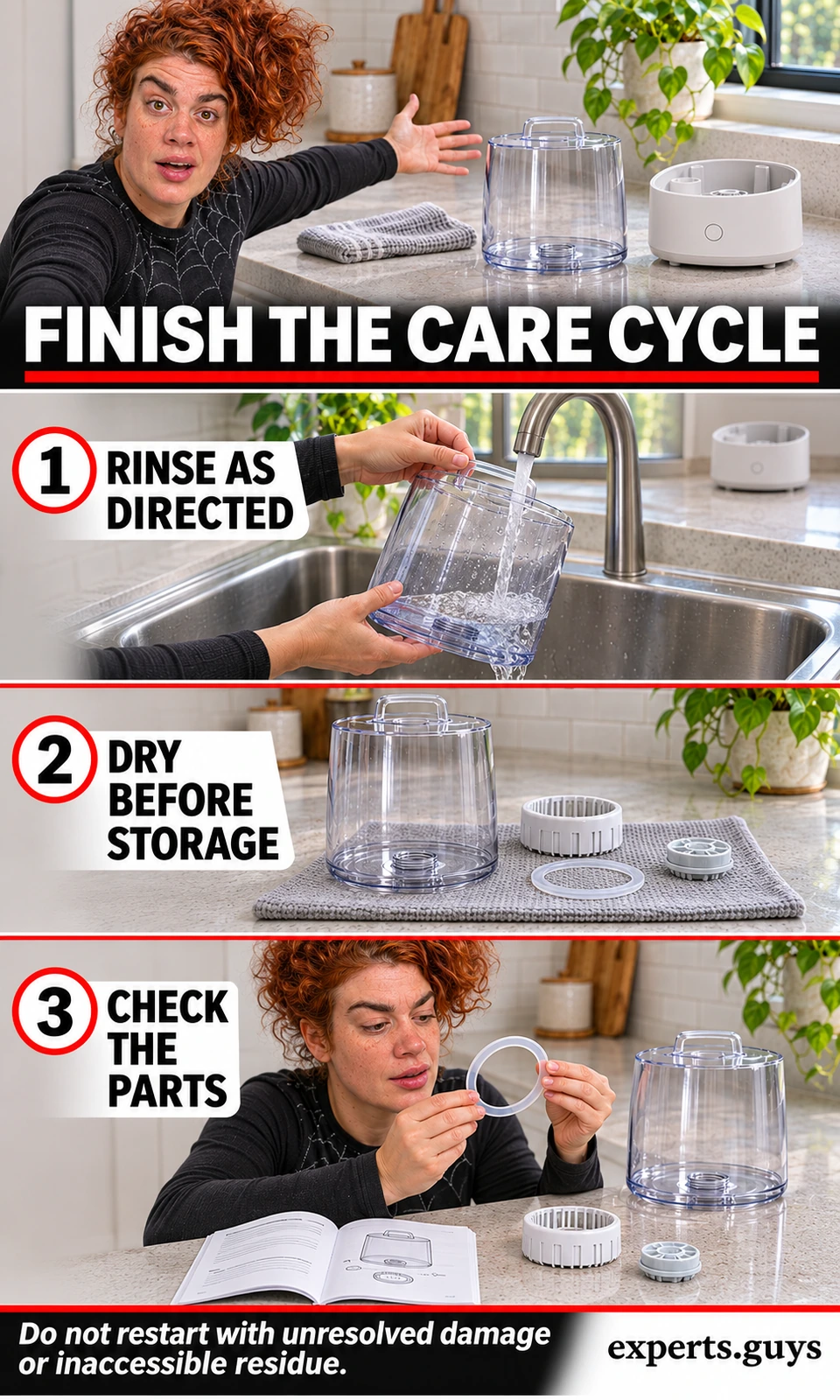
Rinsing is easily shortened when a tank already looks clear. Yet the water that remains after treatment is not the same question as the deposits that were present before it. Follow the directions for removing the cleaning solution from every treated water-contact part. Do not use the operating mist as a way to clear an unwanted cleaner smell from the appliance.
Return parts to a clean stable surface in the arrangement the manual permits. Let the specified areas dry as directed, and avoid closing a damp unit merely to make the counter look tidy. Keep the electrical section dry throughout. A drying instruction is not permission to put the unit near a heater, use an oven or introduce another heat source that the manufacturer never specified.
Before reassembly, inspect the normal seating of the parts you removed. A cap that has been cross-threaded or a seal that has been displaced can turn a cleaning task into a leak. Use the fitting method in the manual and do not force a component that previously fitted easily. If assembly no longer looks or feels correct, resolve that problem before filling and powering the unit.
For seasonal storage, complete the prescribed end-of-use care rather than leaving water inside until the next dry spell. Store the clean dry components as directed and keep the instructions with the appliance’s digital product record. The useful memory aid is the model and its care page, not a handwritten promise that the unit was once cleaned. At the next use, perform the restart checks the manufacturer requires.
The same logic applies to a spare tank. Keeping a second container available can make the daily routine easier, but it does not make an unclean container ready for use. A clean part and a part that merely has no water in it are not interchangeable descriptions. Organizing the counter should make the correct condition obvious without relying on which tank happened to be closer to the machine.
Ask whether the room needs more moisture
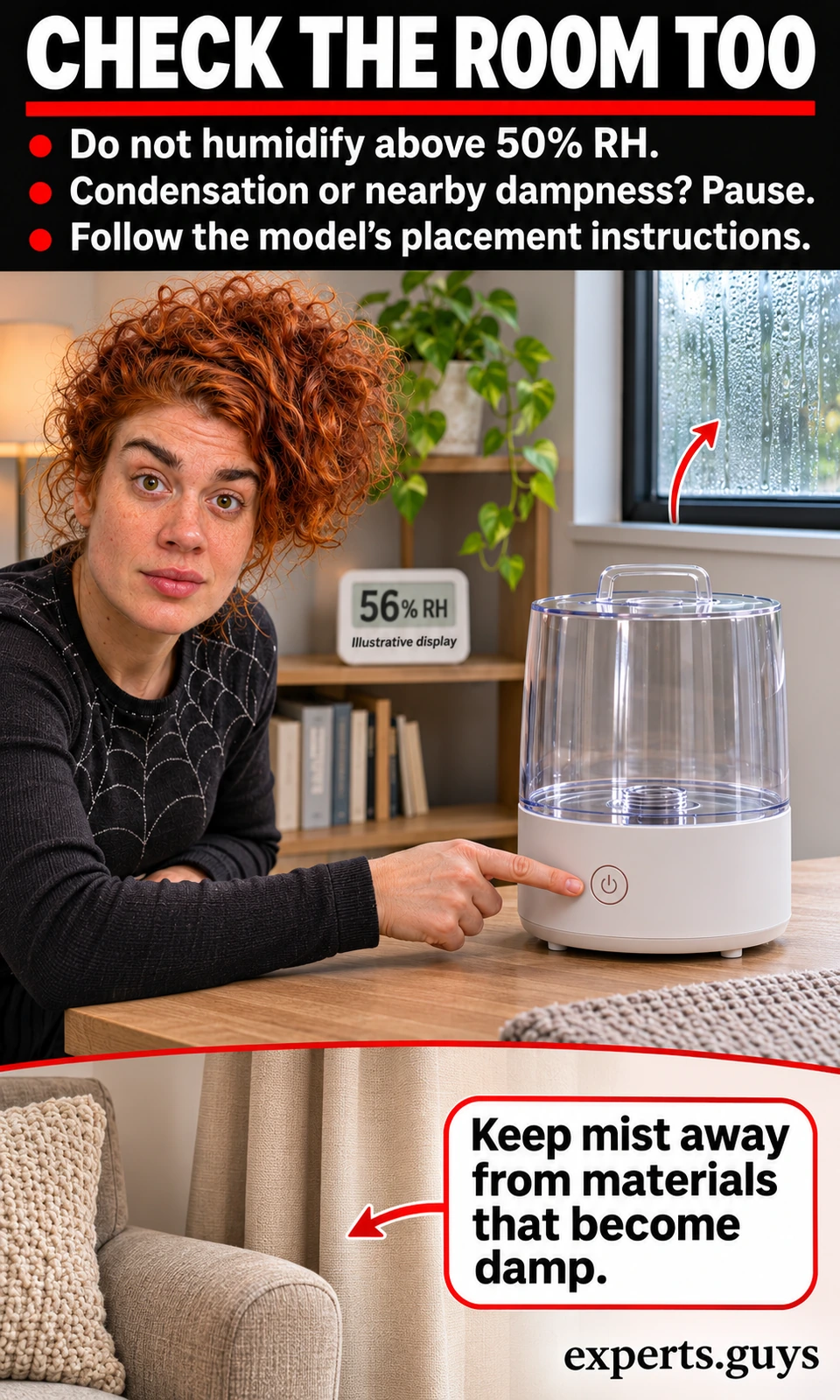
A humidifier is a moisture source. A clean appliance can still be the wrong appliance to operate in a room that is already humid or developing condensation. Use a suitable room hygrometer in a representative position, away from the direct plume, and follow both the room conditions and the product directions. Do not treat the unit’s dial as proof that every part of the room has the same humidity.
The EPA ceiling of 50 percent is a general indoor-air precaution for humidifier use, not a target to push every room toward. Condensation on nearby surfaces or dampness around the unit calls for reducing output or stopping it, even if one displayed number appears acceptable. A local wet patch is information about where moisture is landing; the room-average reading cannot erase it.
Place the appliance according to its own clearance, surface and outlet directions. Do not copy a distance from a photograph of another model. Mist should not be directed at bedding, curtains, a wall, electronics or other items that are becoming damp. If a convenient bedside position repeatedly wets nearby materials, the convenience does not justify continuing that arrangement.
Consider the whole operating period. A placement that seems harmless during a short daytime check may behave differently during a long closed-door run. Reassess the actual room after the unit has been used as intended; do not assume the morning reading from another room describes the bedroom overnight. No fixed runtime can substitute for the room’s actual response and the model’s operating limits.
The reason to stop matters. A unit paused because the tank needs cleaning has a different restart requirement from one paused because the room is already too humid. Cleaning resolves neither a leaking window nor a cold damp wall. For the building side of the problem, use the separate guide to checking basement moisture conditions. Keep appliance care and building moisture assessment distinct.
Why additives do not solve the maintenance problem
An additive can sound appealing because it turns a repeated task into a purchase. But a promise made for one tank treatment does not establish permission to aerosolize it in every humidifier. Use only products explicitly permitted for that model and purpose. Do not put a cleaning chemical into the operating water unless the manufacturer specifically directs that use; a product used during cleaning may need to be completely rinsed away before operation.
Essential oils, fragrances and improvised household ingredients raise the same compatibility question. A model with a designated aroma accessory is not evidence that another tank can accept oil. Treat the manual’s water compartment and any separate accessory as separate systems. The absence of an immediate leak or unpleasant smell is not proof that an added substance belongs in the water path.
Nor does an additive answer the physical problem of a part you cannot clean. If a narrow passage or damaged seal remains in doubt, replacing the water and adding a treatment does not establish the condition of that part. The practical choice may be manufacturer service, an approved replacement component or a different appliance. Continuing to operate because a bottle is available leaves the original question unanswered.
White dust deserves its own interpretation. Mineral dispersal can occur with certain humidifier types and water sources; visible dust is not a mold test. Reducing minerals where appropriate and performing the correct care addresses a different mechanism from treating a wall stain. Avoid cleaning an appliance for the wrong suspected problem while ignoring the water type or the room conditions that actually explain the observation.
Treat a recurring problem as information about the routine
Suppose a tank is emptied each morning but the small reservoir remains full because it is awkward to reach. The person may reasonably feel that daily water changes are happening. The maintenance gap is narrower: one part of the water path is being missed. The answer is to find the prescribed reservoir procedure and make it workable, not to accuse the owner of doing nothing or to double the cleaner strength.
A different example is a unit that receives an elaborate weekly wash but is repeatedly topped up during the week. Here the visible cleaning effort can conceal an incomplete daily reset. Changing the week-end task alone leaves the repeated standing-water pattern in place. These are illustrative household situations, not results from a trial; they show why identifying the missed stage is more useful than counting how many minutes someone spent cleaning.
Another household may have a clean unit but wet curtains every morning. More disinfecting does not answer the moisture deposition problem. The immediate question is whether the operating position, output and room conditions are suitable. The corrective action needs to match that failure. If nearby materials have already been affected, assess them separately rather than assuming the appliance’s next cleaning cycle will restore the room.
A practical routine also has to fit the person using it. If the tank is too heavy to carry safely or the care steps cannot be completed reliably, a large nominal capacity may create more work rather than less. Before replacing a unit, consider access to the water-contact parts, handling weight when full and the clarity of its instructions. Those are concrete maintenance questions; a decorative shape or impressive mist plume does not answer them.
For a shared room, the handover should name the state of the unit. “Empty and awaiting cleaning” is different from “cleaned, rinsed and ready to refill.” A vague “I did it” can hide exactly the stage another person assumes is complete. A simple shared digital task label is enough when needed; there is no reason to create an elaborate tracking application or ask everyone to keep a pen-and-paper diary.
Separate appliance concerns from building mold
A musty smell near a humidifier does not establish that the appliance is the only source. Stop and inspect the accessible unit safely, but also consider whether nearby furnishings or building materials are damp. A water path inside the machine and a moisture problem behind a wall are different investigations. Do not dismantle building finishes because a portable tank was found dirty.
Likewise, a clean-looking tank cannot clear an affected room. The guide to hidden water damage inside walls explains why concealed layers need their own assessment. This article keeps that larger building task separate. Its scope is deciding how to care for, pause or replace a humidifier, and when the room’s response makes continued humidification inappropriate.
Avoid assigning the word mold to every pink, orange, white or dark mark. Appearance alone is not a reliable identification, and a household photograph is not a laboratory result. You can make the immediate maintenance decision without naming an organism: visible film or unexplained residue needs attention according to the maker’s instructions, and a part that cannot be adequately cared for should not be assumed ready for service.
If breathing symptoms appear in connection with use, stop the humidifier and seek medical assessment rather than repeatedly running it to see what happens. Severe breathing difficulty needs urgent help. This is not a claim that the appliance caused a particular illness. It is a boundary against turning an exposure concern into a home experiment while a potentially important symptom is present.
What a better result looks like
A better routine has clear endpoints. Old water has been emptied from the prescribed areas, permitted cleaning stages are complete, treated parts have been rinsed, components are fit for reassembly and the room is suitable for moisture addition. Each endpoint answers a different question. Passing one does not allow the others to be skipped, and none constitutes a promise that microorganisms can never appear.
That is also how to evaluate a claimed shortcut. Ask which stage it replaces and what evidence shows that replacement is appropriate for your model. If the claim is simply that a product keeps water fresh, it has not yet explained deposits, inaccessible parts, rinsing, drying or room humidity. A useful instruction narrows uncertainty; a reassuring slogan merely changes how the same uncertainty feels.
Compare Local Home Specialists Near You
Tell us what kind of help you need, then compare nearby businesses by location, Google rating, review volume and contact options.
HomeFix Local Match
Turn a home problem into a practical local hiring decision. Check the clues, see the specialist types that fit, open focused surrounding-location searches, then compare the strongest three before you call.
 YOUR PROBLEM
YOUR AREA
COMPARE 3
✓ Ready to compare
What is happening?
Choose the closest problem type, then check every clue that applies. Your selections change the specialist order.
Where should the search focus?
Use Google’s “near me” context or enter the area you actually want a specialist to serve.
Simple local search: open nearby Google results, choose the businesses that look suitable, then compare your best three here before you call.
Problem snapshot
Who should you call first?
These are the specialist types most likely to fit the clues you selected.
Search around your location
Compare your top three
Use the same factors for each option so a high star rating does not hide a weak scope, poor diagnosis, missing credentials or unclear aftercare.
Comparison result
Your result combines the Google signals you entered with the practical hiring checks you completed.
Questions to ask every finalist
Use the same questions with each shortlisted business so the comparison stays consistent.
Frequently asked questions
Does distilled water mean I can skip cleaning?
No. Reducing the mineral load does not maintain the surfaces and parts of an appliance after use. Continue the model’s daily care, regular cleaning and replacement instructions. Water choice and maintenance solve different problems. A low-mineral refill is not evidence that the reservoir, outlet or seal is ready to return to service.
Can I put a cleaner in the water and let the mist spread it?
Do not use operating mist to disperse cleaning solution. Follow the exact model’s treatment and rinse instructions before restarting. A cleaner permitted during maintenance is not automatically permitted in operating water. If you have already used an unsuitable substance, stop and obtain the manufacturer’s guidance rather than trying another additive to cancel it.
Is pink residue definitely mold?
A color is not a reliable organism identification. Use the observation to decide that the unit needs attention, not to name a species or diagnose an illness. Follow the permitted care method and resolve any part that remains unserviceable. You do not need a color-based diagnosis to decide that unexplained film should not simply be topped up and operated.
Should I clean a filter in the same way as the tank?
Only if the instructions for that particular filter allow it. Consumables can have different replacement and care rules from hard water containers. Do not assume washing, soaking or disinfecting will restore a spent filter. The exact model’s instructions and replacement part information should determine whether the component can remain in use.
Why pause a clean humidifier if the room is damp?
Appliance cleanliness and the need for added moisture are separate decisions. A unit may be cared for correctly while its output still produces an unsuitable local condition. Nearby condensation, wet furnishings or an already humid room calls for adjusting or stopping moisture addition and assessing the room. More cleaning cannot correct excessive output.
Can I store the humidifier as soon as I empty it?
Emptying is only one stage. Complete the maker’s end-of-use cleaning, rinsing, drying and storage directions, including its instructions for filters or other replaceable parts. A closed damp container can carry an unfinished maintenance problem into the next season. At the next use, perform the model’s restart checks instead of assuming storage itself made the unit ready.
What if I cannot find the manual for an older unit?
Use the model number to ask the manufacturer for the correct instructions and replacement-part information. A manual for a similar-looking product may describe a different reservoir, cleaning treatment or electrical arrangement. If you cannot establish how the unit can be maintained and operated safely, leave it out of use while resolving that gap. A generic online recipe is not a substitute for missing product instructions, particularly when the question involves the powered base or chemical compatibility.
Can a large tank make the routine easier?
Capacity alone does not answer that. Consider the weight you must carry, whether the tank fits the available sink, whether all prescribed surfaces can be reached and whether the daily emptying step is practical. A smaller unit that you can care for correctly may fit your circumstances better than a large one that regularly retains old water. Compare the actual maintenance sequence as well as capacity before treating a purchase as a solution to recurring upkeep problems.
Why does this guide not recommend a fixed number of operating hours?
A fixed runtime would ignore the room, output setting, weather and actual moisture response. The same duration can have different consequences in an open living space and a closed bedroom. Follow the product operating limits and assess room humidity and nearby surfaces during the pattern of use that actually occurs. A timer can control a duration, but it cannot certify that the room needs moisture or that furnishings are staying dry.
Does a cleaning reminder prove the unit was maintained?
No. A reminder tells you that an action is due. It does not establish that the old water was emptied, the correct parts were treated, the solution was rinsed away or a damaged component was replaced. When another person needs to use the unit, a clear digital status such as awaiting rinse or ready to refill is more useful than a checked box with an unclear meaning. Keep the status simple and tied to the actual unfinished stage.
Action checklist
Choose the next action that matches the present state of the appliance. If the unit is operating normally and due for daily care, perform the complete reset. If residue is visible, stop and complete the permitted cleaning process. If a part is inaccessible, damaged or still uncertain after that process, resolve serviceability before restarting. If the room is damp, stop adding moisture and address the room condition.
The point is a reliable water cycle rather than a stronger cleaner or a perfect-looking photograph. Keep the exact model instructions available, make the prescribed care achievable and judge the room separately from the appliance. That approach gives you a specific reason to refill, clean, pause or replace, without pretending that a generic recipe can certify every humidifier.