

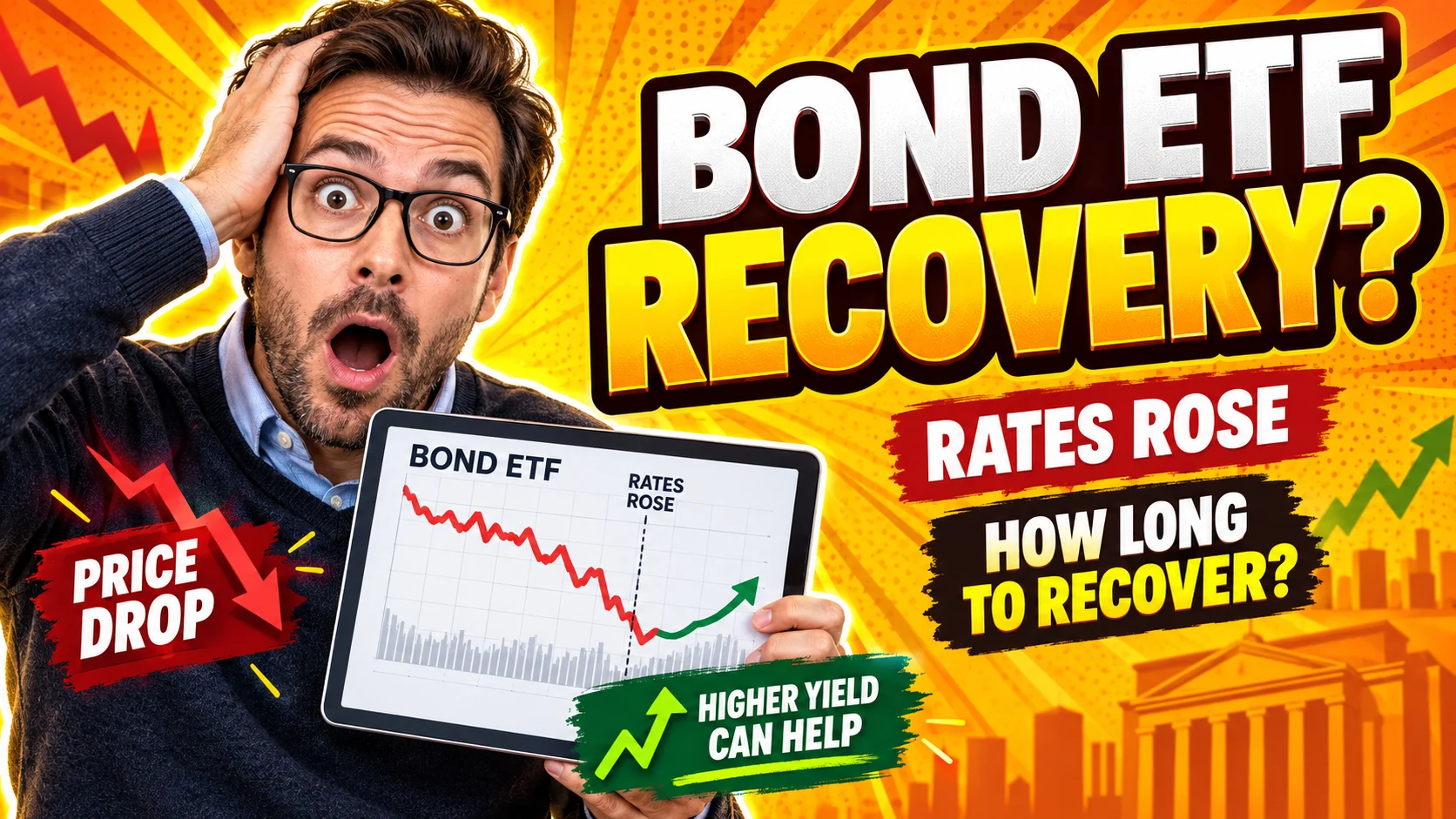

A bond ETF may take roughly a duration-length period for its higher yield to offset the damage from a one-time rise in comparable interest rates, but that is a rule of thumb rather than a countdown clock. The answer also depends on what you mean by “recover,” whether distributions are reinvested, and what interest rates, credit spreads and the fund itself do after the original decline.
There Are Three Different Meanings of Bond ETF “Recovery”
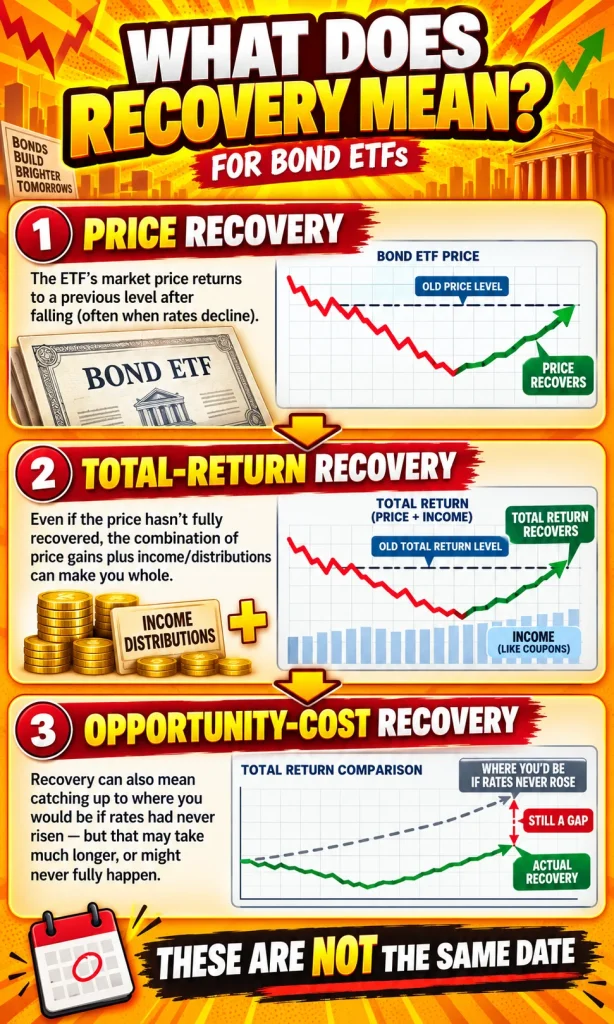
When investors say a bond ETF has not recovered, they often compare today’s share price with an old price on a chart. That comparison leaves out the distributions received along the way, which can become particularly important after yields rise. A useful recovery calculation therefore has to begin by deciding exactly what is being measured.
| Type of recovery | What the investor is asking | What determines it |
|---|---|---|
| Price recovery | When will the ETF’s NAV or market price return to its previous level? | Future market yields, duration, credit spreads and portfolio changes |
| Investment-value recovery | When will price plus accumulated/reinvested income make up the decline? | Starting yield, new yield, distributions, reinvestment and subsequent market moves |
| Opportunity-cost recovery | When will I be as well off as I would have been if rates had never risen? | Duration, rate path, reinvestment and total return rather than NAV alone |
The third definition is the reason duration is so useful. After a sudden increase in yields, a bond fund suffers an immediate price loss but begins earning the benefit of the new higher-yield environment. Under simplified assumptions, those opposing effects can roughly balance over a period related to the fund’s duration.
Why Rising Rates Hurt First but Can Help Later
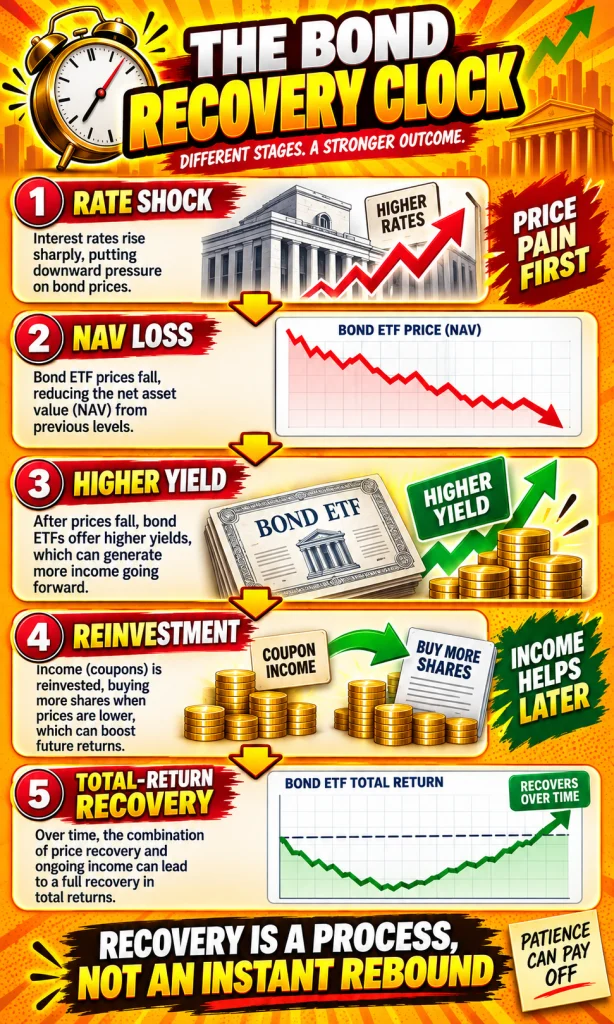
A bond paying an older, lower rate becomes less attractive when newly issued bonds offer higher yields. Its market price therefore falls until a buyer can earn a return that is competitive with current rates. A bond ETF reflects those price changes quickly because the value of its underlying portfolio is continually marked to market.
The same rate increase that causes the immediate loss also changes the economics looking forward. Existing bonds are now priced to higher yields, cash flows can be reinvested at higher rates, and bonds entering the portfolio may carry more attractive yields than the securities purchased before rates rose. The investor experiences the pain first because the price adjustment happens quickly, while the benefit of the higher income accumulates gradually.
Duration Gives You a Recovery Clue – Not a Guaranteed Date
Duration risk is normally introduced as a measure of interest-rate sensitivity. As a simplified example, an ETF with a duration of six years could be expected to lose roughly 6% in price if the relevant market yield suddenly rose by one percentage point, before considering factors such as convexity, credit-spread changes and movements at different parts of the yield curve.
There is another side to the same number. If the rate change happens as a relatively clean one-time shock and yields then stabilize, the higher yield available after the decline can gradually compensate for the initial rate-driven price loss. That is why duration can also provide a rough framework for thinking about the period over which the initial rate shock becomes less important to total return.
A Simple Example: A 1-Percentage-Point Rate Increase
Suppose a high-quality bond ETF has an effective duration of approximately six years. If comparable yields suddenly rise by one percentage point, duration math suggests an initial price decline of roughly 6%, all else equal. That estimate describes the first-order price effect; it does not mean the investor has permanently lost 6%.
After the repricing, the portfolio is earning in a higher-yield environment. If yields then remain broadly stable and the investor continues holding the fund, income and reinvestment gradually work against the original price damage. The important measurement is therefore total return – the change in investment value plus distributions – rather than waiting for the share-price chart alone to revisit the exact number printed before the rate increase.
Why Your Bond ETF Does Not Simply “Return to Par”
This is where a bond ETF behaves differently from an individual bond. An individual bond has a maturity date, and subject to default and its specific terms, its principal is repaid at maturity. Most ordinary bond ETFs do not have one maturity date because the fund continually owns a changing portfolio of bonds.
As bonds mature or move outside the index or strategy’s required maturity range, the fund replaces them with other securities. A fund targeting an intermediate-duration market therefore remains an intermediate-duration investment instead of becoming progressively shorter and finally disappearing. Waiting for a conventional bond ETF to “mature” is consequently the wrong mental model.
What Makes a Bond ETF Recover Faster or Slower?
The recovery path is controlled less by the size of the first drop than by what happens after it. A bond ETF can recover relatively smoothly if the rate increase is largely complete and the fund is allowed to earn its new, higher yield, while repeated rate increases can keep resetting the recovery process. Credit conditions, reinvestment and the part of the yield curve the fund owns can also materially change the outcome.
- Rates stabilize: the fund can begin collecting the benefit of its higher starting yield without another major price shock interrupting the process.
- Rates fall: existing bonds become more valuable, which can accelerate price recovery, although future reinvestment may occur at lower yields.
- Rates rise again: the ETF may experience another price decline, especially when duration is long.
- Credit spreads widen: corporate-bond ETFs can fall even if government yields are unchanged because investors demand additional compensation for credit risk.
- Distributions are reinvested: reinvestment compounds the higher income into additional shares, which can improve the total-return recovery path.
- Distributions are withdrawn: the investor still receives income, but the account balance itself may recover more slowly because those cash flows are no longer compounding inside the position.
The Rate Path Matters More Than One Rate Change
A common mistake is to treat an interest-rate increase as a single permanent event. In reality, bond markets continually reprice expectations for inflation, economic growth, central-bank policy and future borrowing conditions, so a six-year-duration fund can experience several separate rate shocks rather than one neat adjustment followed by six quiet years. The recovery clock therefore does not run independently of the market environment.
Suppose yields rise by one percentage point and then remain broadly stable. The fund initially loses value but begins earning at a higher yield, creating the classic duration-based recovery pattern. If yields rise another percentage point a year later, however, the portfolio experiences a second repricing before the benefit of the first higher-yield environment has fully accumulated.
The opposite can happen when yields decline. A long-duration ETF may recover price rapidly because its existing bonds become more valuable, but that does not mean lower rates are unambiguously better for a continuing investor. New bonds entering the portfolio and reinvested cash will generally carry lower yields, reducing the future income advantage that existed after rates had risen.
Why Long-Duration Bond ETFs Can Take Much Longer to Work Through Rate Shocks
Duration magnifies both sides of the experience. A long-duration bond ETF can suffer a much larger immediate decline from a given increase in yields, but it also locks in exposure to the higher-yield environment for longer than a very short-duration fund. That makes long-duration funds potentially powerful when yields fall and uncomfortable when yields continue rising.
A short-duration bond ETF generally experiences a smaller price reaction to the same rate move because its cash flows arrive sooner. Its holdings also mature or roll through the portfolio more quickly, allowing the fund to reinvest into newer market yields faster. The trade-off is that if yields subsequently fall, that shorter-duration portfolio also resets toward lower yields more quickly.
| Bond ETF type | Typical rate sensitivity | After rates rise | Main recovery issue |
|---|---|---|---|
| Short duration | Lower | Usually smaller initial NAV impact | Income resets to market rates relatively quickly |
| Intermediate duration | Moderate | Meaningful price decline if yields rise materially | Requires enough holding time for higher income to matter |
| Long duration | High | Potentially large price decline | Further rate increases can materially extend the recovery path |
A Bond ETF Can Fall Even When Interest Rates Do Not Rise
Interest rates are only one part of bond pricing. A corporate-bond ETF can decline because investors become more worried about defaults and demand a wider credit spread, even if government-bond yields remain unchanged. Investors who attribute every bond-fund decline to central-bank policy can therefore misdiagnose what is actually driving the portfolio.
Credit-spread risk becomes especially important in lower-quality corporate debt. During periods of economic stress, government bonds and riskier corporate bonds can behave very differently because investors may seek the relative safety of government debt while demanding substantially more yield from weaker borrowers. A fund’s recovery can consequently depend on both the interest-rate cycle and whether credit conditions normalize.
This is also why two bond ETFs with similar duration numbers can produce very different results. Duration describes their sensitivity to changes in yield, but it does not tell you whether the yield change comes from the underlying government rate, additional credit compensation or both. The composition of the fund still matters.
The Yield Curve Can Move Without Every Bond Yield Changing Equally
Bond-market movements are often described as though “interest rates” were one number, but different maturities can move in different directions or by different amounts. Short-term yields might decline while long-term yields remain elevated, or long-term yields might rise even when shorter-term policy expectations are falling. A fund concentrated in one maturity range can therefore behave very differently from another bond ETF during the same period.
That matters for recovery because the duration estimate assumes a reasonably defined relationship between the fund and the yields affecting its holdings. When the yield curve changes shape, a simple one-number duration estimate becomes less precise. Investors should still use duration as an important risk measure, but not as a complete model of every possible bond-market movement.
Reinvesting Distributions Changes the Recovery Math
Bond ETF distributions are not a side detail when measuring recovery. If the fund’s NAV falls from $100 to $94 but the investor receives and reinvests distributions over time, looking only at whether the NAV has returned to $100 ignores part of the investment return. Total-return analysis includes both the market value and the cash generated by the position.
Reinvestment becomes particularly powerful after yields rise because distributions can purchase additional shares at lower prices while the underlying portfolio is earning higher yields. If those additional shares continue producing income, the recovery process compounds. An investor who spends every distribution instead still receives real economic value, but the brokerage account will not display the same compounding path.
This distinction explains why a price chart can make a bond fund appear permanently damaged even when the investor’s total economic outcome has improved substantially. Price return and total return answer different questions, so they should not be substituted for one another.
Do Not Compare Today’s Bond ETF Price With Its Old High in Isolation
A previous high can be a psychologically powerful reference point, but it has no special economic status. A bond ETF trading below an old peak may now offer a materially higher yield than it did at that peak, which changes the return available to someone holding the fund from today forward. The historical price tells you what happened; it does not by itself tell you whether the current position is attractive or inappropriate.
This is one reason buying a bond ETF immediately before a large rate increase feels very different from buying the same ETF afterward. The first investor experiences the repricing loss before receiving the higher income, while the second investor enters after much of that adjustment has already occurred. They own the same fund but have different starting yields and therefore different return paths.
What Happens If You Sell Before the Recovery Period?
Selling converts the fund’s current market value into cash and ends your exposure to its future income and price movements. If the ETF has fallen because yields increased, selling immediately after the decline means you realize the lower market value without remaining invested long enough to benefit from the higher yield that helped create the lower price in the first place. That does not make selling automatically wrong, because the appropriate decision still depends on why the money is needed and whether the investment remains suitable.
The bigger problem occurs when an investor buys a long-duration bond ETF for money that may be needed soon. A fund with substantial duration risk may be perfectly reasonable for one portfolio role but unsuitable for a short, fixed spending horizon. Recovery analysis is therefore not only about predicting markets; it is also about matching the investment’s risk horizon to the investor’s actual holding period.
Duration and Holding Period Should Be Considered Together
An investor with a one-year spending horizon and a bond ETF with a ten-year duration faces a very different risk from someone investing money that will not be needed for many years. The first investor may not have enough time to absorb a substantial rate shock, while the second has more opportunity for higher income and reinvestment to influence the total return. Duration becomes more useful when it is considered alongside the date at which the money may actually be required.
This does not create a universal rule saying that holding period must always exceed duration. Portfolio construction depends on the fund’s role, other assets, liquidity needs and risk tolerance. The important point is that a bond ETF with significant rate sensitivity should not be treated like cash merely because its underlying securities are bonds.
Why a Target-Maturity Bond ETF Behaves Differently
Most conventional bond ETFs maintain a relatively stable maturity or duration profile because they continually replace bonds as the portfolio evolves. A target-maturity bond ETF follows a different structure: it owns bonds that mature around a specified future period and the fund itself is designed to wind down rather than maintain the same maturity profile indefinitely. That gives it an investment path that more closely resembles holding a diversified basket of individual bonds toward a planned endpoint.
As the target date approaches, the remaining maturity and interest-rate sensitivity generally decline. This can make a target-maturity structure easier to align with a known future spending date, although it still carries market, credit, liquidity and reinvestment risks during the holding period. It should not be confused with a guarantee that the investor will receive a predetermined return.
A conventional intermediate-term bond ETF, by contrast, continues being an intermediate-term fund year after year. The two structures can therefore answer different portfolio needs even when both invest in similar types of bonds.
Bond ETF Recovery Is About Total Return, Not Getting Back to One Exact Price
The cleanest way to think about recovery is to stop treating the old NAV as the finish line. A bond ETF can compensate for a rate-driven decline through income and reinvestment without ever following a smooth path back to its previous quoted price. Meanwhile, a falling yield environment can push the NAV upward quickly while simultaneously reducing the income available from future reinvestment.
The investor’s economic result is the combination of price change, distributions and reinvestment. That is why a total-return view is usually more informative for evaluating whether a rate shock has been recovered than a price-only chart. Duration helps explain the timing, but the actual market path determines the result.
Is Your Bond ETF’s Duration Too Long for When You Need the Money?
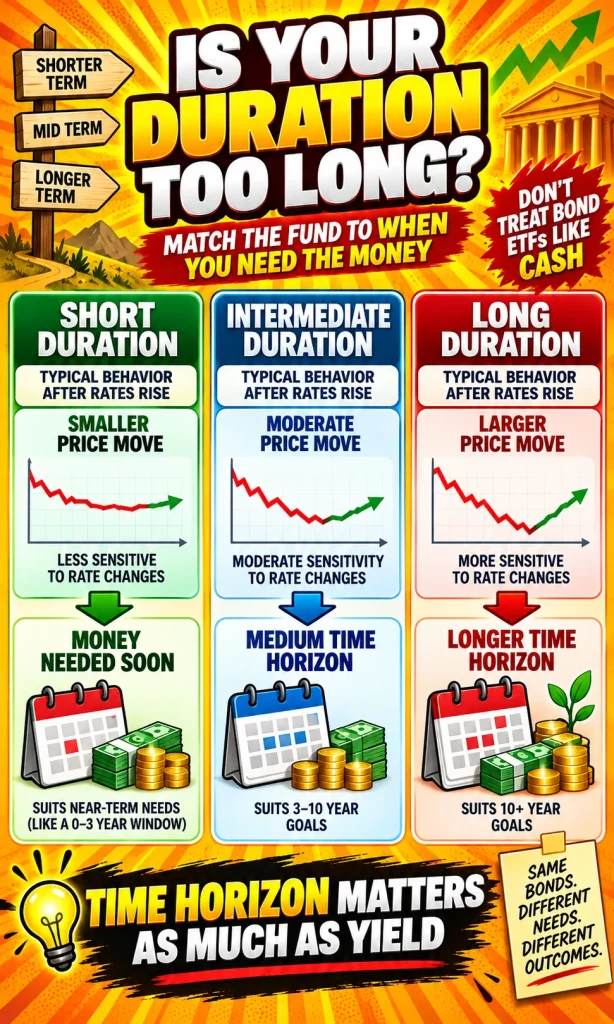
The most useful duration question is not whether a bond ETF is “good” or “bad.” It is whether the amount of interest-rate sensitivity makes sense for the job the money must perform and the time available before that money may be needed. A fund can be perfectly reasonable for a long-term portfolio and still be poorly matched to money earmarked for a near-term purchase.
| Your situation | What deserves attention | Why it matters |
|---|---|---|
| Money may be needed soon | High duration | A rate shock may occur before higher income has enough time to offset the price decline |
| Money has a long investment horizon | Whether duration matches the portfolio role | More holding time allows income and reinvestment to influence total return |
| You want relatively stable capital | Long-duration or lower-quality bond exposure | Interest-rate and credit movements can create more volatility than the word “bond” suggests |
| You expect rates to fall | Duration exposure | Longer duration generally creates greater price sensitivity in both directions |
| You have a known future spending date | Conventional versus target-maturity structure | A defined maturity path may align more naturally with a specific future liability |
The table is not an instruction to replace one type of bond ETF with another. It is a way to expose a mismatch that is easy to overlook when investors choose funds by yield alone. A higher yield can compensate for additional risk, but it does not erase the possibility that the investment may be worth less exactly when the cash is required.
A Five-Step Bond ETF Recovery Check
If your bond ETF has already fallen, diagnose the position before deciding that something has gone wrong. The goal is to separate an ordinary duration-driven decline from credit deterioration, an unsuitable holding period or a misunderstanding of how the fund works. These five checks usually reveal which problem you are actually dealing with.
- Find the fund’s effective duration. Do not assume “short-term,” “intermediate” or “long-term” from the fund name alone. The current duration gives you a much more useful indication of sensitivity to changes in yields.
- Identify what caused the decline. Compare changes in government yields with changes in credit spreads and the fund’s own holdings. A government-bond ETF and a high-yield corporate-bond ETF can fall for very different reasons.
- Look at yield after the decline. A lower NAV following a rate increase is usually accompanied by a higher yield environment. That higher prospective income is part of the recovery mechanism and should not be ignored.
- Decide which recovery measure matters. If you are watching price only, you may miss distributions and reinvestment. If the real concern is whether enough money will be available on a particular date, total value and liquidity matter more than whether the NAV revisits an old high.
- Compare duration with your actual holding period. The fund’s risk should make sense for when the money may be required. A portfolio mismatch matters more than whether the ETF happens to be below its previous price today.
Worked Example: Why the Recovery Clock Can Keep Moving
Consider a simplified bond ETF with an effective duration of five years. If its relevant market yield rises by one percentage point, first-order duration math suggests a price decline of roughly 5%, ignoring convexity and other factors. If yields then stabilize, the investor begins earning from a higher-yielding portfolio, which gradually works against that initial decline.
Now suppose yields rise another percentage point after a year. The investor has collected some higher income, but the fund experiences another negative price adjustment because the market has repriced again. The original five-year recovery intuition did not “fail”; the underlying assumptions changed because the rate shock was no longer a single event.
This is why a recovery estimate should be treated as conditional rather than calendar-based. Every meaningful subsequent movement in yields, credit spreads or portfolio composition can alter the path. Duration gives you a framework for understanding the relationship, not an appointment with a future break-even date.
Why Higher Yield After a Decline Is Not Just a Consolation Prize
When bond prices fall because market yields have risen, the higher yield is part of the mathematical adjustment that made the price fall in the first place. An investor who remains in the fund can therefore experience a less attractive account value immediately but a more attractive stream of prospective income afterward. The two effects should be considered together.
This is one reason rising yields can eventually improve the outlook for long-term bond investors even though the transition is painful. New money enters at more favorable yields, maturing securities can be replaced at higher rates and distributions may be reinvested into lower-priced shares. The benefit is gradual, which makes it psychologically less obvious than the immediate red number created by the original price decline.
When a Falling Bond ETF May Signal More Than Interest-Rate Risk
A large or persistent loss deserves closer inspection when it cannot be explained by ordinary duration sensitivity alone. Credit deterioration, unusually wide spreads, leverage, concentrated holdings, liquidity stress or structural features of a specialized ETF can produce behavior that differs substantially from a plain high-quality bond portfolio. Assuming every bond decline is simply “rates” can therefore hide the risk that actually changed.
| What you observe | Possible explanation | What to inspect |
|---|---|---|
| Fund falls while comparable government yields barely move | Credit-spread widening or security-specific weakness | Credit quality, sector exposure and spread changes |
| Fund moves much more than expected from its duration | Yield-curve movement, credit effects, leverage or other structural factors | Portfolio construction and fund methodology |
| Distribution falls despite stable NAV | Portfolio yield or security mix may have changed | Current yield characteristics and holdings turnover |
| ETF trades unusually far from NAV during stress | Temporary market-liquidity or price-discovery pressure | NAV, bid-ask spread and underlying-market conditions |
The Most Common Bond ETF Recovery Mistakes
Most recovery mistakes come from using the wrong measurement or assuming that a bond fund behaves like an individual bond held to maturity. Correcting these assumptions usually makes the price movement easier to interpret. It also reduces the risk of changing the portfolio for a reason that has little to do with the investor’s actual objective.
- Watching NAV only. A price chart excludes the distributions that form a meaningful part of a bond investment’s return.
- Treating duration as a maturity date. Duration estimates sensitivity and helps frame holding-period risk; it does not tell you when an ETF will terminate.
- Assuming rates moved uniformly. Different points on the yield curve can move differently, so one headline interest rate does not describe the entire bond market.
- Ignoring credit spreads. Corporate bonds can lose value because investors demand more compensation for default risk even when government yields are stable.
- Comparing with an old price high. An old NAV says nothing by itself about the yield available from the position today.
- Buying long duration for short-term money. This turns a normal market fluctuation into a practical problem if the investor is forced to sell before the position has time to work through the shock.
- Assuming a bond ETF is equivalent to cash. Bonds can be lower-risk than equities in many contexts without being immune to meaningful price declines.
Should You Switch to a Shorter-Duration Bond ETF After Rates Rise?
Moving to shorter duration immediately after a large rate increase can reduce sensitivity to another increase in yields, but it also changes the portfolio after the longer-duration position has already absorbed the initial repricing. If yields subsequently fall, the shorter-duration replacement will generally participate less in the price rebound. That makes the decision more complicated than simply choosing whichever fund fell less recently.
The better question is whether the original duration was appropriate before the market moved. If a long-duration fund was being used for money with a short spending horizon, the mismatch may still deserve correction. If the duration was intentionally chosen for a long-term portfolio role, a past loss by itself does not prove that the original role has disappeared.
Short-Duration, Long-Duration and Target-Maturity ETFs Solve Different Problems
These structures should not be ranked as though one is universally superior. Short duration emphasizes lower rate sensitivity and faster reinvestment into current yields, long duration accepts greater price sensitivity in exchange for longer exposure to existing yields, and target-maturity funds gradually move toward a defined endpoint. The right comparison starts with the investor’s job for the money rather than the most recent winner.
| Structure | Main characteristic | Recovery behavior after rates rise | Potential fit |
|---|---|---|---|
| Short-duration ETF | Lower interest-rate sensitivity | Smaller initial rate-driven loss; portfolio resets toward new yields faster | When limiting near-term rate sensitivity is important |
| Long-duration ETF | Greater sensitivity to changes in long-term yields | Larger initial loss from rising yields but larger price response if yields later fall | When substantial duration exposure is intentionally part of the portfolio |
| Target-maturity ETF | Portfolio winds down toward a stated maturity period | Rate sensitivity generally declines as the target date approaches | When an investor wants a bond portfolio linked more closely to a future date |
A Better Way to Think About Bond ETF Recovery
Think of a rate increase as transferring return from the present into the future. The immediate effect is usually negative because existing bonds must reprice downward, while the future effect can become positive because the fund now operates in a higher-yield environment. The investor’s experience depends on whether there is enough time for that future income to matter before the money is needed.
That is also why the same rate increase can be bad news for someone forced to sell next month and potentially constructive for someone continuing to invest over many years. Market prices react immediately, while income is earned gradually. Recovery is the interaction between those two timelines.
Key Takeaways
- There is no single guaranteed bond ETF recovery period. Duration provides a useful framework, but future interest rates, credit spreads, reinvestment and portfolio changes alter the result.
- Price recovery and total-return recovery are different. An ETF does not need to revisit its old NAV for distributions and higher yield to compensate for part or all of a rate-driven decline.
- Longer duration generally means greater rate sensitivity. That increases downside when yields rise and upside sensitivity when yields fall.
- A second rate increase can reset the recovery path. The duration rule works best as a simplified one-shock framework rather than a fixed calendar promise.
- Credit risk can complicate the picture. Corporate-bond ETFs may fall because of wider credit spreads as well as changes in government yields.
- Most conventional bond ETFs do not mature. They continually replace securities and maintain their portfolio role rather than moving steadily toward one redemption date.
- Your holding period matters. A duration profile that is reasonable for long-term money can be unsuitable for cash needed in the near future.
- Diagnose before reacting. Check duration, yield, credit quality, fund structure, total return and time horizon before concluding that a temporary decline means the investment has failed.
Frequently Asked Questions
How long does a bond ETF take to recover after interest rates rise?
There is no guaranteed recovery date, but duration provides a useful rough framework after a one-time rate shock. A fund’s higher yield can gradually offset the initial price decline over a period related to its duration if yields then stabilize, although subsequent rate moves, credit spreads, reinvestment and portfolio changes can shorten or extend that process.
Does a bond ETF eventually recover if I hold it long enough?
A bond ETF can recover from an interest-rate-driven loss through a combination of price changes and higher income, but recovery is not guaranteed simply because time passes. Rates can continue rising, credit conditions can deteriorate and the fund’s portfolio continually changes, so the result should be evaluated through total return rather than an assumed future NAV.
Does duration tell me how many years I need to hold a bond ETF?
Not exactly. Duration estimates how sensitive a bond portfolio is to changes in yields and can also help frame how higher income may offset a one-time rate shock over time. It is not a mandatory holding period, maturity date or guarantee that the fund will break even after a specific number of years.
Why is my bond ETF still down even though interest rates stopped rising?
The ETF may still be below its previous price because higher yields permanently changed the valuation of older bonds, and price recovery does not necessarily occur immediately after yields stabilize. Credit spreads, yield-curve changes and portfolio turnover can also affect NAV, while distributions may already be contributing to total-return recovery even if the price chart remains below its old high.
Can a bond ETF recover without its share price returning to the old high?
Yes. Investors receive distributions in addition to changes in the ETF’s share price, so total return can recover before the quoted price returns to an old peak. Reinvesting those distributions can further change the recovery path because additional shares are purchased and begin producing their own income.
Do bond ETFs mature like individual bonds?
Most conventional bond ETFs do not have one maturity date. They continually buy and sell bonds to maintain the fund’s strategy or maturity range, so an intermediate-term ETF generally remains an intermediate-term ETF instead of becoming progressively shorter until principal is returned. Target-maturity bond ETFs are an important exception because they are designed around a specified future maturity period.
Are short-term bond ETFs safer when interest rates are rising?
Short-duration bond ETFs generally have less price sensitivity to a given change in yields than long-duration funds, so they may experience smaller rate-driven price movements. They still carry risks such as credit, liquidity and reinvestment risk, and reducing duration also means giving up some of the potential price benefit if market yields later decline sharply.
Why can a corporate bond ETF fall when government interest rates are unchanged?
Corporate bonds include credit risk as well as interest-rate risk. If investors become more concerned about defaults or the economy, they may demand a larger credit spread above government yields, which pushes corporate-bond prices lower even without a comparable move in government rates.
Should I sell a bond ETF after interest rates rise?
A rate-driven decline alone does not determine whether selling is appropriate. Check whether the fund’s duration, credit exposure and structure still match the role of the money and when you may need it. Selling after the price decline also ends your participation in the higher-yield environment that follows the repricing, so the decision should be based on portfolio fit rather than the loss alone.