
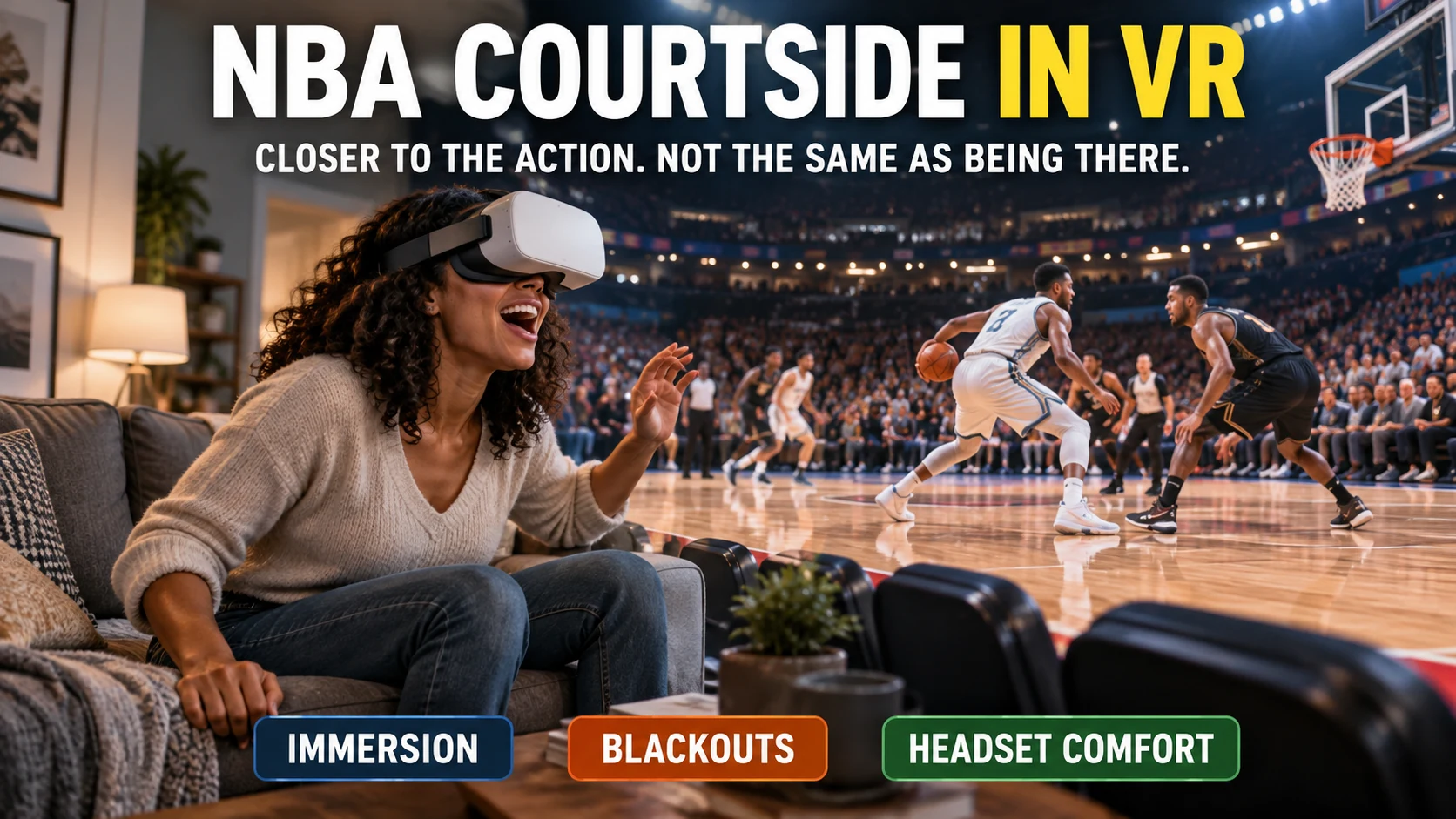

Watching an NBA game from a courtside-style VR feed can feel startlingly close to the action because the camera sits near court level and your head movement changes what you see. It still is not the same as holding a real courtside ticket: picture sharpness, camera placement, blackouts, headset comfort, and the availability of immersive games all shape the experience.
The biggest surprise is not that the players look large. It is that the geometry of the court starts to make sense in a different way: closeouts seem faster, passing lanes feel narrower, and a drive from the wing to the rim occupies much more of your visual field than it does on a television.
That sense of presence is the reason VR basketball can be compelling even when a conventional broadcast is technically sharper. A television gives you a director’s polished overview; courtside VR trades some of that polish for proximity, scale, and the feeling that the play is unfolding in front of your seat.
What “courtside” in VR actually means
A courtside-style VR broadcast is not a free-moving simulation of the arena. You are usually watching video captured from one or more physical camera positions near the court, and the headset lets you look around within that captured view instead of walking anywhere you want.
That distinction matters because two experiences can both be called “NBA in VR” while feeling very different. One can be an immersive 180-degree feed that tries to place you near the floor; another can be a large spatial screen inside a headset, which is useful but feels more like an enormous personal theater than a virtual seat.
The NBA’s current device guidance still lists Meta Quest as its supported virtual-reality platform in the United States. The separate NBA App on Meta Horizon OS supports live and on-demand League Pass viewing, real-time statistics, and Multiview on newer Quest headsets, but those spatial-screen features should not be confused with an immersive courtside camera feed.
| Viewing mode | What you are really getting | Strongest reason to use it | Main limitation |
|---|---|---|---|
| Immersive courtside VR | A near-court video viewpoint that surrounds more of your field of view and responds naturally as you turn your head. | Presence, scale, and proximity to the play. | Only selected games and camera feeds may be offered; picture quality and camera cuts can vary. |
| NBA App on Horizon OS | Live or on-demand League Pass games on spatial screens, with statistics and supported Multiview features. | Flexible personal viewing and multiple information panels. | It can feel like a giant screen rather than a literal courtside seat. |
| Traditional TV or streaming | A director-controlled broadcast with replays, graphics, and familiar camera coverage. | Clarity, comfort, and easy game-long viewing. | Less physical sense of court scale and player proximity. |
Why the court feels faster and more physical in VR
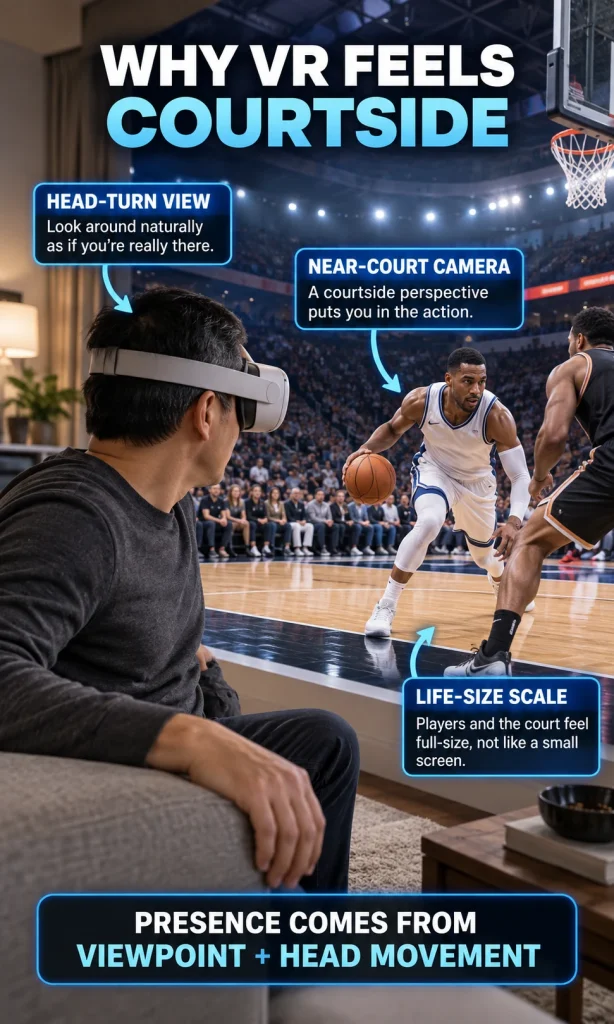
A normal broadcast compresses the court into a rectangle that may occupy only part of your field of view. In immersive VR, the same action can fill much more of what you see, so a defender sliding toward the corner or a center rolling to the rim feels spatially closer and easier to track with your head rather than with a camera operator’s cut.
The camera height is just as important as the width of the image. A lens near table or baseline level changes the apparent size of players, the height of the rim, and the distance across the lane, which is why a basic near-court feed can feel more “present” than a technically perfect high broadcast angle.
This is the same broader principle behind how 3D technology changes depth and presence in gaming: scale becomes convincing when viewpoint, motion, and spatial cues agree with one another. VR sports adds real video to that equation, which makes the illusion powerful even though you remain fixed to a camera position.
VR courtside vs TV vs being in the arena
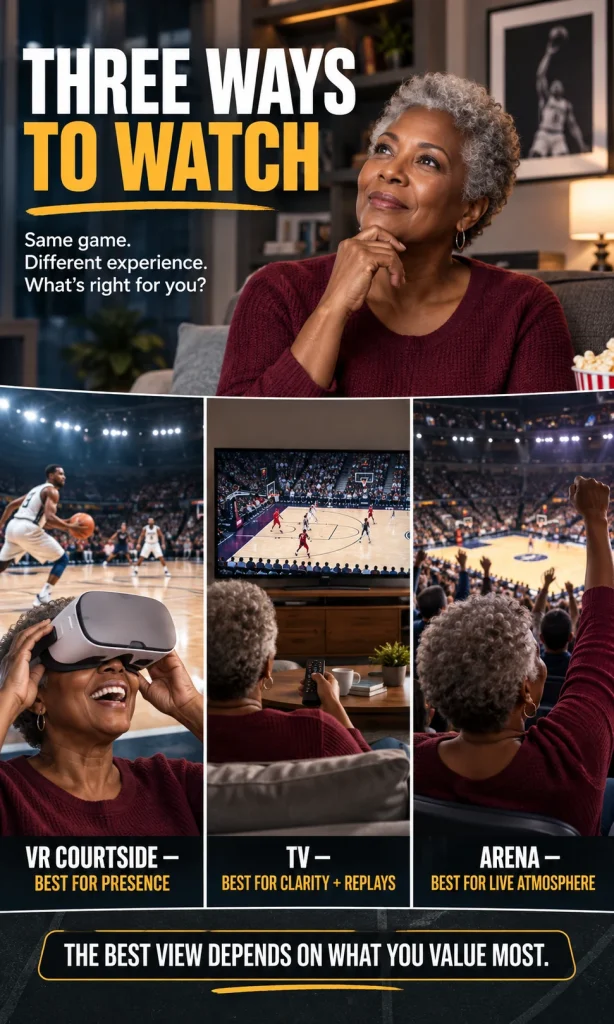
VR does not replace either television or a real seat because each format is good at a different job. If you care most about following tactics, seeing every possession clearly, rewinding a play, and watching for two hours without anything on your face, TV remains extremely efficient.
If you care about presence, VR can do something television cannot: make the court feel physically large and put the action at roughly human scale. If you care about the full arena atmosphere – crowd noise moving through the building, seeing what happens away from the camera, and sharing the moment with thousands of people – the physical venue still has advantages a headset cannot reproduce.
VR also introduces its own compromises. You may notice compression, softer detail, lens glare, headset pressure, or abrupt perspective changes when the production switches cameras; those problems are less important on a TV because your eyes are looking at a stable screen rather than treating the image as the space around you.
The social side can improve the game – or get in the way
Basketball is naturally social, so a shared virtual room can feel more alive than watching alone. Hearing another fan react to a run or a late three-pointer gives the experience some of the spontaneous energy that a silent private screen lacks.
The trade-off is that other people can also become part of the distraction. Voice chat, avatars, movement, and novelty interactions may compete with the game, so the social mode that feels fun during a routine first-quarter stretch can feel irritating during the final possession.
Choose the environment around the way you watch. If conversation is part of the appeal, lean into the shared experience; if you want to study the game, reduce social noise and treat the headset as a viewing device rather than a virtual sports bar.
Current access matters more than the headset spec sheet
The most important pre-game check is not processor speed or display resolution. It is whether the experience you want is actually available for your region, your subscription, and that specific game.
NBA support currently lists Meta Quest VR availability in the United States, and local or national blackouts can still apply to League Pass viewing. That means owning a compatible headset does not guarantee that a particular local matchup will be available in the format you expect.
There is another wrinkle: “NBA in a headset” now includes more than one kind of product. On Quest 3 and Quest 3S, the NBA App on Meta Horizon OS supports up to two Multiview panels, while Multiview is not supported on Quest 2; that feature is useful for following games and statistics, but it is a different promise from an immersive courtside feed.
Game-night decision support
Courtside VR Reality Check
Check access, headset fit, viewing mode and blackout risk before you plan an NBA game night in VR.
Start here
Tell the experience what you actually want to watch.
It will not invent a compatibility score. It uses your answers to separate hard access blockers from checks you can resolve before tip-off.
Your current path
Best route
Must-check before tip-off
What to expect
This experience helps organize access and setup checks. It does not guarantee game availability, remove blackout restrictions, or replace current NBA/Meta listings.
Before tip-off, verify these five things
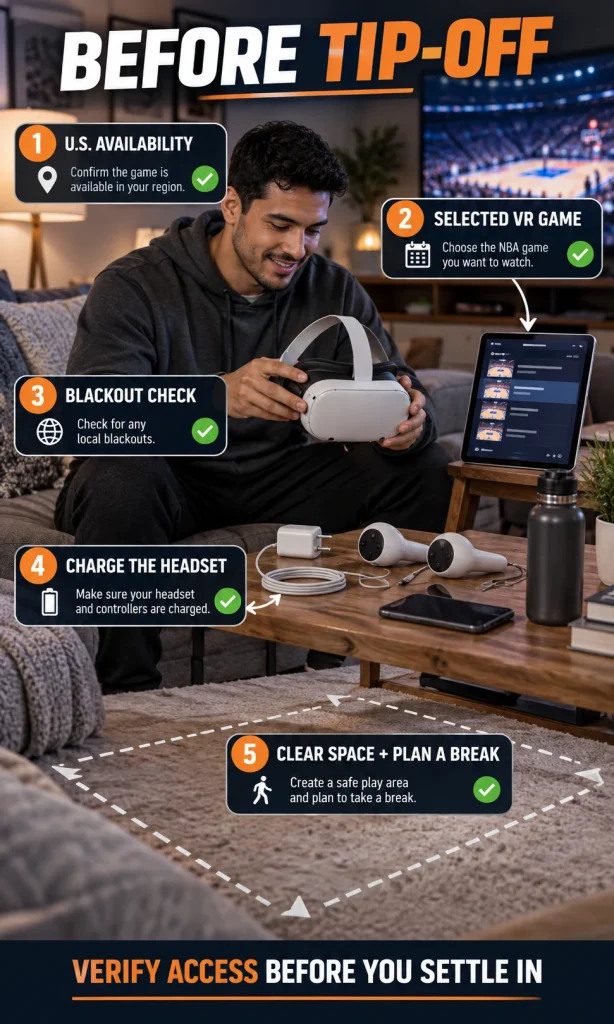
A few minutes of checking can prevent most of the frustration people blame on VR itself. Treat access, battery, comfort, and the game listing as part of the setup rather than discovering a problem after the opening tip.
- Confirm regional availability. The NBA currently lists Meta Quest VR support for the United States, so do not assume a headset bought elsewhere will unlock the same NBA VR options.
- Confirm the exact game and viewing mode. A game available on League Pass is not automatically an immersive 180-degree courtside broadcast.
- Check blackout restrictions. Local and national blackout rules can still affect live viewing, including inside supported headset experiences.
- Charge the headset and controllers. A close game is the worst time to discover that the hardware will not finish the fourth quarter.
- Set up for comfort. Sit where your head can turn freely, keep drinks and obstacles where you will not reach blindly into them, and plan a break if long headset sessions are uncomfortable.
Camera cuts are the hidden difference between “wow” and “wait, what?”
A courtside camera can be thrilling until a coach, referee, or player blocks the lens. Real courtside seats have the same problem, but a VR production cannot leave you staring at someone’s back for every possession, so producers may switch viewpoints.
Those cuts solve one problem and create another. Your brain may be treating the image as a place, then the “place” suddenly jumps several meters because the feed changed cameras; on television that is normal grammar, while in VR it can momentarily break presence.
The best immersive sports production therefore has to balance continuity against visibility. A lower camera gives the strongest sense of scale, but a slightly higher or wider angle may be more useful when bodies at the sideline repeatedly block the action.
Picture quality is not the whole experience
It is easy to compare a headset with a 4K television and conclude that the sharper picture must be the better sports experience. That misses the reason people remember courtside VR: the visual information is distributed around your field of view, and the viewpoint changes the perceived size and speed of the game.
At the same time, the limits are real. Video has to be captured, encoded, streamed, decoded, and then magnified across headset optics, so softness that looks minor on a flat display can become obvious when the image fills your vision.
This is why “more immersive” and “better picture” should be treated as separate questions. A good VR feed can be less crisp than your television and still be more convincing spatially; a poor VR feed can also be immersive in theory and uncomfortable or distracting in practice.
Should you buy a headset just to watch NBA games?
If NBA VR is your only reason for buying a headset, verify the current game slate, your region, and blackout rules before spending money. Immersive broadcasts are selective enough that the safest assumption is not “every League Pass game will feel courtside,” but “some NBA experiences can use VR in a much more immersive way than TV.”
If you already own a compatible Quest headset in a supported market, the threshold is much lower: try an available NBA experience and decide whether presence is worth the trade-offs in comfort and image quality. People who already enjoy VR games may adapt quickly; if you are new to long headset sessions, a shorter trial is a better first test than planning an entire doubleheader.
For a sense of how headset comfort, movement, and immersion change the way a virtual environment feels over a longer session, the site’s VR review of After the Fall is a useful adjacent comparison. A sports broadcast is passive rather than interactive, but the same hardware still sits on your face and still asks your eyes and balance system to accept a virtual space for an extended period.
What has changed since the early “metaverse courtside” era?
The old version of this story centered on Quest 2 and Horizon Venues. The language and products have evolved, but the basic tension has not: VR can deliver a stronger sense of presence than a flat screen while introducing technical and access limitations that a flat screen mostly avoids.
The NBA and Meta have also treated immersive viewing and general VR viewing as related but distinct experiences. In its 2023 partnership announcement, the NBA described a larger slate of VR League Pass games while separately identifying a smaller number of 180-degree immersive broadcasts, which is a useful reminder not to treat every headset stream as “courtside.”
That is the durable lesson for anyone trying the format now. Ask what mode you are actually opening, where the camera sits, whether the game is eligible, and whether you want presence, social viewing, Multiview, or simply the cleanest possible broadcast.
FAQ
Can I watch every NBA game courtside in VR?
No. NBA games that are available through League Pass or a headset app are not automatically immersive courtside broadcasts. Check the current VR listing for the exact game and remember that blackout restrictions can still apply.
Do I need NBA League Pass for NBA VR?
It depends on the experience. The NBA has offered selected VR games and has also integrated League Pass access into headset experiences, so verify the current listing rather than assuming every VR event is either free or subscription-only.
Is NBA VR available outside the United States?
The NBA’s current supported-device guidance lists Meta Quest virtual reality for the United States. Availability can change, so readers outside the U.S. should verify NBA support before buying hardware or a subscription specifically for VR viewing.
Does Quest 2 support the same NBA features as Quest 3 or Quest 3S?
Not all features are identical. NBA support says Multiview on Meta Horizon OS is available with up to two panels on Quest 3 and Quest 3S, while Multiview is not supported on Quest 2.
Is VR basketball sharper than watching on TV?
Usually the advantage is presence rather than raw sharpness. A good television broadcast can look cleaner, while a courtside-style VR feed can make the court and players feel much larger and closer because the view surrounds more of your vision.
Is NBA courtside VR worth trying?
If you already own a compatible headset in a supported region, it is a low-friction way to see whether presence matters more to you than maximum image clarity. If you would need to buy a headset only for NBA VR, confirm the current immersive schedule, regional support, and blackout conditions first.
The bottom line
NBA courtside VR works best when you treat it as a new viewing angle rather than a replacement for television or a real arena seat. The compelling part is spatial presence – feeling the court’s scale and the speed of bodies moving near you – while the practical limits are access, blackouts, image quality, camera continuity, battery, and headset comfort.
For fans who already own compatible hardware, one well-produced immersive game can explain the appeal immediately. For everyone else, the smarter move is to verify the current viewing mode first, because “watching the NBA in a headset” and “sitting courtside in VR” are not always the same thing.