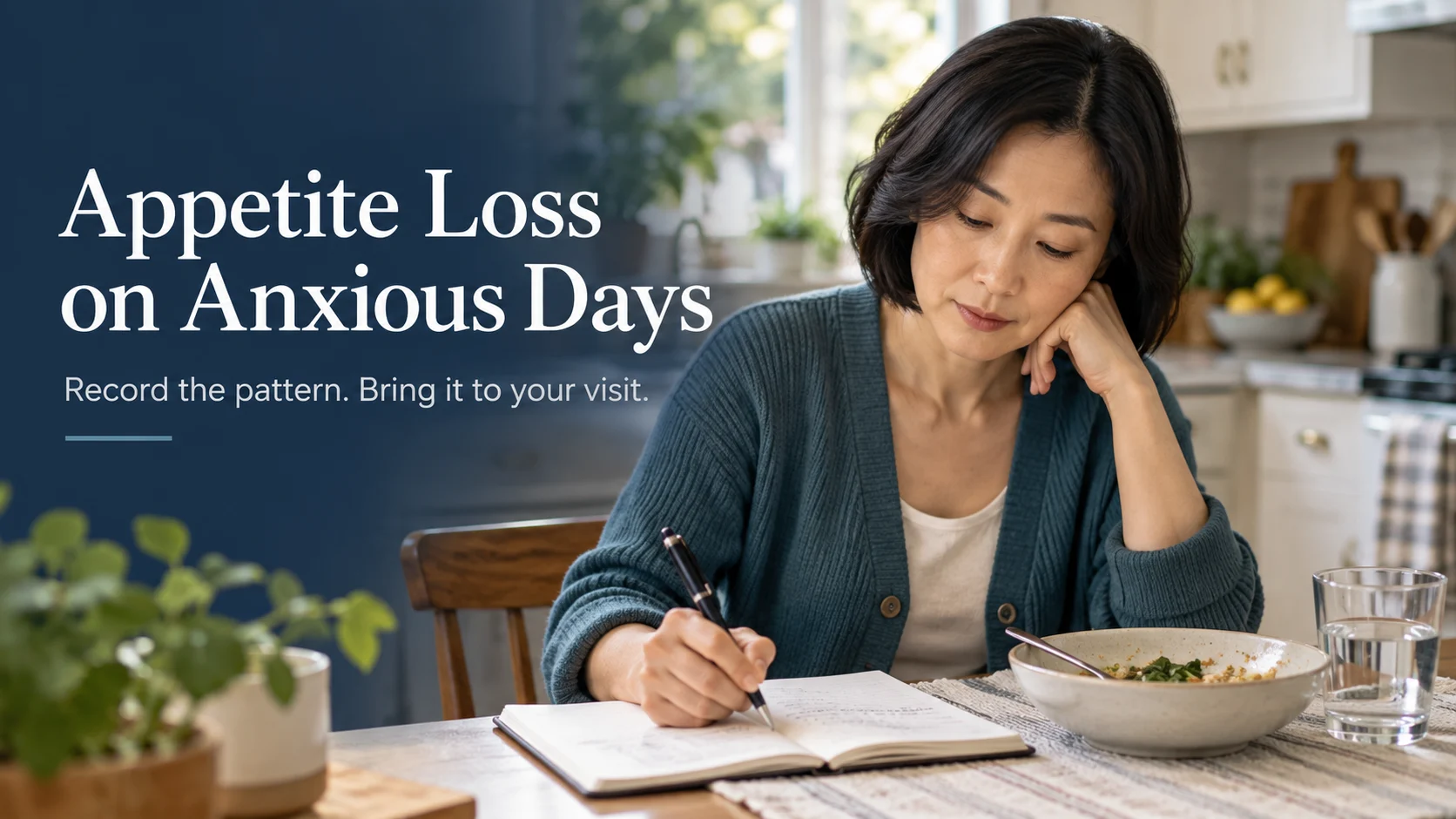

To log appetite loss on anxious days before a doctor visit, write down the time, what was happening, the physical sensation, and what you actually ate or drank. Add whether hunger returned later, along with caffeine and any medicine changes, but do not use the pattern to decide that anxiety caused it. A short record can support the conversation; urgent symptoms or worsening intake need care before the record is complete.
This is an appointment-preparation guide for adults, not a diagnosis, treatment, or nutrition assessment. It cannot tell you whether your intake is adequate or rule out another cause. If you cannot keep fluids down, have trouble swallowing, are losing weight without trying, or feel increasingly unwell, contact a healthcare professional rather than waiting to collect seven days of notes.
What this log is recording
The aim is to describe an eating difficulty clearly enough for a clinician to ask better questions. “I forgot lunch during a busy afternoon” is different from “I wanted lunch, but nausea stopped me after a few bites.” Record both honestly, including an ordinary meal on a calmer day, so the sheet does not contain only the moments you already suspect are anxiety-related.
Appetite loss means reduced interest in eating; it is a symptom, not a diagnosis of anorexia nervosa. Anxiety can include loss of appetite and nausea, but that does not explain every missed meal or early stop. Keep “no hunger cue,” “food felt unpleasant,” and “felt full after starting” as separate observations rather than treating them as the same event.
| What to record | How to write it |
|---|---|
| Date and clock time | Use the time you noticed the difficulty or tried to eat. Mark an estimate as approximate. |
| Situation | Name the event or setting: before a meeting, crowded cafeteria, quiet evening, or no clear trigger. |
| Body signal | Describe nausea, a difficult food smell, throat sensation, dry mouth, or fullness after starting. Report actual swallowing difficulty urgently. |
| Food and fluids taken | Use an ordinary description: some toast, three bites, half a sandwich, water, or nothing at that attempt. Separate food from fluids. |
| Caffeine and medicines | Record the drink, rough amount and time; note new medicines or dose changes. Do not change a prescription to test a theory. |
| Hunger later | Write whether hunger returned, when you noticed it, and whether the situation had changed. Use “not checked” when you do not know. |
Body signal, not just a mood word
“Anxious” explains how the moment felt, but leaves the eating problem unclear. Add the sensation that interrupted the meal: nausea before starting, a smell you could not tolerate, or fullness after a small amount. A sensation of throat tightness should be described plainly; trouble getting food or fluid down, coughing, choking, or food feeling stuck needs medical attention rather than an anxiety label.
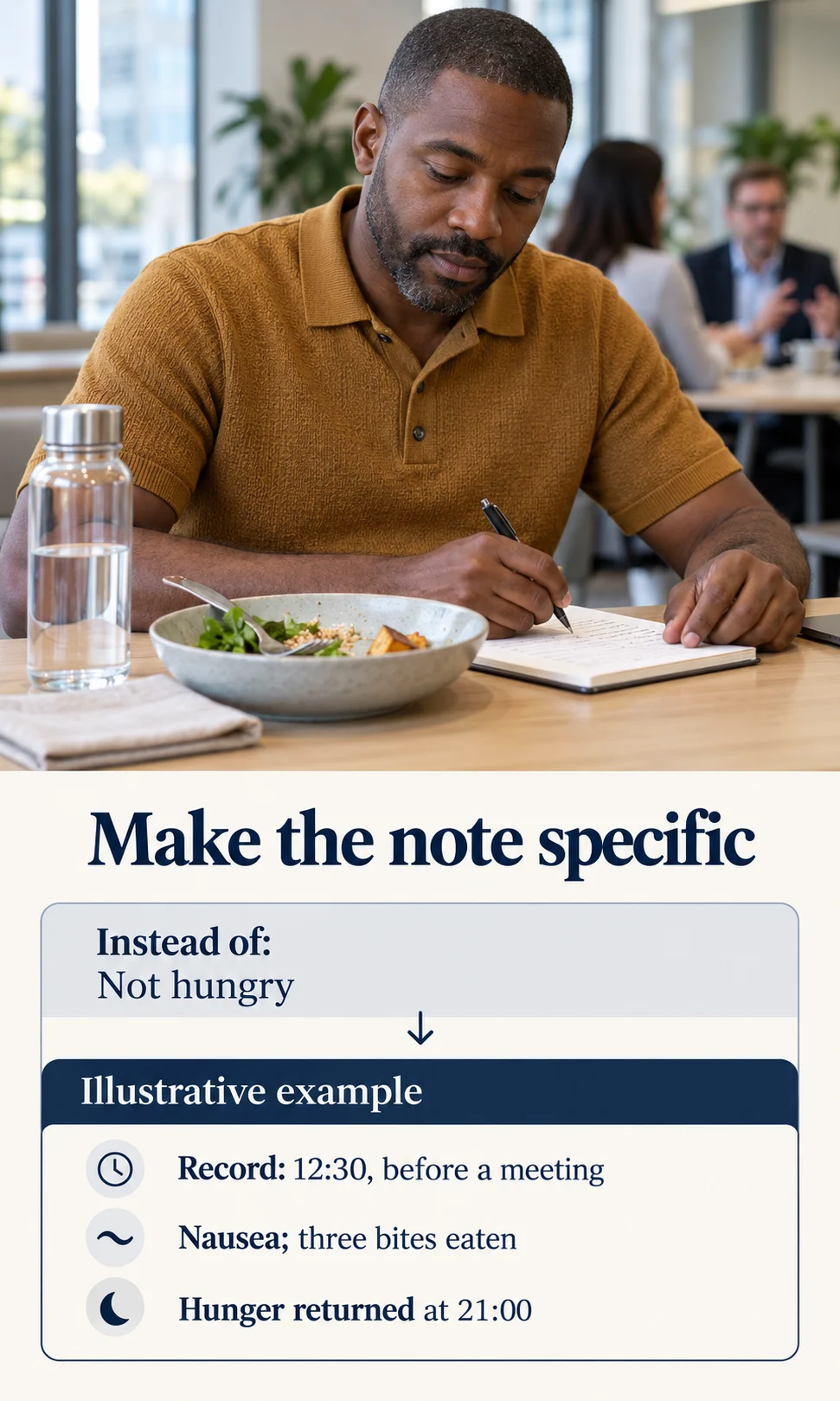
A weak entry reads, “Tuesday: not hungry.” A more useful illustrative entry reads, “Tuesday, 12:30, before a meeting: nausea; ate three bites of lunch and drank water; hunger noticed again at 21:00 after work.” The revised note gives timing and function without claiming a cause, and the bite count is only a remembered description, not a target to monitor obsessively.
A sample week you can copy
The entries below are invented examples, not a patient case or a recommended eating pattern. Each row shows one selected event; it does not describe everything the person ate or drank that day. Your own record should include relevant difficulties and useful comparisons, without copying the sample quantities or assuming the same explanation applies.
| Day / time and setting | Body signal | Food / fluids and context | Hunger later |
|---|---|---|---|
| Monday, 08:00; rushing to work | No hunger cue noticed | Coffee only at that attempt; record drink size and time. No medicine change reported. | Not checked; later intake still needs its own note. |
| Tuesday, 12:30; before a meeting | Nausea | Three bites of lunch; water. Coffee at 08:30. No medicine change reported. | Noticed hunger at 21:00 after work. |
| Wednesday, 13:00; cafeteria | Cooking smell felt difficult | Stopped at the tray; ate some packed food elsewhere. Tea at 09:00. No medicine change reported. | Noticed hunger later; time not recorded. |
| Thursday, 18:30; calm evening | Full after a few bites | Small amount of dinner; water. No caffeine recorded. New medicine started earlier that week; name and date belong in the real log. | Did not notice hunger returning that evening. |
| Friday, 12:00; working through lunch | Forgot / no time | No lunch at that attempt; sandwich later. Coffee at 10:00. No new change reported. | Hungry when work paused at 15:00. |
| Saturday, 09:00; quiet breakfast | No eating difficulty noticed | Usual breakfast and water. No caffeine or medicine change recorded. | Ordinary hunger noticed at lunchtime. |
| Sunday, 19:00; worrying about Monday | Nausea before dinner | Some rice and egg; water. No caffeine recorded. No new medicine change reported. | Not checked before bed. |
Swipe horizontally on small screens to read all columns.
Read this sample as a set of questions, not evidence of a diagnosis. Tuesday suggests asking about eating around stressful events, while Thursday shows that difficulty also occurred during a calm evening. Friday may reflect a practical missed opportunity to eat, and Saturday provides a comparison; none of those rows measures nutritional adequacy or establishes why appetite changed.
Create your own appointment record
Use Appetite Visit Record to add brief entries, correct them, and open a condensed A4 summary. Entries remain only in the open page, so export JSON before leaving if you want to continue later; CSV preserves the detailed record for review. The print summary groups events by date and must be accompanied by the full export or notebook when the clinician needs exact times, amounts, caffeine, or medicine notes.

Appetite Visit Record
Turn eating-event notes into a clear conversation.
Keep brief notes for up to a week if appropriate. Entries stay in this open page only; closing or refreshing loses them. Export JSON to continue later, or export CSV for your clinician. Exported files contain sensitive health notes; store them privately. No entries are sent by this experience.
Record an eating event
A rough description is enough. No calories or exact bite counting required. * Required.
Your appointment summary
No entries yet. The summary describes recorded events only.
Recorded events 0
Up to 21 events across 7 calendar days per record. This is an interface limit, not a recommended meal frequency. Export and start a new record if needed.
| Date / time | Situation / signal | Food / fluids taken | Hunger later / context | Actions |
|---|---|---|---|---|
| Your entries will appear here. | ||||
If tracking increases fear, restriction or compulsive checking, stop and speak to a clinician. Children, pregnancy, diabetes or an eating-disorder history need individual advice. Missing entries do not mean no symptoms, and hunger returning does not rule out illness.
Preparation method: UCLA Health appointment guidance. Symptom and safety references: NHS anxiety symptoms, dehydration and swallowing problems.
What to do when there is no hunger cue
Record that you did not notice hunger, rather than leaving the event blank or writing that you ate nothing all day when you only remember lunchtime. Add what food or fluid you did take later and what remains uncertain. The absence of hunger is not a reason to assume your body needs no nourishment, and a log should never replace an individual eating or hydration plan from your healthcare team.
Keep the record brief enough to use
A short note should support daily life, not turn each mouthful into a test. Approximate descriptions usually communicate the problem better than detailed calorie totals, and a missed entry can simply stay unknown. If recording makes you more fearful of food, encourages restriction, or leads to repeated checking, stop and tell the clinician that tracking itself is becoming difficult.
- Record the event soon afterward when practical; label recalled times as estimates.
- Include a calmer-day comparison if one occurs naturally.
- Keep fluid intake visible instead of burying it under “no appetite.”
- Use “unknown” or “not checked” instead of filling gaps with guesses.
- Export privately and bring the notes you already have; do not postpone an appointment to complete the sheet.
Daytime difficulty versus hunger at night
If eating is difficult during the day but hunger returns in the evening, note both moments separately. Record daytime circumstances, the evening time, and what you could eat once hunger returned. A later appetite may coincide with fewer demands, a different setting, or the effects of a missed meal, but timing alone cannot identify the explanation or diagnose a night-eating condition.
The useful comparison is whether eating difficulty appears around particular events or continues during calm hours too. If your concern includes persistent low mood and missed meals, the related page on depression and not eating addresses that separate subject. Bring both patterns to the appointment rather than using either article to choose between anxiety and depression yourself.
When the smell of food is the stopper
Write down the food, place, and time when a smell made eating difficult, then add whether nausea, fear, or another sensation occurred. If you could eat a different food later, record that too; do not interpret it as proof that the first food was harmful. Smell sensitivity is a description of your experience, and this record cannot show whether anxiety, illness, pregnancy, medicines, or another factor explains it.

A growing list of foods or places you avoid is more useful to mention than a list of foods labelled “safe” and “unsafe.” Tell the clinician if fear of vomiting, choking, contamination, or another consequence is limiting what you eat. Do not use the sheet to carry out an elimination diet or attempt a swallowing or exposure exercise without appropriate professional guidance.
What to hand the clinician
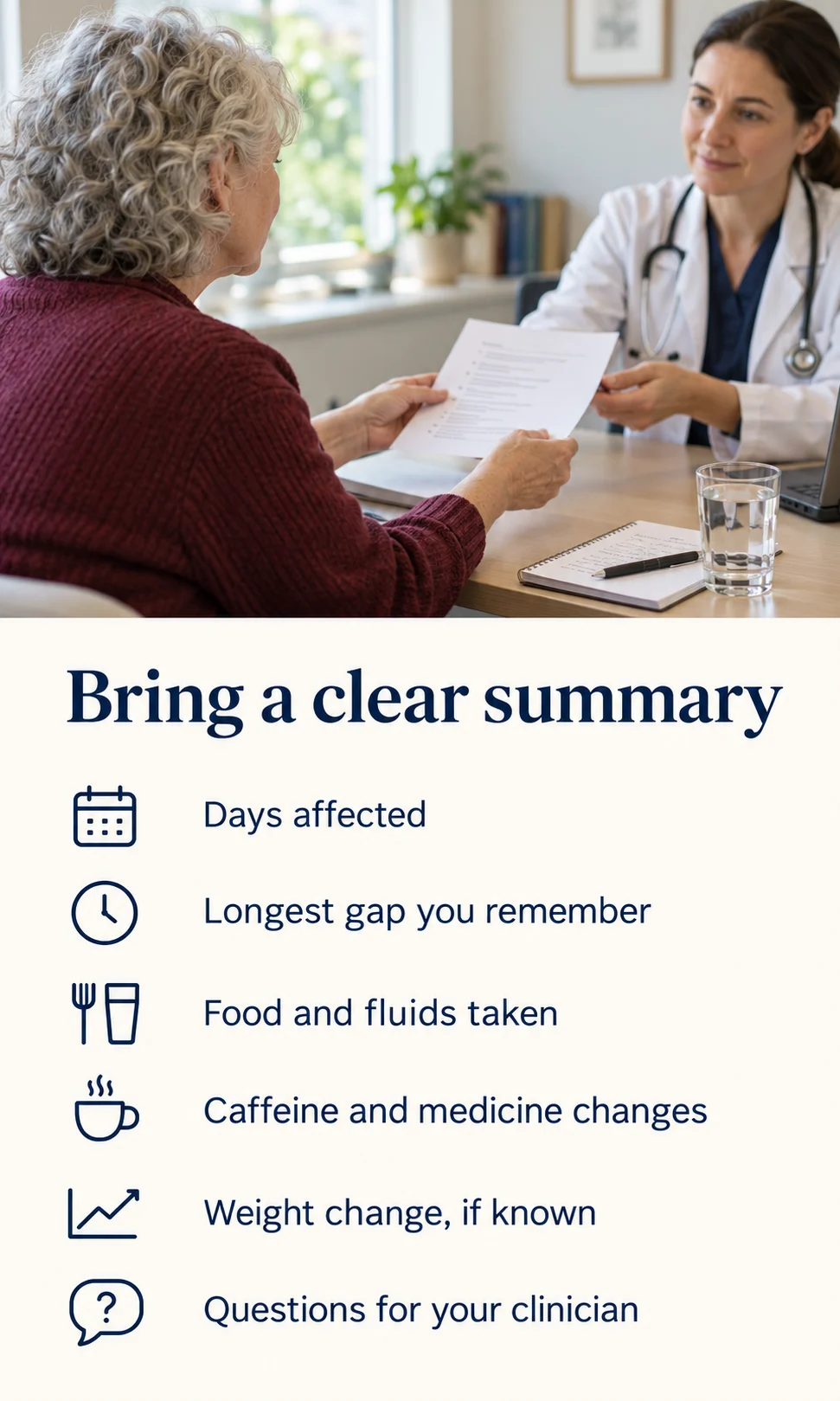
Start the visit with the practical problem: “Eating has become difficult, and this is what I noticed.” Then summarise the dates affected, your longest remembered gap without food, food and fluids on the hardest day, caffeine, any medicine changes, and weight change if already known. Include concerns from days you did not record; the number of recorded dates is not the total number of days you were affected.
Keep one clear question at the end, such as “What should we check, and what should I do if this gets worse?” You do not need to weigh yourself repeatedly or recreate every bite to make the visit worthwhile. Bring your medicine list and the original record, and tell the clinician if appetite changes also involve episodes of eating more, a separate subject covered in depression and eating.
What this record cannot rule out
Appetite changes can have several causes, and more than one may be present. A clinician may need to review mood, medicines, other symptoms, and your medical history rather than treating an event-linked pattern as conclusive. Low intake on calm days, persistent fullness, or a symptom that began after a medicine change should be included even when it does not fit your original anxiety explanation.
This adult preparation sheet is not designed to manage eating problems in children, pregnancy, diabetes, or an eating-disorder history. Those circumstances need individual advice, especially if eating or drinking is becoming harder. Do not stop a medicine, change its dose, or delay care while trying to make the log establish a cause.
When to stop logging and get help
- Emergency help: sudden or persistent chest pain, breathing difficulty, fainting, vomiting blood with feeling unwell, or immediate danger from self-harm should take priority over the record. Use your local emergency service.
- Urgent medical advice: swallowing difficulty, choking with food or drink, fluids that will not stay down, markedly reduced urine, or persistent dizziness need prompt assessment. Do not wait for a full day or a complete week.
- Contact a clinician promptly: weight falling without trying, recurring eating difficulty, very little food over a day, or an increasingly restricted food list warrants advice; seek help sooner if you feel unwell.
- Mental-health crisis: in the US, call or text 988 for suicidal thoughts or crisis support. Elsewhere use your local crisis service; immediate danger requires emergency help.
A week is a convenient preparation window, not a requirement and not a safe waiting period. Bring two days of notes if that is what you have, or attend with no log at all when care is needed. Unintentional weight loss needs medical review, and a later return of hunger does not remove that concern.
Frequently asked questions
Can anxiety cause loss of appetite?
Yes, appetite loss and nausea can occur with anxiety. That association does not establish the cause of your own symptoms. Record what happened and seek assessment for persistent, worsening, or concerning changes.
Why does food smell too strong when I am anxious?
This log cannot explain a change in how you experience food smells. Note the food, setting, timing, and any nausea or fear, including whether it happens when you feel calm. Mention a new or persistent change, or a shrinking food list, to a healthcare professional.
Why can I eat at night but not during the day?
The difference is a useful observation, but it does not identify a diagnosis. Record daytime eating attempts and the later return of hunger separately, including context and intake. Tell the clinician if the difficulty also happens during calm periods or you are losing weight.
Why do I feel full after a few bites?
Fullness after a small amount is different from not feeling hungry before starting. Note when fullness began, roughly what you ate, and any accompanying symptoms without trying to determine the cause yourself. Persistent or worsening early fullness, especially with weight loss, needs medical review.
How many days should I track before the visit?
About a week can provide useful examples if tracking is appropriate, but you do not need seven completed days. Bring whatever notes you have and do not delay an appointment to finish. Urgent symptoms, worsening intake, or distress from tracking are reasons to seek help rather than collect more entries.
How is this different from a depression skipped-meal log?
This record focuses on eating events, physical sensations, and whether hunger changes later around the situation. A depression-focused diary may place more emphasis on low mood, motivation, routines, and missed meals across the day. The distinction helps organise a conversation; it cannot separate or diagnose conditions that can occur together.
Bring observations, not a verdict
The most useful record explains what changed, how it affected eating or drinking, and what you want help with. It does not need to prove anxiety caused the problem or demonstrate that you tracked everything perfectly. Take the brief summary and the detailed notes to the visit, and let your clinician decide what assessment and support fit your circumstances.
References for preparation and symptom checks
- UCLA Health: preparing measurable notes for a mental-health conversation.
- NIMH: generalized anxiety symptoms, assessment and crisis support.
- Cleveland Clinic: appetite loss as a symptom with multiple possible causes.
- NHS: dehydration warning signs and swallowing difficulty.
- NHS: chest pain and vomiting blood.