To handle depression day to day, choose one small action that matches the difficulty in front of you: starting a task, answering self-criticism or reaching out. Self-help can support treatment, but persistent, worsening or disabling symptoms deserve professional assessment. Begin with the smallest useful step, and let safety take priority over any exercise.
Choose a starting point for today
| What is blocking you? | Try first | Smallest useful version |
|---|---|---|
| An ordinary task feels impossible | One clearly bounded task | Place one cup by the sink |
| One mistake becomes “I am useless” | Check one thought against facts | Name it as a thought |
| You are withdrawing from people | One safe check-in request | Draft the message |
| Symptoms are disabling or safety is at risk | Assessment or urgent help | Ask for help accessing care |
The right starting point depends on what is difficult now, not on how productive you think you should be. A task exercise will not resolve unsafe circumstances, and a balanced thought will not remove a medical need. Choose one suitable action; completing every option is not the goal.
Use the Next Step Studio
Select your immediate difficulty and the effort that feels manageable. The Studio returns the matching practice, an illustrative example, an easier version and a next action, with assessment or urgent-support guidance where relevant. Your answers remain in the page, and the experience does not diagnose depression or measure recovery.
Next Step Studio
Choose what is difficult right now. Get a practice you can try at your own pace.
Educational support only. This is not a diagnosis, crisis assessment or treatment. Your answers stay in this page; they are not saved by this experience.
Your next step
Choose your options and select Show my next step. Manual instructions remain available below and in the article.
Manual instructions — available without JavaScript
Start one small task
- Choose one concrete action, such as washing one cup. Leave the rest of the kitchen outside this task.
- Set a timer for up to five minutes. A shorter attempt is fine; five minutes is a limit for this example, not a minimum.
- Begin the chosen action. When the timer ends, pause and choose whether to stop or continue within your energy.
Easier: Place the cup by the sink, or ask someone to sit nearby while you start.
Completion: You attempted the chosen starting action. Finishing the whole chore or feeling happier is not required.
Next: Repeat the same small step if it was manageable. If it was too demanding, shrink it again or ask for practical support.
Answer self-criticism
- Catch one specific thought: “I missed one email. I am useless.” You can do this silently; no journal is required.
- Check what is actually known. One email is late; other tasks got done. Ask whether the thought describes an event or makes a sweeping judgment about your worth.
- Try a fairer sentence: “I am struggling. One delay does not define me.” It can be neutral rather than cheerful.
Easier: Say, “I am having the thought that I am useless.” Naming the thought is a smaller starting point; checking it can wait.
Completion: You caught the thought and attempted a balanced response, or practised the easier naming step.
Next: Use the same sequence when that thought returns. If it becomes a tiring mental argument, pause and discuss the pattern with a therapist.
Make one small contact
- Choose someone who feels safe and respectful. A trusted friend, relative or member of your care team may fit; you do not need to contact someone who mistreats you.
- Make one small, specific request: “Having a hard day. Could you check in later?” You can ask for a short call, company or help with a practical task.
- Send the message, then pause. A delayed reply does not tell you what the person thinks of you.
Easier: Draft the message without sending, or ask a trusted person to help you send it. Supported contact is still a useful attempt.
Completion: You made one contact attempt, or completed the smaller supported or draft step.
Next: If the person is unavailable, choose another safe contact or a professional service. Use urgent help directly when safety is at risk; do not rely on a friend’s reply.
Find and compare local professional support
Where: enter a city or postcode. Who: start with primary care if unsure; a qualified mental-health professional can assess depression and teach psychological skills. Which one: compare credentials, depression experience, availability, fees and urgent-care arrangements.
| Service | Credentials and experience | Availability and fees | Urgent-care arrangements |
|---|---|---|---|
This page does not save comparison entries. These searches send the location you enter to Google only when you open a search link; they are not a crisis service.
The manual instructions below provide the same skills if the experience does not load. You do not need an account, a mood score or a diary to practise them. Completing a step means making the attempt, even when your feelings stay the same.
Why does depression make starting a task so difficult?
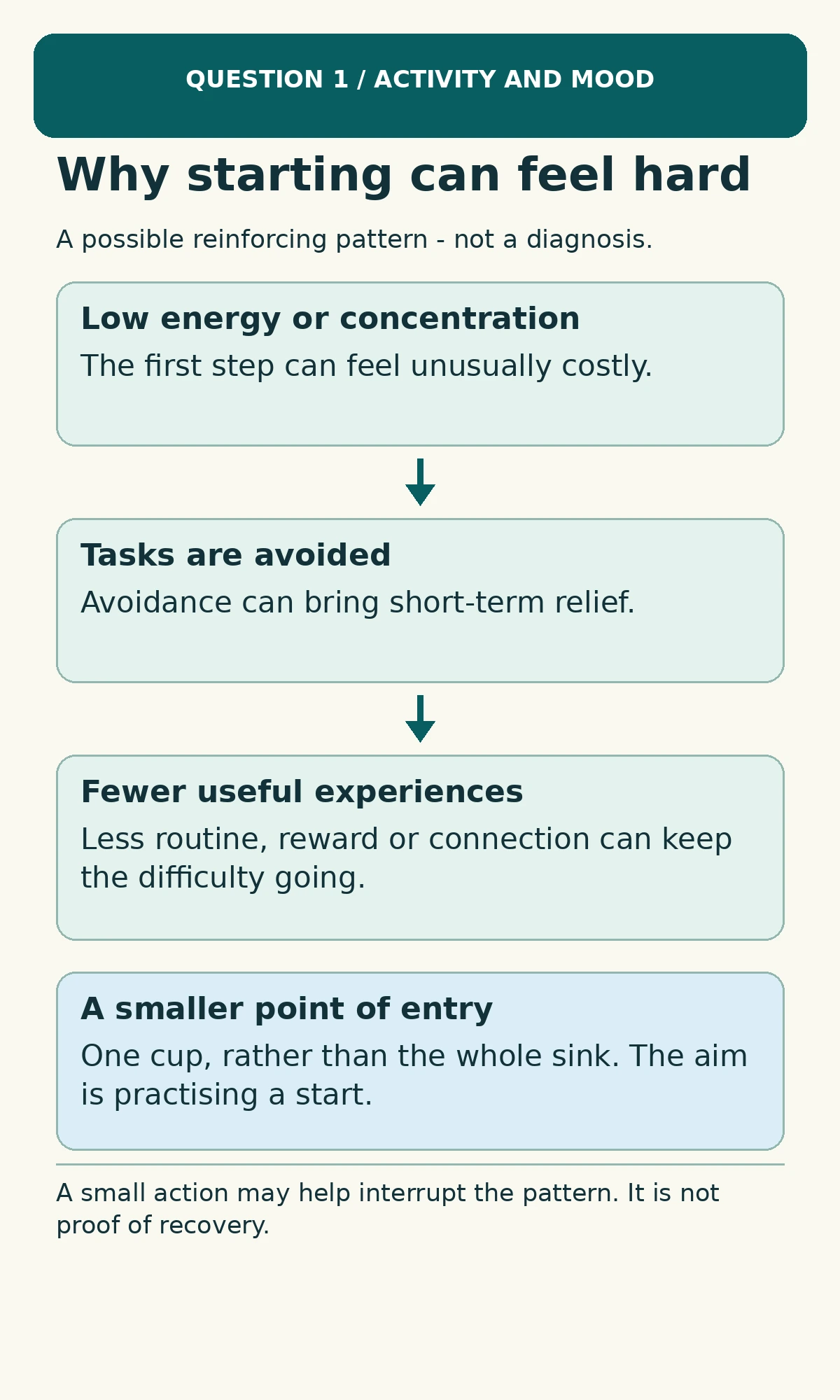
Depression can reduce energy, concentration and the sense that an activity will be rewarding, so the first step can feel disproportionately difficult. Shrinking the task reduces what you are asking yourself to begin. It does not establish why you are exhausted or mean you should push through pain or substantial fatigue.
Avoiding a task may reduce pressure in the moment, but repeated avoidance can leave fewer opportunities for routine, accomplishment or connection. That can make a difficult day harder to shift, although this pattern does not explain every person’s symptoms. The diagram shows a possible behavioural loop, not a complete biological explanation of depression.
When starting feels impossible: shrink one task
Try a starting action so small that you can see where it begins and ends. You need one chosen object or task and, if useful, a phone or kitchen timer. The five-minute limit below is an upper commitment for this example, not a minimum you have to endure.
- Choose one concrete action, such as washing one cup. Leave the rest of the kitchen outside this task.
- Set a timer for up to five minutes. A shorter attempt is fine; five minutes is a limit for this example, not a minimum.
- Begin the chosen action. When the timer ends, pause and choose whether to stop or continue within your energy.
Illustrative example: Alex sees a full sink and cannot begin. Alex selects one cup, sets a five-minute timer and washes that cup. The remaining dishes can wait; starting the chosen task is the completed practice.
- Easier option: Place the cup by the sink, or ask someone to sit nearby while you start.
- Completion: You attempted the chosen starting action. Finishing the whole chore or feeling happier is not required.
- Next action: Repeat the same small step if it was manageable. If it was too demanding, shrink it again or ask for practical support.
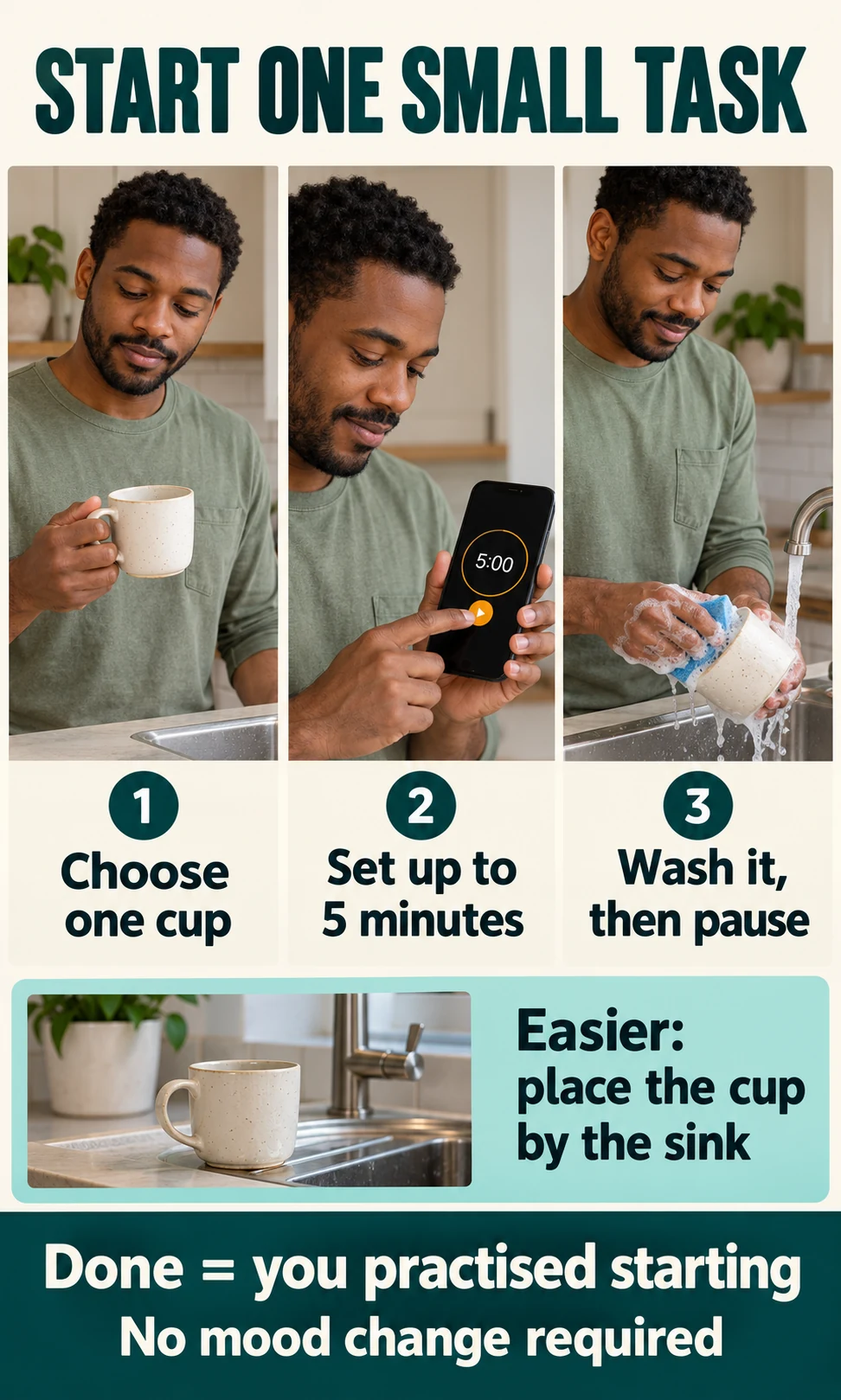
The short-timer approach makes the initial commitment more manageable. The one-cup task is an editorial example, and its smaller fallback is not a separately validated treatment protocol. A therapist-guided behavioural activation programme involves more than a timer: it considers activity patterns, meaningful goals and barriers over time.
A useful checkpoint is whether the chosen action was manageable, rather than whether it instantly lifted your mood. If you started but became depleted, stop and make the next attempt smaller or seek support. For the fuller method and how activity patterns are assessed, see behavioral activation for depression.
How can I answer self-criticism without forcing positive thoughts?
Answer self-criticism by separating a specific event from a sweeping judgment about your identity. You can acknowledge that a task is late without accepting that you are worthless. A balanced response should be believable and fair; it does not have to sound positive.
Thoughts, feelings and behaviour can affect one another, so a global self-judgment may add distress and make the next action harder. The observable fact and the interpretation are different parts of the situation. Checking the interpretation creates room for another response, while the practical problem can still need attention.

When self-criticism takes over: try a fairer response
Work with one specific thought, rather than putting your entire life on trial. You can practise silently or say the sentences aloud; writing is optional. If checking evidence becomes a tiring mental argument, pause rather than forcing yourself to finish.
- Catch one specific thought: “I missed one email. I am useless.” You can do this silently; no journal is required.
- Check what is actually known. One email is late; other tasks got done. Ask whether the thought describes an event or makes a sweeping judgment about your worth.
- Try a fairer sentence: “I am struggling. One delay does not define me.” It can be neutral rather than cheerful.
Illustrative example: Mei notices the late email and immediately judges herself. Checking the facts separates the delayed task from her identity. Mei practises the balanced sentence once; she does not have to believe it completely for the exercise to count.
- Easier option: Say, “I am having the thought that I am useless.” Naming the thought is a smaller starting point; checking it can wait.
- Completion: You caught the thought and attempted a balanced response, or practised the easier naming step.
- Next action: Use the same sequence when that thought returns. If it becomes a tiring mental argument, pause and discuss the pattern with a therapist.
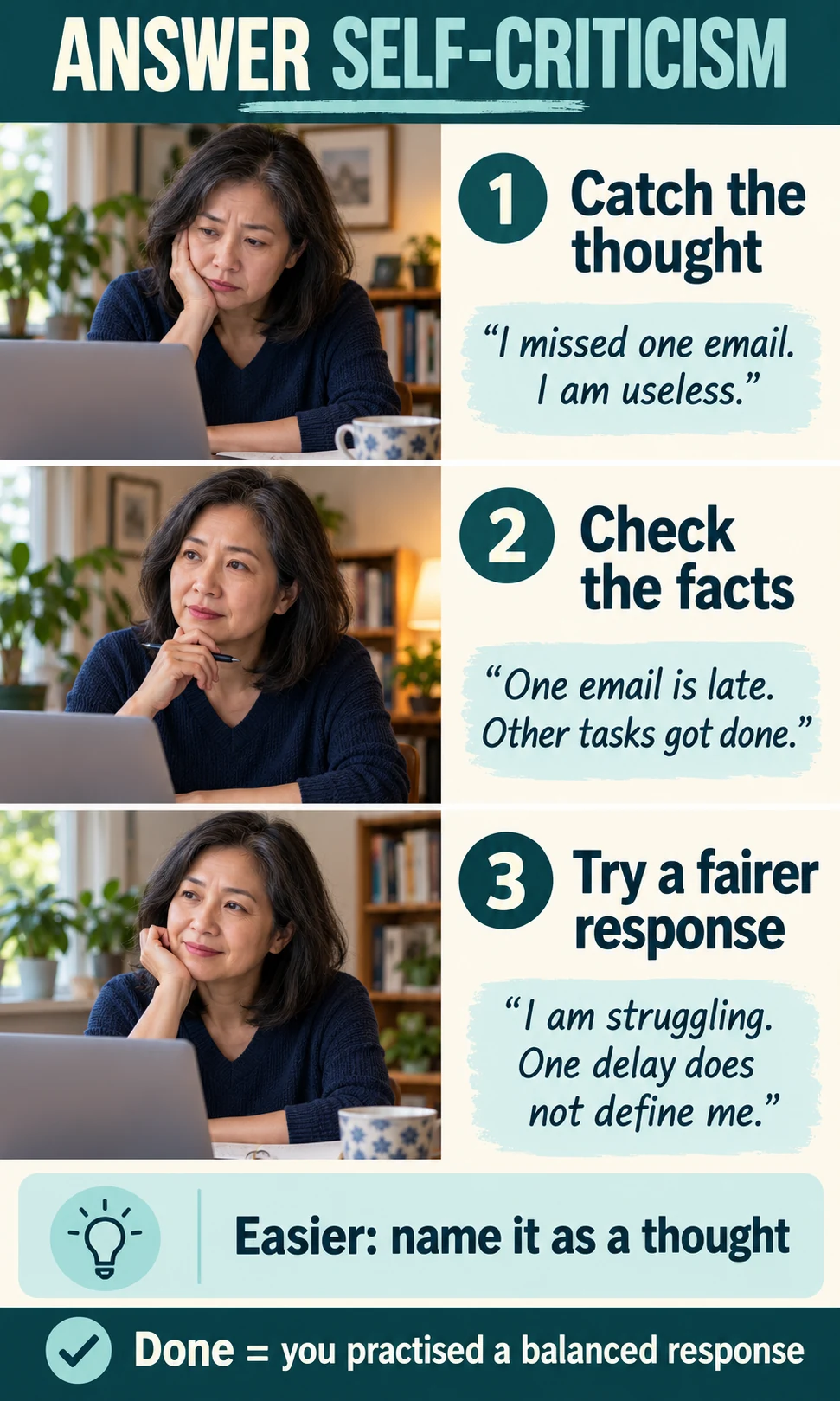
Checking evidence and trying a neutral alternative is a CBT-based self-help approach. It is intended to make thinking more flexible, not to prove that every upsetting thought is false. The late-email example illustrates the method; it is not a clinical case or evidence that one reframe treats depression.
If a thought concerns real abuse, discrimination or danger, practical protection and support matter too. Reframing should not turn a harmful situation into something you are told to accept. When the pattern is repeated self-judgment, how to stop negative self-talk provides a more focused next answer.
What can I do when depression makes me withdraw from people?
Make one small contact with someone safe, using a request that does not require a long explanation. Asking for a brief check-in is often more manageable than arranging a demanding social event. The attempt can count even if the other person cannot reply immediately.
Low energy, reduced enjoyment and fears about being a burden can make conversation feel costly. Less contact may then mean fewer chances for company or practical help, although the relationship between isolation and depression can run in both directions. The aim here is to make one form of support more accessible, not to assume that socialising always improves mood.
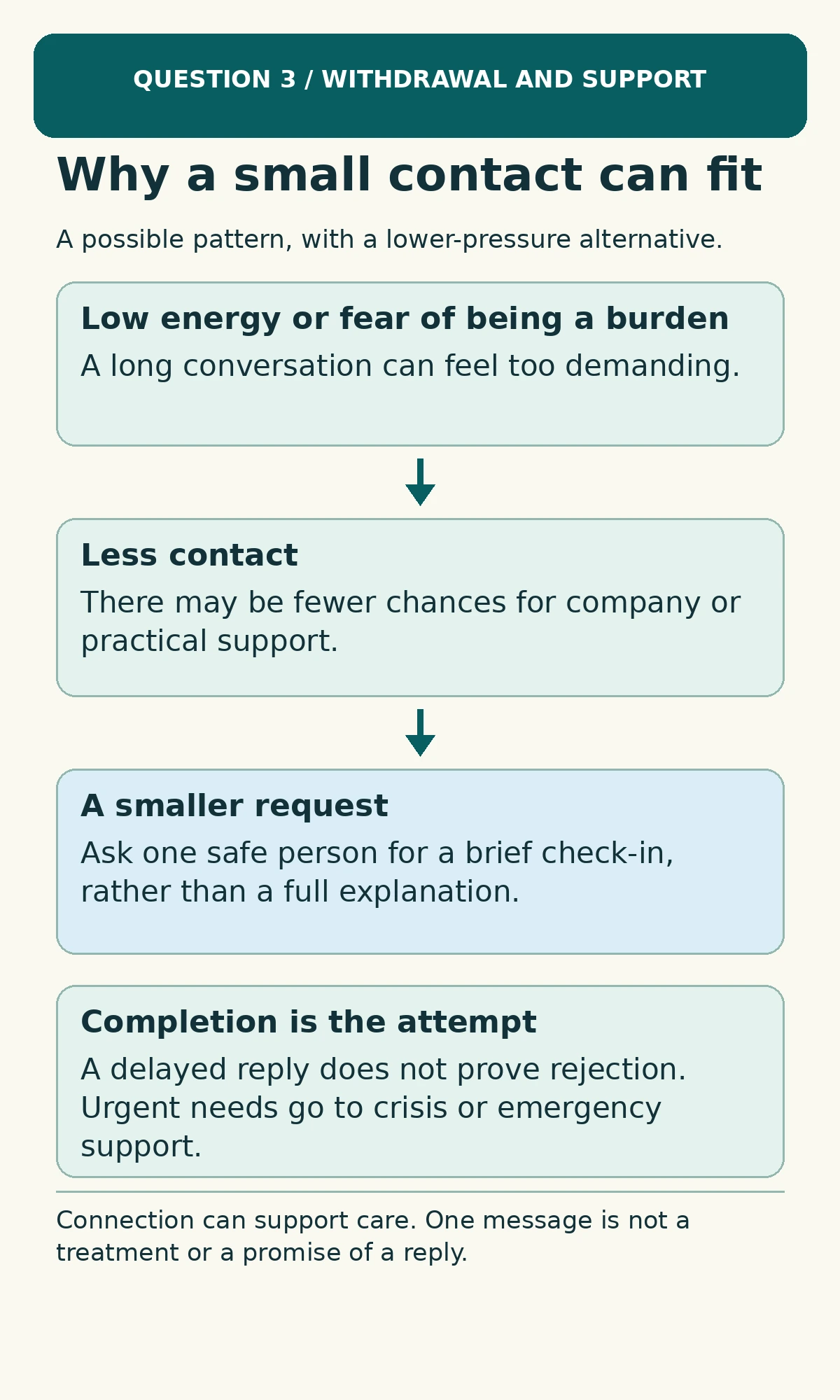
When you withdraw from others: make one small contact
Use a safe person and a specific request, rather than trying to explain everything at once. A trusted friend, relative or member of your care team may fit. Contact someone who respects your boundaries; connection is not a reason to return to an abusive or unsafe relationship.
- Choose someone who feels safe and respectful. A trusted friend, relative or member of your care team may fit; you do not need to contact someone who mistreats you.
- Make one small, specific request: “Having a hard day. Could you check in later?” You can ask for a short call, company or help with a practical task.
- Send the message, then pause. A delayed reply does not tell you what the person thinks of you.
Illustrative example: Rafael has been avoiding conversation because a long explanation feels impossible. He sends a trusted friend the check-in request above. He has made one contact attempt, even if the friend cannot answer immediately.
- Easier option: Draft the message without sending, or ask a trusted person to help you send it. Supported contact is still a useful attempt.
- Completion: You made one contact attempt, or completed the smaller supported or draft step.
- Next action: If the person is unavailable, choose another safe contact or a professional service. Use urgent help directly when safety is at risk; do not rely on a friend’s reply.
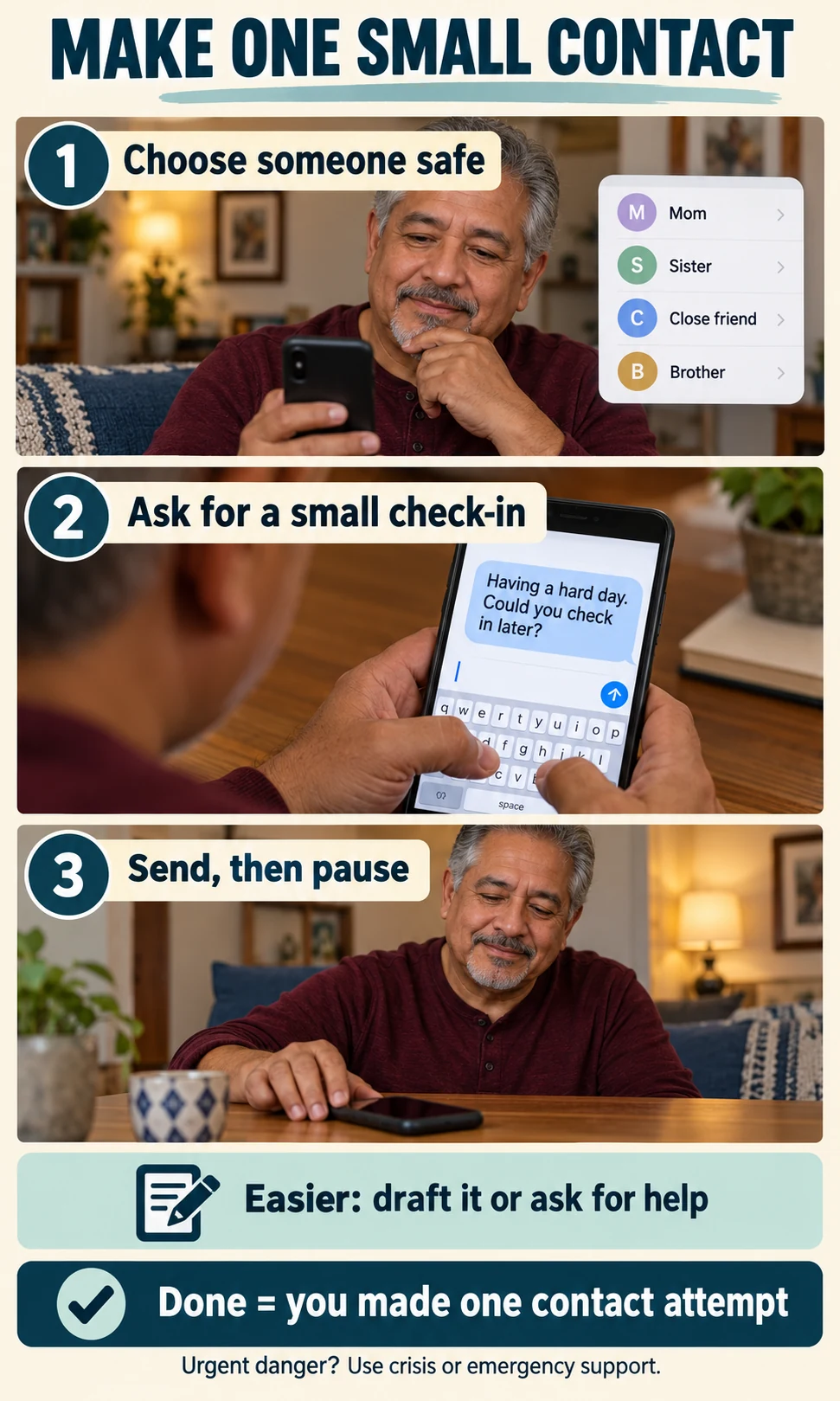
Staying connected and talking to someone trusted are part of recommended depression self-care. The specific check-in message is an editorial adaptation of that guidance, with no guaranteed response or treatment effect. A trusted contact can offer company or practical assistance, but a personal message should not be the only route used in an urgent situation.
If that person is unavailable, another safe contact or a professional service may be a better fit. There is no requirement to make a larger request or attend a group when that feels unsuitable. To understand the wider pattern and its relationship to low mood, see social withdrawal and depression.
When is professional help more useful than another coping exercise?
Professional assessment becomes the more useful next step when symptoms persist, worsen or interfere with daily functioning, and urgent help takes priority when safety or basic medical needs are at risk. You do not have to complete a self-help checklist before asking for care. Symptoms that are severe today deserve attention today.
A short exercise addresses one part of daily life, while an assessment considers symptom patterns, functioning, medical circumstances and treatment options together. A clinician may consider physical conditions or medicines that can resemble or contribute to depressive symptoms. The care diagram uses these differences to explain the next action; it is not a diagnostic test or a severity calculator.
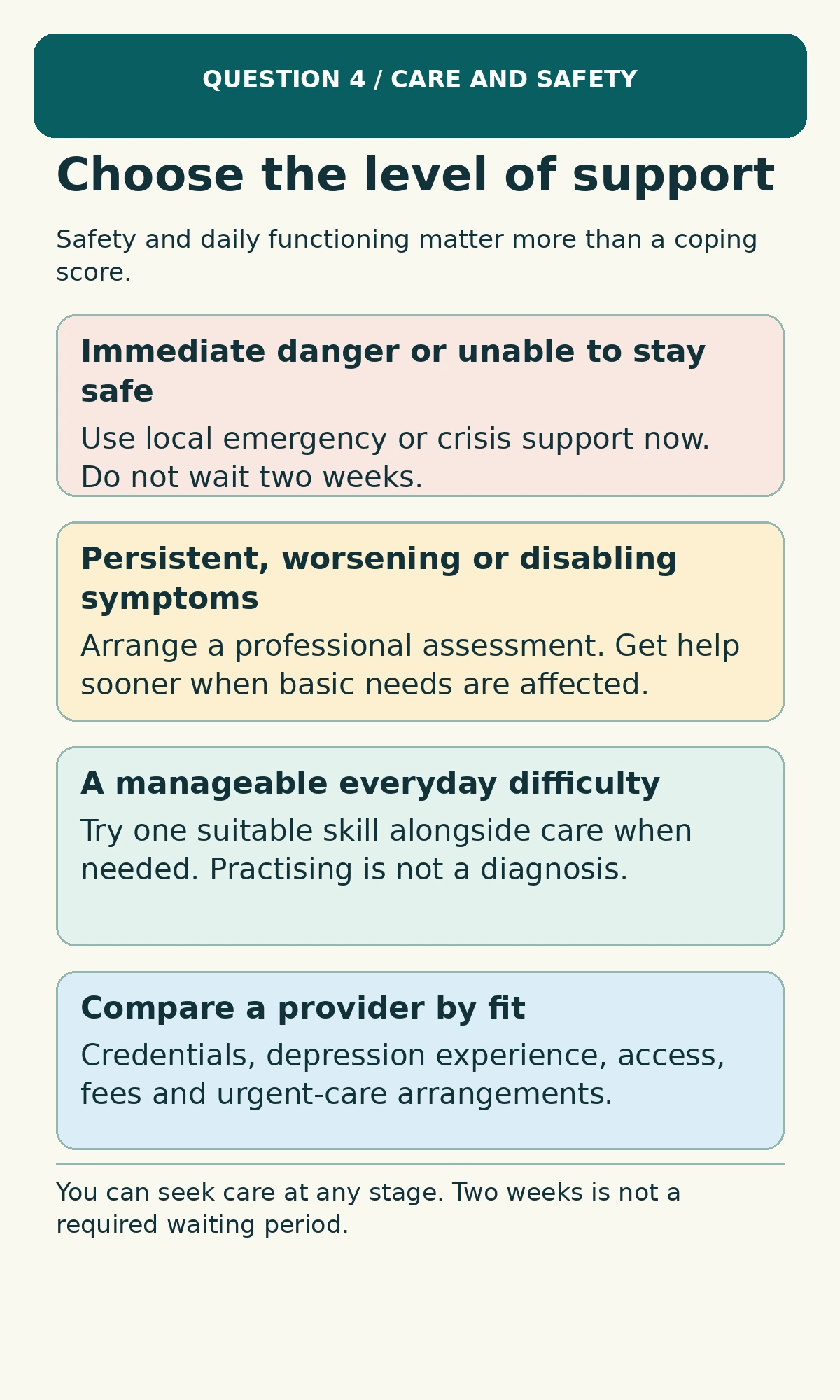
| Situation | Why another exercise may be insufficient | Useful next action |
|---|---|---|
| Ongoing symptoms affecting work, relationships or self-care | The pattern and its causes need assessment | Contact primary care or a qualified mental-health professional |
| Very little sleep with unusually high energy or risky behaviour | A history of elevated mood can change assessment and treatment | Seek prompt clinical assessment and describe both low and elevated periods |
| Serious inability to eat or drink, or rapid deterioration | Basic medical needs may be affected | Seek urgent medical advice or emergency help according to the situation |
| Immediate danger or inability to stay safe | Safety takes priority over coping practice | Use local emergency or crisis support now |
The two-week symptom benchmark helps identify a reason to seek assessment, but it is not a waiting rule. A diagnosis depends on the wider symptom picture, and severe, worsening or unsafe symptoms should prompt help sooner. An illustrative example is someone whose low mood is disrupting meals and work: arranging assessment is appropriate even while using a small task for day-to-day support.
Choose care according to the question you need answered
Primary care is a reasonable entry point if you are unsure whether symptoms are depression, another health problem or a combination. A qualified therapist can offer structured psychological treatment, while a psychiatrist can assess complex presentations and medication needs. Local roles and referral pathways differ, so verify the service’s credentials and scope rather than relying on a rating alone.
- Credentials and scope: Is the provider appropriately qualified or registered where you live?
- Fit: Do they work with depression and your relevant circumstances?
- Access: What are the fees, waiting times and appointment options?
- Urgent concerns: What should you do if symptoms worsen before the appointment?
Depression treatment may include psychotherapy, medication or both, based on needs, preferences and medical circumstances. The treatment options include structured therapies such as CBT and behavioural activation; the brief practices here are not equivalent to those full programmes. Discuss medicine changes with the prescriber, and use the broader depression guide if you need the symptom-and-treatment overview.
Frequently asked questions
What if I try a coping step and still feel depressed?
A practice can count even when your mood does not change. Immediate relief is not a reliable completion test, and one attempt does not measure recovery. Repeat, simplify or seek support according to what was manageable.
Do I need a mood diary to use these methods?
No diary is required for the three practices in this article. A record can be useful when it informs a specific clinical or practical decision. Recording alone is not the same as practising a coping skill.
Can exercise replace depression treatment?
Physical activity can support mental health and may form part of a treatment plan. Its role depends on symptoms, health circumstances and preferences. A blanket claim that exercise replaces psychotherapy or medication is misleading.
Should I stop medication if self-help starts working?
Discuss any medication change with your prescriber. Feeling better after a practice does not show that treatment is no longer needed. Stopping suddenly can create withdrawal symptoms or other problems.
Can a friend’s slow reply mean that I am a burden?
A slow reply does not establish what someone thinks of you. Availability, work, health and other circumstances can affect response time. If support is time-sensitive, choose another appropriate contact rather than relying on one message.
Choose your next action
Choose the skill that matches the difficulty you face now, and attempt its smallest useful version. If it fits, repeat it; if it is too demanding, simplify it or ask for support. Seeking care is a valid next action, and you do not need to prove that you tried hard enough first.