



Depression is a health condition that can persistently change mood, interest, thinking and everyday functioning. Understanding it means connecting the symptom pattern with its duration, impact and wider history, rather than choosing a diagnosis from a list of familiar feelings. This guide explains what those connections mean and how they inform treatment.
This overview is for adults. Its central recommendation is to separate four questions: what has changed, what the diagnostic terms describe, what may contribute, and what care needs to address. A symptom, a possible cause and a treatment choice are different kinds of information; treating them as interchangeable can lead to misleading conclusions.
Urgent help comes first. If you might act on thoughts of suicide, cannot keep yourself safe, or face immediate danger, contact local emergency services or go to an emergency department now. Ask a trusted person to stay with you while help is arranged. New hallucinations, delusions, severe agitation, or inability to eat or drink need urgent assessment; use emergency care when safety or physical health is at risk.
For persistent or worsening difficulties without immediate danger, an assessment can establish a starting point without requiring you to name the condition yourself. You can begin with one ordinary example of what has become hard. You do not need a diary, a completed questionnaire or a convincing explanation of why you feel this way.
Swipe horizontally to compare on a narrow screen.
| Question | What it helps establish | What it cannot establish alone |
|---|---|---|
| What has changed? | Symptoms, persistence and effect on ordinary life. | The diagnosis or its cause. |
| What does the label describe? | A disorder, course, timing pattern or episode feature. | How urgently this individual needs help. |
| What may contribute? | Relevant vulnerabilities, circumstances and health factors. | A single proven cause for one person. |
| What should care address? | A suitable treatment purpose, practical access and review plan. | A guaranteed outcome from one treatment choice. |
Which symptoms suggest a depressive pattern, and what makes them significant?
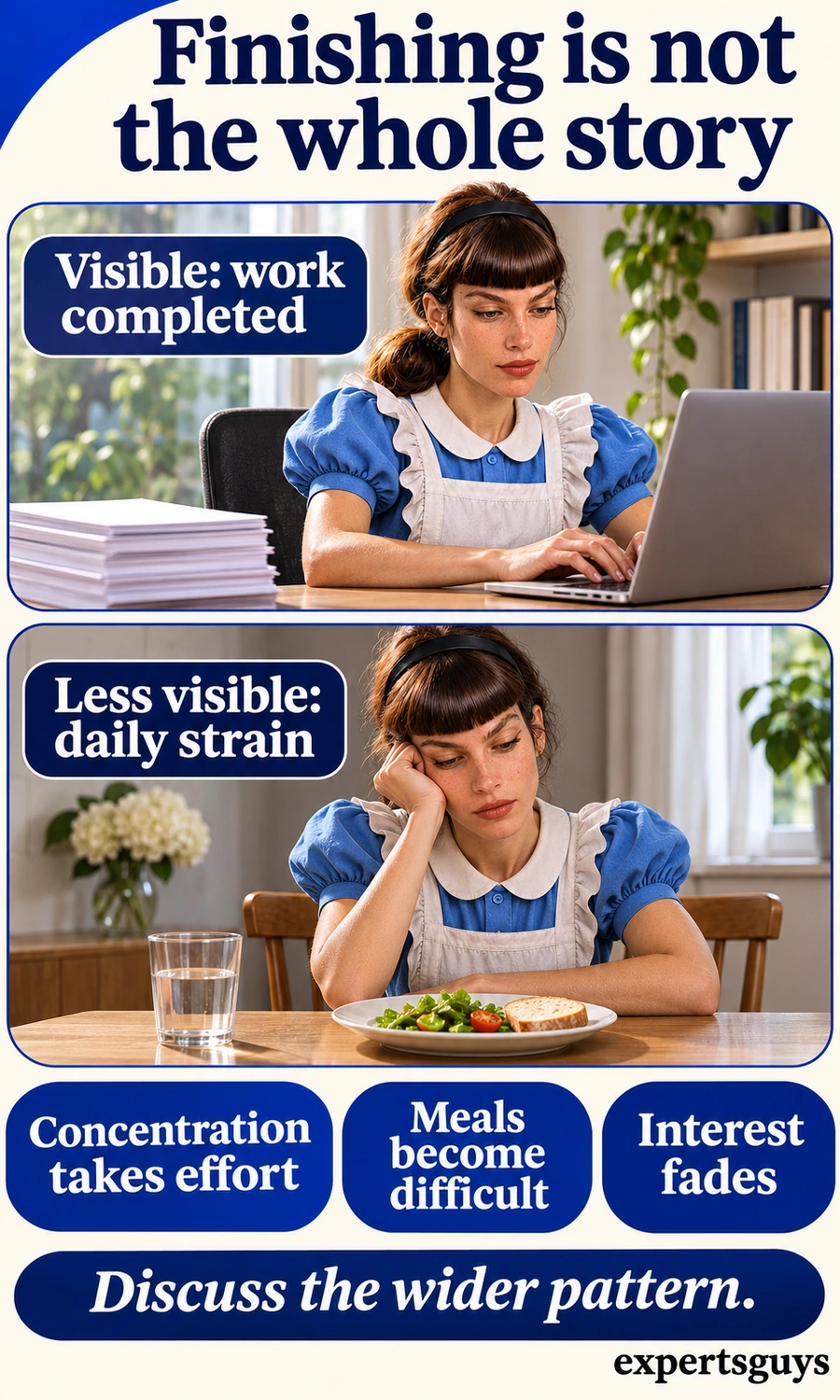
The useful signal is a sustained change involving depressed mood or loss of interest or pleasure, alongside other difficulties and meaningful distress or disruption. A major depressive episode generally involves symptoms over at least two weeks, but that duration is a diagnostic consideration, not an instruction to postpone help. A shorter period can still require prompt attention when symptoms are severe, rapidly worsening or unsafe.
The American Psychiatric Association’s depression overview describes a symptom combination that includes emotional, cognitive and physical changes. Sadness is one possible presentation. Irritability, emptiness or a marked reduction in enjoyment can also be part of the picture, so visible tearfulness is an unreliable gatekeeper for recognising a problem.
Look at the pattern before counting symptoms
Fatigue after several sleepless nights is information about fatigue; it does not identify the reason. The same applies to poor concentration, appetite changes or withdrawal. Symptoms become more clinically informative when considered together, against the person’s usual state, and in the context of illness, substances, medicines, life events and earlier episodes.
Assessment also distinguishes a symptom from its interpretation. “I cannot finish a familiar task” describes an experience. “I have become lazy” adds a judgment that does not explain it. Keeping that distinction clear helps a conversation focus on the actual change rather than requiring the person to defend their character.
The main symptom domains include:
- Mood and interest: persistent low, empty or irritable mood; reduced interest or pleasure in activities that previously mattered.
- Thinking and self-evaluation: concentration or decision difficulties, hopelessness, excessive guilt or feelings of worthlessness.
- Body and behaviour: changes in sleep or appetite, low energy, observable slowing or agitation, and difficulty maintaining ordinary roles.
- Safety: thoughts about death, self-harm or suicide, whether or not the person otherwise appears composed.
These domains are not a home diagnostic formula. For major depression, a clinician considers the required symptom combination, distress or impairment, alternative explanations and the wider course of illness. Recognising only a few symptoms can still be a valid reason to ask for support; falling short of an internet checklist does not establish that nothing is wrong.
Duration, frequency and impact answer different questions
Duration asks how long the change has persisted. Frequency asks how consistently it appears. Impact asks what it costs the person in distress, effort, relationships or daily functioning. None can replace the others: two weeks of intermittent disappointment is different from pervasive loss of interest, and many months of difficulty should not be dismissed simply because it has become familiar.
An assessment needs that combination because the same outward behaviour can conceal different experiences. Leaving a social event early could reflect fatigue, anxiety, pain, low interest or a personal preference. Its meaning depends on the surrounding pattern, rather than the behaviour being proof of depression by itself.
Function includes the effort behind an ordinary task
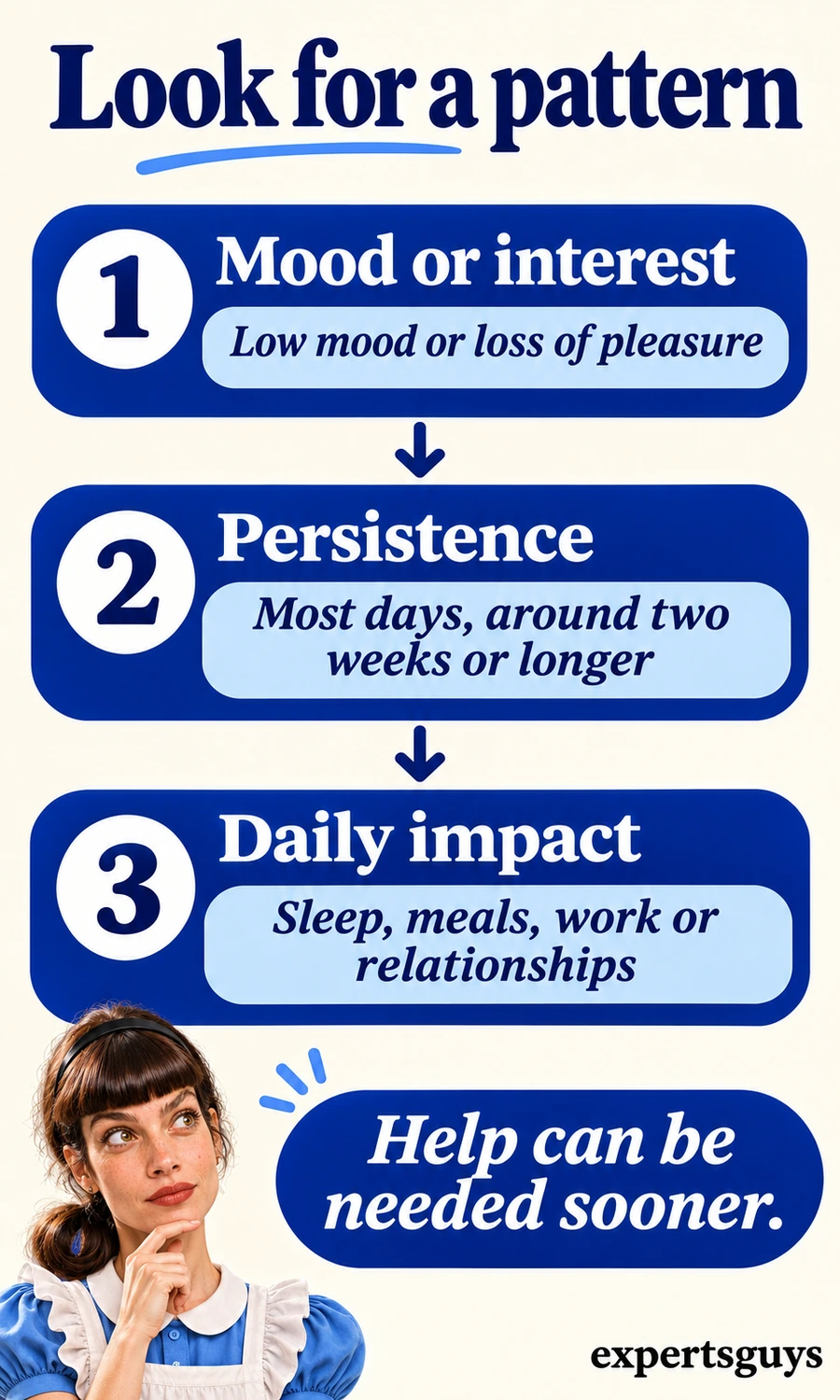
Being able to attend work or answer a message does not describe everything involved in doing it. The guide to depression behind continued outward functioning explores that pattern in depth. For this overview, the assessment point is that the strain, distress or loss of other activities belongs alongside the visible result.
Illustrative example: two adults both complete their work shift. One is tired after an unusually demanding day and expects ordinary rest to help. The other has spent weeks forcing concentration, no longer enjoys anything outside work and repeatedly misses meals because everyday decisions feel overwhelming. The finished shift is similar; the wider pattern and its consequences are different. This example explains an assessment question, not a diagnosis for either person.
For conversation, the second adult could simply say, “I still get through work, but afterwards I cannot manage meals and nothing feels enjoyable.” This is a verbal example, not a recording exercise. Its usefulness comes from connecting the change with daily life; there is no requirement to provide a perfect timeline or calculate how much effort a task takes.
What else can resemble depression?
Medical conditions, sleep problems, medication effects and substance use can produce or worsen overlapping symptoms. Grief, anxiety and other mental health conditions may also be relevant, and more than one difficulty can occur at the same time. Identifying a recent stressor does not rule depression in or out.
The NHS explanation of depression assessment describes a clinical conversation and, when appropriate, examinations or tests for other conditions. There is no routine blood test that confirms depression. Tests may answer a different question, such as whether a thyroid problem could contribute to the presentation.
The takeaway is to describe the change and what it affects. You do not need to prove that every symptom has one explanation before beginning care. A useful assessment can revise the initial understanding as more context becomes clear.
What do depression types and episode labels actually tell you?
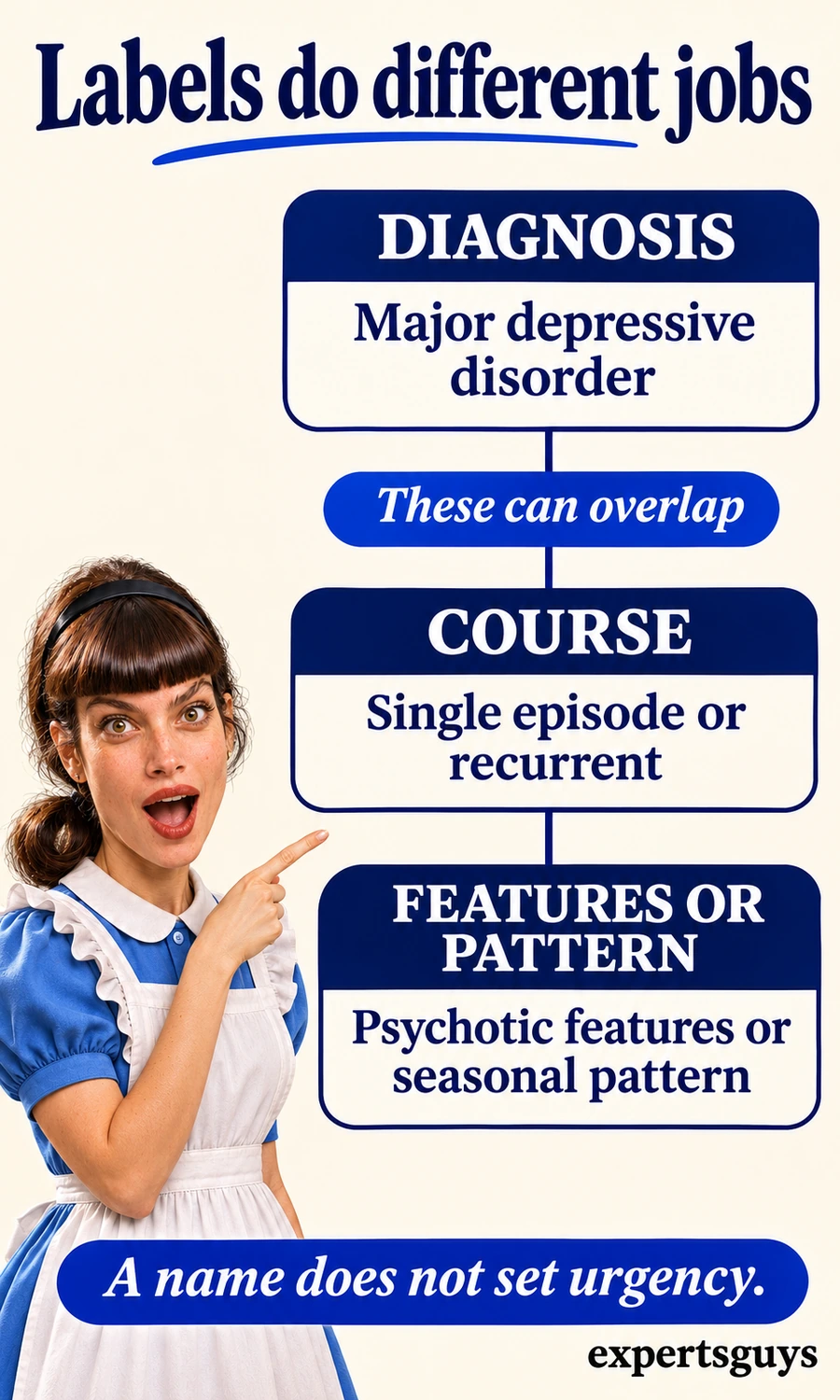
Depression terminology can describe a disorder, the course of episodes, a timing pattern or particular episode features. These labels do different jobs and can overlap. The practical question is what the term adds to assessment or treatment, rather than how many labels a person can collect.
Diagnosis, course and features belong on different levels
Major depressive disorder is a diagnosis; “recurrent” describes a course; “with psychotic features” describes an important clinical feature. A seasonal pattern describes recurring timing. Putting all of these into a flat list of mutually exclusive types makes the terminology seem simpler while obscuring how it is used.
Persistent depressive disorder describes a long-lasting depressive pattern, typically at least two years in adults under DSM terminology. Persistence does not guarantee mild illness, and a person with longstanding symptoms can also experience a major depressive episode. Duration describes the course; it does not replace assessment of current severity.
Swipe horizontally to compare on a narrow screen.
| Term | What it describes | Useful implication |
|---|---|---|
| Major depressive disorder | A depressive disorder assessed through episode criteria and wider history. | A major episode has a qualifying symptom combination; the word major does not make every presentation equally severe. |
| Persistent depressive disorder | A sustained depressive pattern; adult DSM duration is generally at least two years. | Longstanding symptoms can still be disabling and can include major depressive episodes. |
| Single episode or recurrent | Whether there is one episode or a history of multiple episodes. | Course adds information beyond what is happening today. |
| Seasonal pattern | Recurring association of episodes with a season. | A difficult holiday or one bad winter alone does not establish the pattern. |
| Perinatal depression | Depression during pregnancy or after childbirth. | Care must account for this context; ordinary tiredness does not settle the assessment. |
| With psychotic features | Depression accompanied by delusions or hallucinations. | Needs urgent assessment and a suitable clinical treatment setting. |
| Bipolar depression | A depressive episode occurring within bipolar disorder. | History of mania or hypomania changes assessment and treatment. |
The table is an orientation to common language, not a complete classification system. Definitions and naming conventions vary between diagnostic systems. A useful explanation of a diagnosis should specify the term being used and why it matters for this person’s care, rather than relying on the apparent severity of the name.
Why bipolar history changes the interpretation
A depressive episode can occur in bipolar disorder. The important distinction is a history of mania or hypomania, rather than depression being especially intense. Those episodes involve an unusual change in mood together with increased energy or activity; they are not simply a good afternoon or the relief of returning to usual functioning.
For example, being unable to sleep and feeling exhausted differs from sleeping much less while feeling unusually energised and behaving in ways others recognise as a marked change. Either experience needs context. A single restless night, a productive day or a personality description is insufficient to identify hypomania.
This history matters because bipolar depression requires a different treatment approach. The NIMH bipolar disorder guide explains why antidepressants are not used alone for bipolar disorder. Do not start, stop or alter prescribed medication based on a comparison in an article; unexpected changes in energy, sleep or behaviour belong in a treatment review.
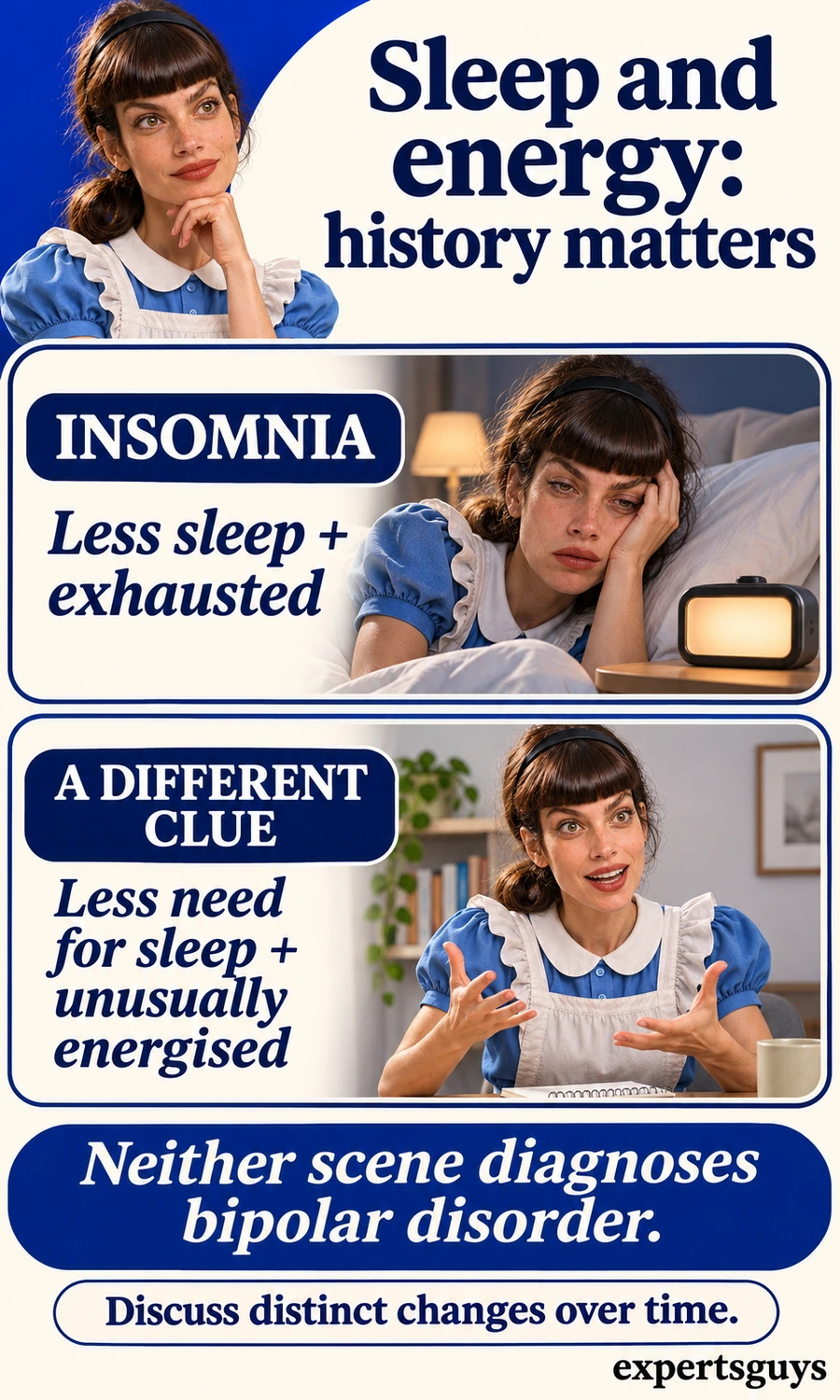
The site guide to unipolar versus bipolar depression covers the episode-history question in more depth. Here, the decision is narrower: an explanation of current depression is incomplete if it ignores a relevant history of elevated or unusually irritable, energised states. Remembered uncertainty is worth discussing too; a person need not arrive with the correct diagnostic word.
Timing and specific features can change care priorities
Depression during pregnancy or after childbirth needs attention to both mental health and the circumstances of pregnancy, birth and infant care. A recurring seasonal pattern raises a different timing question. Premenstrual dysphoric disorder has its own cyclical pattern and criteria; it is not a label for any low mood near menstruation.
Psychotic symptoms, such as hallucinations or delusions, change the assessment and urgency. They should not be reduced to “very negative thinking.” A clinician needs to understand the experience directly and consider safety, physical health and the appropriate treatment setting.
This overview does not ask readers to distinguish all these conditions alone. Its useful boundary is to recognise when timing, history or an unusual feature adds information beyond a general symptom list. The guide to depression types and patterns provides the fuller terminology reference.
What causes depression, and what can statistics tell you about one person?
Depression usually involves interacting biological, psychological and social factors. A risk factor changes the likelihood of illness across people; it does not prove the cause in an individual. Population statistics answer another question again: how common a defined condition was in a specified group and period.
Separate vulnerability, a possible trigger and ongoing difficulties
Family history can indicate vulnerability. Bereavement, violence, financial strain or other adversity may be relevant to onset. Sleep disruption, pain, reduced support and the consequences of depression may then complicate daily life. These categories help organise an explanation, but they are not a formula that identifies each person’s cause.
Illustrative example: an adult develops persistent symptoms after losing employment while also managing chronic pain. The job loss is relevant, but it does not establish that unemployment alone caused the illness. Pain, previous episodes, financial pressure, available support and medical factors may all need consideration. Assigning one cause too quickly could leave important needs unaddressed.
The practical benefit of this layered explanation is that help need not depend on discovering a single original cause. An immediate problem, such as difficulty accessing treatment, can be addressed while the broader picture remains uncertain. Equally, treating symptoms does not make housing insecurity, unsafe relationships or financial hardship irrelevant.
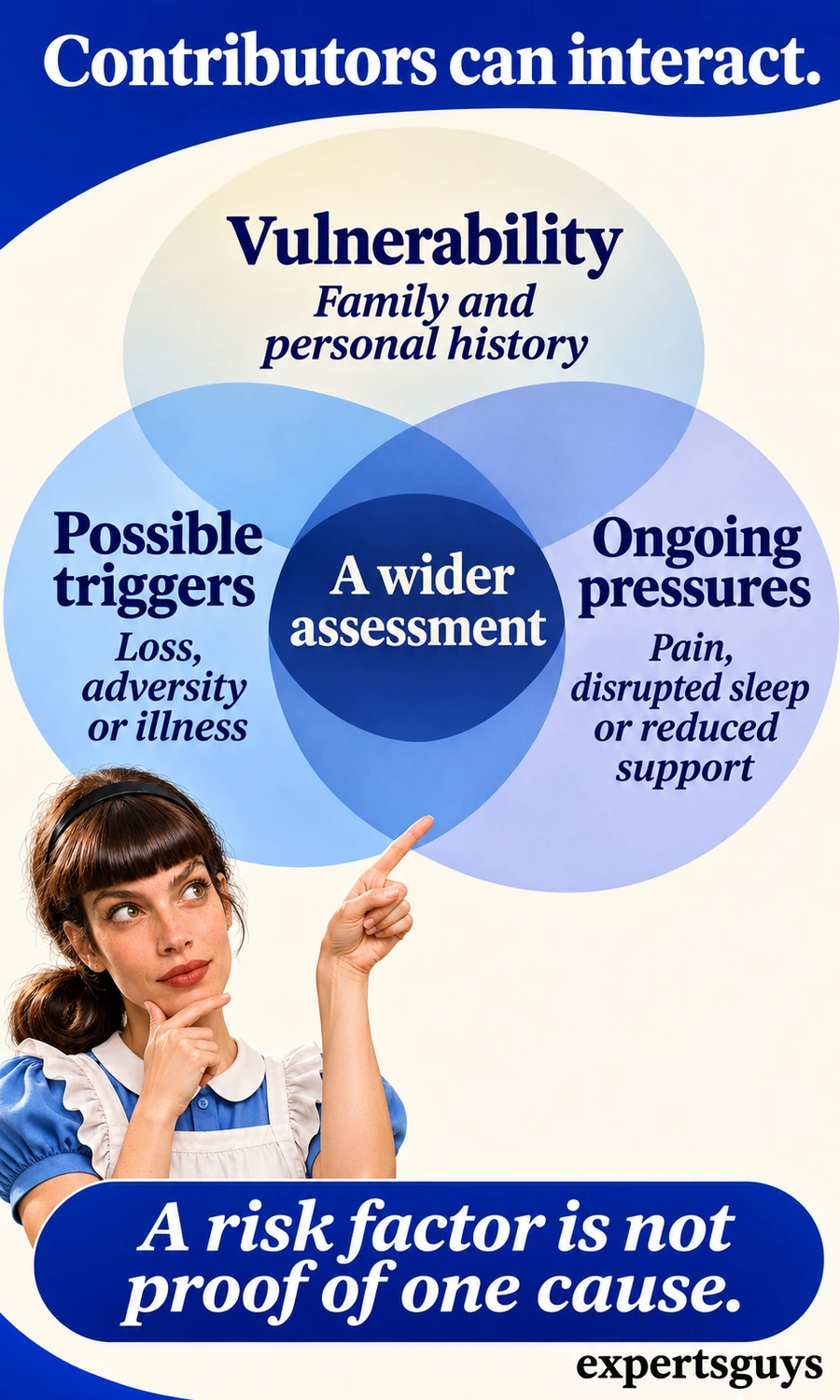
The NHS overview of contributing factors explains how life events, family history, illness and other circumstances can combine. These are possible contributors, not a checklist assigning blame. Depression without an obvious external trigger is still a meaningful clinical presentation.
Biology is relevant without being a personal chemical reading
The brain and body are involved in mood, motivation and stress responses, but a symptom cannot identify a particular neurotransmitter level. Nor does improvement with a medicine prove that a person originally lacked the chemical it affects. Treatment response and causal explanation are related questions that require different evidence.
One useful way to assess a biological claim is to ask what was actually measured. A group difference in a research study is not automatically a usable individual test. A finding about a signalling pathway does not by itself show which treatment is best for someone reading the headline.
The detailed article on neurotransmitter signalling and depression owns that mechanism explanation. The role of this overview is to keep the inference bounded: biological involvement is compatible with psychological and social contributions. It does not make care a choice between “physical” and “real-life” explanations.
Read prevalence with its denominator attached
The WHO depression fact sheet, updated in September 2026, reports estimates for 2023 of approximately 322 million people worldwide and 5.2% of adults experiencing depression. The adult percentage and the all-ages headcount have different denominators. The date describes the estimate’s reference period, not a prediction of your personal outcome.
These figures establish the scale of the condition. They do not tell a reader whether their own symptoms meet diagnostic criteria, whether a particular factor caused them, or which treatment they should receive. Those questions require individual information that a global average does not contain.
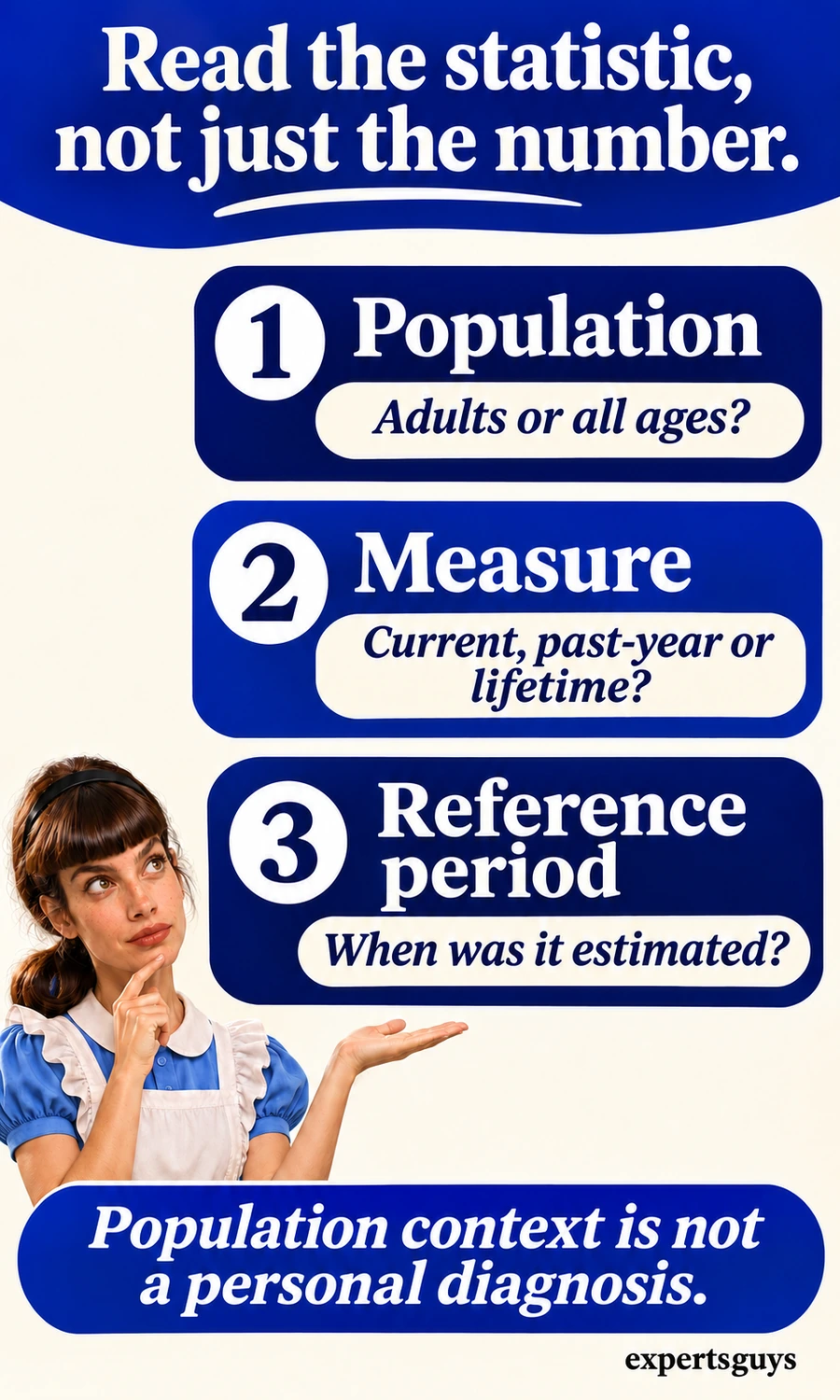
| Detail | Why it changes interpretation |
|---|---|
| Population | Adults, all ages, a particular country and a clinical sample are different groups. |
| Definition | Current symptoms, a diagnosed disorder and lifetime experience are different measures. |
| Reference period | A point estimate, a past-year measure and lifetime prevalence cover different time windows. |
| Method | Screening, clinical assessment and statistical modelling do not count people in identical ways. |
| Individual meaning | A population estimate gives context; it is not a personal diagnostic probability or treatment forecast. |
Statistics can differ without either estimate necessarily being wrong. A survey of current symptoms, a count of diagnosed cases and an estimate of lifetime experience are measuring different things. Differences in age, country, sampling and access to diagnosis can also affect what is counted. Compare definitions before interpreting a larger percentage as proof that depression has become more severe or more common everywhere.
Avoid turning a prevalence figure into reassurance that overrides distress: “It is common” does not mean it is easy to live with. Avoid the opposite inference too: a condition being common does not mean every difficult period is that condition. The useful outcome is better context, with individual assessment kept separate.
How are therapy and other treatments chosen, and what should a useful plan explain?
Treatment should match the person’s symptoms, severity, safety needs, history, preferences and practical access. Psychotherapy, medication and other interventions have different roles; the best starting choice cannot be read from one symptom or a popularity ranking. A useful plan explains both why an option fits and how the decision will be reviewed.
Start with the treatment job
Psychotherapy is a structured treatment delivered by a suitably trained professional. Approaches differ in what they focus on and how they work. A therapy name is therefore only the beginning of an explanation: the reader also needs to understand the problem being addressed, what participation involves and what would count as useful progress.
For example, cognitive behavioural therapy addresses relevant patterns in thoughts and behaviour. Behavioural activation focuses on patterns of avoidance and reduced activity, while interpersonal therapy works with relationship difficulties and life changes connected with depression. These are treatment approaches, not interchangeable names for a supportive conversation. Their inclusion here explains the choice being discussed; it does not provide instructions for conducting therapy alone or establish which approach suits a particular reader.
Medication decisions require attention to expected benefits, possible adverse effects, previous response, other medicines and relevant health conditions. A prescription is not a judgment that psychological or social needs are unimportant. Likewise, choosing therapy does not establish that the person’s depression is less real or solely caused by thoughts.
Swipe horizontally to compare on a narrow screen.
| Option | Main role | Question the plan should explain |
|---|---|---|
| Structured psychotherapy | Works on relevant patterns in thinking, behaviour, relationships or other agreed therapeutic targets. | What are we working on, how will sessions address it, and when will we review progress? |
| Antidepressant medication | A prescribed treatment option selected with attention to benefit, adverse effects and personal history. | Why this medicine, what should I watch for, and how will starting or stopping be supervised? |
| Combined care | Uses appropriate psychological and medication treatment together when the clinical picture supports it. | How do the parts complement each other, and who coordinates the plan? |
| Specialist treatment | Addresses severe, complex, psychotic or insufficiently responsive presentations and other specific needs. | What makes this level of care appropriate, and what are its benefits, burdens and alternatives? |
| Everyday practical support | Helps with access, ordinary responsibilities and barriers while clinical care continues. | Which concrete difficulty does the support remove, and is additional clinical care still needed? |
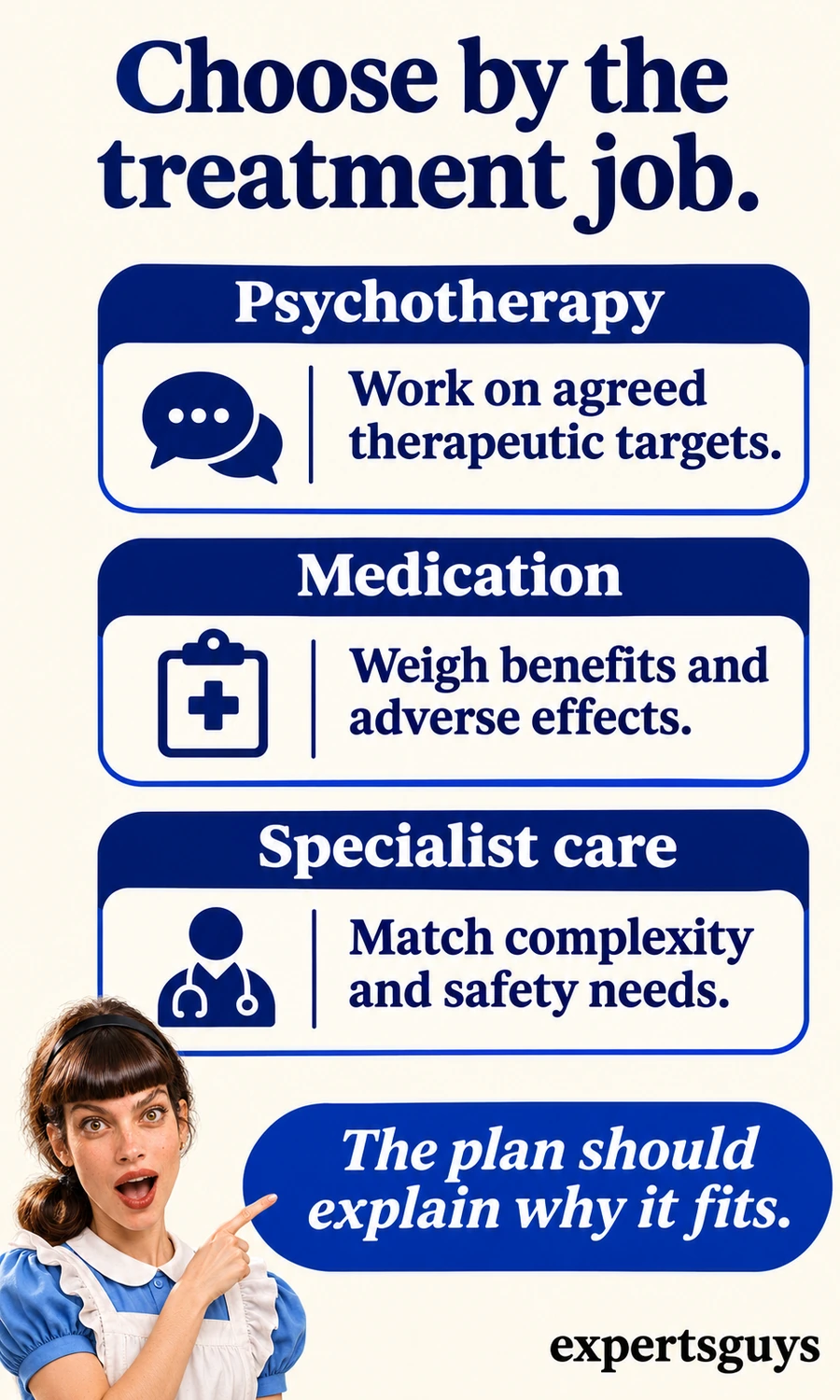
For less severe adult depression, NICE treatment recommendations do not routinely place antidepressants first unless that is the person’s informed preference. The guidance emphasises matching treatment to clinical needs and preferences, including less intrusive options. This is an adult guideline, not a rule to apply unchanged to children, pregnancy or every specialist presentation.
More severe or complicated presentations may need a different combination and intensity of care. Brain stimulation treatments, including ECT or repetitive transcranial magnetic stimulation, have specific clinical roles. They are not interchangeable home techniques or simply the final item in a sequence every person must complete. The NIMH depression treatment overview explains these broader options and the need to individualise care.
A treatment choice must be workable as well as suitable
Access can change which appropriate option is realistically available. Cost, transport, appointment timing, language, disability access and the effort required to attend can all matter. These constraints should be part of the treatment discussion, rather than interpreted as a lack of motivation or as evidence that the person does not want help.
A stated preference also deserves an explanation of the trade-off. Someone may prefer therapy because avoiding a particular medication burden matters to them, while another person may find the demands of a proposed therapy difficult to accommodate. Neither preference alone establishes which option is clinically suitable. The discussion should connect what matters to the person with the benefits, burdens and limits of the available choices, rather than treating a preference as an obstacle to overcome.
That is why a universal treatment league table would be misleading here. An option’s place in one guideline or its usefulness for a particular presentation does not rank it for every adult. Previous benefit, an unwanted effect, an episode-history concern or a practical access barrier may change the balance. The goal is a justified choice that can be revisited, rather than certainty that one treatment must be best before anything can begin.
Illustrative example: weekly daytime sessions conflict with an adult’s working hours. The useful question is whether an appropriate evening, remote or alternative service is available and suitable, not whether the adult is sufficiently committed. An alternative still needs a clear treatment purpose and appropriate professional oversight; convenience alone does not establish quality.
Similarly, concentration difficulty may affect how information is explained or how much between-session practice is manageable. Adaptation should preserve the treatment’s purpose while accounting for the person’s capacity. This overview does not prescribe a new exercise routine; it explains why practical fit belongs alongside evidence when care is chosen.
Review symptoms, daily life, tolerability and safety together
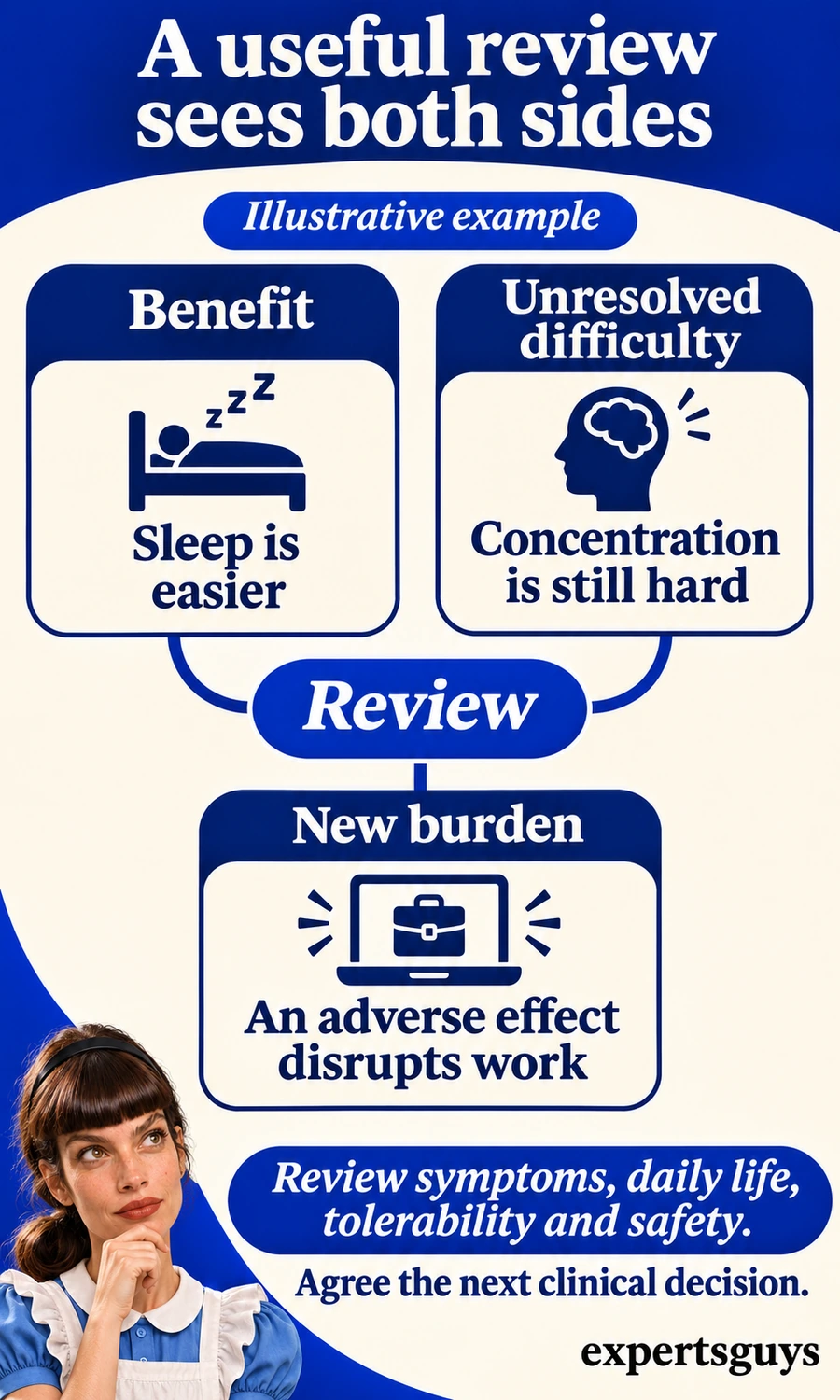
A review needs more than “Do you feel happier?” Changes in symptoms, everyday functioning, side effects and safety may point in different directions. The next decision depends on the whole pattern, including whether the treatment has been delivered or taken as agreed and whether the original understanding still fits.
Illustrative example: sleep improves after starting treatment, but concentration remains difficult and a new adverse effect disrupts work. It would be misleading to call the plan a complete success because one symptom improved, or a complete failure because another persists. The useful review identifies the benefit, the unresolved problem and the burden, then agrees the next clinical decision.
The separate guide to making talk therapy sessions useful teaches participation skills in detail. This page’s contribution is the broader distinction between receiving a treatment and having a comprehensible, reviewable care plan. Neither attendance nor a medication label alone describes whether daily life is becoming more manageable.
Safe boundaries while treatment is being arranged or adjusted
Do not abruptly stop or change a prescribed antidepressant because of a difficult day or an online account of someone else’s experience. Withdrawal effects, adverse effects and returning symptoms can require careful clinical interpretation. Ask the prescriber how changes should be managed; urgent deterioration or safety concerns need prompt attention rather than waiting for the next planned review.
Everyday support can make the interval between appointments more manageable, but it should match the actual difficulty. Someone struggling to access food may need practical help with meals; someone unable to attend an appointment may need transport or an accessible alternative. These are supports to discuss and arrange, not evidence that a household routine can replace treatment.
There is no need to add a symptom-scoring app to understand the distinctions in this guide. A clear explanation, a suitable treatment discussion and a next review point serve this page’s reader job. The useful next step is whichever unresolved question is currently blocking care, rather than repeating a general checklist.
Frequently asked questions
Can someone enjoy an occasional moment and still have depression?
Yes. A brief enjoyable moment does not erase a persistent wider pattern. Assessment considers symptoms over time and their impact, rather than requiring an identical emotional state every minute. Equally, a single unpleasant moment cannot establish a depressive disorder.
Does having a reason to feel low mean it cannot be depression?
No. A recognisable loss or stressor provides context but does not settle whether a depressive disorder is present. The useful distinction concerns the symptom pattern, its persistence, distress and effect on life. Grief and depression can also coexist.
Can a screening questionnaire tell me which treatment to choose?
A questionnaire can contribute to assessment and follow-up, but its score does not replace a clinical history or determine treatment by itself. Safety, previous episodes, other conditions, preferences and practical access may change the decision. A symptom score is not a personal prescription.
Does a diagnosis mean every later difficulty is caused by depression?
No. New or changing symptoms still need to be understood on their own terms. Physical illness, medicines, sleep disruption and other conditions can remain relevant after a depression diagnosis. Assuming one label explains everything can delay recognition of a separate problem.
If the first treatment is unsuitable, does that mean treatment cannot help?
No. An unsuitable or insufficiently helpful first approach is a reason to review the plan. The review can consider what was tried, benefits, adverse effects, practical barriers and whether the assessment needs revision. It does not justify changing prescribed medication without supervision.
Bring the right question to the next decision
If you recognise a sustained change, begin with its effect on daily life rather than trying to choose the perfect label. If treatment is already underway, identify the part that remains unclear: the purpose, expected benefits, unwanted effects, practical access or review plan. Understanding depression becomes useful when it helps resolve that specific uncertainty.










