

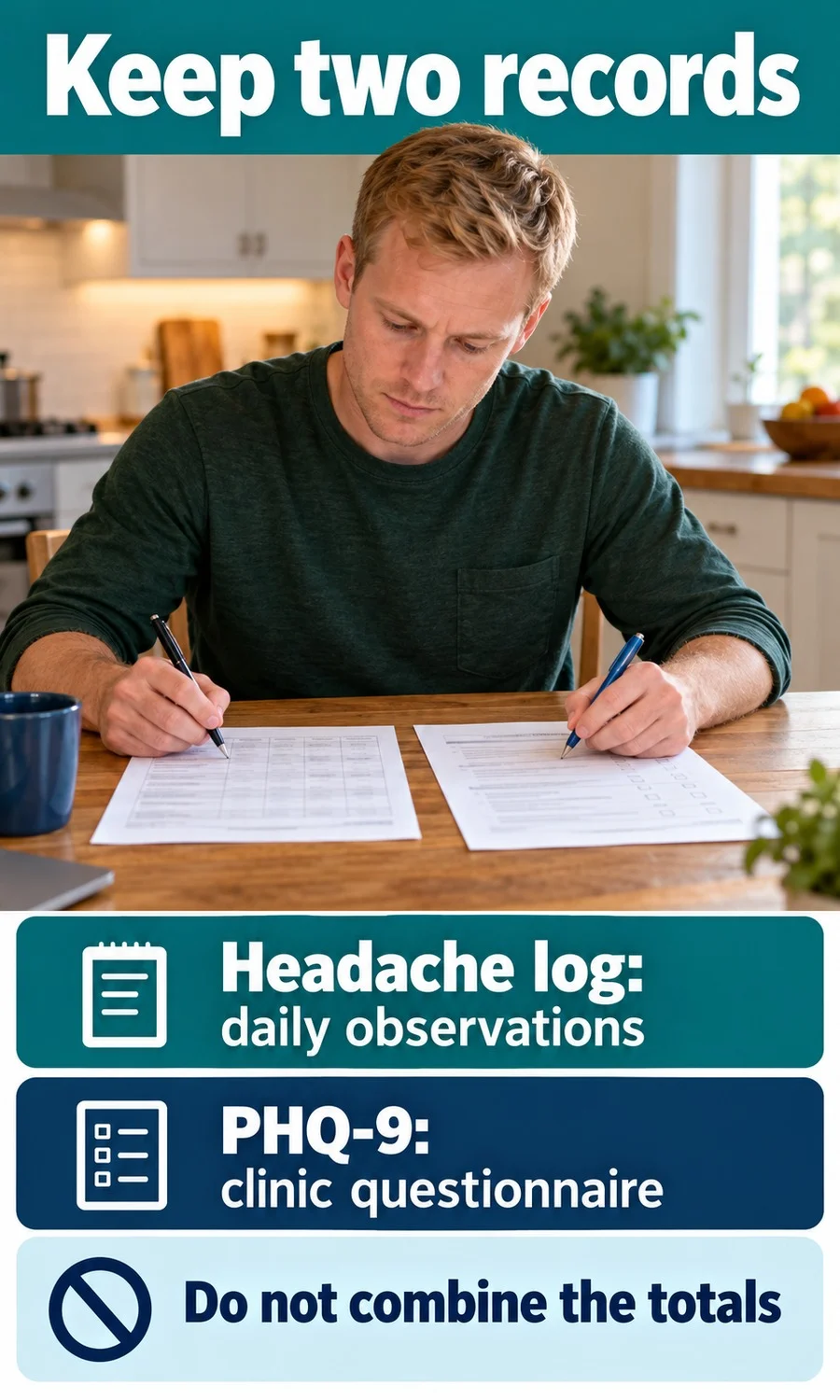
Log each calendar day with a headache on a separate 14-day sheet, then bring it beside the PHQ-9 your clinic uses. A headache count is not part of the questionnaire total, and neither record tells you what caused the pain. Matching the dates helps you explain what happened without trying to diagnose yourself.
Use this page for appointment preparation. It is for adults who have recurring headaches and are discussing mood with a healthcare professional. It does not choose treatment, interpret a screening result or replace medical assessment.
When to seek help instead of completing a log
Seek emergency care for a sudden, extremely painful headache, or a headache with new weakness, confusion, a seizure, difficulty speaking, loss of vision, fever with a stiff neck, or after a head injury. Use your local emergency service rather than waiting to collect two weeks of entries. The NHS headache guidance explains these warning signs.
If you have thoughts of suicide or self-harm, seek prompt support from a healthcare professional or local crisis service. If you might act on those thoughts or cannot stay safe, call your local emergency number or go to an emergency department now. A questionnaire total and a printable sheet cannot provide a safety assessment.
How to log headache days beside a PHQ-9
Start with the date range requested by your clinic. If no range has been specified, a 14-day diary gives you a compact record to discuss alongside the questionnaire’s two-week recall period. Complete one entry each evening, including an explicit “no headache” on days without pain.
Keep the questionnaire as a separate document and follow its instructions when you complete it. Daily diary entries are memory aids, not daily PHQ-9 responses to add or average. If your appointment comes sooner, bring the shorter record and say how many days you observed; do not postpone care to finish the sheet.
What the PHQ-9 asks, and what it leaves out
The official PHQ-9 form covers nine symptom areas over two weeks: interest, mood, sleep, energy, appetite, self-evaluation, concentration, movement or restlessness, and thoughts of death or self-harm. Headache is absent. An accompanying question describes difficulty functioning and is not added to the nine-item total.
Use the original form supplied by your clinic rather than turning this article’s summary into a questionnaire. If the clinic has already given you a total, you can copy it onto the appointment sheet in its separate field. Leave that field blank when you do not have a completed result, and bring the full questionnaire so individual responses remain available.
Choose observations that help you explain the day
The most useful diary is one you can complete consistently. Begin with the date and whether a headache occurred, then add a brief factual note if something needs explaining. You can record start time, where the pain was, pressure or throbbing, nausea, light sensitivity, disrupted sleep, and what activity you missed; you do not need every detail on every day.
| Record | What to put in it |
|---|---|
| Daily headache sheet | One dated headache yes/no entry, or unknown when you cannot remember. Add a short observation about the day. |
| Clinic PHQ-9 | Complete the clinic’s questionnaire using its original instructions. Keep individual answers available for discussion. |
| Appointment summary | State the number of observed days and headache days. Copy an existing questionnaire total separately, if available. |
| Another clinic form | Keep its name, date range and results separate. Do not combine different forms into one score. |
Describe the sensation without selecting a diagnosis. “Pressure across both sides” and “throbbing on the left with nausea” preserve useful differences, while a label such as “depression headache” assumes an explanation that has not been established. If a clinician has already diagnosed a headache condition, you can note that separately from what happened today.
Keep medication details on the clinic’s existing diary or on a separate medicines list if you have one. This sheet does not evaluate doses, medication-overuse risk or which medicine to take. A record of timing is something to discuss with the clinician, not a reason to change treatment yourself.
Count calendar days, not attacks
For this sheet, a headache day means a calendar date on which you experienced head pain. Several episodes on the same date still count as one day; pain continuing past midnight can appear on both dates. This is a simple recording convention for the visit, not a clinical classification rule.
Leave a forgotten day unknown rather than marking it headache-free. For example, six headache days, five confirmed headache-free days and three unknown days should be reported as six headache days among eleven observed days. The unknown dates remain visible, so the sheet does not imply a complete two-week record.

A filled example: observations without a cause claim
The following examples are invented to show how to write useful notes. They are not patient cases, research findings or evidence that pain explains a screening response. Each note records what the person noticed and leaves interpretation for the appointment.
| Observation | A useful way to record it |
|---|---|
| Headaches and interrupted sleep | “Headaches on four dates this week. Woke with pain twice and felt tired the next morning.” |
| Low mood on headache-free days | “No headache on the dates recorded this week. Still noticed low mood and less interest in my usual activities.” |
| Both changing together | “Headache days and difficulty doing everyday tasks both increased. I do not know whether they are connected.” |
| Incomplete recall | “I recorded ten of fourteen dates. Two of those ten had headaches; four dates are unknown.” |
A clinician can use these notes to ask more specific questions. You do not need the two records to rise and fall together for either concern to deserve attention. If you want broader background, the guide to physical symptoms of depression discusses why physical complaints need their own assessment.
Keep sleep, energy and appetite context beside your answers
A difficult headache week may also involve broken sleep, tiredness or changed eating patterns. Describe those changes and their timing without deciding how many questionnaire points should be removed. A note such as “I slept poorly on two nights with head pain” gives context; it does not establish the reason for the response.
Answer the clinic questionnaire honestly, including mood, interest, concentration and the other symptom areas. Do not dismiss a response because you also have a headache, and do not omit the question about death or self-harm. The clinician needs the answers as marked and the accompanying context, rather than a version you have adjusted to fit a cause theory.
If sleep disruption is a major part of your record, the guide to depression and sleep problems can help you describe the pattern. Headaches present on waking can be recorded as an observation and discussed using the separate article on morning headaches. Keep those patterns within the same dated account rather than opening several competing diaries.
What about the PHQ-15 headache item?
The PHQ-15 is a different questionnaire about physical symptoms, including headache. Its standard form asks about how much symptoms bothered you over four weeks, rather than counting headache dates over fourteen days. That difference is why its headache response cannot be substituted for a day count or added to the PHQ-9.
If your clinic asks you to complete both forms, keep both original documents and follow the date range on each. The NHS Talking Therapies manual includes the PHQ-15 form for reference. One isolated headache response is not the complete questionnaire and cannot explain the source of the symptom.
Prepare your two-week visit record
Use the record below to mark headache yes, no or unknown for each date. It counts only the days you entered and keeps an existing clinic PHQ-9 total in a separate optional field. The printable sheet includes every date and short note, so gaps remain visible when you hand it over.
Entries stay in this page’s memory and are lost when you reload or close it. Print the sheet before leaving, or use a paper version if you need an ongoing diary. A blocked script should leave the instructions and a blank printable sheet available; no account is needed.

Headache Visit Record
Keep headache days beside your clinic questionnaire.
A record, not a diagnosis. This experience does not score depression, explain headache causes or select treatment. Seek emergency care for a sudden extremely painful headache, new weakness or confusion, a seizure, fever with a stiff neck, loss of vision, or headache after a head injury. Seek prompt help for thoughts of suicide or self-harm; use local emergency care if you cannot stay safe.
Mark one calendar date at a time. Several headaches on one date count as one headache day. Unknown and unrecorded dates are never counted as headache-free. Follow your clinic’s instructions for the PHQ-9.
Entries stay in this page’s memory. Nothing is saved by this plugin or sent to a server. Reloading or closing clears entries; print before leaving. Other site scripts and printed files are outside this plugin’s controls.
Open a blank A4 sheet · Open the official PHQ-9
Preparing the interactive record. If controls do not activate, use the blank A4 sheet above or record dates on paper.
Your visit summary
Choose the dates and record what you observed, then prepare the summary. No depression score or cause assessment is generated.
What to hand over at the visit
Bring the dated headache record, your completed clinic questionnaire and any longer diary you already keep. Explain whether the diary dates match the questionnaire period and identify missing entries. If symptoms changed after the recorded window, tell the clinician rather than editing old notes to make everything look consistent.
- State the dates covered and how many days you actually recorded.
- Show the headache count separately from the questionnaire result.
- Bring the full questionnaire, including every individual response and its functioning question.
- Bring your medicines list and any earlier clinic diary.
- Ask what needs further assessment and what record would be useful next.

A straightforward opening is: “I recorded headaches on these dates and brought my questionnaire separately. I have not added the headache count into its total, and I would like to discuss both concerns.” That tells the clinician what the sheet can show without asking it to prove a connection. If migraine has already been diagnosed or is being assessed, the separate depression and migraines article covers that related topic.
Frequently asked questions
Does the PHQ-9 ask about headaches?
No. Its nine symptom areas do not include headache. Put your headache observations in a separate dated record and bring it with the clinic form.
Can I add headache pain to my PHQ-9 score?
No. Keep the clinic questionnaire unchanged. Write the headache-day count beside it, with a clear label and the dates covered.
How is the PHQ-15 headache item different?
It asks about headache bother within a different physical-symptom questionnaire. It is not a calendar-day count. Follow the original form’s recall period and keep its result separate.
Do I need fourteen days before I can attend the visit?
No. Bring whatever record you have and identify the observed dates. Do not delay an appointment, urgent assessment or crisis support to finish this sheet.
Should pressure and one-sided pain share a box?
Use one yes/no box for whether head pain occurred that date. Describe different sensations in the note rather than making the box assign a diagnosis. If your clinic requests more detail, follow its diary format.
What if I already use a clinic headache diary?
Keep using it. Mark the dates that overlap the questionnaire period and bring the original diary. You do not need to re-enter the same history in this experience.
Use the record to make the conversation clearer
The useful outcome is a record you can explain: which dates had pain, which dates did not, and where your memory is incomplete. Keep the clinic questionnaire beside it, without changing either record to make the patterns agree. Bring both concerns to the appointment and let the healthcare professional decide what further assessment is needed.