




Depression and chronic pain can reinforce each other, making ordinary plans harder to keep. The useful response is to address both conditions while adapting the practical demands of the day. Start with what has changed, then choose a version of the plan that fits your current capacity.
Chronic pain generally means pain lasting three months or longer; “chronic discomfort” is a less precise everyday description. Pain can have an identified physical cause, and low mood does not make that pain imaginary. These examples are for adults arranging everyday life alongside care, not for identifying the cause of an unexplained symptom.
Is this familiar pain, depression, or a change that needs care?
You cannot reliably separate these possibilities from one symptom or one difficult day. Pain may interrupt sleep and activity, while depression can reduce interest, concentration and the energy available for everyday decisions. Chronic illness and depression can affect one another, so assessment should consider the whole pattern rather than assuming that either diagnosis explains everything.
Compare the present difficulty with your own usual pattern: location, intensity, associated symptoms and what you can do. A familiar flare still matters if it is more intense, lasts longer or repeatedly disrupts basic activities. This comparison helps you describe a change; it is not a home diagnostic test.
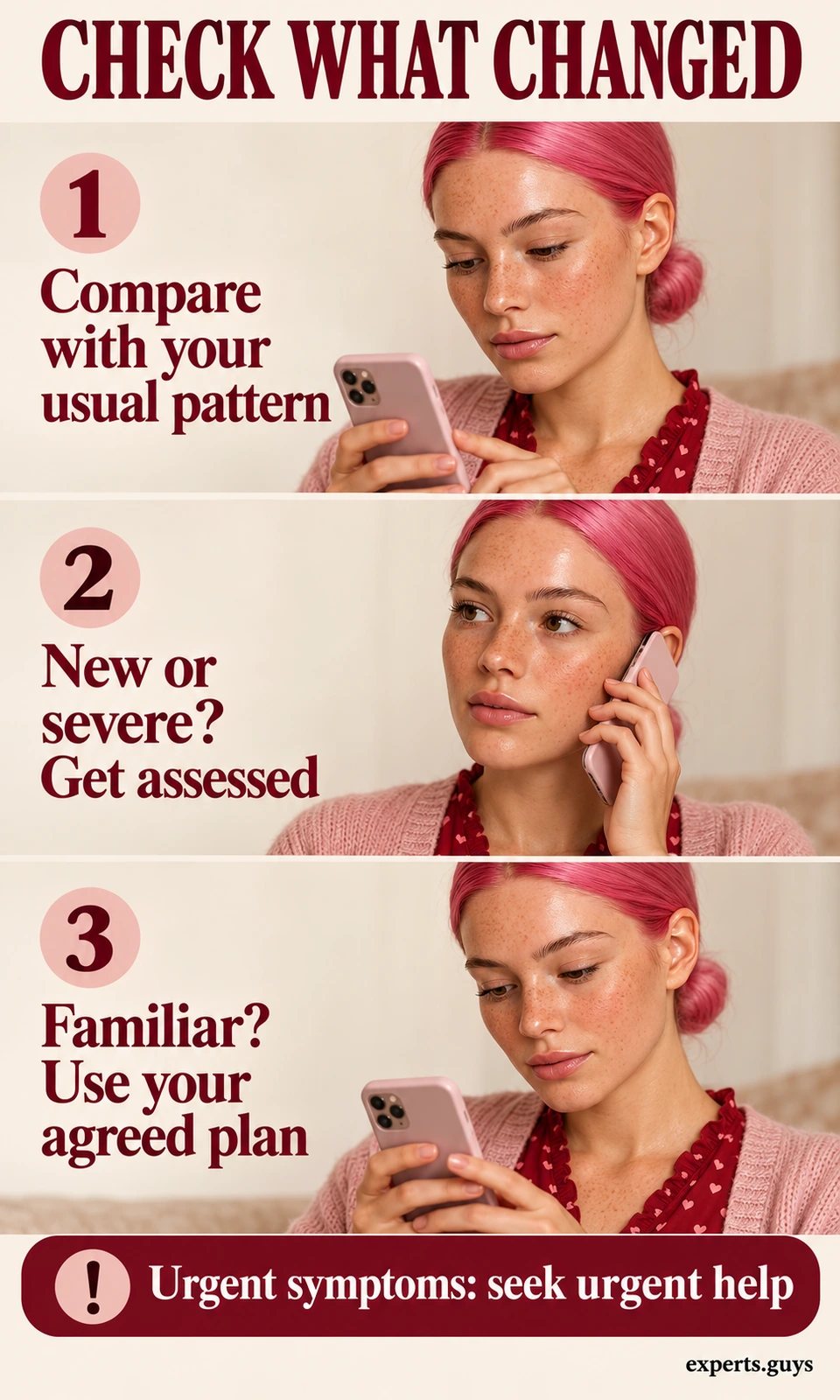
Check the change before reorganizing your day
Use this check when an established pain problem disrupts a plan, with your existing care instructions available if you have them. It helps you decide what to tell a clinician and avoids quietly treating every new problem as “just another flare.” If the cause of your discomfort has never been assessed, arrange an assessment rather than assuming that a chronic-pain routine applies.
- Compare: identify what is different from your usual pain and daily function; one spoken sentence or a short phone note is enough.
- Escalate: use urgent help for the warning signs above; seek a clinical review for other new, worsening or unexplained changes. Follow any condition-specific escalation instructions you have been given.
- Adapt: if the pattern is familiar and your agreed plan covers it, use that plan while reducing the practical demands of the activity. Contact your care team if it is not helping or you remain unsure.
For example, “The usual ache has started waking me, and I now cannot stand long enough to prepare food” is more useful than “everything hurts.” The common mistake is reassuring yourself solely because you already have a pain diagnosis. If typing is difficult, dictate that sentence or ask a trusted person to help communicate it, then check that the next step addresses the actual change.
Persistent low mood or loss of interest also deserves its own attention. Arrange a health appointment if symptoms are present most of the day, nearly every day, for more than two weeks, and seek help sooner if functioning or safety is deteriorating; the depression symptom guidance explains the broader pattern. For the wider physical picture, see physical symptoms of depression rather than using an ache alone to decide whether you have depression.
How can you keep a social plan without forcing the original version?
Keep the purpose of the meeting and change the demands around it. If the purpose is to see a friend, a long drive, standing in a queue and a late dinner are optional features, not the purpose itself. The following planning examples apply the general idea of manageable activity and meaningful contact; they are not validated treatments or promises that pain will improve.
Build three versions of one plan
Prepare the alternatives before the day becomes difficult, using a message thread or calendar invitation you already use. Choose options that differ in travel, position and timing rather than simply making the same exhausting outing a few minutes shorter. You can change your mind if symptoms change, and an agreed fallback is permission to adapt rather than an obligation to participate.
- Version A: choose a visit with a manageable setting, such as a short seated cafe meeting.
- Version B: replace travel with a video or phone call from a comfortable setting.
- Version C: use an asynchronous voice message, so the conversation need not happen at a fixed time.
- Agree the switch: tell the other person how you will confirm the version; do not make them guess whether silence means cancellation.
For example: “Let’s meet seated if I can manage the journey; otherwise we can call, or I’ll send a voice message when I can.” A common mistake is treating the smallest version as failure and dropping contact altogether. If even a message is too much, rest and use an agreed check-in later; judge the arrangement by whether it remains manageable, not by whether you completed the most demanding option.

Check the whole outing, including the return
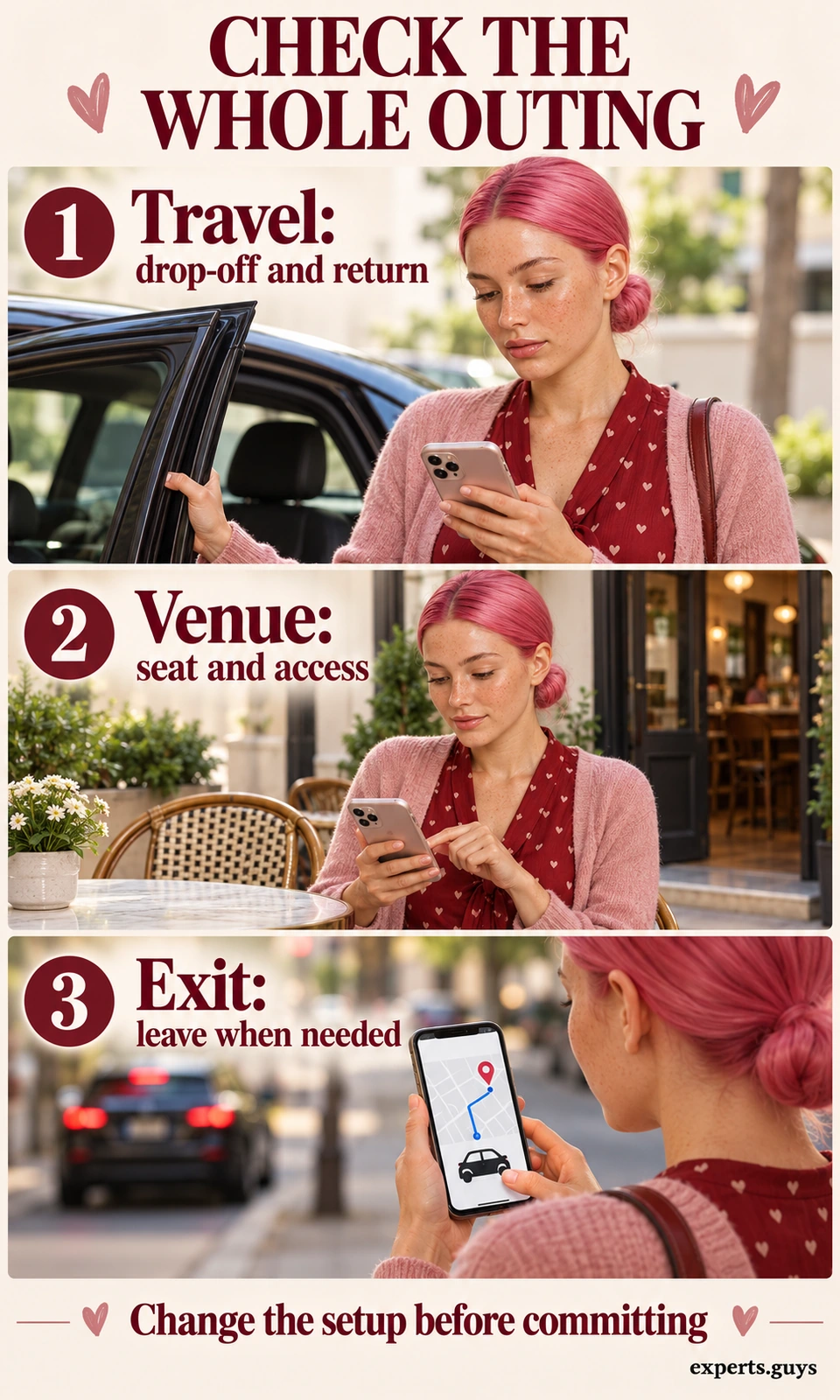
Use an access check when the activity sounds manageable but the journey or venue may create a hidden obstacle. A seat at the destination does not solve a long walk from parking, and a comfortable journey there does not guarantee a way home when you need it. Check the uncertain details with the venue or transport provider before committing.
- Travel: check drop-off distance, unavoidable stairs, waiting and a return option you can use when needed.
- Venue: confirm seating, level access where required and whether you can change position without disrupting the event.
- Exit: agree that you can leave early; tell your companion whether you will need help arranging the journey home.
For a dinner, the useful adjustment might be a nearer venue with a reserved chair and an independent ride home. Do not assume that a photograph of the entrance confirms the full route inside; ask about the specific barrier that matters to you. If that barrier cannot be resolved, use the at-home version and check afterward whether the revised setting reduced the difficulty you anticipated.
| What blocks the plan? | Change to try | What to check afterward |
|---|---|---|
| Travel or prolonged standing | Nearer venue, suitable seating or an at-home option | Was the practical barrier actually reduced? |
| Fixed timing is too demanding | Asynchronous voice message or a flexible check-in | Did contact remain manageable? |
| Low interest continues in every setting | Describe the pattern at a health appointment | Is mood receiving attention alongside pain? |
Ask for one practical change
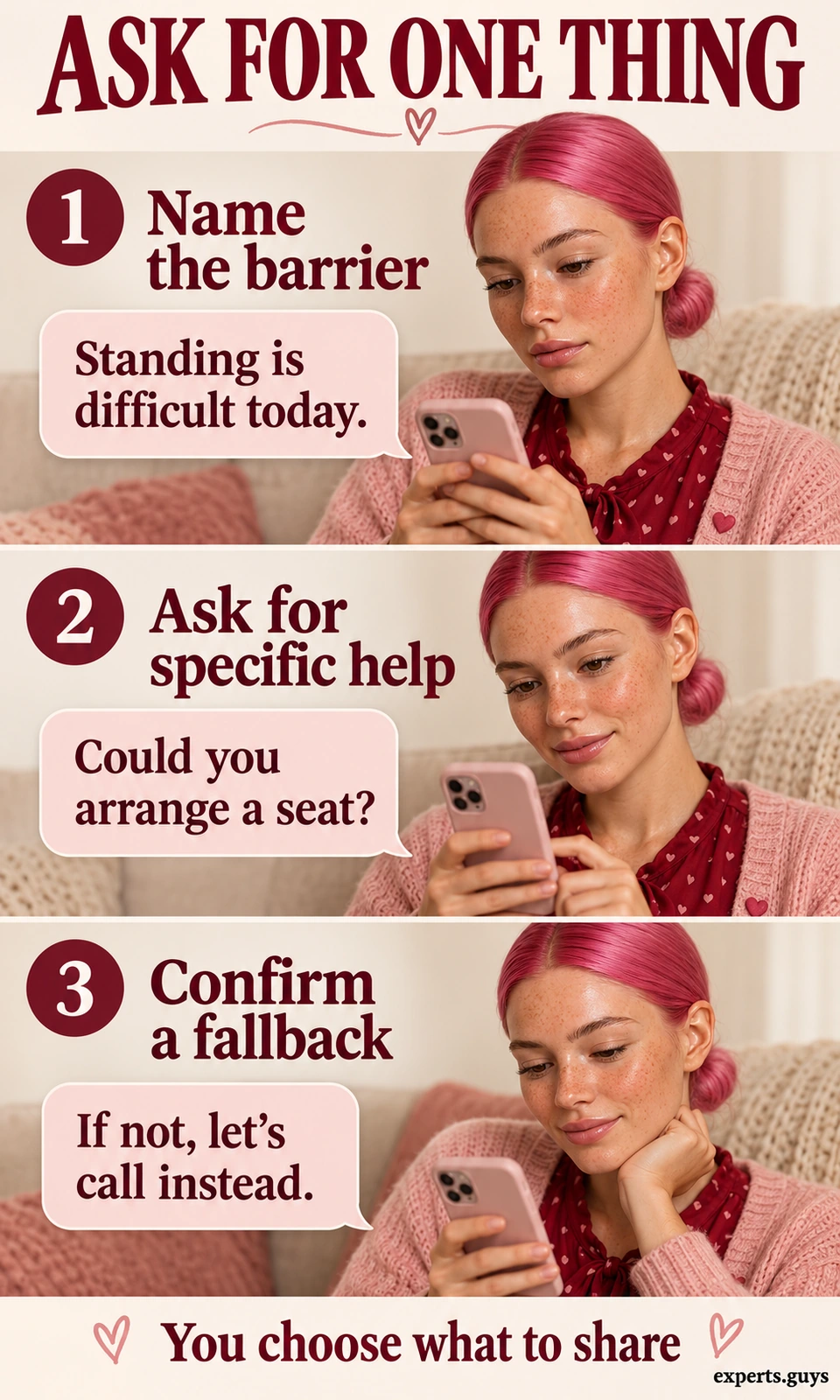
A concrete request helps someone act without having to interpret a pain score or understand your entire medical history. Name the barrier, ask for a specific change and give a fallback you genuinely find acceptable. This is an access conversation, and you decide how much health information to disclose.
- Barrier: “Standing is difficult today.”
- Request: “Could you arrange a seat?”
- Fallback: “If not, let’s call instead.”
The example works because the other person can answer the request directly. Avoid testing whether someone cares by expecting them to infer the right accommodation from “I’m struggling”; say what would help, then check their reply. If explaining aloud is tiring, send the short message, and share only what feels appropriate for that relationship.
An adapted plan may help with access while leaving low interest or emotional distance unresolved. That is useful information, not evidence that you chose the wrong chair or failed to try hard enough. The separate guide to social withdrawal and depression explores those broader patterns, while pain-management guidance on meaningful activity and manageable goals supports keeping practical goals realistic.
How do you share responsibilities without making pain a relationship argument?
Make the work visible and agree who owns each part, instead of asking either person to prove that they are trying hard enough. A household task can contain decisions, reminders, carrying, standing and cleanup, with different demands for each person. The aim is a workable agreement that both people can revisit, not a calculation of whose discomfort matters more.
Separate a task into decision work and physical work
Choose one recurring task that is causing friction, such as groceries, rather than renegotiating the whole household at once. Use the shopping app or message thread already involved in the task. The following handoff is an organizational example; it does not assume that someone with pain is always able to do the mental work.
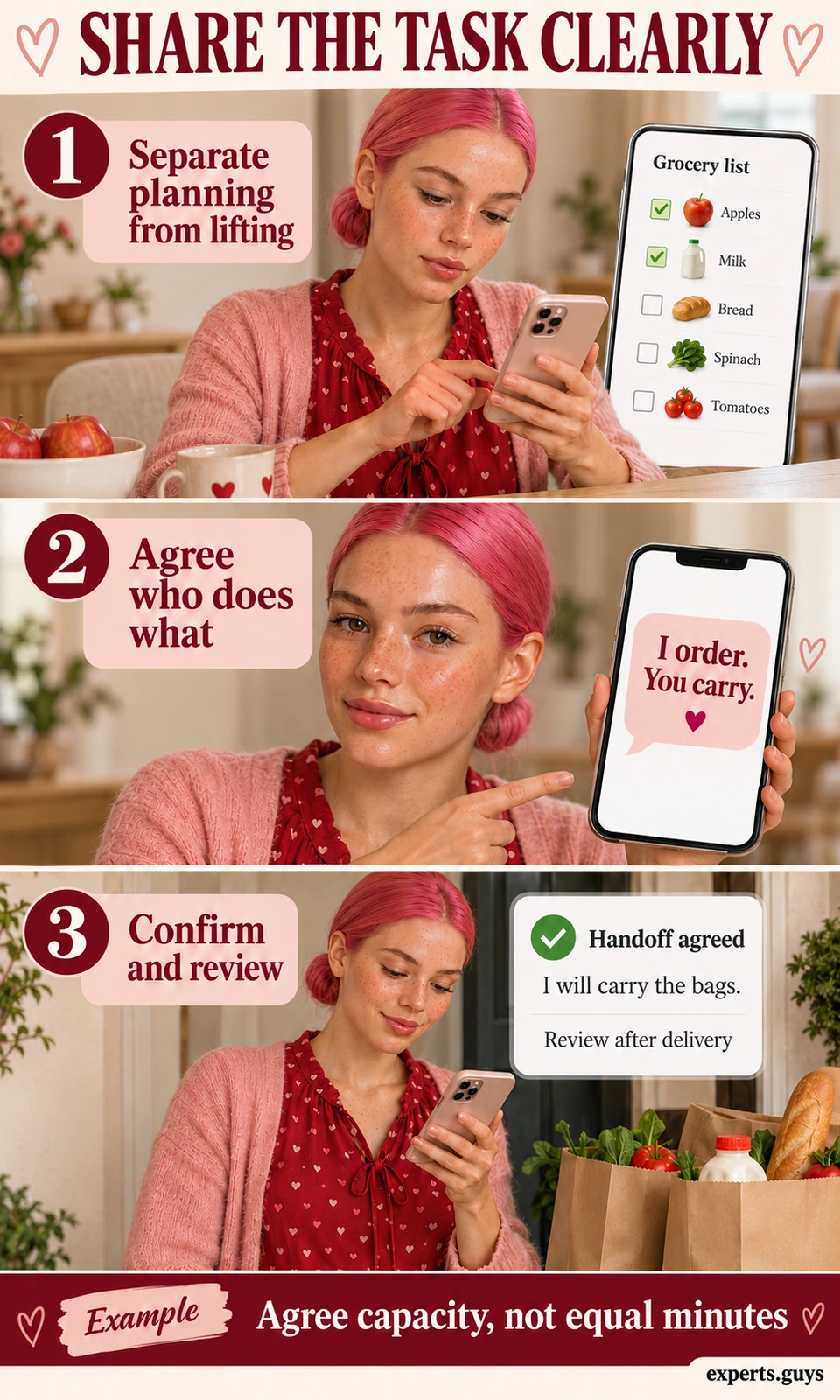
- Separate: identify the decision work, the physical work and any follow-up, such as choosing items, ordering, carrying bags and unpacking.
- Agree: assign each part to someone who accepts it and can currently manage it; include paid or community help only if actually available.
- Confirm: check that the handoff happened and revisit it when capacity changes, instead of silently extending the arrangement forever.
In the illustrated example, one person orders groceries and another agrees to carry them. A frequent mistake is assigning all planning to the person staying home, even when low mood makes concentration difficult; a saved shopping list or shared ordering session may be easier. If nobody has capacity, reduce the task or seek practical support, and assess success by whether essential needs are met without an unagreed burden.
Practical agreements can reduce ambiguity, but they do not resolve every relationship problem. Threats, coercion or controlling access to care are safety concerns, not failures to communicate clearly enough. For repeated arguments and wider patterns, use the separate depression and relationship conflict guide; this page stays focused on the demands added by persistent pain.
What should you bring to a review when pain and mood both need attention?
Bring a short account of function, mood and treatment effects, then ask how the next steps fit together. Depression may be treated with talking therapy, medicine or both, while pain care depends on its cause and type. A clinician needs to consider physical causes, depression and treatment-related difficulties rather than treating a single pain score as the whole story; a digital note can support that conversation, but you can also simply say the examples aloud.
Bring both concerns into the same appointment
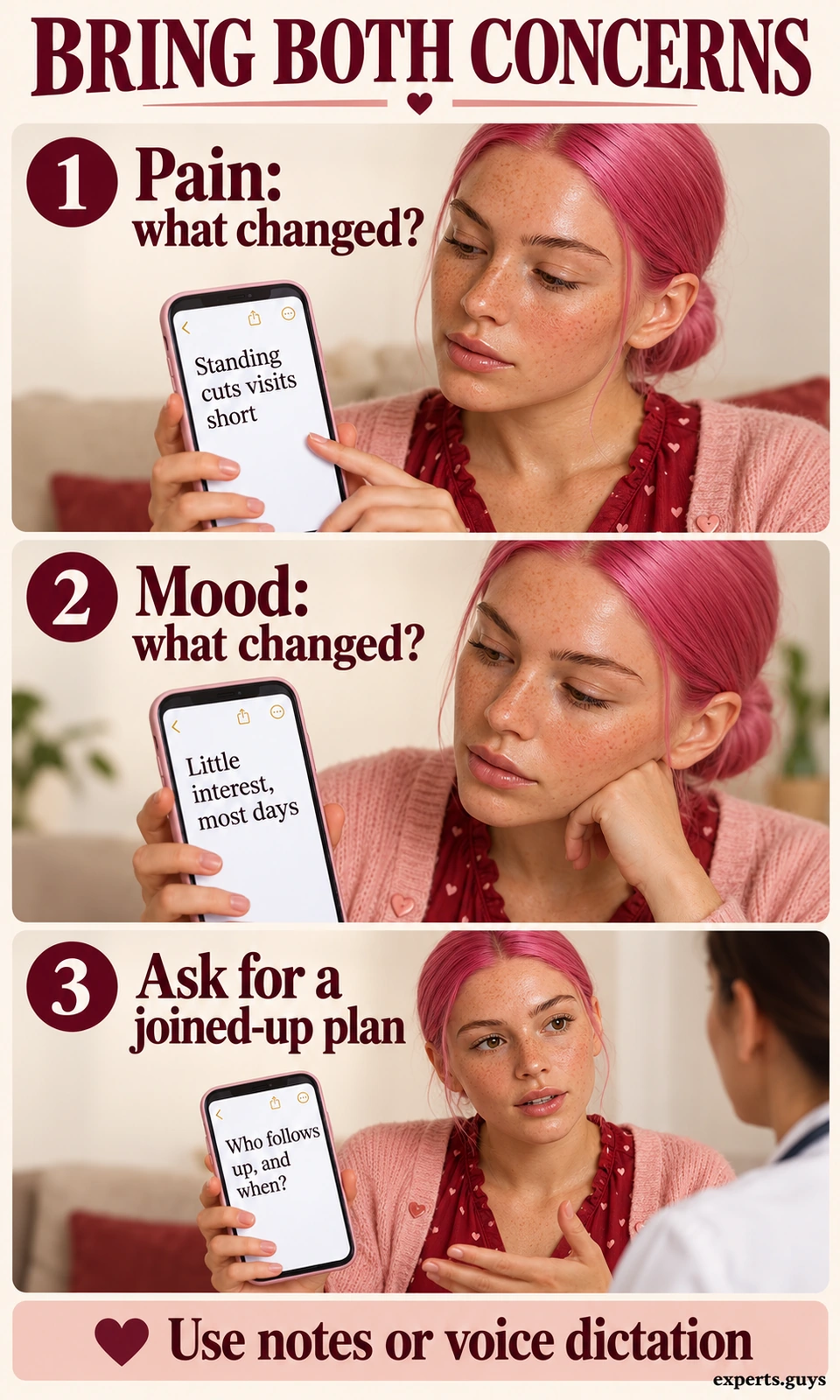
Prepare for a routine review by choosing one specific example of a pain-related limitation and one of a mood change. Include when the changes began and whether they are becoming more frequent or difficult. Keep the note brief enough to open with it, rather than saving the mood concern until the appointment is ending.
- Pain: describe the activity affected and any change from your normal pattern.
- Mood: describe interest, mood and daily function in your own words, including how long the change has lasted.
- Coordination: ask what is being assessed, who owns the next step and when follow-up should happen. Ask what changes would need earlier contact.
For example: “Standing cuts visits short, and I have had little interest in seeing people most days for several weeks.” Follow with “Who follows up on both concerns, and when?” If you freeze in appointments, show the note or bring a support person with your agreement; check that you leave knowing the next action, rather than interpreting a referral as a complete plan.
Compare treatment benefit with treatment burden
Prepare a medicine review when an effect such as drowsiness, dizziness or reduced concentration is disrupting activities, or when you are unsure what a medicine is helping. Use your current prescription list and packages to identify what you actually take, including non-prescription products and supplements. The discussion is about benefits, unwanted effects and safety; it is not an invitation to experiment with doses.
- Check the list: verify names and prescribed instructions, and tell the clinician about missed doses or other differences without guessing.
- Describe the trade-off: give one concrete benefit and one burden, or say clearly when you have noticed no benefit.
- Ask for review: discuss the pattern with your prescriber or pharmacist and ask what to do next, including when to reassess.
An example is “I seem to sleep better, but daytime drowsiness makes the journey to see friends difficult.” Do not abruptly stop or change a medicine yourself, and do not drive when impaired; guidance on reviewing medicines for persistent pain explains why benefit and side effects both matter. If the list is confusing, bring the packages or ask the pharmacy for help, then confirm that you understand the agreed instructions.

Check what changed beyond the pain score
At the follow-up you have agreed, compare participation, recovery and mood separately. This avoids declaring everything unsuccessful because pain remains present, or declaring everything resolved because one outing went better. Use a brief phone note or voice memo only if it helps; an exhaustive diary is unnecessary for the examples below.
- Participation: name something you could do, could not do or had to change.
- Recovery: describe how the activity affected the rest of that day or the next, without forcing a numerical score.
- Mood: say whether interest, hopelessness or withdrawal changed, then discuss the pattern with your care team.
| Illustrative observation | What it can tell the review | What it cannot prove |
|---|---|---|
| “I kept a short visit.” | The adjusted format was possible on that occasion. | That the underlying pain condition has improved. |
| “I needed less recovery time.” | The demands may have been more manageable. | That increasing the next outing is automatically appropriate. |
| “My interest is still low.” | Mood still needs attention alongside participation. | A diagnosis or a failed treatment by itself. |

The common mistake is changing several things at once and then deciding that one of them caused the result. Describe what happened and what else changed, keeping uncertainty visible. If the method itself becomes burdensome, bring one remembered example; worsening function, significant side effects or safety concerns justify earlier contact rather than waiting for a scheduled review.
Frequently asked questions
Does an antidepressant prescription mean the clinician thinks my pain is imaginary?
No. Some antidepressants are also used for particular pain conditions, so the name alone does not tell you why it was prescribed. Ask what symptom it targets, what benefit to expect and how its effects will be reviewed; do not change it independently.
Do I need to explain my depression to everyone when I change a plan?
No. You can explain the practical adjustment, such as needing a seat or a call from home, without sharing a diagnosis. Share more only when you want to, or when a healthcare conversation needs the information for appropriate care.
Can I use these examples if I do not have a partner?
Yes. A friend, relative or another trusted person may be involved, and some adjustments can be made directly with a venue or service. If practical support is unavailable, say so during your care review rather than treating an unavailable helper as part of the plan.
What if a familiar activity makes me substantially worse afterward?
Do not keep increasing it to meet an arbitrary target. Describe the delayed change to your clinician and ask how to adapt activity to your condition; some illnesses need specific activity-management advice. These social-planning examples are not an exercise programme or a graded-exercise prescription.
Choose the next step that fits the problem
A new symptom needs attention to the change; an inaccessible outing needs a different setup; ongoing low mood needs its own care discussion. Choose the one obstacle that is currently stopping you and use the matching example, without turning the whole day into a self-improvement project. The goal is a workable next step while pain and mood receive the care they need.
The urgent back-pain warning signs support the early safety guidance above. All scenarios and images here are illustrative examples, not patient accounts or evidence of treatment results.









