The best samurai games offer different pleasures: Ghost of Tsushima Director’s Cut is the strongest starting recommendation for a cinematic adventure, while Sekiro suits players who want sword combat to become a demanding skill. Choose Nioh 2 or Nioh 3 when building a character and learning layered combat systems sounds as enjoyable as winning the fight.
A katana on the cover tells you surprisingly little about the evening ahead. You might spend it exploring countryside, repeating a boss encounter, comparing equipment or watching a character drama, so this shortlist matches ten games to those activities rather than treating them as interchangeable.
These are editorial recommendations based on each game’s documented design, supported platforms and relevant limitations, rather than numerical ratings or a claim of first-hand performance testing. The selection includes samurai protagonists and adjacent Japanese sword adventures; Sekiro’s lead is a shinobi, and the historical settings throughout the list contain substantial fictionalisation.
Which samurai game matches the experience you want?
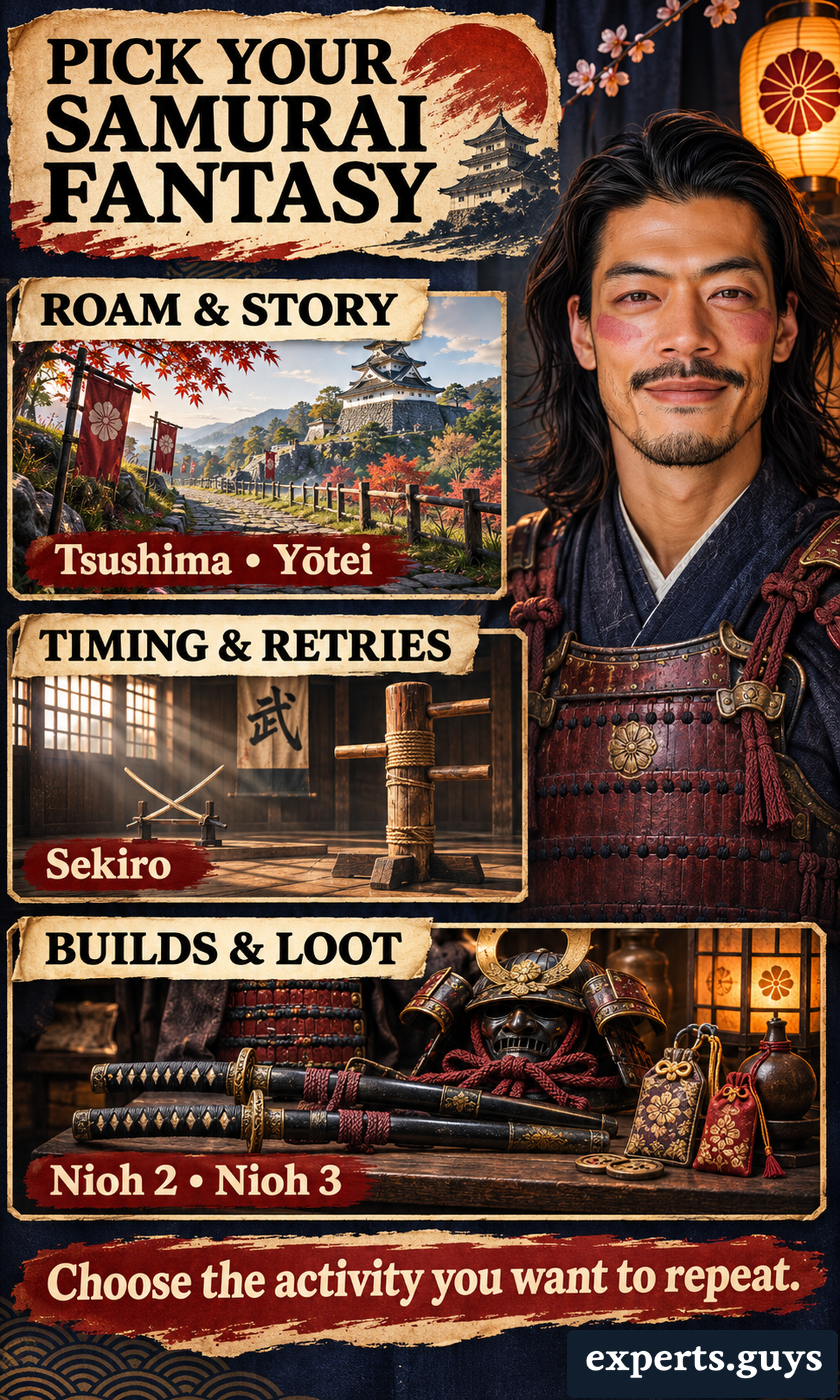
Start with the activity you want to repeat. For a first purchase, the useful distinction is between a cinematic adventure, a precision combat challenge and an action RPG with extensive character-building decisions; the remaining picks serve more specific preferences.
| Game | Best fit | Why choose it | Main condition |
|---|---|---|---|
| Ghost of Tsushima Director's Cut | First cinematic samurai adventure | Story, exploration and flexible combat | Large-world travel is part of the experience |
| Ghost of Yōtei | A different Ghost journey | Standalone Atsu story in northern Japan | PS5; check the edition contents |
| Sekiro: Shadows Die Twice | Precision and mastery | Posture pressure and demanding encounters | Single-player; repeated attempts are central |
| Nioh 3 | Hybrid styles and exploration | Samurai/Ninja switching in open fields | Layered systems; no PS5-PC crossplay |
| Nioh 2 | Builds and bounded missions | Stances, Ki and equipment refinement | Frequent system and gear decisions |
| Rise of the Ronin | A created character and choices | Open-world action RPG with adjustable difficulty | Co-op covers supported missions |
| Assassin's Creed Shadows | Stealth and direct-combat contrast | Naoe and Yasuke have different approaches | A broad adventure; not solely one swordsman |
| Like a Dragon: Ishin! | Period character drama | Swords, firearms and varied fighting styles | Heightened fiction rather than simulation |
| Samurai Warriors 5 | Battlefield spectacle | Crowd-clearing momentum and objectives | Co-op unlock and version restrictions |
| Trek to Yomi | Directed, film-inspired atmosphere | Monochrome presentation and a linear journey | Less scope for open-world or build freedom |
The order below starts with broad entry points and then moves into specialist choices. A lower position does not mean a worse game: Samurai Warriors 5 can be the better purchase than Sekiro for someone who wants spectacular battlefield momentum rather than an evening spent learning one opponent.
1. Ghost of Tsushima Director’s Cut: the best first samurai adventure
Choose it for a coherent mix of sword fights, exploration and story. Jin Sakai’s struggle during the Mongol invasion gives the adventure a clear centre, while travel, stealth and ranged options provide space between close combat encounters. Director’s Cut includes the Iki Island expansion, making the edition relevant to the purchase rather than merely a cosmetic label.
Its strongest advantage for an undecided newcomer is flexibility. You can enjoy the landscape and character journey without committing to the equipment complexity of Nioh, and the difficulty options give you more control over resistance than a fixed-challenge combat game. That combination makes it the most defensible starting recommendation when someone asks for a samurai game without yet naming a preferred subgenre.
The trade-off is the open-world rhythm. If travelling, optional discoveries and returning to familiar activities already sound like obligations, the scenery will not automatically solve that mismatch. Pick it because the journey appeals, rather than assuming that every moment will resemble an isolated, cinematic duel.
Our Ghost of Tsushima Director’s Cut review covers the edition and wider adventure in more detail. This shortlist’s job is the earlier decision: whether its mixture of activities suits you better than the alternatives.
2. Ghost of Yōtei: a fresh Ghost adventure after Tsushima
Choose it for another expansive sword adventure with a different lead and setting. Ghost of Yōtei follows Atsu in northern Japan, roughly 300 years after Tsushima. It is a standalone story, so familiarity with Jin’s journey can provide series context without becoming required narrative homework.
The recommendation becomes stronger when your favourite part of Tsushima was inhabiting its world. Another landscape to explore, a new character motivation and a broader weapon-focused direction offer reasons to continue within the series’ style. Conversely, someone who disliked the underlying explore-and-fight structure should investigate that structure before treating a different protagonist as the solution.
For a newcomer who owns a PS5, choosing Yōtei first is reasonable if Atsu’s setting and revenge story are the stronger attraction. Tsushima remains our default entry recommendation because it directly supplies the original Jin Sakai samurai adventure, not because playing it first is compulsory. Neither story needs to be reduced to a graphics contest.
Yōtei’s current official game page lists PS5 and distinguishes the available editions. Check the included content when comparing offers; a familiar game title does not establish that two listings contain the same package.
3. Sekiro: Shadows Die Twice: the choice for sword mastery
Choose it when learning the exchange is the main attraction. Sekiro concentrates its sword fighting around attack pressure, deflection and Posture. Its protagonist, Wolf, is a shinobi rather than a samurai, but the demanding blade encounters make it directly relevant to readers searching for Japanese sword combat.
The important mechanism is that defence can advance the fight. A well-timed deflection contributes to an enemy’s Posture pressure, while attacking helps prevent the exchange from becoming passive waiting. Activision’s combat mechanics explanation describes how attacks and deflections build the opening for a Deathblow.
That design creates a particular kind of satisfaction: the player becomes more capable at reading and answering an opponent. It also creates a purchase risk. If your preferred escape from a difficult boss is lowering a conventional difficulty setting or inviting a friend into the fight, Sekiro does not offer that route. Its single-player structure and demanding baseline belong near the recommendation, not in the small print.
Choose something else when the story is your only reason for persisting through combat. Sekiro is a strong specialist recommendation precisely because the challenge occupies so much of the experience; it becomes a weaker general recommendation when that same challenge blocks the reader’s actual goal.
4. Nioh 3: a hybrid for players who want more combat options
Choose it for a demanding action RPG built around switching approaches. Nioh 3 combines Samurai and Ninja combat styles with exploration across open fields. It belongs on a current shortlist as an available game, rather than an upcoming possibility; the official overview lists PS5 and Steam.
The styles change the decisions within an encounter. Samurai play emphasises direct engagement, martial techniques and timed defensive opportunities, while Ninja play brings agile movement and ninjutsu. The attraction is adapting how you fight, not simply equipping an outfit that makes one unchanged moveset look different.
That breadth makes Nioh 3 a more interesting next step for someone who wants to keep learning systems after becoming comfortable with a simpler action adventure. It is less attractive when the obstacle is already too many gauges, equipment choices and unfamiliar terms. More options are valuable only when experimenting with them is part of the pleasure.
The official Nioh 3 systems guide documents the two styles and online features. Our recommendation is based on that design distinction: choose it for the hybrid combat and exploration, rather than assuming the newest numbered entry must fit every reader better.
5. Nioh 2: the specialist pick for builds and mission-based combat
Choose it when refining a character is part of the entertainment. Nioh 2 layers weapon movesets, stances, equipment and supernatural abilities into a mission-based action RPG. Its half-human, half-yokai protagonist also makes the fantasy element central rather than an occasional departure from historical drama.
Ki is a useful illustration of the difference from a straightforward adventure. Combat involves managing a resource, and a Ki Pulse can recover a portion spent on actions. Weapon choices and stance behaviour add further decisions, so the learning experience extends beyond memorising the moment to press one defensive button.
Prefer Nioh 2 over Nioh 3 when its mission structure and particular systems are the attraction. Prefer Nioh 3 when the newer hybrid styles and open fields are what you want to explore. There is no need to turn that distinction into an unsupported claim that one is universally deeper, easier or better value at every price.
The caution is equipment administration. If inspecting another item feels like friction rather than a possibility, a long build-focused game may work against your reason for playing. Someone who enjoys that comparison can find value in refinement itself; someone who wants uninterrupted narrative momentum should give Tsushima or a more linear adventure greater weight.
Why these sword systems feel different
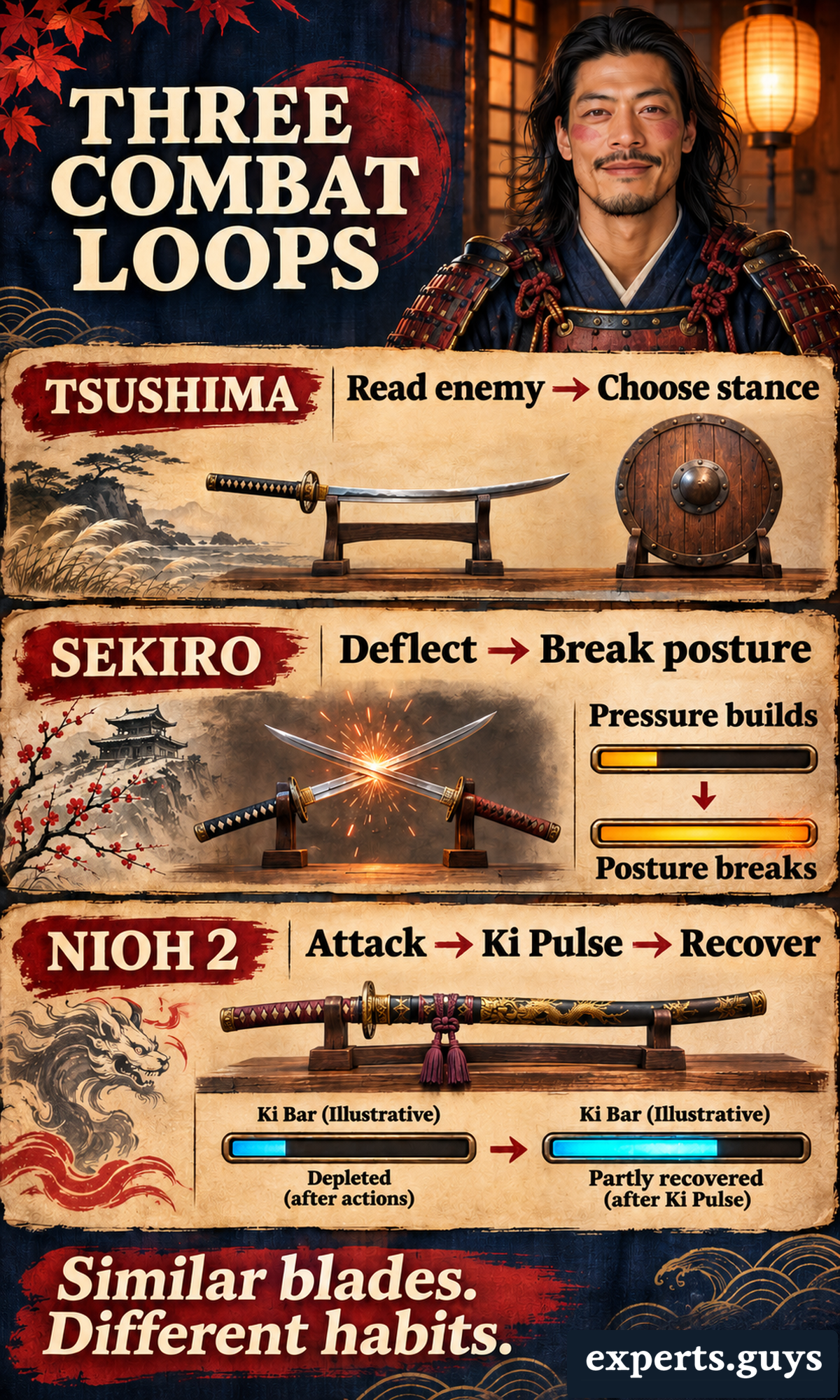
Tsushima asks you to recognise opponents and select useful responses, Sekiro turns pressure and deflection into a Posture contest, and Nioh 2 adds resource recovery and build decisions to the exchange. These are differences in the actions you repeat, not merely different difficulty labels applied to the same sword fight.
The comparison below illustrates those priorities rather than reproducing a game interface. It is a selection aid, not a combat tutorial: the question is which decision you would enjoy making repeatedly once the initial spectacle becomes familiar.
6. Rise of the Ronin: a created character in a changing Japan
Choose it for an open-world role-playing adventure with a character of your own. Rise of the Ronin combines a customisable protagonist, historical faction choices and a mixture of Japanese and Western weaponry. Its Bakumatsu setting brings firearms and political change into the fantasy rather than presenting every encounter as an isolated katana duel.
The appeal differs from following Jin’s fixed identity. Making a character and deciding which relationships or allegiances interest you can be the reason to explore. The combat also has its own counter-focused identity through Counterspark, rather than functioning as a copy of either Ghost or Nioh.
Difficulty selection makes Ronin worth considering when you want mechanical depth without assuming that a demanding default must be your only route. That does not mean the systems vanish on a lower setting; it means you have more control over how much resistance accompanies learning them.
Check the developer’s current platform information when shopping. Ronin is available on Steam as well as PS5, despite older console-focused pages still describing it as exclusive. Its co-op also has mission boundaries, which matters if your buying plan depends on roaming the entire world together.
7. Assassin’s Creed Shadows: stealth and samurai contrast
Choose it when infiltration deserves as much attention as direct fighting. Shadows pairs the shinobi Naoe with the samurai Yasuke, giving the adventure two deliberately contrasting protagonists. That is a meaningful reason to choose it over a game centred on one warrior’s core sword system.
Naoe’s stealth-oriented approach and Yasuke’s more direct combat support different kinds of encounter. The purchase makes most sense when you want that contrast within a large historical-Japan adventure. It makes less sense when your requirement is uninterrupted play as one traditionally armoured swordsman, regardless of what the mission or character structure asks.
World scale is another condition. A broad landscape, reconnaissance and side activity can be a benefit for someone seeking an extended place to inhabit, but a burden for someone looking for a tightly bounded series of duels. Decide whether the connective activity is appealing before letting a spectacular combat clip make the decision alone.
Ubisoft’s current Shadows page lists the supported platforms, including Switch 2. Do not confuse that with an original Switch release, and do not assume footage captured on one system predicts the presentation on another.
8. Like a Dragon: Ishin!: character drama with swords and firearms
Choose it for a story-led adventure whose personality extends beyond combat. Ishin! follows a fictionalised Sakamoto Ryoma through a dramatic Bakumatsu-era tale. Its appeal includes character relationships, tonal changes and the life around the central plot, rather than treating the setting primarily as a succession of combat arenas.
Its four fighting styles also distinguish it from a pure sword-only fantasy: Swordsman, Gunman, Wild Dancer and Brawler. The combination of blades, guns and unarmed action should be a positive part of the attraction. If you are seeking a restrained simulation of one historical sword discipline, the variety points in a different direction.
Ishin! is a useful alternative when you want Japanese period atmosphere but are tired of a large wilderness travel loop. The more concentrated setting and story priorities change what occupies the space between fights. That does not make it automatically quick to finish, particularly if optional activities become a major part of your visit.
SEGA’s Ishin! overview explains the combat styles and setting. Treat the history as a dramatic framework rather than a literal record, and choose the game for its storytelling tone instead of expecting the same emotional register as a solemn samurai film.
9. Samurai Warriors 5: battlefield spectacle and momentum
Choose it when you want to cut through crowds and keep moving. Samurai Warriors 5 belongs to the Musou style of action: large-scale encounters, expressive attacks and battlefield objectives. That purpose gives it a different appeal from games where a single ordinary opponent demands extended caution.
The design rewards a sense of sweeping progress. The official systems description connects Hyper Attacks with moving through enemies and linking attacks, which helps explain why it serves a player seeking momentum. A crowd encounter and a precision duel can both involve swords while producing very different levels of attention to each individual enemy.
The main limitation is repetition tolerance. If clearing groups stops feeling satisfying once the spectacle becomes familiar, a different cast or another weapon may not create the type of depth you want. If battlefield flow is exactly the activity you enjoy, the absence of Sekiro-style concentration on one opponent is an advantage.
It also deserves a place on a co-op shortlist, with conditions. Koei Tecmo’s official Co-officer manual explains the unlock requirement and excluded battles; its online restrictions also include region and language compatibility, and the Luna version does not support online Co-officer play. Check the version rather than buying from the multiplayer label alone.
10. Trek to Yomi: a focused samurai-film direction
Choose it for monochrome presentation and an authored journey. Trek to Yomi uses striking cinematic framing and a more directed structure than the sprawling adventures above. Its young swordsman Hiroki and supernatural journey support a film-inspired experience rather than a character-build playground.
This is the useful recommendation when your hesitation is commitment to a large map. A more linear path can reduce the number of choices between one story moment and the next, giving the experience a clearer direction. That is a structural advantage, not a promise that every player will finish within a particular number of evenings.
The trade-off is freedom and mechanical expectation. Choose it because composition, atmosphere and forward motion matter to you, rather than assuming it will replace the combat variety or long-term experimentation of Nioh. Black-and-white presentation can be the reason to buy a game, but it does not establish that its sword system is the deepest one.
If you are comparing it with an open-world purchase, ask what you actually want to remove: travel, map decisions, equipment management or lengthy commitment. Trek to Yomi is especially relevant to the first two; the exact fit still depends on whether its ordinary gameplay, rather than the trailer alone, appeals.
How should difficulty and available time change the choice?
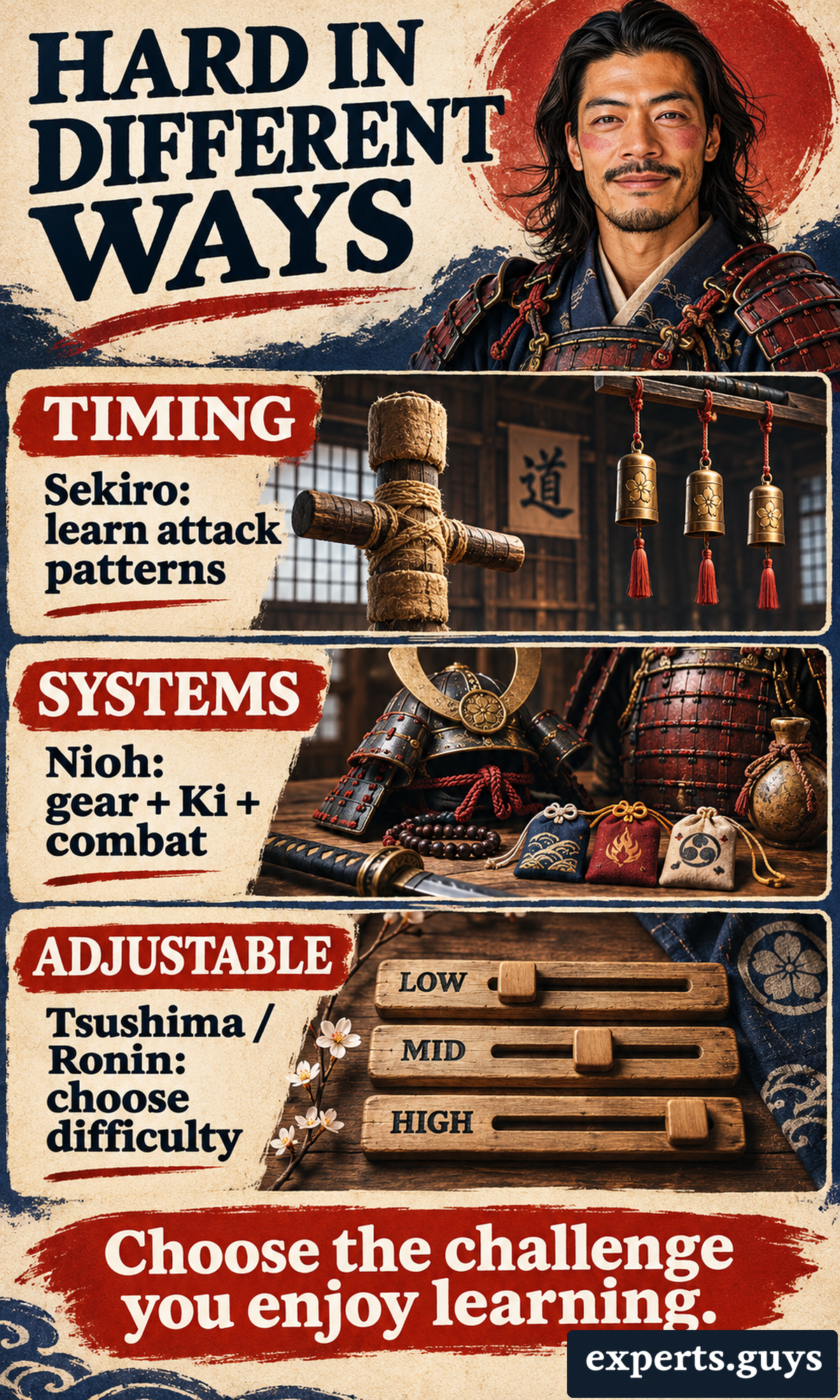
Choose by the kind of effort you enjoy, then by how your sessions usually end. A game can be difficult because of precise execution, layered systems or a long sequence of decisions, and those demands do not affect every player equally.
Separate execution difficulty from system complexity
Execution difficulty asks whether you can recognise a cue and respond consistently. System complexity asks whether you understand what your equipment, resources and options are doing. Sekiro puts unusually strong emphasis on the first, while Nioh combines demanding execution with extensive systems; liking one burden does not establish that you will like the other.
An adjustable adventure can therefore be the more useful purchase even for an experienced player. You might want to learn its sword system while keeping the story moving, or prefer to raise the resistance later. Ronin’s documented Dawn, Dusk and Twilight settings make that flexibility explicit, including additional assistance options under Dawn.
Equipment can change a game’s demands without removing its identity. The Ghost of Tsushima armour guide is useful after choosing that game, when the question becomes which equipment supports your combat habits. It should not be necessary to understand a detailed build before deciding whether the broader adventure appeals.
Think about what counts as a satisfying stopping point
A mission-based game offers a clearer objective boundary, but a difficult mission may still exceed the time you intended to spend. An open-world game offers more freedom to choose an activity, yet travel and optional discoveries can consume the session before a story objective advances. Neither structure guarantees that a short evening will feel productive.
For an illustrative example, imagine a player with 45 minutes after work. One person would be pleased to explore a new valley and stop without completing a mission; another would feel that nothing happened. The first has a stronger reason to shortlist a Ghost game, while the second should investigate more bounded mission or linear structures before buying a large world.
A boss-focused session introduces a third possibility: progress can mean understanding an attack rather than defeating the opponent. That can be absorbing when learning is the point and frustrating when visible story progress is the reward you wanted. Make that distinction before comparing completion-time estimates, which cannot predict how often you will retry.
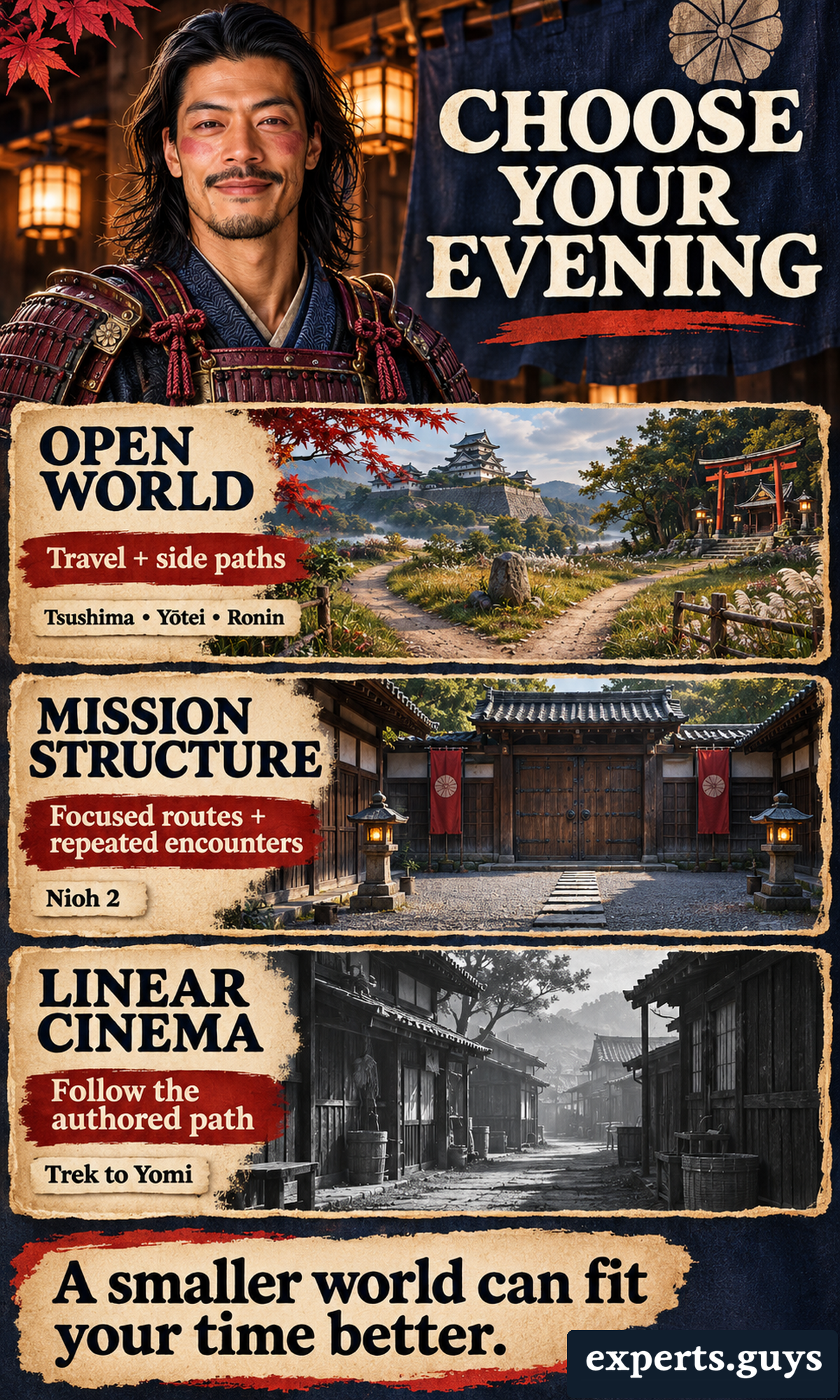
Practical takeaway: choose a structure that lets your normal stopping point feel satisfying. A large game is good value when you want its repeated activities; a smaller, more directed game can be better value when it delivers the experience you will actually finish.
Which platforms, editions and co-op modes matter?
Platform support is the first filter, and multiplayer needs a second, separate check. The table lists the main local-play releases relevant to these recommendations; streaming services, compatibility features and regional store availability need their own verification.
| Game | Platforms | Mode or version condition |
|---|---|---|
| Ghost of Tsushima Director's Cut | PC, PS4, PS5 | Legends is separate from Jin's solo campaign |
| Ghost of Yōtei | PS5 | Legends is separate from Atsu's solo campaign |
| Sekiro | PC, PS4, Xbox One | Single-player |
| Nioh 3 | PC (Steam), PS5 | Co-op; no crossplay between platforms |
| Nioh 2 | PC, PS4, PS5 Remastered | Online cooperative modes; check version compatibility |
| Rise of the Ronin | PC (Steam), PS5 | Supported missions for up to three players |
| Assassin's Creed Shadows | PC, PS5, Xbox Series X|S, Switch 2, Apple-silicon Mac | Single-player; original Switch is a different platform |
| Like a Dragon: Ishin! | PC, PS4, PS5, Xbox One, Xbox Series X|S | Single-player |
| Samurai Warriors 5 | PC, PS4, Xbox One, Switch | Local/online Co-officer conditions apply; check newer-console compatibility |
| Trek to Yomi | PC, PS4, PS5, Xbox One, Xbox Series X|S, Switch | Single-player |
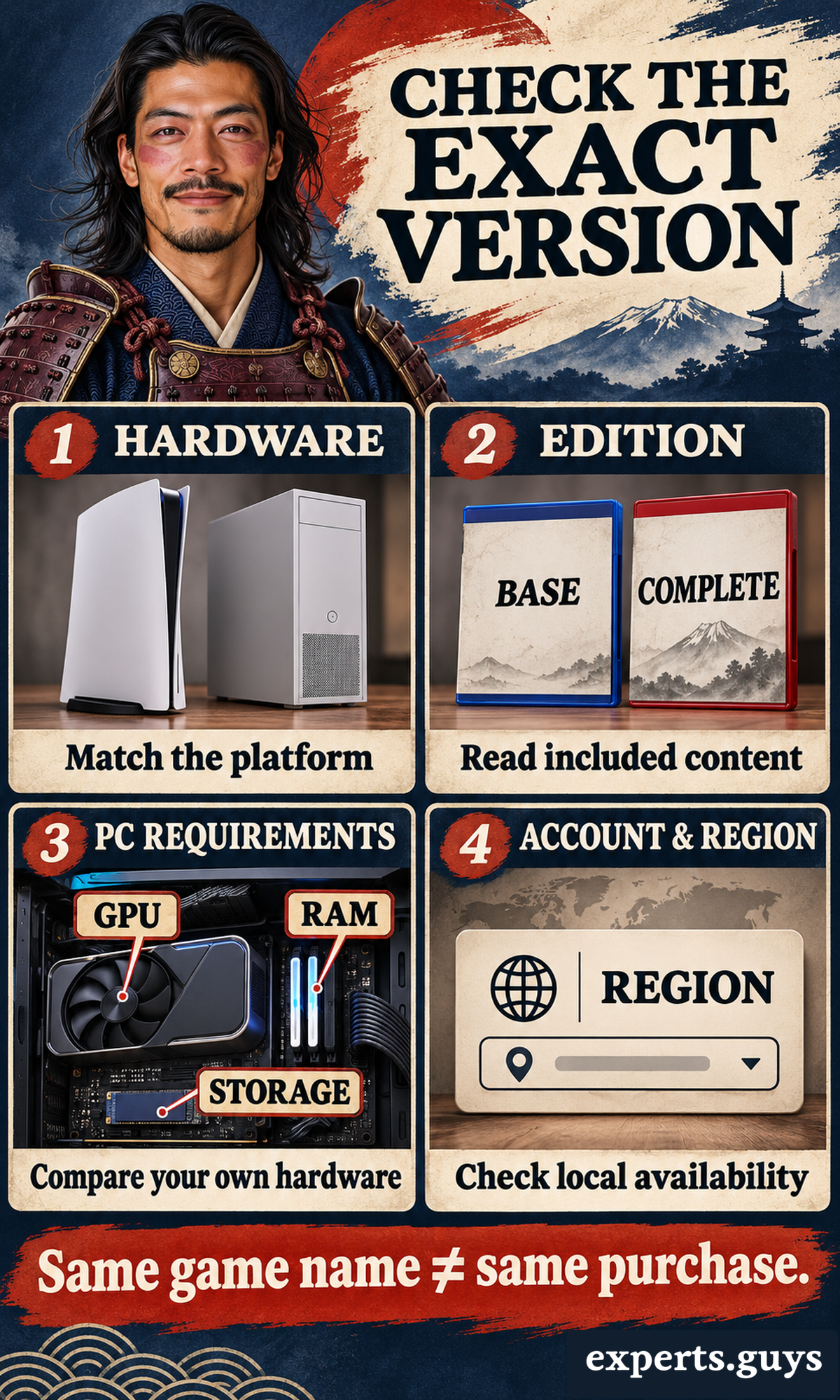
Check the exact version before paying
First match the listing to your hardware, including the console generation. Next read the edition contents rather than relying on words such as Deluxe or Complete, which do not have one consistent meaning across publishers. Then compare PC requirements with your actual processor, graphics card, memory and available storage, or confirm the relevant console version.
Finally, check your store region, account conditions and the mode you intend to use. These steps are particularly useful when a sale makes several editions look interchangeable. If the listing cannot answer a requirement that matters to you, keep the purchase pending rather than assuming the most expensive edition resolves it.
For example, PlayStation’s Tsushima PC requirements distinguish performance targets and identify account requirements for online features. A minimum specification means something different from the hardware recommended for your chosen resolution and frame rate; it is not a promise of identical performance on every PC carrying the same GPU family name.
Ask what you will actually play together
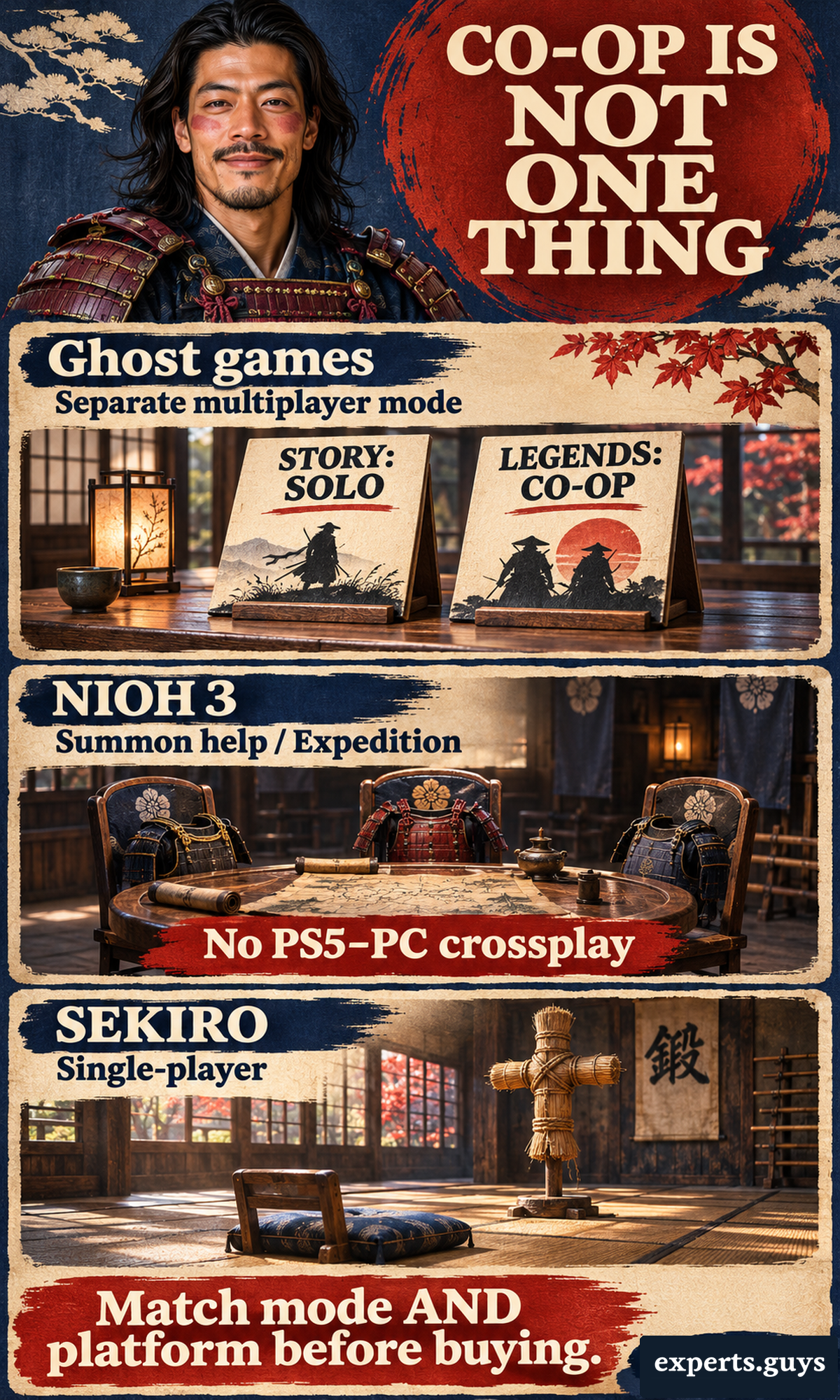
Co-op can mean a separate multiplayer mode, assistance during an encounter, selected missions or shared exploration within supported areas. Those arrangements are not interchangeable. A pair buying a game to follow its central hero’s entire story together needs a more specific answer than a store badge saying online play.
In the Ghost games, the main character campaign is solo and Legends is a separate multiplayer experience. The official Tsushima Legends overview distinguishes its two-player story missions and larger group modes. Yōtei Legends likewise supplies its own co-op activities rather than turning Atsu’s campaign into a shared playthrough.
Nioh 3 offers Summon Visitor and Expedition features, with online play for up to three players, but the developer explicitly excludes crossplay between platforms. Ronin supports co-op in numerous missions rather than promising unrestricted shared-world travel. Sekiro remains a solo choice, so it should leave the shortlist when playing the combat together is a non-negotiable requirement.
Crossplay also needs a game-specific answer. PlayStation’s Tsushima PC support page describes friend-invite crossplay between PC, PS4 and PS5 as a beta feature and states that online multiplayer is unavailable on Steam Deck. That is more useful than assuming PC availability means every PC-like device and every matchmaking route has identical support.
Practical takeaway: agree on the exact game, version, platform and multiplayer mode with your friend before either purchase. For local play, verify local co-op explicitly; online co-op does not imply two players can share one screen.
How can you choose one game without buying the wrong fit?
Reduce the list with one non-negotiable requirement and one preferred activity. Then inspect ordinary play and the exact edition before spending; this is more reliable than trying to convert ten different designs into one universal score.
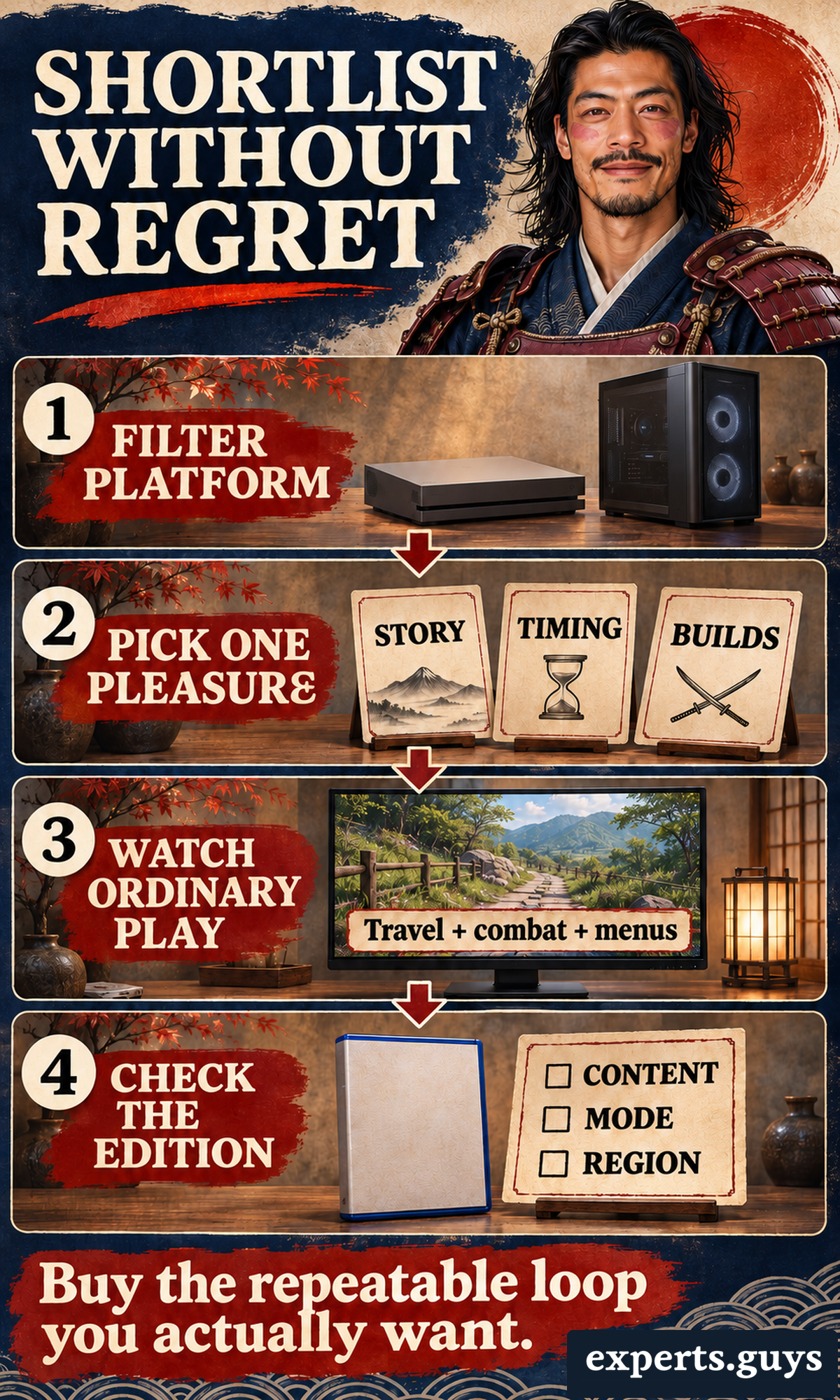
A four-step shortlist that ends in a usable decision
- Filter the platform. Remove games that do not have the version or multiplayer compatibility you need. An unavailable favourite is not a useful finalist, and there is no need to buy different hardware simply because a ranking places it first.
- Pick one main pleasure. Choose story and exploration, timing and mastery, or builds and experimentation as your leading preference. For a specialist preference such as battlefield spectacle or monochrome cinema, keep the corresponding specialist pick instead.
- Watch ordinary play. Look at travel, a normal encounter and the equipment or progression menus. A short representative section is more informative for this decision than a montage of finishers, dramatic scenes and late-game abilities.
- Check the edition. Confirm the included content, intended mode and regional listing. Finish with one game whose usual activities fit your preferences; if an essential condition remains unclear, leave that purchase pending.
The common mistake is deciding from the best-looking moment, then hoping the rest of the game will resemble it. Correct that by checking the activity around the moment: how you reached the fight, what you do afterwards and how frequently it repeats. If video spoilers are a concern, use a spoiler-light early-game segment or an official gameplay overview instead of a complete walkthrough.
A worked choice: returning to sword games without another large map
Consider an illustrative player who owns a capable PC, enjoyed Tsushima’s duels and now wants less wandering. Multiplayer is optional, and comparing equipment is usually tedious. That player should place Sekiro and Trek to Yomi ahead of another open-world adventure, but for different reasons: Sekiro preserves demanding blade encounters, while Trek changes the structure toward a directed cinematic journey.
The deciding question is whether repeated attempts sound inviting. If yes, Sekiro has a stronger fit; if the priority is forward narrative movement and film-like atmosphere, Trek deserves the closer look. Nioh 2 should not automatically win because it has more combat systems: the player’s stated dislike of equipment management is a real cost.
Change the constraints and the recommendation changes. If the same player enjoys experimenting with character setups, Nioh 2 becomes a much stronger finalist. If shared exploration and a new hybrid fighting system matter more than avoiding menus, Nioh 3 deserves attention, subject to the platform restrictions already described.
Use price as a tie-breaker after fit
A discount can decide between two suitable games, but it rarely repairs a fundamental mismatch. An inexpensive purchase that you avoid launching is poor value, while a more expensive game can be worthwhile if its ordinary activities are exactly what you want to return to. Compare the full edition you need, rather than a base price against a bundle with different content.
Existing access also matters. If you already own a suitable game or have access through a subscription, trying it may resolve uncertainty with less commitment than buying a second option. Catalogue access, demos, trials and refund conditions vary by store and can change, so check the current offer instead of treating an old availability claim as a permanent feature.
Once you have chosen Tsushima, our Ghost of Tsushima beginner guide handles the next job: starting the adventure. Keeping that separate lets this page remain focused on selecting a game rather than repeating the same early upgrades, activities and combat advice.
Frequently asked questions
Are samurai games historically accurate?
Historical names, locations and conflicts can provide a framework, but these games change events, character roles and combat for their own stories. Supernatural enemies and highly stylised abilities make some departures obvious; less visible narrative changes still mean a game should not be treated as a historical record.
Do I need to finish earlier Nioh games first?
Prior familiarity can make the vocabulary and combat ideas easier to recognise, but do not buy an earlier entry solely as homework. Choose the entry whose structure interests you, then use its own tutorials; the distinction here is Nioh 2's mission-based design versus Nioh 3's hybrid styles and open fields.
Are these games suitable for children?
Several contain strong violence, blood, mature themes or other age-sensitive content. Read the rating and content descriptors for the exact game in your region rather than assuming that a historical setting or a colourful art style makes it suitable for a younger player.
Can I play in Japanese with English text?
Language combinations depend on the game, platform and regional edition. Check the separate audio and subtitle listings before buying; an English store page alone does not establish that every spoken language can be combined with every text language.
Should I wait for a sale or buy a complete edition?
First confirm that the game fits and that you want the extra content. A discounted base edition can be sufficient when cosmetics or expansions do not interest you, while a bundle may suit someone who already wants the included expansion. Compare the actual contents and current total prices rather than the edition label.
Your next samurai game
Choose the experience you can picture enjoying on an ordinary evening, including the quiet travel, repeated attempts or equipment decisions between its best moments. Keep one finalist, confirm the version you can actually play, and let the other games remain different options for a different mood.