
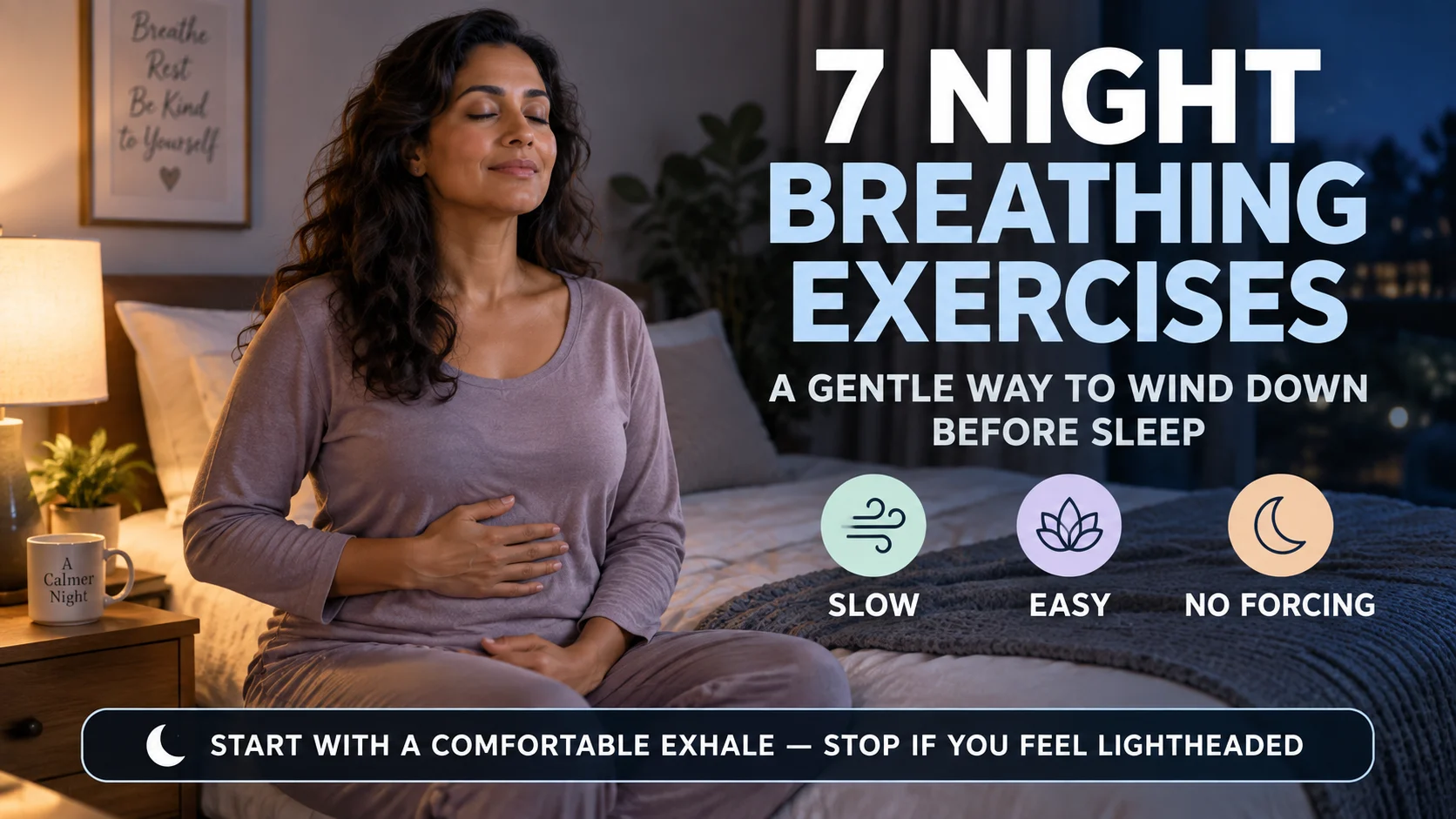

Slow, comfortable breathing can be a useful way to lower bedtime arousal and make the transition into sleep feel easier, especially when stress or racing thoughts are keeping you alert. The strongest recent review evidence is encouraging for self-reported sleep quality and duration, but objective sleep measurements remain mixed, so breathing exercises are better treated as a calming routine than as a guaranteed insomnia treatment. If one pattern feels strained, shorten the count or choose a no-hold version instead.
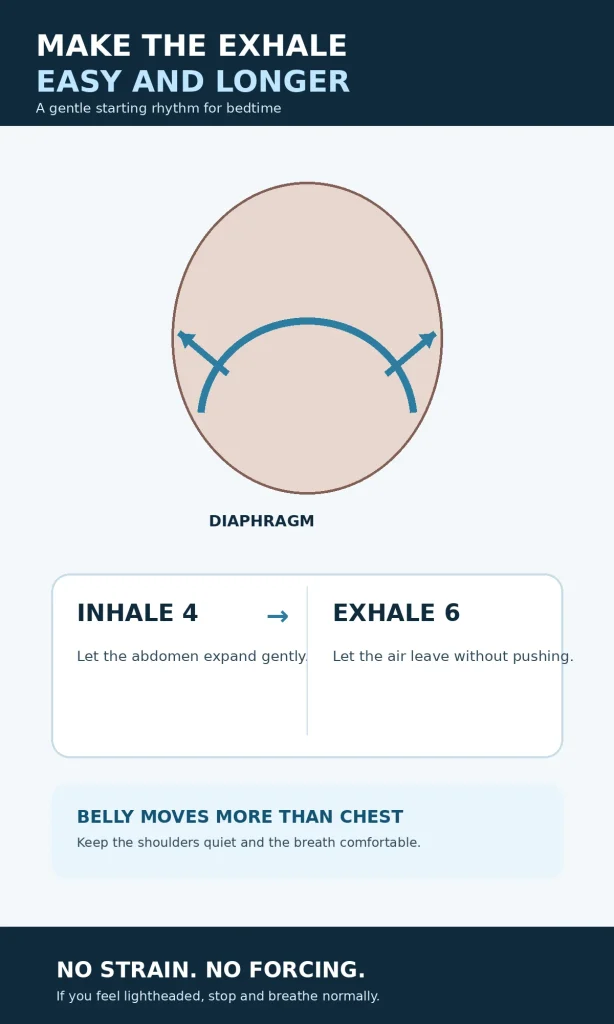
A practical starting point is five minutes of gentle diaphragmatic breathing or an extended exhale, such as inhaling for four counts and exhaling for six. The exact count matters less than keeping the breath smooth, quiet, and comfortable. Stop if you become lightheaded, and return to normal breathing before trying again.
Bedtime Breath Studio
Choose a comfortable pattern, follow the live pacer, and keep the session gentle enough to repeat.
Set up tonight's session
Pick the situation that best matches what is keeping you awake.
Your starting pattern
A suggestion based on comfort and the goal you selected.
Use a simple no-hold rhythm to give a busy mind one quiet task.
Press start when you are comfortable.
What the evidence actually says about breathing before sleep
A 2026 systematic review of slow breathing before bedtime included nine studies and 457 participants. It found improvements in self-reported sleep duration and sleep quality across several studies, while actigraphy and polysomnography results were inconclusive; the authors also noted that longer and higher-quality trials are still needed. That makes slow breathing a reasonable low-equipment relaxation practice, but not a substitute for established insomnia care when sleep problems are persistent.
The physiology is plausible because deliberately slowing respiration can influence cardiorespiratory coupling and autonomic activity. Reviews of slow breathing research have reported changes in heart-rate variability and other autonomic measures, although those physiological effects should not be translated into promises that a particular count will make everyone fall asleep. The useful target is reduced effort and reduced arousal, not chasing a perfect number.
For chronic insomnia, breathing belongs inside a larger sleep strategy. The National Heart, Lung, and Blood Institute describes cognitive behavioral therapy for insomnia (CBT-I) as the usual first treatment option for long-term insomnia, while relaxation and meditation can be part of that broader approach. The American Academy of Sleep Medicine likewise strongly recommends CBT-I for chronic insomnia and lists relaxation therapy as a conditional option.
Start with the easiest rhythm, not the longest count
Breathing exercises work poorly when the person is trying to “win” the count. A long inhale can lead to over-breathing, while a long hold can create tension that is the opposite of a bedtime wind-down. Choose a pattern that leaves your jaw, shoulders, and abdomen relaxed enough that you could repeat it without effort.
Use the first two exercises below if you want the simplest starting point. They avoid breath holds and make it easy to shorten the count without breaking the technique. Once those feel natural, the more structured counting patterns can be tried as optional variations.
The 7 breathing exercises for better sleep
1. Diaphragmatic breathing
Diaphragmatic breathing is the best place to learn what “gentle” actually feels like because it focuses on where the movement happens rather than on hitting a demanding count. Lie down or sit supported, place one hand on the upper chest and the other over the abdomen, and inhale quietly through the nose so the lower hand moves more than the upper one. Exhale without pushing the air out, then repeat for about three to five minutes.
If four seconds in and six seconds out feels comfortable, use that rhythm; if not, shorten it to three in and four out. The goal is smooth breathing with little shoulder movement, not maximum lung filling. A 2021 study of diaphragmatic breathing relaxation training in nurses reported improvements in several self-reported sleep measures, but it was not a randomized sleep-treatment trial, so the result should be viewed as supportive rather than definitive.
2. Extended-exhale breathing
Extended-exhale breathing keeps the method simple: inhale comfortably, then let the exhale last a little longer. Try four counts in and six counts out for several minutes, or use three in and four out if that is easier. Do not squeeze the abdomen at the end of the exhale or wait until you feel air-hungry before the next inhale.
This pattern is often easier at bedtime than techniques with long holds because the rhythm can be adjusted immediately. If counting itself feels stimulating, stop counting and simply make the exhale slightly longer than the inhale. The benefit comes from a calm, repeatable rhythm, not mathematical precision.
3. 4-7-8 breathing
The 4-7-8 pattern uses a four-count inhale, a seven-count hold, and an eight-count exhale. Sit or lie comfortably, exhale once, inhale through the nose for four, hold gently for seven, then exhale slowly for eight; start with only a few cycles. If the hold causes strain, shorten it substantially or switch to a no-hold pattern.
4-7-8 is popular because the count occupies attention and gives the exhale plenty of time, but there is not strong evidence that this exact ratio is uniquely superior to other slow-breathing patterns for sleep. Treat it as one structured option, not as a requirement. People who dislike breath holds often do better with diaphragmatic or extended-exhale breathing.
4. Equal breathing
Equal breathing uses the same comfortable count for the inhale and exhale, such as five in and five out. This creates a steady rhythm without the added challenge of a hold and works well for people who become distracted by changing numbers. Keep each breath quiet and reduce the count if you feel the need to take an extra-large recovery breath.
A five-in, five-out rhythm is roughly six breaths per minute when the counts track seconds, which falls within the slow-breathing range often studied in autonomic research. That does not make six breaths per minute a universal sleep prescription. Use it only when it feels natural rather than artificially slow.
5. Box breathing
Box breathing divides the breath into four equal phases: inhale, hold, exhale, hold. A common version is four counts for each phase, but bedtime practice can use shorter counts if a four-count hold feels tense. Complete several cycles and stop before the pattern becomes work.
Some people like box breathing because its symmetry gives a busy mind something simple to follow. Others find the holds too alerting, especially when already frustrated about not sleeping. If that is you, return to equal breathing or a longer exhale instead of forcing the square pattern.
6. Counted natural breathing
Counted breathing removes the pressure to control timing. Breathe normally, count “one” after the first exhale, “two” after the next, and continue to five or ten before starting again at one. When you lose your place, simply return to one without correcting or speeding up.
This technique is useful when controlling the breath itself makes you self-conscious. The count gives attention a narrow task while the body keeps its own comfortable rhythm. It can also be paired with a phrase such as “soften” on each exhale if that helps you release tension.
7. Breathing with a body scan
For the final exercise, combine ordinary slow breathing with a short body scan. Start at the forehead and jaw, move down through the shoulders, hands, abdomen, hips, and legs, and notice one area at a time while letting the exhale soften that area. You do not need to make every muscle completely relaxed before moving on.
This is especially useful when physical tension is more obvious than racing thoughts. The breath becomes a pacing cue for checking the body rather than an exercise that demands perfect execution. If you reach the feet and are still awake, restart at the face or switch to natural breathing without monitoring it.
Which breathing pattern fits tonight?
| Tonight’s problem | Easy starting pattern | Why it may fit | Change it if… |
|---|---|---|---|
| Racing thoughts | Extended exhale | Simple count with no hold | Counting becomes effortful |
| Body tension | Diaphragmatic breathing | Focuses on physical softening | You start taking oversized breaths |
| You like structured counting | Equal or box breathing | Predictable repeating pattern | Holds feel tense |
| You wake during the night | Natural counted breathing | Low effort and easy to restart | Monitoring the breath makes you more alert |
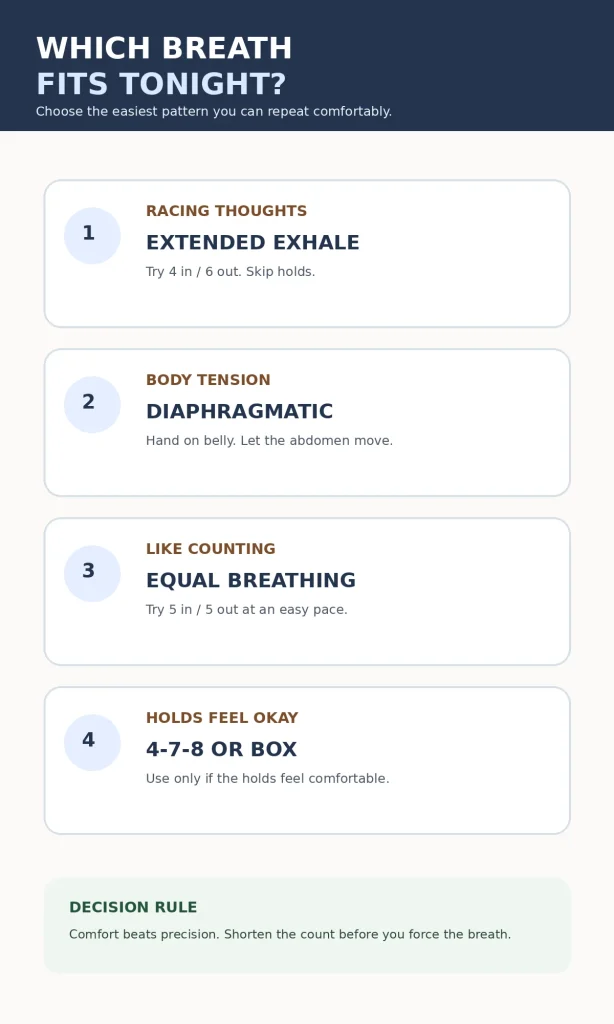
How long should you practice before bed?
Five minutes is enough for a first test because it is long enough to settle into a rhythm without turning bedtime into another task. If the practice feels pleasant, extend it gradually to ten minutes; if it creates frustration, stop earlier. Consistency is more useful than forcing a long session on one difficult night.
Practice can begin before you are fully exhausted, for example during the last quiet part of your bedtime routine. Keeping a regular sleep-wake schedule and reducing late-night stimulation still matter, and the NHLBI also recommends a sleep-friendly environment and avoiding caffeine, nicotine, and alcohol close to bedtime. A broader routine can be more effective than asking one breathing pattern to carry the entire job.
Daytime habits can also influence the night. Regular physical activity is part of healthy sleep guidance, so readers who want a low-barrier option can also review our guide to the benefits of walking and easy ways to make it routine. If stress is driving inconsistent evenings, our discussion of how routines can reduce stress may help with the behavioral side of winding down.
Common mistakes that make bedtime breathing harder
The most common mistake is breathing too deeply rather than simply breathing more slowly. Oversized breaths can make the exercise uncomfortable and may contribute to lightheadedness, while tense breath holds can turn a relaxation practice into a performance challenge. Use a smaller breath and an easier count before assuming the method “doesn’t work.”
- Forcing the inhale: keep it quiet and comfortable rather than filling the lungs to maximum capacity.
- Holding through discomfort: shorten or remove the hold immediately.
- Pushing the exhale: let it lengthen without squeezing out every last bit of air.
- Watching the clock for results: use the exercise to lower effort, not to demand sleep on a deadline.
- Changing techniques every minute: give one easy pattern a few minutes before switching.
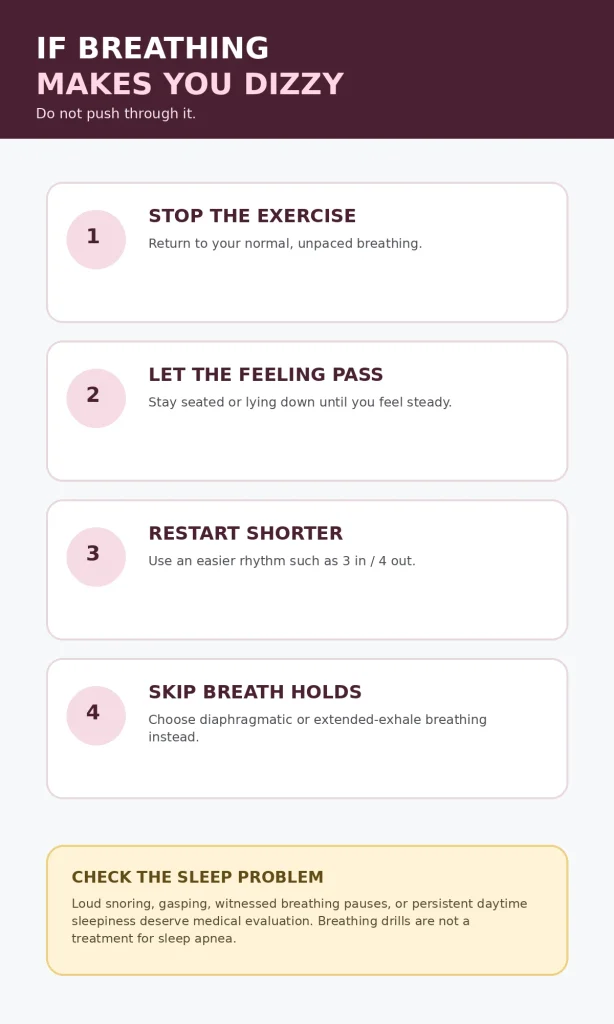
When breathing exercises are not enough
Breathing exercises can reduce arousal, but they do not diagnose or treat every cause of poor sleep. If you have persistent insomnia, CBT-I has a stronger evidence base and should be discussed with a qualified clinician, especially when sleep trouble is affecting daytime function. If sleep difficulty overlaps with low mood or other symptoms, our article on depression and sleep problems explains why the relationship can be more complicated than simply “not relaxing enough.”
Breathing practice should also not be used as a substitute for evaluation of possible sleep apnea. The NHLBI lists breathing that starts and stops, frequent loud snoring, gasping for air, and daytime sleepiness among common sleep-apnea symptoms. If those signs are present, the next step is medical assessment rather than trying to train yourself to breathe differently while asleep.
Build a simple seven-night test
Use the week as an experiment in comfort rather than a competition between techniques. Pick one pattern per night, note whether it felt easy, and keep only the methods that reduce effort instead of adding it. The purpose is to discover a repeatable wind-down cue that fits your body and your bedtime, not to finish all seven exercises.
- Night 1: diaphragmatic breathing for five minutes.
- Night 2: extended exhale for five minutes.
- Night 3: equal breathing for five minutes.
- Night 4: counted natural breathing.
- Night 5: 4-7-8 only if breath holds feel comfortable.
- Night 6: box breathing or repeat your favorite no-hold pattern.
- Night 7: breathing with a body scan, then choose the method you would actually repeat.
Frequently Asked Questions
Which breathing exercise is easiest to start with before sleep?
Diaphragmatic breathing or a gentle extended exhale is usually the simplest starting point because neither requires a breath hold. Use a count that feels easy and shorten it if you begin to strain. The best starting pattern is the one you can repeat without creating more tension.
How many minutes should I do breathing exercises before bed?
About five minutes is a practical first session. You can extend the practice toward ten minutes if it remains comfortable, but there is no need to keep going once the exercise becomes work. A short routine you repeat consistently is more useful than an occasional long session that feels forced.
Is 4-7-8 breathing better than other sleep breathing methods?
There is not strong evidence that the exact 4-7-8 ratio is uniquely superior for sleep. It is a structured slow-breathing pattern that some people find calming, while others dislike the seven-count hold. If the hold creates tension, use a no-hold method such as diaphragmatic or extended-exhale breathing.
What should I do if a breathing exercise makes me dizzy?
Stop the exercise and return to normal breathing until the sensation passes. If you try again, use a smaller breath, a shorter count, and no breath holds. Repeated or unexplained dizziness deserves medical advice rather than repeated breath training.
Can breathing exercises cure chronic insomnia?
No. Breathing can be a relaxation component, but chronic insomnia has stronger evidence for cognitive behavioral therapy for insomnia. If sleep trouble is frequent, persistent, and affecting daytime life, discuss the pattern with a healthcare professional rather than relying on breathing alone.
Can breathing exercises treat sleep apnea?
Bedtime breathing exercises are not a treatment for obstructive sleep apnea. Loud frequent snoring, gasping, witnessed breathing pauses, or excessive daytime sleepiness should be discussed with a healthcare provider. A sleep study may be needed to identify the cause.
Next step
Tonight, choose one easy pattern and keep the session short enough that it still feels relaxing. If the breath starts to feel like a performance task, return to normal breathing and try again another night with a simpler rhythm. Better sleep is not earned by holding your breath longer; the useful skill is learning how to reduce effort at the end of the day.