

To eliminate crop failure caused by localized frost pockets, scorching sun exposure, or soil waterlogging, gardeners must design around their property’s distinct microclimates rather than relying solely on regional USDA hardiness zones. Microclimates are shaped by physical structures, sun angles, wind obstructions, and soil topography that alter temperature and moisture levels within inches of the ground. By mapping light hours, establishing thermal heat sinks, deploying aerodynamic windbreaks, and raising soil beds, you can extend your growing season by up to four weeks and improve plant survival rates.
Strategy 1: Map Solar Radiation and Shade Patterns Across Seasons
Solar exposure changes dynamically throughout the year as the sun’s azimuth and elevation shift across seasons. A location receiving eight hours of direct sunlight in midsummer may receive less than two hours during autumn due to structure shadows and tree canopies. Accurately plotting true solar hours requires measuring sunlight duration at key crop zones during both the spring equinox and summer solstice.
- Full-Sun Zones (6+ Direct Hours): Essential for fruiting crops like tomatoes, peppers, and squash that require high daily light integrals for energy production.
- Partial-Shade Zones (3–6 Hours): Ideal for leafy greens, root vegetables, and brassicas, protecting them from mid-day heat stress while maintaining steady growth.
- Deep-Shade Zones (<3 Hours): Best suited for cold-hardy perennials, woodland herbs, or structural landscaping rather than high-yield edible crops.
Placing sun-demanding crops in micro-shadows created by solid privacy fences leads to leggy stems, delayed flowering, and high pest vulnerability. High-canopy pruning of surrounding trees increases ground-level light penetration without removing wind-shielding shelter.
Strategy 2: Leverage Masonry and Stone as Thermal Heat Sinks
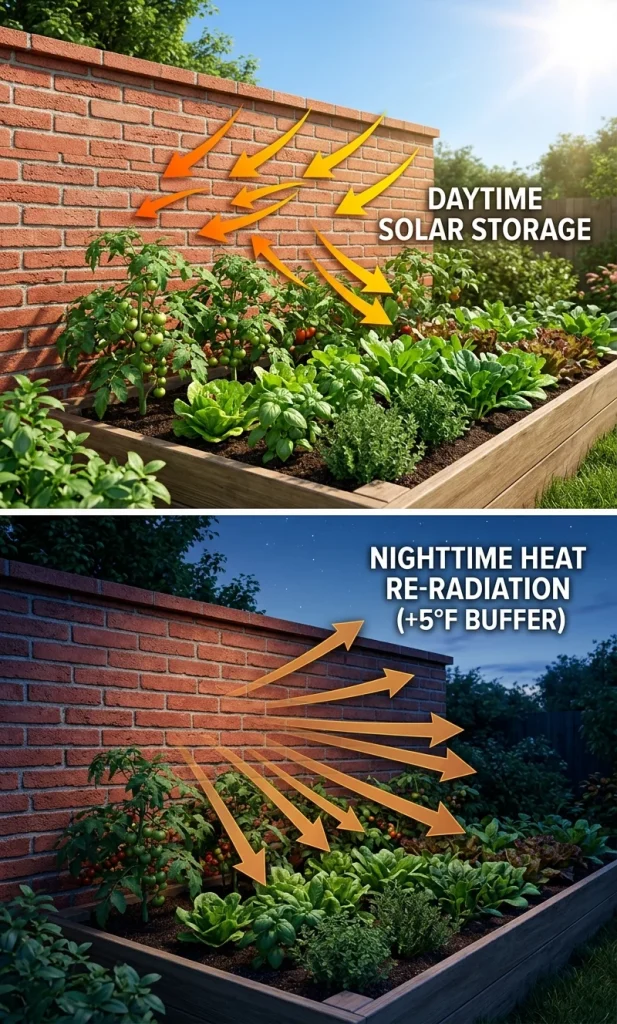
Solid structures such as brick walls, concrete retaining edges, and stone paving absorb solar energy during peak day hours and slowly re-radiate that energy as far-infrared heat during the night. Positioning frost-sensitive plants within 18 inches of a south- or west-facing masonry wall creates a protected thermal zone that buffers against sudden nighttime temperature dips.
Thermal absorption prevents soil temperatures from dropping precipitously during early spring frosts. However, gardeners must maintain a 2-inch gap between plant foliage and stone surfaces; direct contact with sun-baked masonry during peak summer afternoons causes foliage scorch and cellular dehydration.
Strategy 3: Deploy Permeable Windbreaks to Prevent Desiccation
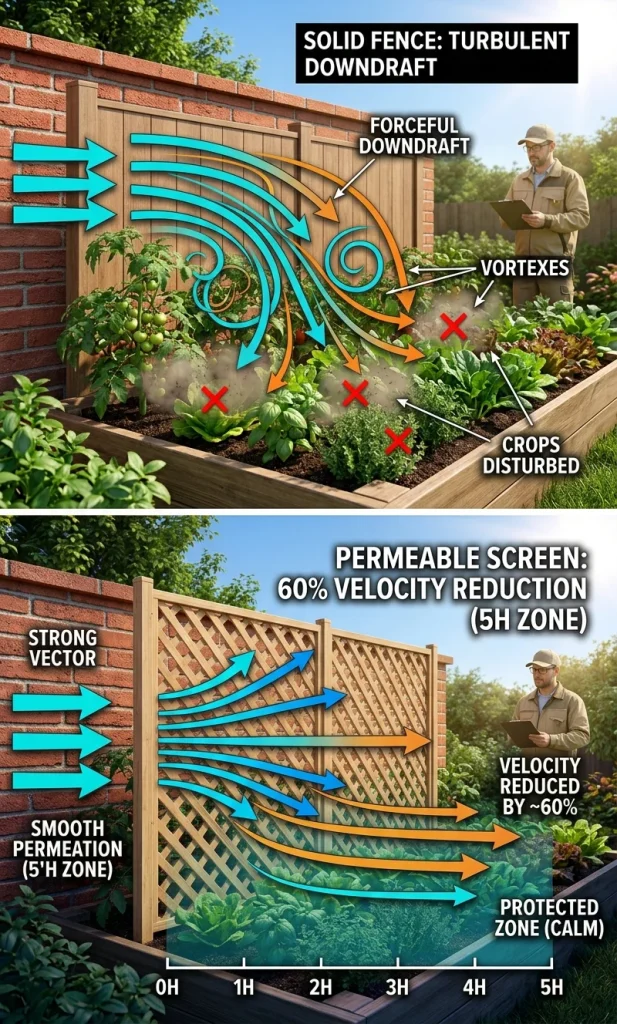
Strong wind exposure damages plants through physical mechanical stress and rapid moisture loss from leaves and soil. Solid fences or walls fail as effective wind barriers because they force wind over the top, creating turbulent downdrafts on the leeward side that break stems and erode topsoil.
- 50% Porosity Ratio: Lattice screens, slatted wooden fences, or semi-permeable hedgerows break wind speed without generating downstream turbulence.
- Protection Distance ($H:D$ Ratio): A windbreak provides effective wind reduction up to a distance equal to five times its height ($5H$) on the leeward side.
- Airflow Circulation: Filtering wind rather than blocking it entirely preserves internal garden humidity while preventing stagnant air pockets where fungal pathogens thrive.
Planting a mixed shelterbelt of native shrubs or installing cedar trellis panels fitted with climbing vines provides durable wind reduction while maintaining ventilation across crop beds.
Strategy 4: Optimize Soil Drainage to Regulate Root Zone Moisture

Soil texture directly governs water infiltration rates, oxygen availability, and root zone temperature. Heavy clay soils retain excessive water during spring rains, delaying warming and suffocating roots through anaerobic soil conditions. Conversely, coarse sandy soils drain rapidly, leaching essential plant nutrients before root systems can absorb them.
Building raised garden beds elevated 8 to 12 inches above native grade accelerates soil warming by $3\text{–}5^\circ\text{F}$ in early spring while establishing consistent gravity drainage. Incorporating well-decomposed organic matter improves water retention capacity in sandy soils while creating macro-pores in clay soils that allow excess water to drain freely.
To test drainage, dig a 12-inch deep hole, fill it with water, and monitor the drawdown rate. If water remains after 6 hours, install sub-surface French drains or shift exclusively to elevated raised beds.
Strategy 5: Eliminate Cold Air Pockets with Topographic Air Channels
Cold air behaves like water: it flows downhill along slopes and accumulates in low-lying depressions, creating localized frost pockets. Solid bottom garden gates, un-pruned dense hedges at the base of a slope, or low landscape retaining walls dam this drainage path, causing cold air to pool directly over garden beds.
- Clear Downhill Barriers: Prune lower branches of hedge lines and install slotted gates at low property points to allow cold air to drain away.
- Elevate Frost-Sensitive Beds: Position early-season vegetables along upper or mid-slope zones where cold air remains in motion rather than settling.
- Swale and Mound Diversion: Construct shallow earth swales lined with turf upstream from planting areas to divert cold airflow away from vulnerable crop zones.
Establishing clear cold-air drainage channels prevents unseasonal late-spring frosts from destroying newly transplanted crops.
Frequently Asked Questions
How do I measure my garden’s exact solar radiation hours?
Use a solar pathfinder tool or take photograph checkpoints every two hours from 8:00 AM to 6:00 PM on a clear day near the spring equinox. Record areas receiving uninterrupted sunlight to categorize full-sun, partial-shade, and deep-shade microclimates across your beds.
Can a masonry wall get too hot for plants during summer?
Yes. Unshaded south- and west-facing brick or concrete walls can reach surface temperatures above 110°F (43°C) in midsummer, re-radiating intense heat that scorches nearby foliage. Maintain a 12- to 18-inch buffer distance or use light-colored reflective washes to reduce extreme radiant heat buildup.
What is the ideal windbreak height for a small backyard garden?
A 6-foot-tall windbreak with 50% porosity provides effective wind reduction for up to 30 feet (5H) downstream. This height shields standard raised beds and staked vegetables without casting excessive shadows over small growing areas.
Microclimate Gardening Optimizer
Analyze your property's precise solar radiation hours, masonry heat sinks, windbreak permeability ratios, and soil percolation mechanics to optimize crop yield.
Site Environmental Parameters
Diagnostic Assessment
Microclimate Site Diagnostic Report
Generated by Microclimate Gardening Optimizer v3.8
Location: Austin, Texas, USA
1. Environmental Site Inputs
| Direct Sunlight Exposure: | 6.5 Hours / Day |
| Adjacent Structure: | Red Clay Brick Wall |
| Wind Protection Barrier: | 50% Permeable Lattice Screen |
| Soil Percolation Profile: | Silty Loam (0.5–1.0 in/hr) |