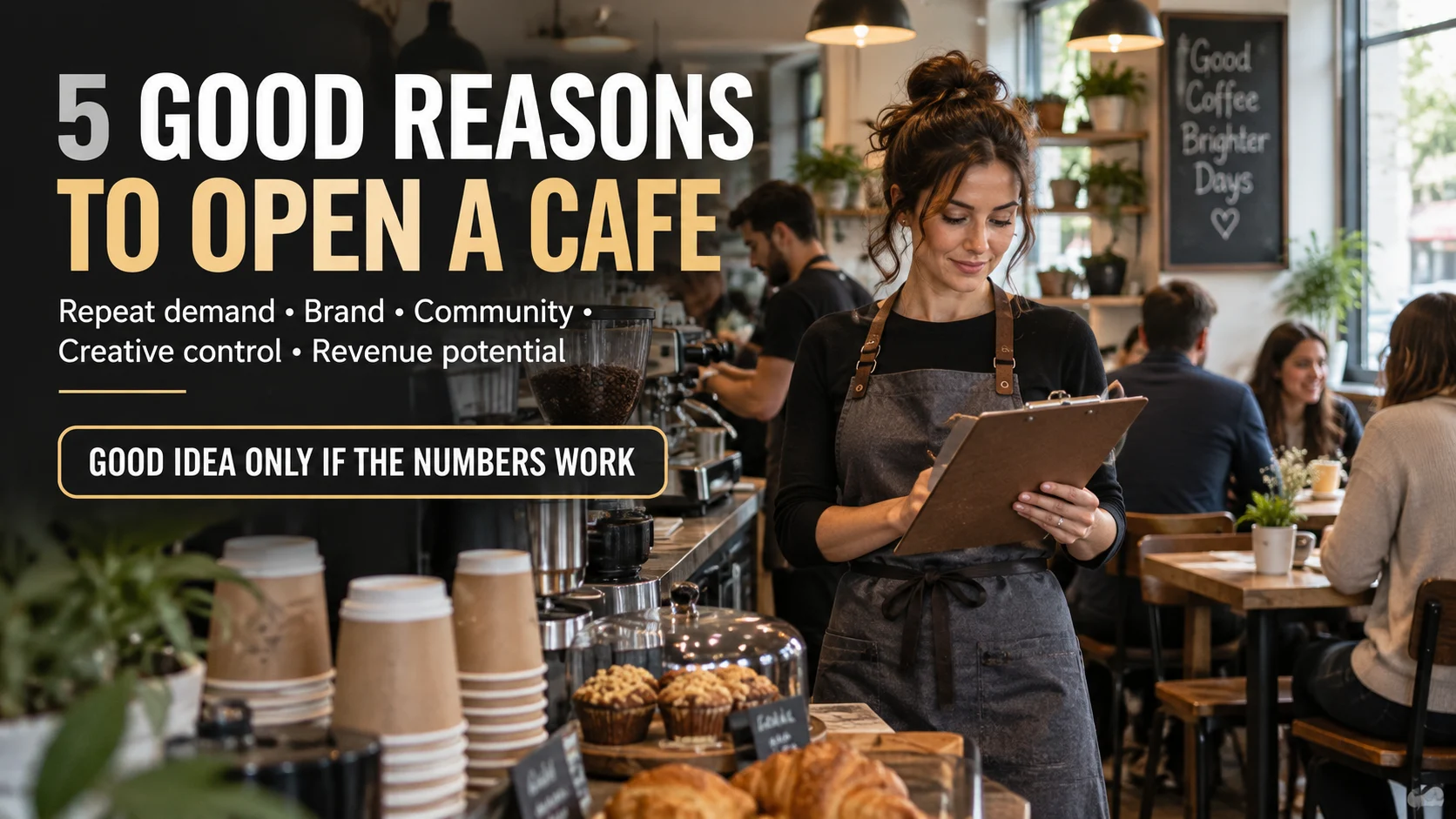

A cafe can be a strong business when it turns an everyday habit into repeat local demand, but coffee popularity alone does not make a location profitable. The opportunity becomes much more attractive when you can prove the site, price the menu correctly, control fixed costs, and build an experience customers have a reason to revisit.
The strongest reasons to enter the cafe business are repeat purchase behavior, room for a distinctive brand, community value, creative control, and the possibility of attractive product-level margins. The catch is that a busy-looking counter can still lose money if rent, labor, waste, debt payments, or low average tickets absorb the gross profit.
Why the cafe business can still be attractive
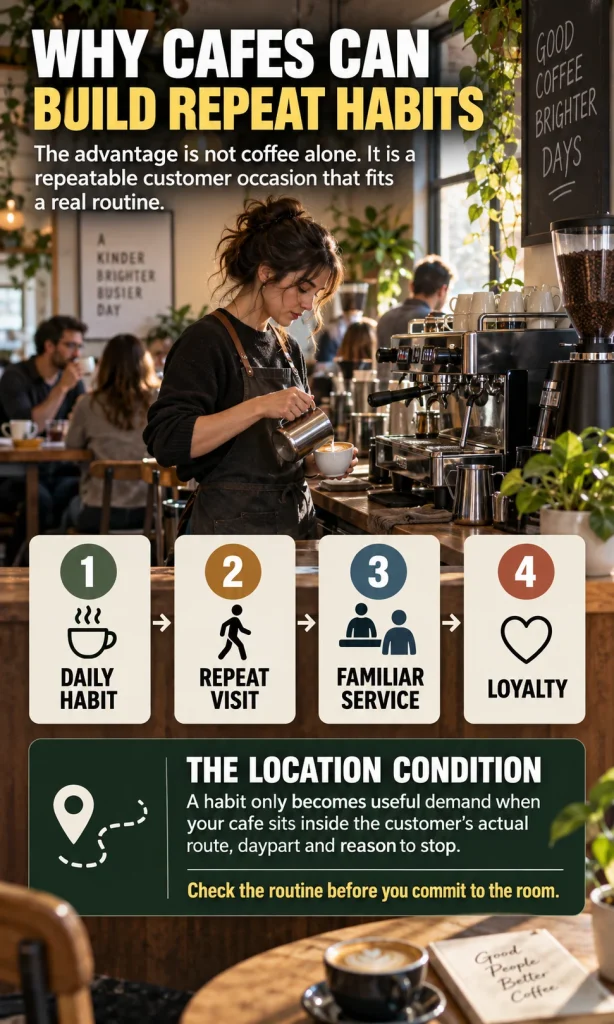
Coffee is unusually compatible with routine. People may buy it on the way to work, between meetings, after school, during social time, or as part of a weekend ritual, which gives a well-positioned cafe more opportunities for repeat visits than many occasional-purchase businesses.
Demand, however, has to be read at the level of your actual market rather than the category as a whole. As one large-market indicator, the National Coffee Association’s Fall 2026 data reported that 66% of U.S. adults had consumed coffee in the past day, while out-of-home coffee consumption among past-day drinkers reached 38%; those figures show a large habit base, not a guarantee for any individual storefront.
The practical question is therefore not, “Do people like coffee?” It is, “Do enough of the right people pass this concept at the right times, and will they choose it often enough at a price that covers the full operating model?”
The five reasons – and the condition attached to each one
| Reason | Why it is attractive | What must be true |
|---|---|---|
| 1. Repeat demand | Coffee and light food can fit daily or weekly routines. | Your location, hours and offer must match a real daypart habit. |
| 2. Brand differentiation | A cafe can compete through atmosphere, service, product focus and identity. | The concept must be specific enough that customers can explain why they would choose you. |
| 3. Community value | A good cafe can become a familiar third place for locals, workers and visitors. | Seating, speed, noise, Wi-Fi, service and menu need to support the people you want to attract. |
| 4. Creative control | Owners can shape the menu, design, sourcing, service style and events. | Creativity has to simplify or strengthen the customer proposition, not create waste and operational complexity. |
| 5. Revenue potential | Beverages can carry strong gross profit per item, and food or retail can raise the average ticket. | Rent, payroll, waste, payment fees, utilities, debt and slow periods must still leave enough contribution to cover fixed costs. |
Notice that none of the five reasons stands alone. A cafe can have excellent coffee and still be a weak business, while a simpler concept with a clear daypart, disciplined menu and manageable occupancy cost can be much easier to operate.
That is why the better question is not whether cafes are “good businesses” in general. It is whether your proposed cafe has a repeatable economic and customer pattern that can survive ordinary weeks, not just opening-month excitement.

CAFE BUSINESS DECISION SUPPORT
Cafe Launch
Reality Check
Turn a cafe idea into a practical go / test / rethink decision using your own costs, expected orders and real-world evidence.
Start with the numbers, then test the story.
This screening experience does not predict whether a cafe will succeed. It shows what your current assumptions imply and which evidence gaps deserve attention before a lease, fit-out or major financing commitment.
-
-
Estimated sales needed to cover the fixed-cost figure you entered at your blended gross margin.
Required daily orders at the average ticket you entered, across your planned trading days.
How your expected daily orders compare with the modeled break-even level. This is not a profit forecast.
Evidence signals
Local due-diligence help
Search without an API key, then compare the candidates you find instead of relying on fabricated ratings or recommendations.
Compare up to 3 candidates you find
1. Repeat demand can be powerful when it is tied to a real habit
A cafe benefits from selling products that can fit frequent routines, but the useful unit of analysis is a customer occasion. Morning commuters may value speed and predictable quality, remote workers may value seating and dwell time, parents may value convenience, and destination customers may accept a longer journey for a distinctive product.
This is where location analysis becomes more important than vague claims about foot traffic. Count the people who resemble your target customer during the hours you expect to make most of your sales, observe where they are coming from and going to, and note what they already buy nearby.
A crowded street can still be poor for a cafe if people are moving quickly in the wrong direction, have no reason to stop, or are already well served by convenient competitors. A quieter location can work better when it sits directly in a repeat path and the rent leaves room for the business to breathe.
2. A cafe gives you room to build a brand people can actually experience
Cafes are unusually physical brands. The promise is expressed through the first sight of the storefront, the queue, the smell of the room, the speed of ordering, the cup in the customer’s hand, the lighting, the seating, the staff’s behavior and the consistency of the drink.
That can be a competitive advantage because local operators do not need to outspend large chains on advertising if they create a specific experience that is easy to recognize and recommend. The brand becomes useful when it helps a customer answer a simple question: “Why this cafe instead of the one two minutes away?”
Start with one clear promise rather than a long list of personality traits. A narrow breakfast-and-espresso concept, a quiet study cafe, a bakery-led neighborhood shop, a fast commuter counter, or a coffee-and-dessert evening concept gives operations a clearer target than trying to satisfy every possible customer.
3. Community can create loyalty that discounting cannot
A cafe can become a local habit because it offers more than the product itself. Familiar staff, reliable seating, a predictable atmosphere, small rituals and recognition can turn a transaction into a place people choose repeatedly.
Community value also creates useful feedback. Regular customers tell you which items are missed, which hours feel inconvenient, whether the music is too loud, which table layout works, and whether a new menu idea fits the reason they come in the first place.
Do not confuse community with unlimited dwell time, however. If the concept depends on high seat turnover but the room encourages multi-hour stays from low-ticket customers, the emotional success of the space can conflict with the economics of the floor.
4. Creative control is valuable when it improves the operating model
A cafe owner can make decisions about menu size, drink style, seasonal products, sourcing, service sequence, interiors and events. That freedom is satisfying, but it becomes commercially useful only when the choices reinforce the same customer and reduce unnecessary complexity.
- Keep the core menu legible. Too many low-volume ingredients increase purchasing complexity and waste.
- Design for the rush, not the empty room. Espresso, milk, ice, pastry, payment and pickup positions should support the busiest realistic service period.
- Use seasonal items deliberately. A special should create interest without requiring a second kitchen inside the first one.
- Let the interior serve the business model. Seating density, table size, power outlets, acoustics and queue space should match the customers you want.
- Measure what changes after a creative idea. A new item or layout should improve demand, ticket size, speed, waste, labor efficiency or customer retention – not simply look impressive.
If you are still shaping the concept, compare it with the process in how to test business ideas before you treat your first version as final. Testing a smaller version of the promise is cheaper than learning through a fully fitted lease.
5. The unit economics can work – but gross margin is not net profit
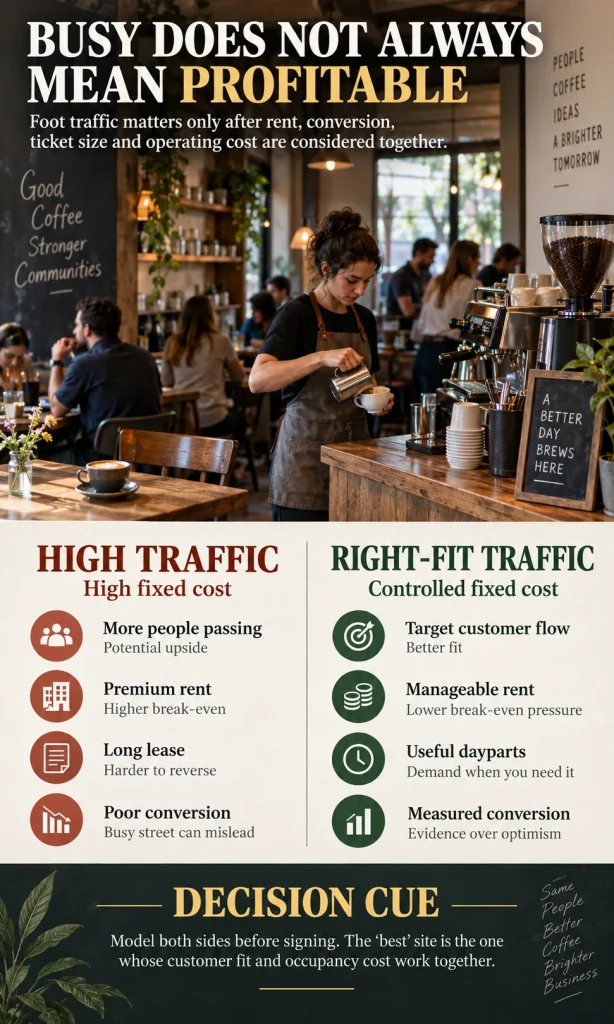
One of the attractions of coffee is that the ingredient cost of a drink can be much lower than its selling price. That spread has to pay for everything else: staff, occupancy, equipment, repairs, card fees, utilities, cleaning, software, insurance, marketing, debt, spoilage and the owner’s compensation.
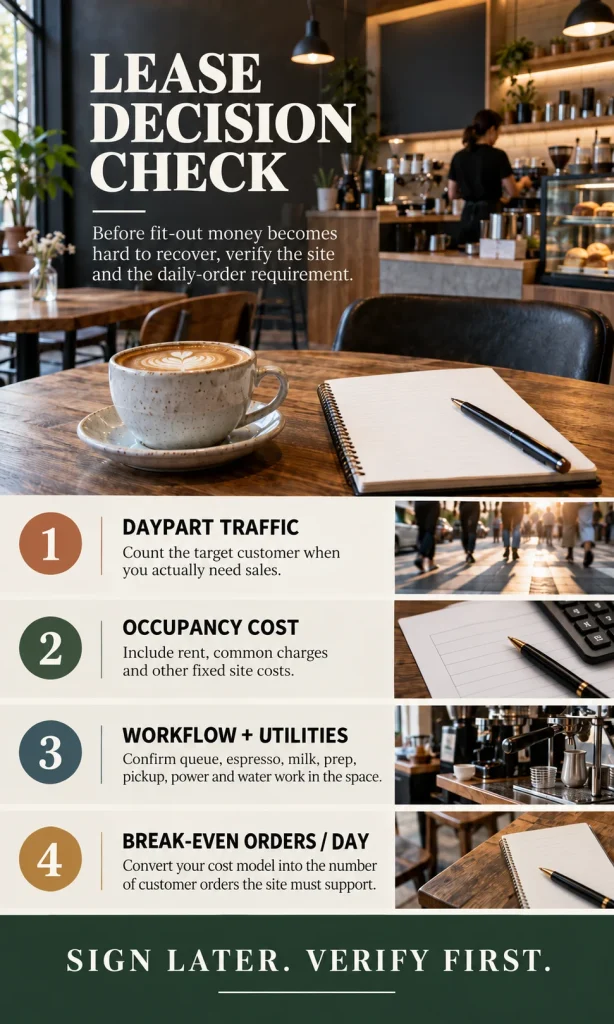
The simplest way to bring the idea back to reality is a break-even calculation. The U.S. Small Business Administration’s break-even guidance frames the same discipline as fixed costs divided by contribution margin; for a mixed cafe menu, you can estimate the required monthly sales using your blended gross margin and then convert that sales target into daily transactions.
For example, if your model needs a surprisingly high number of daily orders just to cover fixed costs, do not solve the spreadsheet by assuming a miracle increase in foot traffic. Change the site, rent, menu mix, hours, staffing model, average ticket, capital structure, or concept before you commit.
What can go wrong even when the five reasons are real?
Cafe businesses are exposed to a particular combination of low-ticket transactions and high operational repetition. Small errors in scheduling, waste, queue speed, machine downtime or ordering can repeat hundreds of times and consume the margin that looked generous at product level.
Location mistakes are especially difficult because they are expensive to reverse. A beautiful fit-out cannot repair the wrong customer flow, and a long lease can turn a temporary demand problem into a fixed-cost problem that lasts for years.
Before signing, review the broader risks when starting a business and separate reversible decisions from irreversible ones. Menu experiments are easy to change; a lease, major fit-out, debt package and oversized payroll are much harder.
A better pre-lease test than “I love coffee”
Passion matters because hospitality is repetitive, physical and people-intensive, but passion is not demand validation. A stronger pre-lease process combines direct observation, a small market test, recipe costing, a break-even model and a realistic view of the hours the owner or management team will need to cover.
The SBA’s planning guidance is useful here because it separates market research, competitive analysis, startup costs and business-plan work instead of treating a good idea as a single yes-or-no decision. The same logic applies anywhere: verify the customer, the competitive gap and the economics before you lock in the expensive parts.
If you are unsure whether the concept itself is differentiated enough, work through how to know if your business idea is good. The most useful outcome may be a narrower concept, a smaller format, a pop-up, a kiosk, a shared venue, or a delayed lease rather than an immediate full cafe.
When opening a cafe makes the most sense
The case is strongest when you can describe the target customer and daypart precisely, have direct evidence that the location can reach them, know the contribution from the core menu, and have enough operating runway to survive the period before routines are established. It also helps when the concept has one or two memorable reasons to visit that do not depend entirely on discounting.
The case is weaker when the plan relies on “busy area” as the demand argument, assumes the owner will quickly become hands-off, uses optimistic sales to justify high rent, or treats a high drink markup as proof of healthy net profit. Those are signals to keep testing rather than signals to abandon the idea automatically.
A cafe can absolutely be a worthwhile business, but the good reasons become meaningful only after the numbers and operating reality support them. Build the habit, brand and community story around a model that can break even under ordinary conditions, then let growth be the upside rather than the rescue plan.
Frequently Asked Questions
Is a cafe a good first business?
It can be, but it is not a passive or simple business. A first-time owner should be especially careful with lease commitments, staffing assumptions, menu complexity and cash runway, and should test the concept as cheaply as possible before taking on large fixed costs.
What is the biggest advantage of a cafe business?
The biggest structural advantage is the possibility of repeat purchase behavior around a product that can fit daily or weekly routines. That advantage only converts into a good business when the location, service speed, pricing and customer experience support repeated visits at sustainable economics.
How do I know if a cafe location is good?
Observe the specific dayparts you intend to trade, count relevant customer flow, study direct and indirect competitors, check access and visibility, and model the rent against conservative sales assumptions. The right location is not always the busiest one; it is the one where customer fit and occupancy cost work together.
Do high coffee margins mean cafes are highly profitable?
No. Product-level gross margin is only the starting point because rent, payroll, utilities, waste, fees, equipment, repairs, insurance, debt and other overhead determine what remains as operating profit. Break-even transactions per day are often more useful than a headline drink markup.
Should I open a full cafe or test a smaller format first?
If demand, menu fit or the customer profile is still uncertain, a smaller test can produce better information with less irreversible cost. A pop-up, market stall, shared venue, catering offer or short-term activation can help you measure demand and operations before committing to a permanent site.