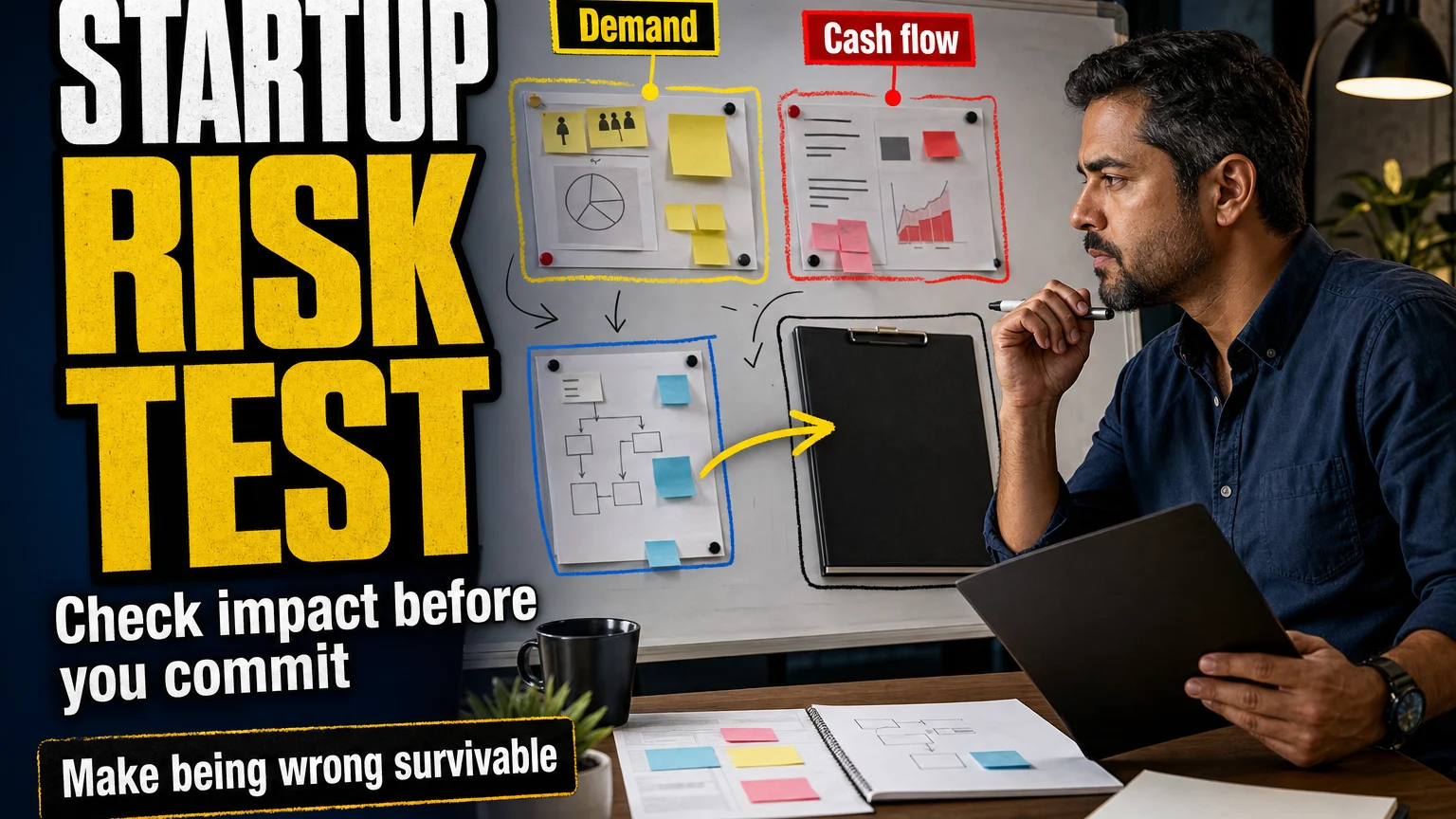
Starting a business means making decisions before you have complete information. You may need to choose a customer, set a price, commit money, sign contracts, buy equipment, hire people or promise delivery before the business has enough operating history to show exactly how those decisions will work. That uncertainty is unavoidable. The more useful question is which uncertainties could cause serious damage if your assumptions are wrong.
Some startup mistakes are inexpensive and reversible. A $300 advertising experiment that attracts nobody may be disappointing, but the loss is contained and the result can teach you something. Signing a long lease, hiring several employees, ordering a large amount of inventory or borrowing heavily before demand is proven creates a different kind of exposure because the cost continues after the original assumption fails.
The most dangerous situations often involve several risks reaching the same weak point at once. Weak demand may be survivable when fixed costs are low. High fixed costs may be manageable when sales are predictable. Limited cash may be manageable when customers pay immediately. Combine weak demand, high fixed costs, slow customer payments and a short cash runway, however, and the business can lose room to respond much faster than any one risk suggests.
A practical startup risk assessment therefore should not ask only, “What could go wrong?” It should ask what can go wrong, how much damage it could cause, how difficult the commitment is to reverse, and how much warning you would have before the problem becomes serious.
If your main uncertainty is whether the underlying opportunity deserves pursuing, start with how to know if your business idea is good. If the opportunity seems promising but the assumptions are still mostly theoretical, how to test business ideas focuses on turning those assumptions into customer, behavior and payment evidence. This article deals with the next question: what could still threaten the business, and how much exposure should you accept before launch?
The Quick Answer: What Are the Main Risks of Starting a Business?
The major risks of starting a business usually include market risk, demand risk, pricing risk, cash-flow risk, fixed-cost risk, operational risk, supplier dependency, people risk, founder concentration, legal and compliance exposure, cyber and data risk, reputation risk, and external events the company cannot directly control.
These risks do not deserve equal attention in every business. A freelance consultant may have very little inventory exposure but enormous founder concentration. A restaurant can face significant lease, payroll, food-cost and demand risk. An online retailer may have relatively light premises costs but substantial supplier, fulfillment, platform and customer-acquisition exposure.
The goal is therefore not to build the longest possible risk register. It is to find the handful of risks capable of materially changing whether your particular business can continue.
The U.S. Small Business Administration recommends using market research to investigate demand, market size, location, market saturation and what customers already pay for alternatives. Those questions are useful because startup risk begins well before an obvious crisis. A business can expose itself to trouble simply by committing resources to a market that behaves differently from the one in the founder’s forecast.
Risk Is Different From Uncertainty
Uncertainty means you do not know exactly what will happen.
Risk appears when an uncertain outcome has a consequence.
You may be uncertain whether a new advertisement will generate 30 leads or 10. If the campaign is capped at a small test budget, the financial consequence is limited. You may also be uncertain whether a storefront will produce enough customers. If testing that assumption requires a five-year lease, renovation, deposits, equipment, inventory and payroll, the same basic uncertainty about demand now carries a much larger consequence.
This difference is crucial because entrepreneurs sometimes spend too much effort trying to become certain. Complete certainty is rarely available before launch. A more practical approach is to change the size and structure of the commitment so that being wrong becomes survivable.
A Risk Can Be High Even When It Is Unlikely
A problem does not need to happen frequently to deserve attention.
Suppose there is only a small chance that a critical supplier becomes unavailable. If another supplier can be substituted within two days, the exposure may be modest. If losing that supplier would stop your only product for six months, the impact is far more serious.
The same reasoning applies to a single major customer, a founder holding the only password to essential systems, one employee possessing irreplaceable technical knowledge, an uninsured piece of critical equipment, or a contract whose failure could create a large financial obligation.
Probability matters.
So does consequence.
Use the Startup Risk Pressure Test Before You Commit
A simple way to compare startup risks is to examine four characteristics.
1. Likelihood – How Plausible Is the Problem?
Do you have evidence that the risk occurs often in your business model, market or operating setup?
A newly launched service with no tested acquisition channel should treat demand uncertainty seriously. A company dependent on one unproven supplier should take supplier reliability seriously. A founder expecting customers to wait 90 days for an unfamiliar product should examine whether that behavior is realistic.
Likelihood should come from whatever credible information is available: customer tests, quotations, supplier conversations, historical business data, market research, contracts, pilot results or professional advice where appropriate.
2. Impact – What Happens If the Assumption Is Wrong?
A failed decision can affect several parts of the company:
- cash
- customer relationships
- delivery
- reputation
- legal exposure
- employee workload
- the owner’s personal finances
- the ability to keep trading
Two risks with similar probabilities may therefore deserve very different priorities.
A $1,000 experiment that fails completely may deserve less attention than a moderately likely event capable of consuming six months of available cash.
3. Reversibility – How Difficult Is the Decision to Undo?
Reversibility is one of the most useful startup filters because founders can often control it before launch.
Compare:
Monthly software subscription
Easy to stop.
Small advertising experiment
Usually easy to cap.
Limited initial inventory order
May be manageable.
Large customized equipment purchase
Harder to reverse.
Long commercial lease with fit-out costs
Potentially much harder.
Large debt commitment
May continue regardless of whether the original plan works.
The less reversible the decision, the stronger the supporting evidence should generally become before you commit.
4. Warning Time – How Quickly Would You Know You Have a Problem?
Some risks reveal themselves gradually.
Sales conversion may weaken over several weeks. Gross margin can decline over several months. Customer retention can slowly deteriorate.
Other problems can appear with little useful warning. A critical system account may be compromised. A major client can leave. A supplier can stop shipping. Equipment can fail.
Warning time determines how much preparation matters.
A business that can see a problem three months in advance has more options than one that discovers the problem three hours before customers are affected.
The Risks That Deserve Attention First
A useful risk register should prioritize consequences rather than create a wall of red warnings.
| Risk Pattern | Typical Exposure | Better Pre-Launch Response |
|---|---|---|
| High likelihood + high impact | A major assumption is both poorly supported and capable of seriously damaging the business. | Reduce or avoid the commitment until stronger evidence or protection exists. |
| Low likelihood + very high impact | The event may be uncommon, but failure could stop operations or create major loss. | Consider backup capacity, insurance, contractual protection or another contingency appropriate to the risk. |
| High likelihood + low impact | The problem may happen regularly, but each occurrence is relatively inexpensive. | Build it into normal operating cost and improve the process where worthwhile. |
| Low likelihood + low impact | The event is uncommon and affordable if it occurs. | Monitor without allowing it to consume excessive planning time. |
| Hard to reverse | The decision creates costs or obligations that continue after the original assumption fails. | Increase evidence before commitment and look for smaller staged alternatives. |
| Little warning time | The business may have limited time to react once the problem appears. | Create backup access, cash reserves, contingency procedures or alternative resources in advance. |
This framework should not be treated as a mathematical prediction. Its purpose is to force comparison. If one risk is both difficult to reverse and capable of consuming most available cash, it probably deserves attention before a minor problem that is easy to fix after launch.
Risk 1: The Market Is Smaller or Different Than You Expected
Market risk begins when the real opportunity differs materially from the market assumed in the business model.
A founder may correctly identify a real problem and still overestimate how many people experience it, how frequently they need a solution, how easy they are to reach, how much they already spend or how willing they are to switch from existing alternatives.
This is particularly dangerous when the business makes large commitments before resolving those questions.
Imagine opening a specialized retail store because “everyone in the area” seems like a possible customer. The relevant market is much narrower than the city population. You need enough people within a practical catchment area who want the specific product, can afford it, prefer your offer to alternatives and buy frequently enough to support the location.
Market size therefore has several layers:
People who could theoretically use the product
is not the same as:
People who have the relevant problem
which is still not the same as:
People you can realistically reach
and that is not necessarily the same as:
People who will buy at your required price.
How to Reduce Market Risk
Reduce market risk before making the most difficult-to-reverse commitments.
You can investigate customer concentration, competitor density, purchasing behavior, geographic reach and current alternatives. For some businesses, direct customer interviews and small tests can answer more than a large abstract market report. For others, industry and demographic data may help establish whether the opportunity is even plausible.
The objective is not to produce a gigantic market-size number.
It is to determine whether your reachable market is large and active enough to support your operating model.
Risk 2: People Like the Idea but Do Not Buy
Demand risk deserves to be separated from market risk.
A potentially large market can exist while your particular offer produces weak demand. Prospective customers may understand the problem and even compliment the concept without being willing to change behavior.
This is where opinion can become dangerous.
Friends may like the idea.
Survey respondents may say they would try it.
Social-media users may click “like.”
People at an event may tell you the product looks excellent.
None of those actions carries the same commercial meaning as requesting a quote, booking an appointment, joining a paid pilot, placing a deposit or completing a purchase.
The practical danger appears when the founder treats weak evidence as strong evidence and increases spending accordingly.
Customer Commitment Should Rise Before Founder Commitment Rises
This creates a useful startup rule:
Do not dramatically increase your commitment while customer commitment remains weak.
If customers have only expressed interest, spending heavily on inventory may be premature.
If customers have taken meaningful actions but have never faced the real price, pricing still needs evidence.
If some customers have paid but you have never delivered the service at realistic cost, operational risk remains.
The separate business idea testing guide goes further into the progression from problem evidence to behavior, payment, delivery and repeat evidence.
The point here is risk management: each layer of customer evidence can justify a somewhat larger experiment, but no single signal eliminates the remaining startup risks.
Risk 3: Customers Will Buy, but Not at a Sustainable Price
Pricing risk can remain hidden because low prices often make early demand look stronger.
Suppose customers enthusiastically buy a product for $25. The test appears successful. But if realistic materials, labor, delivery, payment fees, customer service, overhead and acquisition costs require the business to charge closer to $65, the first experiment has not established a sustainable price.
The risk is therefore not simply “customers think the price is high.”
The risk is that the customer’s acceptable price and the company’s required price do not overlap enough.
That mismatch can create several bad responses:
- the owner works for too little compensation
- quality is reduced
- essential costs are postponed
- marketing stops because there is no room to acquire customers
- prices are increased later and demand collapses
- sales grow while cash problems become worse
Strong demand at the wrong economics can create a surprisingly fragile business.
Test Price Alongside Demand
Do not hide the intended economics until launch.
As evidence improves, tests should gradually resemble the price and offer the eventual company actually needs. A heavy introductory discount can be useful when its purpose is clear, but it should be recorded as evidence of demand at the discounted price, not proof of demand at full price.
Pricing also connects directly to business planning. The concept of business planning becomes more useful when customer demand, price, operating capacity and financial assumptions are tested as one connected system rather than separate sections of a document.
Risk 4: The Business Runs Out of Cash Before the Model Has Time to Work
A company can have customers, revenue and even accounting profit while experiencing serious cash pressure.
The timing of money matters.
You may have to:
- pay deposits before launch
- buy inventory before selling it
- pay staff before customers pay invoices
- fund advertising before acquisition produces revenue
- purchase equipment before it generates output
- pay rent every month regardless of sales
- absorb refunds, delays or customer disputes
- hold enough cash to cover early operating losses
This makes cash risk especially important for a young business because there may be little historical information showing how quickly sales will grow or when customers will actually pay.
The SBA recommends identifying startup expenses and separating one-time costs from ongoing monthly costs when estimating how much capital a business will need. That distinction matters because an entrepreneur who budgets only for opening the doors can underestimate how much money is required to keep them open while the business develops.
Opening Cost Is Not the Same as Survival Cost
Imagine a business requires:
- $12,000 in equipment
- $6,000 in deposits and setup
- $4,000 in opening inventory
The founder may conclude that the startup requirement is $22,000.
But suppose the company also expects $9,000 of monthly operating costs and sales are likely to build gradually.
The important question becomes:
How much cash will remain after launch, and how long can the business continue if revenue arrives more slowly than planned?
That question shifts attention from startup cost to cash runway.
Use a Downside Case Before You Use the Money
A startup forecast should not contain only the founder’s preferred result.
If the base plan assumes $20,000 of monthly sales, examine what happens at $15,000 and $10,000.
If customers are expected to pay within 15 days, test 30 or 45 days where that payment pattern is plausible.
If materials are expected to cost $4,000, determine what happens if they cost $5,000.
The point is not to make the plan pessimistic.
The point is to find the point where the company loses room to maneuver.
Risk 5: Fixed Costs Make a Weak Month Difficult to Survive
Fixed commitments change the shape of startup risk because they continue even when sales decline.
Examples can include:
- rent
- salaries
- loan payments
- equipment leases
- software contracts
- insurance
- minimum supplier commitments
- vehicle financing
- professional retainers
A founder with low fixed costs may respond to weak demand by reducing discretionary spending and extending the testing period. A founder carrying substantial fixed obligations may have much less flexibility.
This is why the same revenue uncertainty can be tolerable for one business and dangerous for another.
Fixed Cost Creates a Minimum Performance Requirement
Suppose Business A needs $3,000 each month to keep operating.
Business B needs $30,000.
If both are still discovering the right customer and acquisition channel, Business B has much less room for slow learning.
Fixed-cost planning therefore should ask:
What minimum monthly performance does this commitment force the business to achieve?
The SBA’s break-even guidance defines the break-even point as the point where total revenue and total cost are equal and provides a simple unit formula based on fixed costs, selling price and variable cost. The SBA break-even calculator can help estimate the sales volume required to cover a particular cost structure.
A simple model is:
Fixed costs ÷ (selling price – variable cost per sale) = approximate break-even sales volume
If fixed monthly costs are $15,000 and each sale contributes $500 after its variable cost:
$15,000 ÷ $500 = 30 sales per month
Now the risk question becomes much clearer:
Do you have credible evidence that the business can generate and deliver 30 sales every month?
If the answer is uncertain, the founder may need to reduce fixed cost, improve contribution per sale, strengthen demand evidence or retain more cash before making the commitment.
Several Small Risks Can Combine Into One Serious Cash Problem
This is where startup risk becomes more realistic than a checklist.
Consider the following situation:
Customer demand is 20 percent below forecast.
The company discounted prices to attract more orders.
A supplier raises costs.
Customers take longer to pay than expected.
Rent and payroll remain unchanged.
None of these problems automatically destroys a healthy business.
Together, however, they attack the same resource:
cash.
That is why risk assessment should include a second question after identifying individual risks:
Which risks would damage the same part of the company if they occurred together?
Cash is one common pressure point.
Founder availability is another.
Customer trust is another.
Operational capacity is another.
The highest-value mitigation may therefore protect the shared weak point rather than addressing each individual risk independently.
The Goal Is to Make Being Wrong Less Expensive
A startup does not need to remove every risk before launching.
That would usually be impossible.
A better objective is to identify which assumptions could produce an unacceptable consequence and then redesign the commitment so the company can survive if reality disagrees.
That could mean:
- testing demand before ordering more inventory
- leasing less space initially
- using a shorter commitment where commercially possible
- introducing hiring in stages
- keeping more cash available
- identifying a second supplier
- limiting customer credit
- defining a spending threshold
- testing one location before several
- requiring deposits where appropriate
- documenting critical founder knowledge
- delaying a large capital purchase until demand earns it
The strongest risk decision is often not “yes” or “no.”
It is:
How can I make this decision smaller, staged, measurable and easier to reverse?
Risk 6: Sales Grow Faster Than Operations Can Deliver
Strong demand sounds like the problem every startup wants, but demand can become a risk when the company sells faster than it can fulfill what customers have been promised. An early business may have enough capacity for 10 projects a month, receive demand for 25, and respond by accepting every order because turning customers away feels like wasting an opportunity. The short-term revenue looks encouraging while delivery dates stretch, employees rush, quality weakens and customer support begins consuming more time.
This is an important distinction because sales capacity and delivery capacity are different. Marketing can increase demand quickly. Operational capacity may require hiring, training, equipment, inventory, supplier lead time or process changes that cannot expand at the same speed.
The risk is particularly high when the founder personally handles exceptions. As volume grows, unusual customer requests, scheduling conflicts, supplier delays and quality problems begin moving toward the same person. What initially looked like a successful launch can become a founder bottleneck.
How to Reduce Operational Risk
Before increasing demand aggressively, determine how much the business can realistically deliver without heroic effort.
For a service business, that might mean estimating:
- projects per employee
- appointments per day
- preparation time
- travel time
- revision or rework time
- customer-support requirements
- management capacity
- supplier lead times
For a product business, capacity may depend on inventory, manufacturing throughput, warehousing, packaging, shipping and returns.
Then test what happens when demand rises above the normal level. If an operation works at 70 percent capacity but becomes unreliable at 95 percent, the business needs to know where that threshold sits before marketing pushes it there.
The objective is not to leave capacity permanently unused. It is to avoid promising a level of demand the operating system cannot yet support.
Risk 7: One Supplier, Platform or Customer Controls Too Much
A startup can become dependent without realizing it because concentration often feels efficient in the beginning.
One supplier gives you good terms.
One customer provides most of the early revenue.
One advertising platform produces nearly every lead.
One marketplace handles most transactions.
One payment processor controls the flow of customer payments.
One software platform contains essential operating data.
When everything works, concentration can make the business appear simpler. The risk becomes visible when that relationship changes.
A supplier can increase prices.
A customer can leave.
A platform can change its rules.
An account can be suspended.
A vendor can stop supporting a product.
The relevant question is not whether the partner is currently reliable. It is:
What happens to the business if this dependency disappears?
Customer Concentration Can Hide Inside Strong Revenue
Imagine a company generating $600,000 in annual revenue, with $360,000 coming from one client.
The headline revenue may look strong.
Operationally, however, 60 percent of the business is linked to one commercial relationship.
If that customer leaves, the company does not merely lose a sale. It may suddenly have excess staff, unused capacity, fixed expenses and a sales pipeline that was never designed to replace such a large account.
That does not mean a startup should reject an excellent large customer. It means management should recognize concentration as an exposure and decide how much dependence it is willing to tolerate.
How to Reduce Dependency Risk
Depending on the business, useful responses can include:
- qualifying a second supplier
- maintaining backup payment access
- diversifying customer acquisition
- exporting important platform data
- documenting vendor alternatives
- reducing dependence on one major client over time
- negotiating important terms before dependency becomes severe
- maintaining backup procedures for critical systems
You do not need duplicate vendors for every ordinary purchase. Concentrate the effort on dependencies whose failure could stop an important part of the business.
Risk 8: The Founder Becomes the Single Point of Failure
Early businesses naturally depend heavily on the founder. The founder may know the customers, approve prices, sell the service, manage suppliers, solve delivery problems, hold passwords and understand why important decisions were made.
That is understandable at the beginning.
The risk increases when the company grows but the knowledge does not move with it.
A business can have several employees and still remain completely dependent on one owner because every unusual situation requires the owner’s judgment.
That dependency often becomes harder to see as the company grows because more people can be performing work while the underlying decisions still flow through the founder. The broader problem of why entrepreneurs struggle when building business systems becomes especially relevant when processes, authority and operating knowledge have not moved beyond the owner.
Ask a simple question:
If the founder became unavailable for five working days, what would stop?
If the answer includes quotations, customer refunds, supplier orders, payroll approvals, scheduling, passwords, project changes and major customer communication, the issue is larger than workload. The company has concentrated operating knowledge and authority in one person.
The small business roles and responsibilities framework explains how to separate work the owner should retain from responsibilities that can be delegated or managed through review.
Reduce Founder Risk Before You Need the Backup
Begin with the activities whose absence would immediately affect customers, cash or operations.
Document essential access.
Identify backup decision-makers.
Record recurring processes.
Define spending and customer-resolution limits.
Make important supplier and customer information accessible to the people who genuinely need it.
The founder does not need to remove themselves from every decision. The goal is to avoid creating a company in which ordinary operations can continue only when one specific person is available.
Risk 9: Early Hiring and Partnership Decisions Carry Disproportionate Weight
The first few people in a company can influence a much larger share of the operation than employees joining a mature organization.
An early hire may interact with half the customers.
A business partner may control key finances or intellectual property.
A contractor may become responsible for an entire technical system.
A new manager can establish practices that later become difficult to undo.
That makes early people decisions a risk-management issue as well as a recruiting issue.
Hiring Too Early and Hiring Too Late Create Different Risks
Hiring too early creates fixed payroll before demand or cash flow can reliably support it.
Hiring too late can overload the founder, weaken service and prevent the business from taking advantage of real demand.
The planning question should therefore focus on the constraint the new role is meant to solve.
Is there a recurring capacity problem?
Does the company lack a capability it genuinely needs?
Is valuable owner time trapped in repeatable lower-value work?
Would another person create enough additional capacity or expertise to justify the cost?
A role becomes easier to assess when the expected outcome is defined before the job title.
Partners Need More Than Shared Enthusiasm
Partnership risk deserves separate attention because two people can agree strongly on the initial idea while disagreeing later about money, working hours, decision authority, ownership, compensation, expansion or exit.
Those issues are easier to discuss before the business becomes valuable or stressful.
The exact agreement and legal structure depend on jurisdiction and circumstances, so founders should obtain appropriate professional advice where necessary rather than treating an informal understanding as sufficient protection.
Risk 10: Legal, Tax and Compliance Requirements Are Missed
A promising business can create avoidable risk by treating compliance as something to solve after customers arrive.
The requirements vary substantially by business structure, industry, location and whether the company has employees. They may involve registration, licenses, permits, tax obligations, employment requirements, contracts, safety rules, consumer obligations or industry-specific regulation.
For U.S. businesses, the SBA’s launch guidance explains that business structure affects matters including taxes, paperwork, financing and personal liability, and that businesses may also need appropriate registrations, tax IDs, licenses and permits. The IRS Small Business and Self-Employed Tax Center provides federal tax resources for businesses and self-employed taxpayers.
The important risk-management principle is simple:
Find out which obligations apply before the event that triggers them.
Do not wait until the first employee is already working to investigate employer obligations.
Do not wait until the first regulated service is sold to investigate licensing.
Do not wait until tax time to discover that the business was supposed to collect, withhold, report or retain information differently.
Workplace Safety Becomes an Operating Responsibility
Businesses with employees or physical work environments may also have workplace-safety obligations. In the United States, OSHA provides dedicated safety and compliance resources for small businesses, and its employer guidance explains responsibilities under applicable workplace-safety requirements.
This does not mean the owner needs to become an expert in every regulation personally. It means relevant compliance should have a clear owner, reliable professional support where needed, deadlines and a process for escalating problems.
Risk 11: Cybersecurity and Data Problems Can Arrive Before the Business Feels Established
A startup does not need a large IT department to become dependent on digital systems.
Customer details may live in cloud software.
Invoices may be sent by email.
Payments may move through online platforms.
Staff may share documents remotely.
A business can depend on website access, social accounts, banking credentials, domain registration, scheduling software and customer databases before it has hired its second employee.
That creates operational risk as well as privacy and security risk.
The Cybersecurity and Infrastructure Security Agency provides cybersecurity guidance specifically for small businesses, while the Federal Trade Commission’s Cybersecurity for Small Business resources cover issues such as account protection, networks and common cyber threats.
Start With the Systems That Could Stop the Business
A small company does not need to treat every digital asset as equally critical.
Start with:
- business email
- banking access
- payment systems
- customer records
- website and domain control
- essential cloud software
- employee access
- backups
- administrator accounts
Then ask who has access, how access is protected, whether recovery information is current and how the business would operate if the system became unavailable.
CISA’s small-business resources emphasize practical measures including phishing awareness, stronger password practices, multifactor authentication and software updates.
The useful mindset is to treat access and recovery as part of normal operations rather than as a technical concern that becomes relevant only after an incident.
Risk 12: Early Reputation Damage Can Outrun the Business’s Ability to Correct It
A mature company may have years of customer relationships and reviews supporting its reputation. A startup has much less history.
That means a small number of early experiences can influence how new customers perceive the business.
Reputation risk can emerge from:
- missed delivery promises
- inconsistent quality
- poor complaint handling
- misleading marketing
- unexpected charges
- unanswered customer communication
- security incidents
- public disputes
- badly managed refunds
The risk becomes larger when the founder is trying to grow quickly. More marketing can amplify an operational weakness just as effectively as it amplifies a strong offer.
Protect the Promise Before You Promote It
Before increasing customer acquisition, verify that the company can consistently deliver the promise being advertised.
If delivery currently takes two weeks, advertising three-day service creates avoidable risk.
If stock is uncertain, do not present availability as guaranteed.
If an introductory price is temporary, make the conditions clear.
If customer remedies are needed, decide who has authority to resolve ordinary issues.
A strong reputation is easier to build when marketing and operations describe the same experience.
Risk 13: External Events Expose Weaknesses the Founder Cannot Control
Some startup risks come from outside the company.
Examples can include:
- severe weather
- fire
- utility interruption
- supply-chain disruption
- transportation problems
- economic changes
- major technology outages
- unexpected loss of premises
- regional emergencies
The founder may have little control over whether these events happen.
The company can still influence how vulnerable it is when they occur.
The federal Ready Business program provides continuity and emergency-planning resources for businesses, including guidance for business continuity and recovery planning. Its current continuity-planning materials focus on preparing the organization to manage disruptions rather than improvising only after operations have already stopped.
Business Continuity Starts With Critical Functions
Instead of trying to prepare for every imaginable disaster separately, ask which functions must recover first.
For example:
- Can employees communicate?
- Can customers reach the business?
- Can the company access essential records?
- Can payments be received?
- Can critical suppliers be contacted?
- Can work continue from another location?
- Can important data be recovered?
Ready.gov’s current IT recovery guidance also identifies data backup and recovery as part of broader business continuity and IT disaster-recovery planning.
A continuity plan becomes more useful when it prioritizes recovery rather than attempting to predict the exact disruption.
Insurance Can Transfer Part of a Risk, but It Does Not Remove the Underlying Problem
Insurance is one risk-management mechanism, but it should not be treated as a substitute for good operations.
Depending on the business and policy, insurance may help transfer part of the financial impact associated with particular losses. It cannot make poor demand attractive, fix unsustainable pricing, create backup suppliers or restore a business model that never worked.
The practical sequence is:
Identify the exposure → reduce preventable risk → decide what remains → determine whether appropriate insurance or another transfer mechanism is suitable.
Coverage terms, exclusions, limits and legal requirements vary, so policy decisions should be based on the actual business rather than a generic list.
Some Risks Should Be Accepted Instead of Eliminated
Trying to remove all risk can become expensive enough to make the business impossible.
A startup may accept uncertainty around a small advertising experiment because the maximum loss is capped.
It may accept that a new product needs several iterations because each test is inexpensive.
It may tolerate some customer concentration during the first months because diversification takes time.
The important question is whether the founder understands the exposure and can absorb the consequence.
That leads to a more practical decision framework.
Use Accept – Reduce – Transfer – Avoid – Monitor
Once a risk has been identified, decide what you will actually do with it.
| Response | When It May Fit | Startup Example |
|---|---|---|
| Accept | The downside is limited, understood and affordable if the assumption fails. | Run a small capped advertising test and accept that the budget could produce no customers. |
| Reduce | The exposure matters, but changing the structure can make failure less damaging. | Start with a smaller inventory order or delay hiring until demand evidence improves. |
| Transfer | Part of the financial consequence can appropriately move to another party through insurance, contracts or another mechanism. | Obtain suitable coverage for a material insurable exposure while still maintaining preventive controls. |
| Avoid | The downside is unacceptable relative to the available evidence or potential reward. | Do not sign a large long-term commitment while basic demand remains untested. |
| Monitor | The uncertainty cannot reasonably be eliminated, but early warning would improve the response. | Track supplier lead times and create an escalation point before shortages affect customers. |
A single risk can use more than one response. Supplier exposure might be reduced by maintaining a second source, monitored through lead-time changes and transferred in part where suitable insurance or contractual arrangements apply.
The framework is useful because it forces action. “Supplier risk: high” describes a concern. “Qualify a backup supplier before monthly volume exceeds 500 units” describes a risk-management decision.
Watch for Risks That Share the Same Failure Point
The most important improvement you can make to a startup risk assessment is to stop viewing each risk independently.
Consider four separate assumptions:
Demand is slightly weaker than expected.
Customers pay later than expected.
Supplier prices increase.
The business hires two employees before revenue stabilizes.
Four boxes on a risk register might show four moderate risks.
But all four reduce cash.
Together they may create one high-priority cash survival risk.
The same pattern appears elsewhere.
Founder illness + no documented processes + no backup authority all attack continuity.
Strong marketing + limited capacity + weak quality control all attack customer experience.
One supplier + one product + long replacement lead time all attack fulfillment.
The founder should therefore ask:
Which Risks Hit the Same Weak Point?
Useful weak points to examine include:
- cash
- founder availability
- customer trust
- operating capacity
- digital access
- one supplier
- one customer
- one location
- one acquisition channel
The answer often reveals a more important risk than the individual entries on the list.
Take a Pre-Launch Risk Pressure Test
Before making a major commitment, write down the five risks most capable of changing whether the business survives the first stage.
For each one, answer:
Likelihood
What evidence makes you believe this could happen?
Impact
What would happen to cash, customers, operations or the founder if it occurred?
Reversibility
Can the commitment be stopped quickly, or does the obligation continue?
Warning Time
How early would you see the problem?
Current Response
Are you accepting, reducing, transferring, avoiding or monitoring it?
Trigger
What measurable event would force you to act?
This last question is especially important.
A risk becomes easier to manage when the founder knows what would trigger a response before the pressure arrives.
Define the Trigger Before the Business Is Under Stress
Examples might include:
Cash: If unrestricted cash falls below three months of planned operating expense, discretionary expansion pauses.
Customer concentration: If one client rises above the company’s chosen concentration threshold, new-business development shifts toward diversification.
Supplier lead time: If normal lead time doubles, the backup supplier is activated.
Delivery quality: If late projects exceed the business’s acceptable level, marketing growth pauses until capacity is corrected.
Founder dependency: If more than a chosen number of routine approvals still require the owner each day, decision authority is redesigned.
These are examples, not universal benchmarks. The correct threshold depends on the economics and risk tolerance of the individual business.
What matters is that the response is defined while management can still think clearly.
Warning Signs That Startup Risk Is Becoming Too Concentrated
Several patterns deserve additional scrutiny before a major launch or expansion:
- the business requires optimistic sales immediately to meet fixed obligations
- most available cash will be committed before demand is adequately tested
- the company depends on one customer, supplier, platform or founder without a realistic backup
- pricing works only if major costs are ignored
- customer acquisition has never been tested at meaningful scale
- demand has been tested, but delivery has not
- the founder cannot explain what would happen in a downside scenario
- important compliance questions are being postponed until after launch
- nobody knows which events would trigger spending cuts or strategic changes
- multiple moderate risks could attack the same resource at once
None of these signals automatically means the business should be abandoned. They mean the structure deserves more work before commitment increases.
A Risky Business Idea and a Risky Launch Are Not Always the Same Thing
Sometimes the opportunity is reasonable and the launch structure is the problem.
A founder may have genuine customer demand but choose a lease that is too large.
The product may be attractive but the first inventory order is unnecessarily aggressive.
The service may work but hiring five employees before the sales pipeline is proven creates avoidable exposure.
A different launch structure can produce a very different risk profile without changing the underlying business idea.
This is why “Is this business risky?” is often too broad a question.
A better question is:
Which part of the way I am launching it creates the largest irreversible exposure?
The Best Startup Risk Strategy Preserves the Ability to Make Another Decision
Entrepreneurs often think of risk management as defensive behavior. For a new company, it is better understood as protecting optionality.
Cash gives you time to change.
A smaller lease gives you room to expand later.
A limited inventory order lets you react to real demand.
A second supplier gives you another route.
Documented processes allow another person to act.
A staged hiring plan lets payroll grow with capacity.
The purpose is not to make the startup timid.
It is to prevent one early assumption from consuming all of the company’s ability to respond.
Starting a Business Always Involves Risk, but the Size of the Bet Is a Choice
No research process can guarantee demand.
No forecast can guarantee cash flow.
No contract can eliminate every dispute.
No backup system prevents every disruption.
A founder eventually has to commit while some uncertainty remains.
The quality of the decision depends on whether the business understands what is being risked in return for the opportunity.
A good startup does not necessarily choose the safest possible path. It chooses risks whose downside can be understood, financed and survived while avoiding commitments where one wrong assumption could remove the ability to continue.
That creates a more useful launch sequence:
Test what you can → expose the weak assumptions → reduce irreversible commitments → protect critical dependencies → define warning signals → commit deliberately → review what reality tells you.
Business risk never disappears after launch. What improves is the company’s ability to see it early enough to respond.
Frequently Asked Questions
What are the biggest risks when starting a business?
The biggest startup risks usually include weak demand, unsustainable pricing, cash-flow pressure, high fixed costs, operational problems, supplier or platform dependency, founder concentration, hiring mistakes, legal or compliance gaps, cybersecurity problems and reputation damage. The most important risks vary by business model, so founders should focus on the exposures that could materially damage cash, customers, operations or the ability to continue trading.
How can I reduce risk before starting a business?
Reduce startup risk by testing important assumptions before making difficult-to-reverse commitments. That can include validating customer demand, testing realistic pricing, limiting initial inventory, keeping fixed costs manageable, building a cash buffer, identifying backup suppliers, documenting critical processes and checking legal or regulatory requirements before launch. The objective is not to remove all uncertainty but to make being wrong less damaging.
Why is cash flow one of the biggest startup risks?
Cash flow can become a serious startup risk because money often leaves the business before revenue is collected. Founders may need to pay for inventory, payroll, rent, advertising, equipment or deposits before customers pay them. A business can therefore appear profitable on paper while still running short of cash, especially when sales grow slowly or customers take longer than expected to pay.
What is market risk when starting a business?
Market risk is the possibility that the real commercial opportunity is smaller or different from what the founder expected. The addressable market may be too small, customers may already have acceptable alternatives, demand may be concentrated in another segment or the reachable customer base may not support the planned cost structure. Market research and small-scale tests can reduce this uncertainty before larger commitments are made.
What is demand risk in a startup?
Demand risk is the possibility that customers understand or like the idea but do not take enough real action to support the business. Compliments, survey responses and social-media interest are weaker evidence than quote requests, appointments, deposits, paid pilots or completed purchases. Demand risk becomes more serious when the founder increases spending before customer commitment has increased.
How does pricing create risk for a new business?
Pricing creates risk when the amount customers are willing to pay is too low to support the real cost of delivering the product or service. A low introductory price may produce strong demand while hiding weak margins. A startup should test pricing close enough to the intended sustainable range and include realistic materials, labor, delivery, payment fees, overhead and customer-acquisition costs when evaluating whether the model can work.
Why are fixed costs risky for a startup?
Fixed costs continue even when sales are weaker than expected. Rent, salaries, equipment leases, financing payments and certain subscriptions can create a minimum monthly performance requirement that reduces the founder’s flexibility. The higher the fixed-cost base, the less time the business may have to improve demand, pricing or operations before cash pressure becomes serious.
Can rapid growth be a risk for a new business?
Yes. Rapid demand can create risk when sales increase faster than inventory, staffing, suppliers, customer support or delivery capacity can expand. The business may begin missing deadlines, reducing quality or overloading the founder. Startups should understand their practical capacity before increasing marketing aggressively and should identify what additional resources are needed when demand rises.
Why is relying on one customer or supplier risky?
Heavy dependence on one customer, supplier, marketplace, payment provider or other external partner creates concentration risk. If that relationship changes suddenly, a large portion of revenue, inventory, customer access or operations can disappear at once. The appropriate response may include qualifying alternatives, reducing concentration gradually, maintaining backup access or monitoring warning signs before the dependency becomes critical.
What is founder concentration risk?
Founder concentration risk occurs when too much essential knowledge, authority or customer access depends on one owner. If only the founder can approve pricing, access important accounts, solve customer problems, contact suppliers or understand critical processes, normal operations may stop when that person is unavailable. Documentation, backup access and clearer decision authority can reduce this risk as the business grows.
What legal risks should I consider before starting a business?
Legal and compliance risks depend on the business structure, industry and jurisdiction, but may include registrations, permits, licenses, contracts, taxes, employment requirements, consumer obligations, workplace safety and industry-specific rules. Founders should identify applicable requirements before the activity that triggers them and obtain qualified professional advice when the consequences or rules are unclear.
Do small businesses really need to think about cybersecurity?
Yes. Even a small business may depend on email, banking access, payment systems, customer data, cloud software, websites and administrator accounts. A compromised account or unavailable system can disrupt operations quickly. Basic protections such as strong authentication, controlled access, software updates, backups and recovery procedures should therefore be treated as normal business operations rather than something reserved for large companies.
Can insurance remove the risks of starting a business?
Insurance can transfer part of the financial consequence of certain covered events, but it cannot remove the underlying commercial risks of weak demand, unsustainable pricing, poor operations or excessive dependency. A better sequence is to identify the exposure, reduce preventable risk, determine what remains and then evaluate whether suitable insurance or another transfer mechanism is appropriate for that remaining exposure.
What is the difference between survivable risk and business-threatening risk?
A survivable risk has a downside the business can absorb without losing the ability to continue or make another decision. A small advertising test or limited prototype may fall into this category when the maximum loss is capped. A business-threatening risk is one whose failure could consume most available cash, stop critical operations or create obligations that continue for a long time. The distinction depends on the size of the exposure relative to the business, not only on the type of decision.
How should I decide whether to accept, reduce or avoid a business risk?
Consider the likelihood of the problem, its potential impact, how difficult the commitment is to reverse and how much warning you would have before serious damage occurs. A limited and affordable downside may be accepted, an important but manageable exposure may be reduced, some financial consequences may be transferred where appropriate, an unacceptable exposure may be avoided and risks that cannot reasonably be eliminated can be monitored using defined warning signals.
How do I know if I am taking too much risk when starting a business?
Risk may be too concentrated when the business needs optimistic sales immediately to meet fixed obligations, most available cash will be committed before demand is proven, one customer or supplier controls too much of the business, pricing works only when important costs are ignored, or several moderate risks could damage the same weak point at once. These signals do not automatically mean the idea should be abandoned, but they usually justify redesigning the launch before commitment increases.
Is starting a business always risky?
Yes. Starting a business always involves uncertainty because customer behavior, costs, competitors, operations and external conditions cannot be known perfectly in advance. The goal of risk management is therefore not to eliminate all uncertainty. It is to understand the most important exposures, limit irreversible commitments, protect critical dependencies and preserve enough cash and flexibility to respond when reality differs from the original plan.