



A sales development representative (SDR) works at the front of the sales process. The SDR researches potential buyers, makes initial contact, determines whether there is enough fit and interest to continue, records useful context, and usually books a qualified conversation for an account executive or another closing salesperson.
The role is easy to misunderstand because companies use the title differently. One business may give SDRs mostly inbound leads, another may expect heavy outbound prospecting, and another may use SDR and BDR almost interchangeably. The more reliable way to understand the job is to look at the handoff: the SDR usually owns the work before a prospect is ready for serious closing attention.
That also explains why an SDR should not be judged only by how many meetings appear on the calendar. A meeting with a poor-fit company, the wrong contact or no meaningful reason to buy can consume account-executive time without creating useful pipeline. The real job is to move the right prospects forward with enough context for the next salesperson to continue intelligently.
What an SDR Usually Owns
An SDR’s exact workload changes with the sales model, although these responsibilities commonly sit within the role:
- Prospect research – identifying suitable accounts, contacts, buying roles and relevant context before outreach.
- Initial outreach – using phone, email, social channels, chat or another appropriate channel to begin a conversation.
- Inbound follow-up – responding to people who request information, submit forms, attend events or otherwise signal interest.
- First-pass qualification – determining whether the account, problem and level of engagement justify continued sales attention.
- Early discovery – learning enough about the prospect’s situation to understand whether a useful next conversation exists.
- CRM documentation – recording contact history, qualification information, relevant objections and agreed next steps.
- Meeting creation – scheduling an AE conversation when the agreed qualification standard has been met.
- Handoff – transferring the opportunity with enough context that the AE does not need to start the conversation again from zero.
This is why describing the SDR as simply a “cold caller” is too narrow. Cold outreach may occupy a large part of some SDR jobs, while an inbound SDR can spend far more time responding to existing demand, qualifying inquiries and deciding which leads deserve sales attention.
Where Does the SDR Fit in the Sales Process?
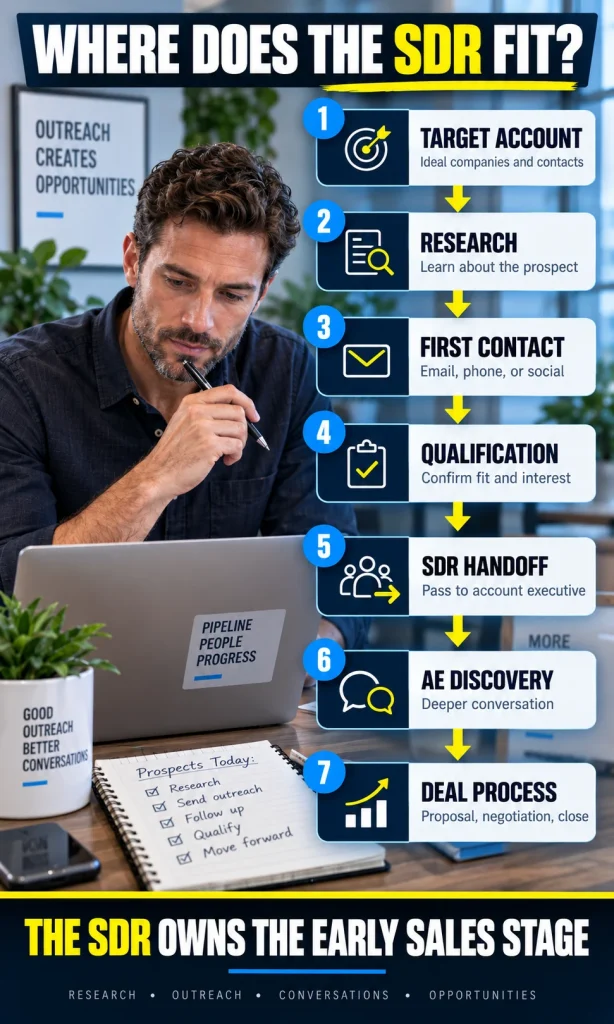
A useful sales-development process separates several different jobs that are easily mixed together in a small team.
Marketing may create awareness and generate demand. The SDR works with the people or accounts that enter the top of the sales pipeline, investigates whether they belong there, starts the conversation and determines what should happen next. Once the prospect reaches the company’s agreed handoff point, the account executive takes responsibility for deeper discovery, solution development, commercial discussion and closing.
The simplified sequence often looks like:
Potential buyer → research or inquiry → SDR contact → qualification → qualified handoff → AE discovery → proposal or commercial process → close
The boundary does not have to be identical in every organization. A relatively simple service business may allow the same salesperson to prospect, qualify and close. A company selling a complex B2B product across a large target market may gain more from separating those activities because the research and outreach workload can otherwise consume a significant portion of the closers’ time.
An SDR therefore becomes most useful when there is a repeatable early-stage sales job worth specializing. Hiring one before the business knows who it wants to reach, what makes a lead qualified or what the AE should receive at handoff can simply add another person to an unclear process.
That is an important distinction for small businesses. Adding an SDR does not automatically create demand. If the offer, target customer or sales motion has not been validated, the business may scale activity faster than it scales useful opportunities.
SDR vs Account Executive vs BDR
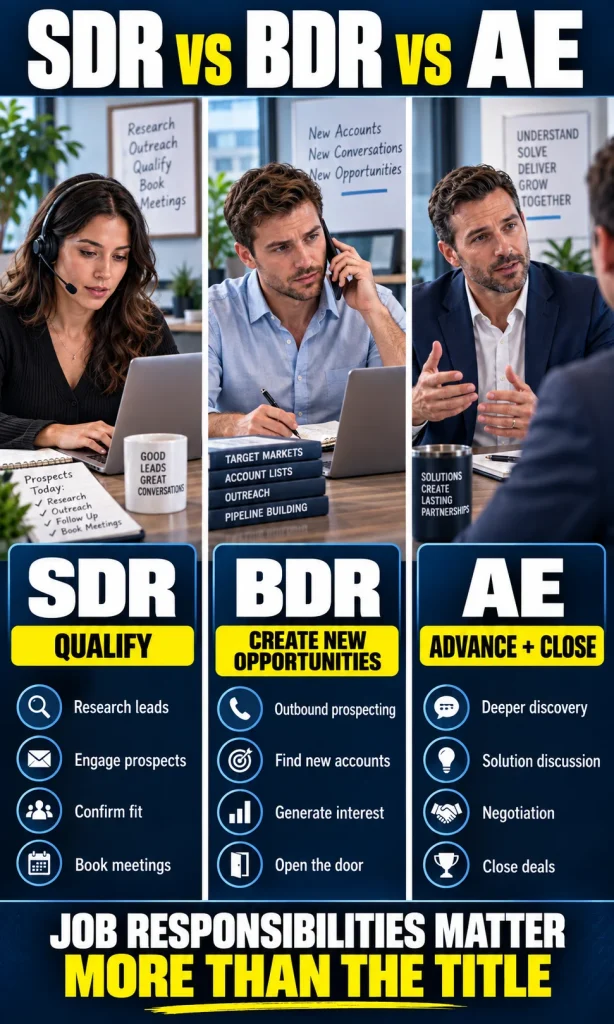
Titles vary between companies, so job descriptions matter more than the abbreviation printed beside someone’s name.
| Role | Primary job | Typical position in pipeline | Usually closes? |
|---|---|---|---|
| SDR | Research, outreach, qualification and meeting creation | Top of funnel / early sales stage | Usually no |
| Account Executive | Deeper discovery, solution discussion, negotiation and closing | Middle and later sales stages | Usually yes |
| BDR | Often outbound prospecting and new-business creation | Top of funnel | Usually no |
| Marketing | Create awareness, demand and lead-generation opportunities | Before and around the sales funnel | No |
The SDR-versus-BDR distinction is especially inconsistent. Some companies reserve SDR for inbound work and BDR for outbound prospecting. Others use SDR for outbound work. Some use one title for both. When evaluating a job or designing a sales team, read the actual responsibilities rather than assuming the title establishes the channel.
Pipeline Relay
See where an SDR should own the work, where the account executive should take over, and whether your sales motion is ready for a dedicated handoff.

Describe the sales motion
Use current monthly workload and how your team actually sells.
This is a planning diagnostic. It uses your inputs to show workload and process pressure; it does not claim an industry benchmark or guarantee a hiring outcome.
Decision snapshot
Run the analysis to see whether the team needs a separate prospecting-and-qualification role and whether the handoff process is ready.
Your recommendation will appear here.
The experience then lets the reader test the same distinction against their own sales motion: Does the team actually need a separate SDR? Is the handoff ready? Should the role be inbound, outbound or hybrid?
What Does an SDR Do During a Typical Workday?
An SDR’s day is usually divided between finding the right people, starting conversations and deciding which conversations deserve to progress. The balance changes according to whether the team is inbound, outbound or mixed.
An outbound-heavy SDR may begin by reviewing target accounts, identifying relevant contacts and checking for information that makes an approach more specific. A large part of the day may then be spent making calls, writing emails, following previous conversations and updating the CRM.
An inbound SDR works from a different queue. Someone may have requested a demo, downloaded material, attended an event or contacted the company directly. The SDR has to determine whether the inquiry represents a serious potential customer, a person still researching, an existing customer who needs support or someone who is unlikely to be a useful sales opportunity.
The common thread is prioritization. A strong SDR cannot spend equal time on every name in a database. The job requires making repeated judgments about who deserves attention now, who requires another follow-up, who should be nurtured elsewhere and who should be disqualified.
How Do SDRs Qualify Leads?

Lead qualification is the point where an SDR decides whether a prospect deserves more sales attention, needs more time, or should leave the active pipeline. The aim is not to force every conversation toward a meeting. It is to protect the next stage of the sales process from prospects who have little fit, little relevance or no realistic reason to continue.
The original version of this article focused on needs, pain points, budget, urgency and purchasing authority as common qualification considerations. Those questions are still useful, although a modern SDR should treat them as inputs rather than a rigid script. A first conversation rarely needs to extract every possible piece of buying information. The SDR needs enough evidence to decide whether another sales conversation is worthwhile.
A practical qualification sequence starts with four questions.
1. Does the Prospect Fit the Type of Customer the Business Serves?
Customer fit comes first because strong interest from the wrong type of buyer can still create a poor opportunity.
For a B2B company, relevant fit criteria might include:
- company size;
- industry;
- geography;
- technology environment;
- use case;
- regulatory or operational requirements;
- team structure;
- expected purchase size;
- whether the company can realistically use the product or service.
The exact criteria should come from the company’s actual customer strategy. An SDR should not invent qualification rules independently just because a particular prospect sounds enthusiastic.
A clear ideal customer profile also makes outbound prospecting more efficient. Instead of beginning with a huge list of companies and trying to persuade all of them, the SDR can concentrate research and outreach on accounts that have a plausible reason to benefit from the offer.
2. Is There a Relevant Problem or Opportunity?
Fit alone does not create a sales opportunity. A company may match the target profile perfectly while having no meaningful reason to consider the product now.
The SDR therefore needs to understand what prompted the conversation. The trigger might be an operational problem, a growth objective, an upcoming change, a failed existing solution, an internal project or a request from another stakeholder.
The important part is relevance. A prospect saying, “That sounds interesting,” is much weaker than a prospect explaining that the team is actively struggling with the problem the product addresses.
This is also where product knowledge matters. An SDR should understand the offer well enough to recognize when there is a genuine connection between the prospect’s situation and what the company can provide. The older article correctly treated product, service and competitive knowledge as a core SDR skill.
That knowledge should help the SDR diagnose fit rather than turn the first conversation into a full product presentation.
3. Is There Enough Engagement to Continue?
A qualified-looking account is still only an account until somebody participates in the buying conversation.
Engagement can appear in different ways. A prospect may respond to an outbound message, ask a detailed question, request a demonstration, explain an internal problem or introduce another stakeholder. In an inbound motion, the prospect may have submitted a form or requested contact, although even that does not automatically make the lead ready for an AE.
The SDR needs to judge whether there is enough reciprocal interest for another conversation to be useful.
Repeatedly pushing an unresponsive prospect toward a meeting can make activity numbers look healthy while weakening the quality of the pipeline. On the other hand, abandoning a potentially strong account after one unanswered message can be premature, particularly in outbound sales where timing matters.
This is why persistence is useful when paired with judgment. The existing article identifies persistence and the ability to handle rejection as important SDR qualities. The practical skill is knowing when persistence still has a purpose and when continued pursuit has become low-value activity.
4. Is an Account Executive’s Time Justified?
The final qualification question is operational:
Would the next conversation be a good use of the AE’s time?
This is where a company needs an explicit handoff threshold.
The SDR should be able to explain why the prospect is moving forward. A useful explanation might sound like this:
The company fits our target customer profile, the operations team is trying to reduce a specific manual process, the prospect has confirmed that the issue is active this quarter, and the person we spoke with wants to evaluate whether our solution can address it.
That is far more useful than:
They seemed interested, so I booked a meeting.
The qualification threshold does not need to prove that the prospect will buy. If the SDR could establish that with certainty, much of the remaining sales process would be unnecessary. The threshold should establish that there is enough customer fit, problem relevance and engagement to justify deeper sales work.
What Makes a Good SDR-to-AE Handoff?

A good handoff allows the account executive to continue the conversation instead of forcing the prospect to repeat the first conversation from the beginning.
This seems simple, yet handoffs frequently become one of the weakest parts of a segmented sales process. The SDR may be rewarded for creating meetings while the AE cares about opportunities that can actually progress. If those two roles use different definitions of “qualified,” friction appears quickly.
The solution is to define what information must accompany an accepted handoff.
A Useful SDR Handoff Should Answer Five Questions
Who is involved?
Identify the company, the people already involved and each person’s relevant role.
Why are they talking to us?
Record the problem, objective, use case or event that created the conversation.
What have we learned?
Capture the information that changes how the AE should approach the next conversation. Avoid filling the CRM with a transcript when a concise summary would be more useful.
Why now?
Note whether something makes the issue timely. There may be an upcoming project, contract renewal, operational problem, leadership request or another reason the prospect is considering action.
What happens next?
Record what the prospect expects from the scheduled conversation. A demo, technical discussion, pricing conversation and deeper discovery call are different meetings.
The handoff should also preserve unanswered questions. Pretending the SDR has already completed deep discovery can be as damaging as providing no context at all.
A strong note can explicitly say, for example, that the budget owner has not yet been identified or that technical requirements still need investigation. That tells the AE where to continue rather than giving them false confidence.
The Handoff Needs a Feedback Loop
A handoff process cannot improve if SDRs never learn what happened after the meeting.
If an AE rejects a lead, the reason should be visible. Perhaps the account was too small, the problem was irrelevant, the supposed project had no priority or the person was simply gathering information.
Those rejection reasons help the SDR refine future qualification.
The same is true when an opportunity progresses successfully. If a certain combination of account characteristics, problems and engagement repeatedly produces strong opportunities, the sales-development team gains useful information about where to focus its attention.
This is why SDR and AE collaboration should extend beyond calendar bookings. The two roles are part of the same pipeline.
The old article already described SDRs as working closely with account executives throughout the day and receiving input on qualified leads. A more useful modern operating model formalizes that feedback instead of leaving it to occasional conversations.
How Should SDR Performance Be Measured?

SDR performance should be evaluated across activity, qualification quality and downstream sales outcomes. Measuring only calls or meetings can encourage behavior that increases volume while decreasing usefulness.
Activity metrics still have a role. A manager needs to know whether the SDR is doing enough prospecting work for the sales model. The mistake is treating activity as the final result.
| Metric | What it tells you | What it can hide |
|---|---|---|
| Calls, emails or outreach attempts | Whether enough prospecting activity is occurring. | Poor targeting or weak conversations. |
| Meetings booked | How often outreach creates a scheduled next step. | Low-fit meetings, cancellations and weak qualification. |
| Meeting held rate | Whether scheduled prospects actually attend. | Whether the meeting deserved to happen. |
| AE acceptance rate | Whether the closing team believes SDR handoffs meet the agreed standard. | Whether accepted opportunities ultimately progress. |
| Qualified meeting to opportunity conversion | Whether qualification predicts a real sales opportunity. | Longer-term deal quality and revenue. |
| CRM completeness at handoff | Whether the AE receives useful context. | The actual quality of the conversation behind the data. |
The right combination depends on the sales motion. An inbound team may care heavily about response speed and lead handling because somebody has already raised their hand. An outbound team may care more about account coverage, contact quality and whether conversations from targeted accounts progress.
The important principle is that the measurement system should discourage empty meetings.
If an SDR receives praise for every booked meeting while the AE absorbs the cost of poor qualification, the company has created conflicting incentives.
Activity Is an Input – Pipeline Quality Is the Test
Consider two SDRs.
The first books a large number of meetings, but many prospects fail to attend, AEs reject numerous handoffs and few meetings become genuine opportunities.
The second books fewer meetings, but a much larger share of those prospects attend, satisfy the qualification standard and continue through the sales process.
Looking only at meeting count makes the first SDR appear stronger. Looking at the full pipeline may reveal the opposite.
That does not mean every SDR should be judged directly on closed revenue. Closing outcomes depend on the AE, pricing, competition, product fit, market conditions and many other factors outside the SDR’s control.
It does mean that some downstream signal should connect SDR activity to sales quality.
A practical dashboard might therefore track:
- outreach activity;
- meaningful conversations;
- meetings booked;
- meetings held;
- accepted handoffs;
- qualified opportunities created;
- handoff rejection reasons;
- progression from qualified meeting to opportunity.
The manager can then see whether a problem begins with insufficient activity, poor targeting, weak qualification, low meeting attendance or the handoff itself.
What Skills Does a Successful SDR Need?
The previous article organized SDR skills around product knowledge, time management, persistence and interpersonal ability. Those remain useful foundations, although the role usually requires a broader combination of research, communication and judgment.
1. Prospect Research
A strong SDR can learn enough about a person and company to decide whether outreach is justified and what should make the opening relevant.
Research does not mean spending an hour preparing every email. The level of research should reflect the potential value and complexity of the account.
The skill lies in identifying information that changes the conversation rather than collecting facts simply because they are available.
2. Clear Written and Verbal Communication
SDRs often have very little time to earn attention.
An email needs to establish relevance without becoming a miniature brochure. A call needs to reach the reason for the conversation without sounding like a memorized monologue. A follow-up should make the next step obvious.
Good communication also means listening. Qualification becomes unreliable when the SDR is so focused on delivering the pitch that they miss what the prospect is actually saying.
3. Product and Customer Knowledge
An SDR does not need to perform every technical demonstration that a specialist or AE can provide. They do need enough understanding to identify plausible use cases, recognize poor fit and answer the level of question appropriate to an early sales conversation.
They should also understand who the product is not for.
That boundary is important because qualification requires the confidence to disqualify, not merely the ability to persuade.
4. Organization and CRM Discipline
An SDR can be managing many conversations at different stages simultaneously. Without reliable organization, follow-ups disappear, prospects receive contradictory messages and useful information never reaches the person responsible for the next step.
The CRM should therefore support memory rather than become an administrative task performed at the end of the week.
Useful records capture what happened, what matters and what comes next.
5. Persistence With Judgment
Sales development includes rejection, silence and conversations that do not progress. An SDR needs enough resilience to continue working without interpreting every unanswered message as personal failure.
Persistence still needs boundaries.
Following up because the prospect fits the target profile and the timing remains plausible is different from continuing indefinitely because the SDR does not want to accept a lost opportunity.
The strongest SDRs learn when to continue, when to change the approach and when to stop.
6. Curiosity and Qualification Judgment
This may be one of the most underestimated SDR skills.
The SDR is repeatedly deciding whether something deserves another question, another contact or another person’s time. That requires curiosity about the buyer’s situation and enough commercial judgment to distinguish a promising signal from a superficial one.
Scripts and qualification frameworks can help create consistency, but they cannot replace listening.
A useful SDR understands why the question is being asked rather than merely moving through a checklist.
Common SDR Mistakes That Weaken the Sales Pipeline
Most SDR problems are not caused by a lack of effort. They usually come from aiming effort at the wrong accounts, measuring the wrong outcome, qualifying inconsistently or handing opportunities to AEs without enough context.
A sales-development process can therefore look extremely active while producing surprisingly little useful pipeline. High call volume, busy inboxes and full calendars are visible. Poor targeting and weak handoffs are harder to see until account executives begin complaining that the meetings are not worth their time.
Treating Every Lead as Equally Valuable
One of the fastest ways to waste SDR capacity is to work a large list without meaningful prioritization.
A prospect that closely matches the ideal customer profile, has a plausible business problem and recently showed intent should usually receive different treatment from a name that happens to exist in a database.
Prioritization can consider:
- customer fit;
- account value;
- recent engagement;
- relevant business events;
- previous conversations;
- timing signals;
- role or seniority of the contact;
- whether the company already uses a competing or complementary solution.
The purpose is not to create a complicated scoring system for its own sake. The SDR needs a practical way to decide who deserves attention first.
Overpersonalizing Every Message
Personalization can improve relevance, but research has a cost.
An SDR who spends 25 minutes studying every prospect may produce beautifully customized messages while reaching too few people to learn what actually works.
The level of research should match the value and complexity of the account.
A strategic enterprise account may justify deeper preparation. A broader small-business campaign may need lightweight personalization based on company type, role, problem and a useful trigger.
The question is not:
How personalized can this message become?
It is:
What information would make this outreach meaningfully more relevant?
Everything beyond that has to earn the time it consumes.
Using the Same Script Regardless of What the Prospect Says
Scripts are useful for consistency, particularly when someone is new to the SDR role. Problems begin when the script becomes more important than the conversation.
If a prospect says they are replacing an existing system because implementation has become unreliable, the SDR should explore that information. Returning mechanically to question number three because it appears next on a document wastes the signal the buyer has already provided.
A better structure gives the SDR:
- a clear opening;
- the important qualification areas;
- examples of useful questions;
- common objections;
- the information required before handoff.
The SDR can then navigate the conversation naturally while still collecting the information the sales process requires.
Booking Meetings With People Who Cannot Move the Conversation Forward
The first contact does not always have to be the final decision-maker. Complex B2B purchases often involve several people.
The problem is booking a meeting without understanding the contact’s relationship to the issue.
A knowledgeable operational user may be highly valuable even if they do not approve the purchase. They may understand the problem deeply, influence requirements and help the sales team identify other stakeholders.
A contact with no connection to the problem, budget, workflow or decision process is different.
The useful question is therefore not simply:
“Are you the decision-maker?”
A more practical question is:
“How does this person relate to the problem and the decision that may follow?”
Hiding Weak Handoffs Behind Meeting Volume
If SDR compensation, recognition and management attention revolve almost entirely around meetings booked, the system naturally encourages more meetings.
Some of those meetings may have little chance of progressing.
That creates a predictable conflict. The SDR says the calendar is full. The AE says the leads are poor. Management then debates whether the problem is prospecting, qualification or closing.
A shared definition of an accepted handoff reduces this conflict because both roles evaluate the same event.
A meeting should count as a meaningful sales-development outcome when it satisfies the company’s agreed criteria, not simply because an invitation was accepted.
Failing to Learn From Rejection
SDRs hear “no” frequently, but not every rejection means the same thing.
A prospect may reject the conversation because:
- the company is a poor fit;
- there is no active problem;
- timing is wrong;
- another project has priority;
- the contact is wrong;
- the outreach message failed to establish relevance;
- a competitor is already deeply embedded;
- the prospect simply does not want to engage.
Those distinctions matter.
If a particular account segment repeatedly says the same thing, the problem may be targeting rather than SDR technique. If strong-fit prospects consistently disengage after the opening, the messaging deserves investigation.
Rejection becomes useful when the organization captures enough context to identify patterns instead of treating every “no” as identical.
When Should a Company Hire Its First SDR?
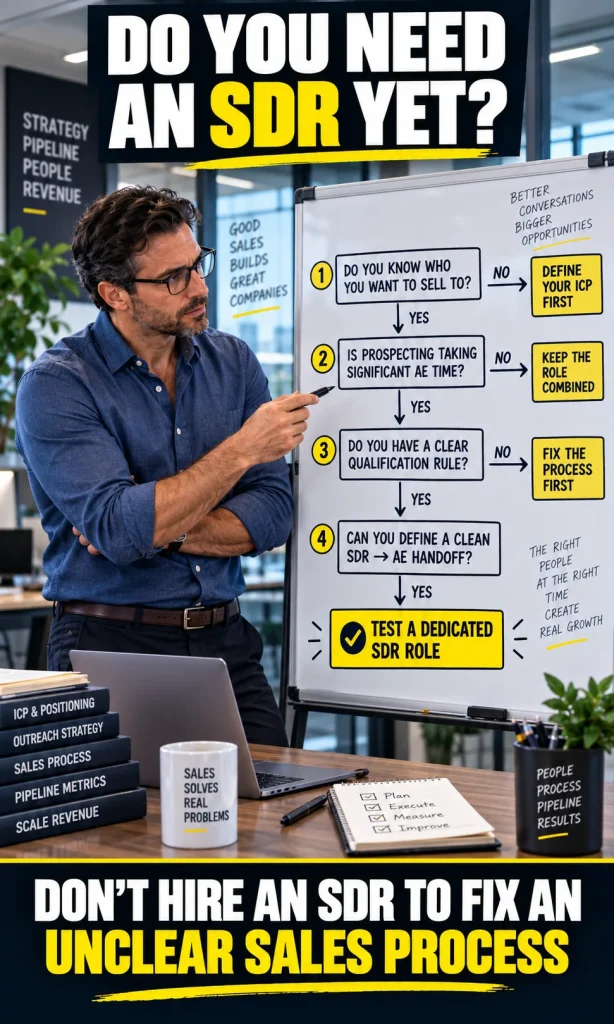
A company should consider hiring a dedicated SDR when prospecting and early qualification have become substantial, repeatable work that is consuming time better spent on deeper sales conversations.
That does not mean every business should eventually build an SDR team.
A founder-led sales organization with a small number of high-value accounts may benefit from keeping prospecting close to senior sellers because insight gathered during outreach is strategically valuable. A transactional business with a short sales cycle may not need separate prospecting and closing roles at all.
The role becomes more compelling when several conditions are present.
Signs the Business May Be Ready for an SDR
The Ideal Customer Is Reasonably Clear
The company can describe which types of customers are most likely to benefit and which ones usually do not fit.
Without that clarity, an SDR can increase outreach without increasing useful conversations.
Prospecting Is Consuming Significant Closing Time
If account executives spend large portions of their week building lists, following early-stage leads and trying to find interested contacts, specialization may free them to spend more time on discovery, proposals and active opportunities.
The important issue is opportunity cost.
An AE spending an hour prospecting is not necessarily wasting that hour. The question is whether another role could perform that work effectively while the AE uses the hour on activity where their closing skill matters more.
There Is Enough Lead or Account Volume
A dedicated SDR requires enough ongoing early-stage work.
If the company has only a small number of realistic target accounts, adding a separate layer may create more handoff friction than capacity.
Volume does not mean flooding the SDR with thousands of names. It means there is a continuing stream of meaningful accounts or inquiries that justifies specialization.
Qualification Can Be Defined
The business should know what distinguishes:
qualified → nurture → disqualified
before hiring someone whose job is to make those decisions repeatedly.
An SDR can help improve the rules, but the company should not expect a new employee to invent the entire sales strategy from scratch.
The AE Handoff Can Be Explained
The company should be able to answer:
What has to be true before an SDR sends a prospect to an AE?
If nobody can answer consistently, hiring another person adds a role boundary before the boundary itself has been designed.
Signs You May Not Need an SDR Yet
A separate SDR role may be premature when:
- the company is still trying to discover its ideal customer;
- the offer changes frequently;
- founders are still learning why customers actually buy;
- prospect volume is low;
- the same person can efficiently prospect and close;
- qualification criteria are unclear;
- there is no consistent CRM process;
- AEs already have enough capacity for prospecting;
- most new business comes through relationships or a small number of strategic accounts.
In these cases, the founder or AE may learn more by remaining close to early conversations.
That learning can be especially valuable when a company is still testing positioning or refining its business model. Similar reasoning applies when deciding when to hire your first employee: hiring works best when there is a repeatable body of work and enough clarity to transfer responsibility.
Hiring an SDR Will Not Fix a Weak Sales Process
A common mistake is recognizing that sales growth has slowed and concluding that the company needs more prospecting.
Sometimes it does.
Sometimes the underlying problem is elsewhere.
If prospects respond but rarely progress, the offer, qualification process or sales conversation may be weak. If AEs reject most SDR meetings, the handoff definition may be wrong. If nobody replies to outreach, targeting and messaging deserve attention before hiring more people to send more messages.
Before adding an SDR, examine where the sales process actually breaks.
| What you observe | Likely issue to investigate first | Would another SDR automatically fix it? |
|---|---|---|
| Not enough target accounts are being contacted | Prospecting capacity | Possibly, if targeting and messaging already work |
| Plenty of outreach but very few replies | Targeting, relevance, messaging or channel fit | No |
| Many meetings but AEs reject them | Qualification and handoff standards | No |
| AEs accept meetings but opportunities rarely advance | Sales discovery, offer fit, buyer process or deal execution | Usually not |
| AEs spend substantial time finding and chasing early prospects | Role specialization and capacity | Potentially yes |
| Nobody agrees on who the target customer is | Sales strategy and ICP definition | No |
The distinction saves money because hiring solves capacity problems much better than it solves strategy problems.
How Should a New SDR Role Be Set Up?
A new SDR should receive more than a CRM login, an account list and a target number.
The role needs an operating structure that makes good behavior easier to repeat.
1) Define the Ideal Customer
Give the SDR a clear description of the accounts the company wants.
Include important exclusions too.
Knowing that the company targets “technology businesses” is far less useful than knowing which company sizes, use cases, regions and buyer roles consistently produce worthwhile conversations.
2) Define the Handoff
Write down what must be true before an opportunity goes to an AE.
Do this with the AEs who will receive the meetings.
A strong handoff standard might specify:
- acceptable customer fit;
- relevant problem or objective;
- required contact information;
- level of engagement;
- context that must be recorded;
- what the next meeting is intended to accomplish.
This prevents the SDR and AE from quietly developing different definitions of success.
3) Give SDRs Access to the Right Sales Systems
The exact software matters less than whether the workflow is coherent.
An SDR may use a CRM, phone system, email sequencing platform, prospecting database, social platform, scheduling system and research resources. Adding software does not automatically improve sales development.
The useful question is whether each system removes friction from a specific job.
A CRM should preserve context. A sequencing system should help follow-up remain consistent. Prospecting data should improve targeting. Scheduling should make the handoff easier.
Businesses reviewing their software stack can also compare the broader sales tools teams use rather than buying a separate application for every small inconvenience.
4) Train Around Real Conversations
Product training is necessary, but an SDR also needs practice handling the conversations they will actually encounter.
Useful training material includes:
- examples of strong and weak target accounts;
- good opening messages;
- real objections;
- qualification examples;
- calls that progressed;
- calls that should have been disqualified;
- strong CRM notes;
- poor handoffs and why the AE rejected them.
The training becomes much more useful when the SDR can see the difference between “correct information” and “good judgment.”
5) Review Quality Before Scaling Activity
During the first weeks, managers should inspect whether the SDR is targeting appropriate prospects and using the qualification standard correctly.
Increasing activity before correcting targeting errors multiplies the wrong behavior.
A slower start with frequent review can create a stronger operating pattern than immediately demanding maximum call or email volume.
What Is the Career Path for an SDR?
For many sales professionals, SDR is an entry point into broader sales responsibility.
A common progression is:
SDR → Senior SDR → Account Executive
although that path is not automatic and it is not the only option.
An SDR may move into account management, customer success, sales operations, revenue operations, enablement, partnerships, recruiting or management depending on their strengths and interests.
The role can provide unusually broad exposure to the beginning of the buying process. SDRs learn which messages attract attention, what objections appear repeatedly, which customer problems create urgency and what separates a polite conversation from a real opportunity.
Those skills can become valuable later in closing roles.
What Should an SDR Learn Before Moving to AE?
A promotion should depend on more than hitting an activity target.
An SDR preparing for an AE role should increasingly demonstrate:
- reliable qualification judgment;
- strong discovery questions;
- understanding of customer problems;
- ability to manage a structured conversation;
- clear written follow-up;
- CRM discipline;
- knowledge of competitors and alternatives;
- understanding of how deals progress after handoff;
- commercial curiosity;
- ability to handle objections without becoming defensive.
Shadowing AE calls can accelerate this transition because the SDR sees what happens to opportunities after the initial meeting.
It also improves current SDR performance. Once someone understands which handoff details become useful later, they can collect better information earlier.
Is SDR Work the Same as Inside Sales?
SDRs often work within an inside-sales organization, but the terms describe different things.
Inside sales usually refers broadly to selling remotely rather than relying primarily on face-to-face field selling. An inside salesperson may prospect, qualify, demonstrate, negotiate and close without meeting the customer physically.
An SDR describes a particular function within the sales process: early-stage prospecting and qualification.
An SDR can therefore be part of an inside-sales team, but not every inside salesperson is an SDR.
Businesses deciding how to structure remote selling can explore the broader distinction in what inside sales is and why companies use it.
Can AI Replace SDRs?
AI can automate or accelerate parts of SDR work, particularly research, data enrichment, call summaries, CRM updates, prioritization and first-draft outreach.
That does not mean every early-stage sales conversation should be automated.
The most valuable parts of sales development often involve judgment: determining whether a problem is meaningful, recognizing an unexpected buying signal, deciding which question deserves follow-up, understanding hesitation and adapting the conversation when the prospect says something the workflow did not anticipate.
A sensible division is to use automation where repetition dominates and human judgment where interpretation affects the quality of the opportunity.
For example, software may help an SDR assemble account information. The SDR still decides which information matters.
Software may summarize a call. The SDR still decides what should influence the handoff.
Software may draft an email. The SDR still needs to decide whether the message is relevant enough to send.
The useful question is therefore less dramatic than “Will AI eliminate SDRs?”
A better operational question is:
Which parts of SDR work should require human judgment, and which parts should no longer consume human time?
That distinction is likely to matter more as sales teams continue adopting automation.
The SDR Role Is Ultimately a Quality-Control Point
The easiest way to understand sales development is to stop thinking about the SDR as simply the person who makes calls.
The SDR sits between a large universe of possible buyers and the limited time of the people responsible for serious sales conversations.
That makes the role a form of pipeline quality control.
A strong SDR helps the company answer:
- Which accounts deserve attention?
- Which people should we contact?
- Is there a real reason for a conversation?
- Does this prospect belong in the sales process?
- What should happen next?
- What does the AE need to know before taking over?
When those decisions improve, sales development creates value even before a deal closes.
When those decisions are poor, higher activity can simply move more weak opportunities deeper into the funnel.
Frequently Asked Questions About Sales Development Representatives
What is a sales development representative?
A sales development representative, or SDR, works at the early stage of the sales process. SDRs typically research prospects, make initial contact, qualify whether there is a meaningful fit and reason to continue, document useful context, and pass qualified opportunities to an account executive or another salesperson responsible for deeper discovery and closing.
Do SDRs close sales?
Usually, no. In many sales organizations, the SDR creates and qualifies the opportunity while an account executive owns deeper discovery, proposals, negotiation and closing. Smaller companies may combine those responsibilities, so the actual job description matters more than the title alone.
What is the difference between an SDR and a BDR?
There is no universal distinction. Some companies use SDR for inbound qualification and BDR for outbound prospecting, while others use SDR for both inbound and outbound work or use the two titles almost interchangeably. Compare the responsibilities, lead source and handoff expectations rather than assuming the acronym defines the role.
What does an SDR do all day?
A typical SDR day may include researching target accounts, contacting prospects, responding to inbound leads, following previous conversations, asking qualification questions, booking qualified meetings, updating CRM records and coordinating handoffs with account executives. The balance depends heavily on whether the role is inbound, outbound or hybrid.
How do SDRs qualify leads?
A practical qualification process checks whether the prospect fits the company’s target customer profile, has a relevant problem or use case, shows enough engagement to continue and deserves deeper sales attention. The company should define what qualifies a lead for handoff instead of leaving every SDR to invent the standard independently.
What makes a good SDR-to-AE handoff?
A good handoff tells the account executive who is involved, why the prospect is interested, what has already been discussed, why the issue matters now and what the prospect expects from the next conversation. The AE should be able to continue the sales process rather than force the buyer to repeat the first conversation.
What metrics should SDRs be measured on?
Useful SDR metrics can include outreach activity, meaningful conversations, meetings booked, meeting held rate, AE acceptance rate, qualified opportunities created and conversion from qualified meeting to opportunity. The strongest measurement system combines activity with downstream quality instead of rewarding meeting volume alone.
When should a company hire its first SDR?
A dedicated SDR becomes more useful when the company has a reasonably clear ideal customer, enough ongoing prospecting or inbound lead volume, a repeatable qualification process and account executives who are spending significant time on early-stage work that could be separated. Hiring an SDR is less likely to help when targeting, messaging or the sales process itself is still unclear.
Is SDR a good entry-level sales role?
It can be. SDR work gives early-career sales professionals repeated practice in prospect research, communication, qualification, objection handling and CRM discipline. People who develop strong judgment and discovery skills may later move into account executive, account management, customer success, sales operations or other revenue roles.
Can AI automate SDR work?
AI can automate or accelerate parts of SDR work such as research, data enrichment, call summaries, CRM updates, prioritization and first-draft outreach. Human judgment remains valuable when the SDR has to interpret a prospect’s situation, decide whether a signal is meaningful, adapt the conversation and determine whether a handoff is genuinely justified.
Action Checklist: Building an SDR Role That Actually Helps Sales
A company does not need a complicated sales-development operation on day one. It needs a clear division of work, a qualification standard the team trusts and enough feedback to improve the handoff over time.
Use this checklist before hiring or restructuring the role.
Customer definition
- We can describe the types of companies or buyers we want the SDR to pursue.
- We can identify common poor-fit prospects the SDR should deprioritize or disqualify.
- The SDR understands the problems or use cases our offer can realistically address.
- Targeting criteria are specific enough to guide day-to-day prospect research.
Prospecting process
- We know whether the role is primarily inbound, outbound or hybrid.
- There is enough recurring early-stage sales work to justify specialization.
- We have decided which channels the SDR is expected to use.
- Research requirements match the value and complexity of the account.
- The SDR has enough freedom to adapt outreach rather than reading a rigid script.
Qualification
- The company has one shared definition of a qualified lead or meeting.
- Customer fit is checked before the prospect consumes significant AE time.
- The SDR understands which problems, use cases or signals make an opportunity relevant.
- The SDR knows what should be nurtured instead of immediately handed off.
- Disqualification is treated as a legitimate outcome when the prospect does not fit.
SDR-to-AE handoff
- The AE knows exactly what has to be true before a meeting is passed over.
- The handoff contains company and contact context.
- The problem or use case is recorded.
- Relevant details from the first conversation are visible.
- The reason for the next meeting is clear.
- The AE can reject a handoff using a meaningful reason rather than simply saying the lead was bad.
- Rejection reasons are reviewed so qualification can improve.
Measurement
- Outreach activity is tracked as an input rather than the only success measure.
- Meetings booked and meetings held are separated.
- AE acceptance of SDR handoffs is visible.
- The team can see whether qualified meetings become real opportunities.
- SDRs are not encouraged to book weak meetings simply to hit a volume target.
- Managers review downstream quality as well as top-of-funnel activity.
Management and development
- New SDRs receive real examples of good and poor-fit accounts.
- Training includes real objections and conversations.
- The SDR receives feedback from AEs about what happens after handoff.
- Managers review quality before aggressively increasing activity targets.
- Strong SDRs are given opportunities to learn deeper discovery and later sales stages.
- The company periodically checks whether automation can remove repetitive work without weakening judgment.
The Bottom Line
An SDR is valuable when the business needs someone to specialize in finding, engaging and qualifying potential buyers before deeper sales work begins.
The strongest sales-development teams make that boundary clear. The SDR knows which accounts deserve attention, what counts as qualification and what information the AE needs. The AE knows what to expect from a handoff and gives feedback when the opportunity does not meet the agreed standard.
That clarity matters more than the title.
A company with a strong process may call the role SDR, BDR, sales development, business development or something else entirely. The operating question remains the same:
Who owns the work before a prospect is ready for serious closing attention, and what has to be true before that prospect moves forward?
When the answer is explicit, sales development can reduce wasted AE time, improve pipeline quality and give the business a more repeatable way to turn possible buyers into real sales conversations.