
A service business model explains more than how much a customer pays. It describes what the customer is buying, when value is delivered, how revenue reaches the business, how much delivery capacity each customer consumes, and who carries the financial risk when the work takes longer or produces a different result than expected. Those choices shape the economics of a service company long before the owner worries about branding, hiring or scale.
A consulting firm charging $5,000 for a defined project operates differently from one charging $5,000 per month for continuing access. A subscription service may collect recurring revenue like a retainer, yet depend much more heavily on standardized delivery. A performance-based provider may appear attractive to customers because part of the fee depends on results, while the provider accepts substantially more revenue uncertainty. A marketplace creates another structure entirely because the business may facilitate the service rather than perform all of it itself.
Choosing among these models therefore requires more than asking which one sounds most profitable. The model has to fit how the customer experiences value and how the provider can repeatedly deliver that value without allowing revenue growth to overwhelm capacity or margin.
If you are still deciding whether the underlying opportunity is commercially promising, start with how to know if your business idea is good. If the idea appears promising but the assumptions about customers, price and demand remain largely theoretical, how to test business ideas covers the evidence-building stage. This article deals with the next design decision: which business model should carry the economics of the service?
The Quick Answer: What Are the Main Service Business Models?
The six most useful service business models to compare are project-based, retainer, subscription, usage-based, performance or commission, and marketplace models. A productized service can sit on top of several of these structures by making the scope, process, timing and price more standardized.
The models differ because customers are paying for different things.
In a project model, the customer buys a defined outcome or engagement.
In a retainer, the customer pays repeatedly for continuing professional access or reserved capacity.
In a subscription, the customer pays repeatedly for standardized ongoing access or service.
With usage-based pricing, revenue changes according to consumption.
With a performance model, some or all payment depends on an agreed result.
A marketplace earns revenue by helping buyers and providers find, transact with or trust one another.
None is automatically superior. The stronger model is the one whose revenue structure matches the service’s delivery reality.
Quick Comparison of Service Business Models
| Business Model | Customer Mainly Pays For | Revenue Pattern | Main Provider Risk |
|---|---|---|---|
| Project | A defined piece of work, deliverable or outcome. | One-time or milestone-based. | Scope and delivery cost exceed what was priced. |
| Retainer | Ongoing professional access, support or reserved capacity. | Recurring. | Scope creep or excessive use of reserved capacity. |
| Subscription | Repeatable access to a standardized recurring service. | Recurring. | Churn combined with expensive ongoing delivery. |
| Usage-Based | Measured consumption or activity. | Variable. | Revenue volatility and unpredictable customer usage. |
| Performance / Commission | A measurable result, transaction or successful outcome. | Contingent or partially contingent. | The provider performs work before knowing how much revenue will be earned. |
| Marketplace | Access, matching or transaction facilitation between buyers and providers. | Transaction fees, commissions, subscriptions or combinations. | Insufficient buyer-provider activity, trust or transaction volume. |
The table is a starting point rather than a ranking. A model that creates predictable revenue can still be weak if delivery requirements are unpredictable. A model that transfers financial risk to the provider can still be attractive when the provider has enough control over the outcome to price that risk intelligently.
A Pricing Method Is Not Always a Business Model
This distinction prevents a lot of confusion.
Hourly pricing, day rates and fixed fees are ways of calculating what a customer pays. They do not necessarily describe the full business model.
A consulting company might sell a defined three-month transformation project for a fixed $30,000 fee. Another might calculate a similar project’s price using an estimated number of consultant days. Both companies can still fundamentally operate a project model because the customer is buying a defined engagement rather than continuing access.
Likewise, a retainer could technically be calculated from a hidden hourly capacity assumption while the customer sees only a fixed monthly payment.
The broader model needs to answer more questions:
- What triggers the customer payment?
- Is the relationship one-time or continuing?
- How variable is the amount of work?
- How easily can delivery be standardized?
- Does revenue rise when usage rises?
- Is payment linked to an outcome?
- Who bears the cost if work takes longer than expected?
- What happens when demand becomes much stronger?
Those questions expose the commercial architecture underneath the price.
Use the Service Model Triangle: Revenue, Delivery and Risk
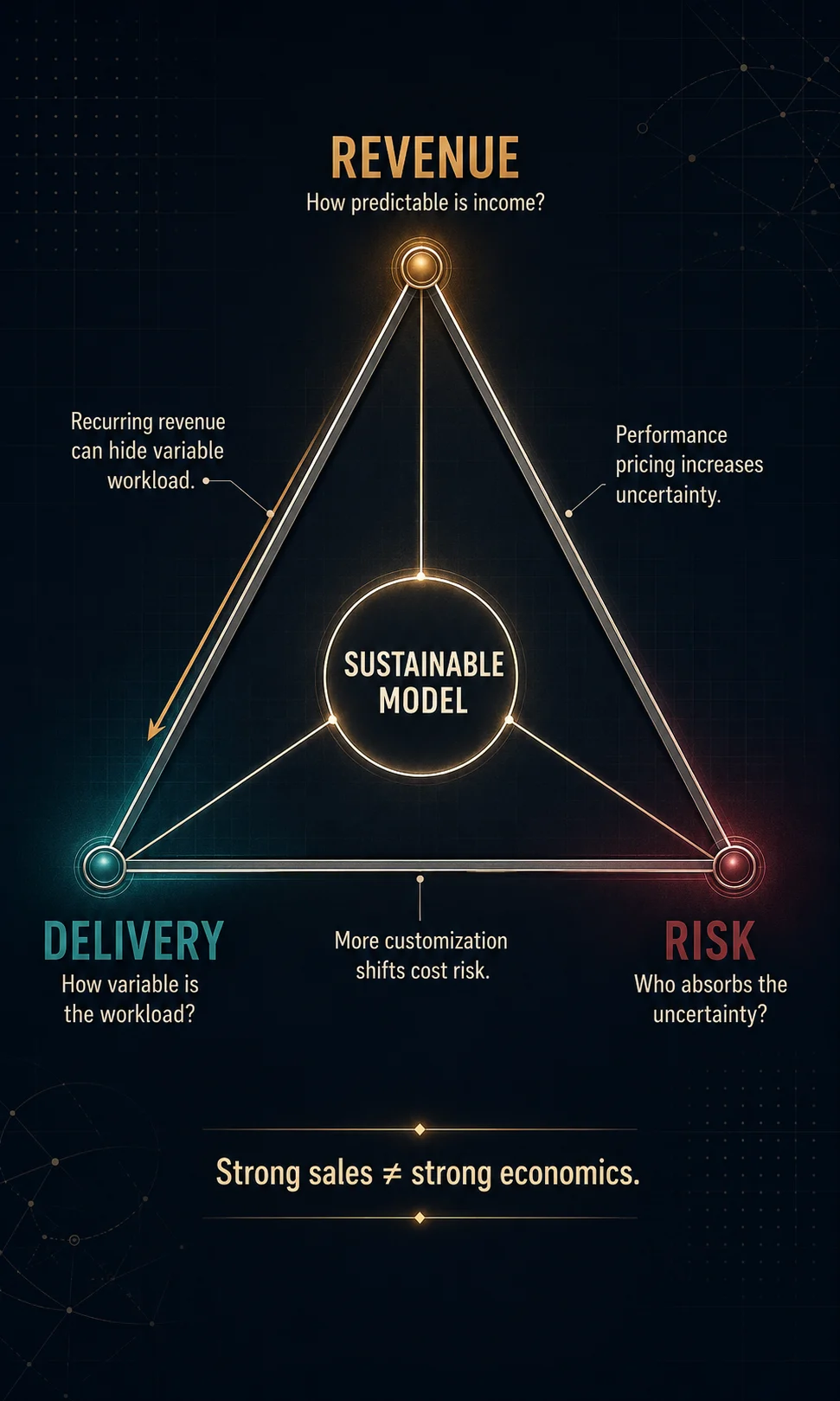
A practical way to compare service models is to examine three forces simultaneously.
Revenue Predictability
How much confidence does the business have about revenue arriving next month?
A signed six-month retainer usually creates more short-term revenue visibility than beginning every month with an empty project pipeline. A subscription can create recurring revenue as well, although churn changes how durable that revenue actually is.
Predictability can improve planning, but it should never be considered by itself. Revenue that appears secure can become unprofitable if the corresponding delivery workload is uncontrolled.
A service model should ultimately survive its financial assumptions, not only sound attractive commercially. The U.S. Small Business Administration recommends comparing marketing and sales costs with the revenue they generate and continuing to track those costs as the plan is executed, which is particularly important when recurring or performance-based revenue creates a different cost pattern from one-time projects.
Delivery Variability
How much can one customer’s workload differ from another customer’s workload?
Some services are inherently variable. A complex strategy engagement may require significantly different research and senior attention from one customer to another. Other services can be tightly standardized: the provider performs largely the same process, uses the same templates and delivers a comparable output every time.
The more variable the work, the more carefully the company has to manage models that promise broad or unlimited access.
Provider Risk
Who absorbs the consequences when reality differs from the estimate?
With hourly work, customers may absorb more of the cost when the work takes longer.
With a fixed-price project, the provider generally carries more of that overrun risk.
With performance pricing, the provider may perform substantial work and earn very little if the agreed result does not occur.
The model therefore affects who carries uncertainty, not only when revenue arrives.
The Best Model Balances All Three
Consider two marketing agencies.
Agency A charges $8,000 per month for broad access to the team. The recurring revenue looks excellent, but clients can submit a highly variable amount of work. If requests expand faster than staffing, the model produces predictable revenue and unpredictable cost.
Agency B sells carefully defined campaigns at fixed prices. Revenue is less predictable because new projects continually have to be won, but delivery requirements may be easier to estimate because each engagement has a clear scope.
Neither model is automatically better.
The relevant question is:
Which set of tradeoffs fits the way this service creates value?
That is where the model choice begins.
1. The Project-Based Service Model
A project model is one of the most familiar structures in professional services. The customer purchases a defined engagement with an intended scope, timetable, deliverables or outcome, and the relationship may end when the work is completed.
Examples include:
- an interior design engagement
- website development
- a brand redesign
- a consulting study
- an installation
- a photography package
- a recruitment project
- implementation work
- an audit
- a legal matter with defined scope
The project model works particularly well when the customer can understand what completion looks like and the provider can estimate the effort required with reasonable confidence.
How Project Revenue Works
Payment structures vary.
A project could use:
100 percent upfront
deposit + final payment
milestone payments
monthly progress billing
or another arrangement appropriate to the service and contract.
Those payment mechanics do not change the underlying model. What defines it is that the commercial relationship centers on completing a particular engagement.
Why Customers Often Like Project Pricing
Defined projects can make the purchase easier to evaluate.
The customer can compare:
What do I receive?
against:
What will it cost?
The provider also has an opportunity to sell the value of the completed outcome instead of exposing every hour used behind the scenes.
A well-defined project can therefore create a cleaner commercial conversation than billing every task individually.
The Main Project Risk Is Scope
The provider’s financial risk rises when the work required is less predictable than the fee.
Suppose an agency prices a project at $20,000 expecting 200 hours of work.
If delivery actually requires 300 hours, revenue remains $20,000 while internal cost rises substantially.
That difference may be caused by:
- unclear requirements
- customer changes
- excessive revisions
- poor internal estimates
- dependencies the provider overlooked
- delayed customer approvals
- technically difficult work
- weak change-control procedures
The provider should therefore avoid confusing fixed price with unlimited work.
When the Project Model Fits Best
Project models tend to fit well when:
- the outcome can be reasonably defined
- delivery has an identifiable beginning and end
- scope can be estimated
- customers do not need continuous access afterward
- the provider can manage changes
- the customer values completion more than continuous availability
The model becomes harder to manage when every customer requires constant reinterpretation and nobody agrees on when the work is actually finished.
Productized Services Can Make Project Work More Repeatable
A productized service takes work that might otherwise be custom and standardizes enough of the commercial experience to make selling and delivery more repeatable.
Instead of:
“Contact us for consulting.”
the business might offer:
Conversion Audit – $2,500 – delivered within 10 business days
with a clearly defined:
- input
- process
- output
- price
- timetable
- revision policy
The customer still buys a project. The company has simply reduced variability.
This is why productized service deserves its own section but should not automatically be classified as a separate fundamental revenue model.
Productization Can Reduce Selling Friction
Standardization can make an offer easier to explain and compare.
Salespeople do not need to design a new service from scratch for every prospect. Operations can develop checklists, templates and repeatable workflows. Pricing becomes easier to defend because the company knows more about the normal amount of work required.
That can improve both sales efficiency and delivery consistency.
But Standardization Has a Limit
A productized service becomes weak when the customer’s real needs vary more than the package allows.
If every buyer requires a different diagnosis, different process, different specialists and different output, forcing all of them into the same package can create poor outcomes or hidden customization.
The provider therefore needs to determine which parts of the service can genuinely repeat and which parts require professional judgment.
2. The Retainer Business Model
A retainer creates an ongoing commercial relationship in which the customer pays a recurring amount for professional support, access, capacity or an agreed range of continuing services.
Typical examples include:
- marketing agencies
- accountants
- outsourced finance functions
- HR support
- IT support
- legal advisory relationships
- public relations
- strategic consulting
- maintenance services
The central idea is that the customer continues to value availability and ongoing work, rather than purchasing one clearly separated project.
Why Retainers Are Attractive to Service Businesses
The most obvious advantage is revenue visibility.
A company with ten clients paying $5,000 per month begins the month with $50,000 of contracted recurring revenue before winning another project.
That can make:
- staffing
- cash planning
- capacity planning
- budgeting
more manageable.
It can also strengthen the customer relationship because the provider learns the organization over time rather than repeatedly starting from zero.
The Retainer Problem Is Usually Scope, Not Revenue
Recurring revenue becomes dangerous when the customer’s workload is recurring but unbounded.
Consider two clients paying the same $5,000 monthly retainer.
Client A needs approximately 20 hours of professional attention.
Client B consumes 70 hours.
The revenue looks identical.
The economics are not.
This is why a strong retainer usually defines some combination of:
- service scope
- included activities
- expected responsiveness
- capacity
- turnaround
- exclusions
- escalation
- additional work
The provider needs enough flexibility to solve real customer problems without turning the retainer into unlimited labor for a fixed fee.
A Retainer Should Reserve Something Real
One way to test the quality of the model is to ask:
What is the customer actually paying repeatedly to secure?
It might be:
- a defined number of deliverables
- ongoing access to expertise
- priority response
- recurring management
- reserved team capacity
- routine monitoring
- scheduled advisory work
If the answer is simply “whatever the customer asks us to do,” the commercial boundary may be too weak.
Retainers Work Best When Customer Need Is Recurring
The customer should have a genuine reason to continue the relationship.
A business that needs strategic financial oversight every month may naturally suit a fractional finance retainer.
A customer who needs one website redesign every five years probably does not need a permanent website-design retainer simply because recurring revenue would benefit the agency.
The business model needs to fit the customer’s buying behavior rather than forcing the customer into a billing structure designed solely for the provider.
This is where broader business planning becomes relevant. A recurring-revenue target should be connected to actual customer need, delivery capacity and the economics required to support the team.
3. The Subscription Service Model
A subscription also produces recurring revenue, but it generally becomes more scalable when the service is standardized enough that many customers can receive broadly similar ongoing value.
Examples can include:
- recurring research services
- maintenance memberships
- standardized coaching access
- membership advisory
- monitoring services
- recurring content production
- SaaS-enabled services
- recurring data or reporting services
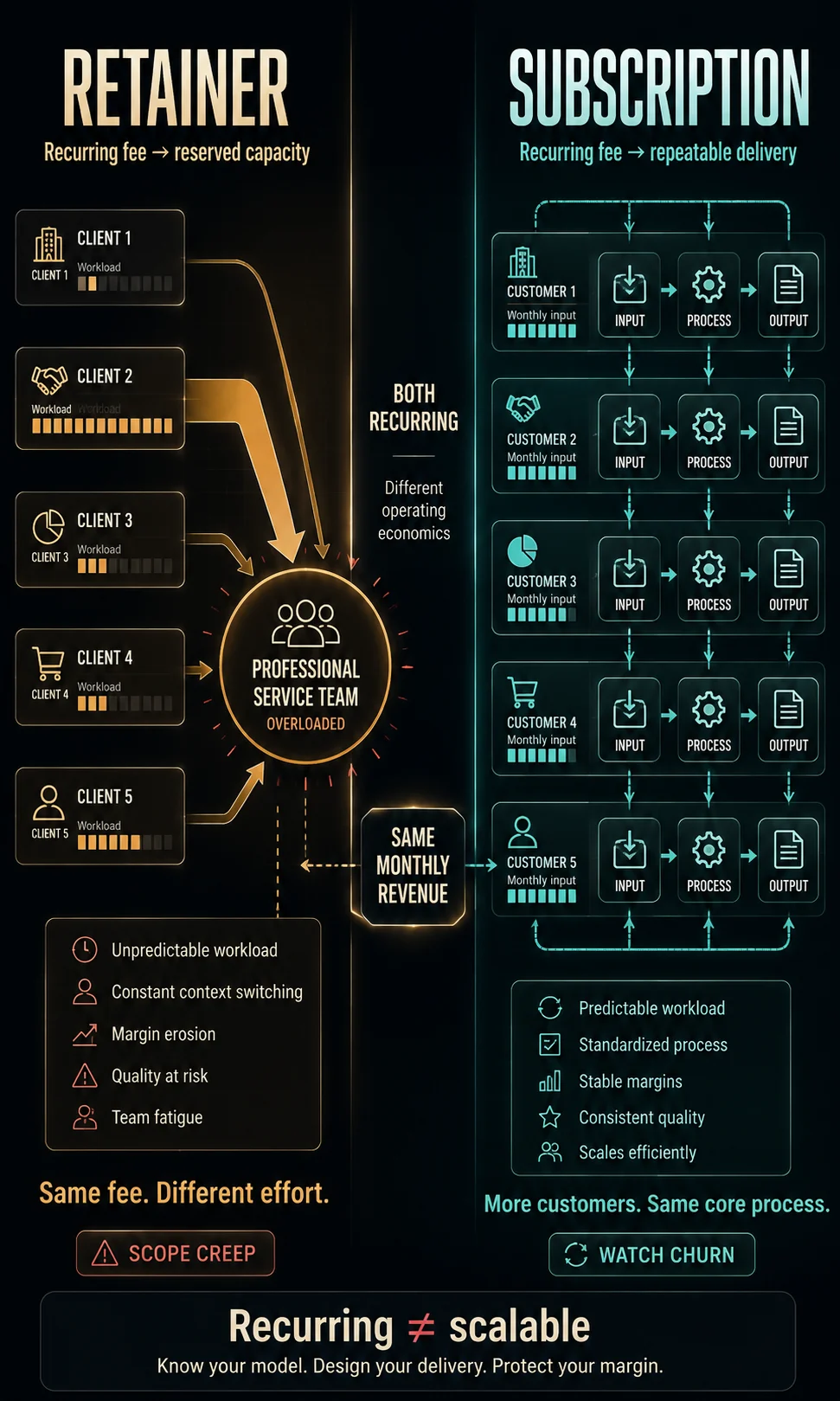
The important distinction from a retainer is not the payment frequency. Both can charge monthly.
The stronger distinction is the delivery architecture.
A retainer often reserves professional attention or capacity for a particular client.
A subscription generally works better when the business can create a repeatable service system used across many customers.
Recurring Revenue Does Not Automatically Mean Scalable Revenue
This is one of the most important mistakes to avoid.
Imagine a company sells a $500 monthly subscription to 100 customers.
Revenue is:
100 × $500 = $50,000 per month
That looks attractive.
But suppose every subscriber requires four hours of individual specialist work each month.
The company now has:
400 hours of recurring monthly delivery
As subscriptions grow, delivery grows almost directly with them.
The model is recurring, but it may not be particularly scalable.
A stronger subscription model tries to reduce how quickly delivery cost rises relative to customer count.
That may come from:
- standardized processes
- shared resources
- automation
- reusable content
- software
- group delivery
- defined service limits
- repeatable workflows
Subscription Economics Depend on Retention
A subscription business does not benefit much from recurring billing if customers leave quickly.
If the business continually replaces departing customers just to maintain the same subscriber count, customer acquisition can become a permanent burden.
The real value of the model therefore depends on whether customers continue to receive enough value to renew.
That makes churn one of the defining risks of subscription services.
A subscriber who stays for three years creates a very different business from one who stays for three months, even if both pay the same monthly price.
4. The Usage-Based Service Model
A usage-based model charges according to how much of the service the customer actually consumes. Instead of paying one fixed amount for access regardless of activity, the customer’s bill rises or falls with a measurable unit such as transactions, booked hours, processed documents, deliveries, storage, API calls, seats used for a period, or another service unit that can be counted reliably.
In practical billing systems, Stripe describes usage-based pricing as charging customers according to their measured consumption of a product or service, including approaches such as pay-as-you-go, fixed-fee-plus-overage and other metered structures.
This model can feel fair to customers because spending is connected more closely to consumption. A small customer can start with a relatively modest bill, while a larger customer naturally pays more as usage grows. For the provider, that creates the possibility of revenue expanding with customer activity without repeatedly renegotiating a new contract.
The tradeoff is that revenue predictability usually weakens as usage variability increases.
A customer who pays $2,000 one month and $8,000 the next may be economically attractive, but the provider cannot treat that relationship like a fixed $5,000 retainer. Capacity planning, staffing and cash forecasting become more complicated because demand moves with customer behavior.
Usage-Based Pricing Works Best When the Unit Is Clear
A strong usage model begins with a unit that both sides can understand.
Examples might include:
- per transaction
- per delivery
- per processed document
- per active seat
- per appointment
- per gig completed
- per thousand API requests
- per gigabyte processed
- per qualified service unit
The unit should have a sensible relationship to the value received or the resources consumed. If customers cannot understand what creates the bill, usage pricing can feel unpredictable even when the calculation itself is mathematically accurate.
The provider also needs reliable measurement. A model that depends on usage becomes difficult to manage if customers constantly dispute how consumption was recorded.
The Revenue Can Scale Without the Cost Scaling Equally
Usage-based models become especially attractive when each additional unit of customer activity creates relatively little incremental cost.
Suppose a service charges $2 for every automated transaction it processes. If transaction volume rises from 10,000 to 20,000 while infrastructure and support costs rise only modestly, revenue may grow faster than delivery cost.
That is very different from a human-delivered service charging per hour. Doubling billable hours may require roughly twice as much labor capacity.
This is why the same pricing label can hide very different economics. A metered digital service and a manually delivered hourly service are both technically usage-based, but their ability to scale can be completely different.
The Main Risk Is Volatility
Usage can decline.
Seasonal customers may consume very little during quiet months. A client’s own business may slow. A customer may optimize their usage specifically to reduce the bill.
The provider should therefore model:
minimum expected usage
normal usage
high usage
and determine what each level means for revenue and capacity.
Some businesses address this by combining a base recurring fee with usage charges. That creates a hybrid model, which we will examine later.
5. The Performance or Commission Business Model
A performance model links some or all of the provider’s compensation to an agreed result.
Examples can include:
- recruiting placement fees
- sales commissions
- affiliate commissions
- certain lead-generation arrangements
- revenue-share structures
- recovery or collection percentages
- transaction success fees
- outcome bonuses layered onto a base fee
Customers often find these arrangements attractive because payment appears aligned with the result they care about. The provider is effectively saying, “Part of what I earn depends on what happens.”
That alignment can be commercially powerful, but the provider accepts more uncertainty than under a fixed fee.
Performance Pricing Moves Risk Toward the Provider
Imagine two consultants doing similar work.
Consultant A charges $10,000 regardless of the client’s eventual commercial result.
Consultant B receives 10 percent of the measurable gain created by the engagement.
Consultant B may earn much more when the outcome is strong. The same consultant may also perform substantial work and earn little when the result is weak.
The key question becomes:
How much control does the provider actually have over the outcome that determines payment?
That matters because customer results may also depend on:
- the customer’s sales team
- implementation quality
- market conditions
- budget
- pricing
- customer response speed
- internal politics
- other vendors
- decisions the provider cannot control
A provider should be cautious about accepting unlimited financial responsibility for outcomes influenced heavily by people or conditions outside its control.
Attribution Has to Be Clear Enough to Prevent Disputes
Performance models also need a workable way to determine what caused the result.
Suppose a marketing company earns a percentage of additional sales. What counts as an additional sale?
Was the customer already in the pipeline?
Did another campaign contribute?
How long after the engagement does attribution continue?
What happens with returns or cancellations?
Who has access to the underlying data?
A vague outcome can create a vague invoice.
The stronger the financial dependence on performance, the more important the measurement method becomes.
A Base Fee Plus Performance Component Can Balance the Risk
Many service businesses do not need to choose between 100 percent fixed compensation and 100 percent contingent compensation.
A hybrid structure might include:
$5,000 monthly base fee + success bonus
or:
fixed project fee + commission on measurable incremental revenue
The base payment helps cover some delivery cost. The performance component creates alignment and upside.
The exact balance depends on how measurable the outcome is, how much influence the provider has, and how much financial volatility the business can tolerate.
6. The Marketplace Business Model
A marketplace model creates value by bringing service buyers and service providers together rather than performing every unit of service itself.
Examples include platforms that connect:
- homeowners with contractors
- companies with freelancers
- travelers with local service providers
- businesses with temporary staff
- customers with tutors
- patients with appointment providers
- clients with specialist consultants
The marketplace may earn money through:
- transaction commissions
- booking fees
- provider subscriptions
- customer memberships
- promoted listings
- lead fees
- combinations of several revenue sources
The central commercial product is not necessarily the underlying service. It is the reduction of friction between two sides of a market.
A Marketplace Needs Both Sides at the Same Time
A consulting firm can start with one consultant and one customer.
A marketplace has a different problem.
Customers are less interested when there are too few providers.
Providers are less interested when there are too few customers.
This creates a classic coordination challenge. The company needs enough relevant supply and demand in the same place, category or time window for the platform to feel useful.
A marketplace with 10,000 registered providers may still perform badly if only a handful are suitable for the particular customers arriving that week.
This is why marketplace scale should not be measured only through total sign-ups.
The better questions include:
- Can customers find suitable providers quickly?
- Are providers receiving worthwhile opportunities?
- Do transactions actually happen?
- Does the platform create enough trust for both sides to stay?
- Are users completing transactions on-platform or bypassing it?
Trust Is Part of the Marketplace Product
When a marketplace introduces strangers to one another, trust mechanisms often become part of the value proposition.
Depending on the sector, that can include:
- identity verification
- reviews
- payment protection
- dispute handling
- qualification checks
- cancellation rules
- service standards
- guarantees
- provider screening
Not every marketplace needs all of these mechanisms. The important point is that matching alone may not be enough when customers perceive meaningful risk in the transaction.
Marketplace Revenue Can Grow Without Owning All Delivery Capacity
This is one of the model’s main attractions.
A marketplace can potentially support more service volume by expanding its provider network rather than hiring every provider as an employee.
That does not make the model asset-free or operationally simple. Customer acquisition, provider acquisition, technology, payments, trust, support and compliance can all become significant functions.
The marketplace simply places the delivery relationship in a different structure.
Where Productized Services Fit
A productized service deserves special treatment because it is often described as though it were a completely separate business model.
It is more useful to think of productization as a delivery and packaging layer.
The service becomes more product-like because the business defines:
- what is included
- what is excluded
- what information is required from the customer
- how the work is performed
- what the customer receives
- how long delivery takes
- how revisions work
- how the price is presented
The revenue model underneath can still be project, retainer, subscription or even usage-based.
Project + Productized
Example:
Website Conversion Audit – $2,000 – delivered in 10 business days
The underlying model is project-based. Productization makes it easier to sell and deliver repeatedly.
Retainer + Productized
Example:
Monthly Financial Review – $1,500 per month – one management report, one review meeting and defined email support
The underlying model is a retainer, but the recurring scope has been standardized.
Subscription + Productized
Example:
Monthly Research Membership – standardized reports, data updates and group briefings
The subscription itself may already depend heavily on productization because every customer receives broadly similar recurring value.
The useful question is therefore not:
Is this a productized service or a retainer?
It can be both.
The better question is:
What is the underlying revenue relationship, and how standardized is delivery?
Hybrid Service Business Models Are Often More Practical Than Pure Models
Real service companies frequently combine models because one structure does not solve every commercial problem.
The goal should not be to create the most complicated revenue system possible. A hybrid should solve a specific weakness in the primary model.
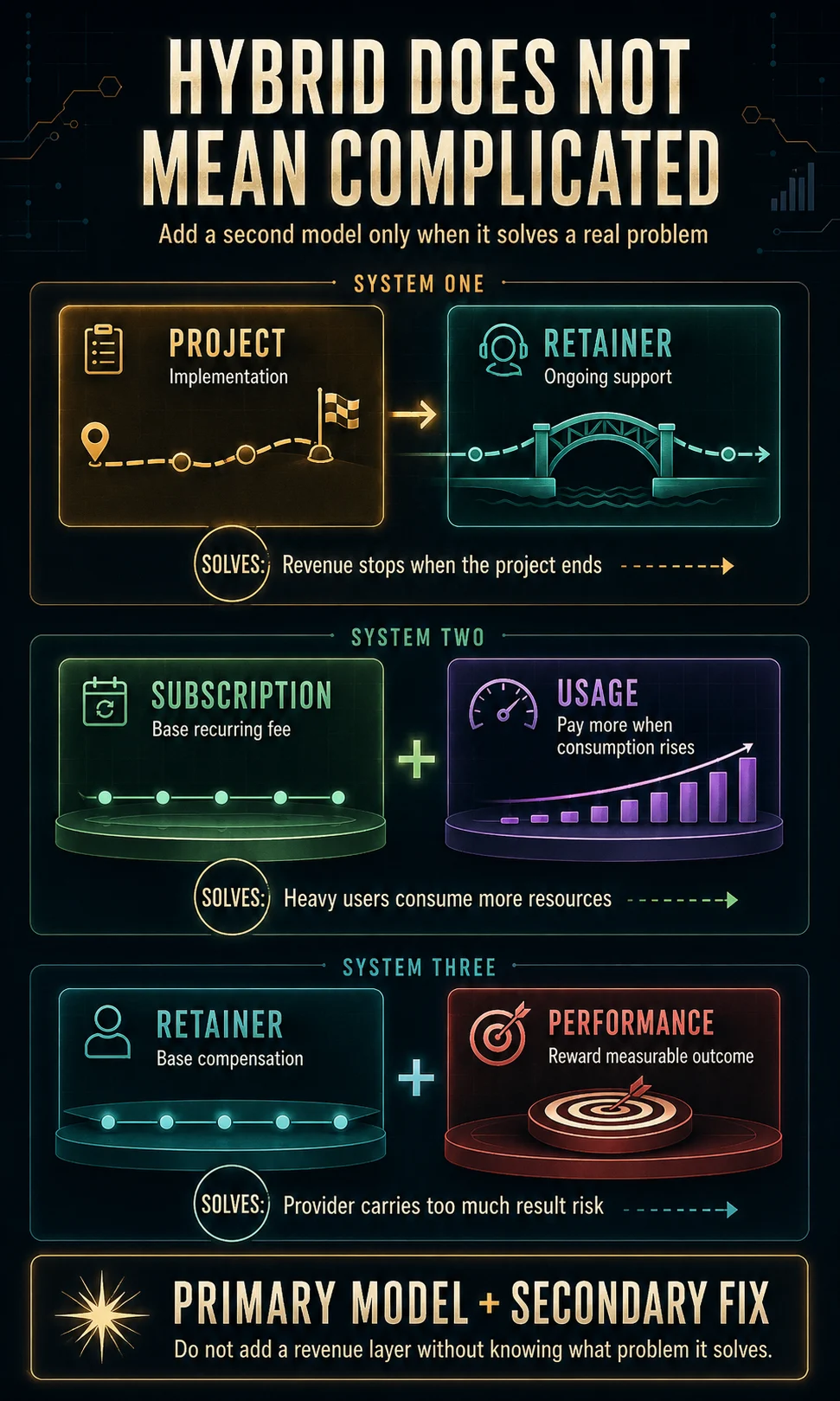
Project + Retainer
This is one of the most natural combinations.
The customer first buys a defined implementation or transformation project.
After completion, the relationship moves into continuing support.
For example:
Initial website rebuild → monthly optimization retainer
or:
Business system implementation → ongoing advisory
The project creates a clear starting point. The retainer extends the relationship where continuing work genuinely exists.
Subscription + Usage
The customer pays a recurring base fee plus additional charges when activity rises.
For example:
$500 monthly platform fee + $1 per transaction
The subscription component gives the provider some revenue stability. The usage component allows revenue to increase when the customer consumes more resources.
This can work particularly well when there is a meaningful minimum service cost even at low usage.
Retainer + Performance
The provider receives predictable base compensation plus additional payment when agreed results occur.
For example:
$4,000 monthly recruiting support retainer + placement fee
The base retainer compensates for ongoing effort. The performance component rewards the provider when measurable value is delivered.
Marketplace + Subscription
A marketplace might charge providers a recurring membership for enhanced tools or visibility while also earning transaction fees.
The risk is that the company begins layering charges without creating enough additional value. Every revenue layer should have a clear reason for existing.
A Hybrid Model Should Fix a Real Economic Problem
Before combining models, ask what weakness the second layer addresses.
Does it:
- stabilize revenue?
- compensate for heavy usage?
- reward measurable results?
- pay for reserved capacity?
- fund a minimum service level?
- reduce reliance on one-off sales?
- make customer spending easier to forecast?
If the answer is unclear, the hybrid may create complexity rather than value.
How to Choose a Service Business Model Using Revenue, Capacity and Risk
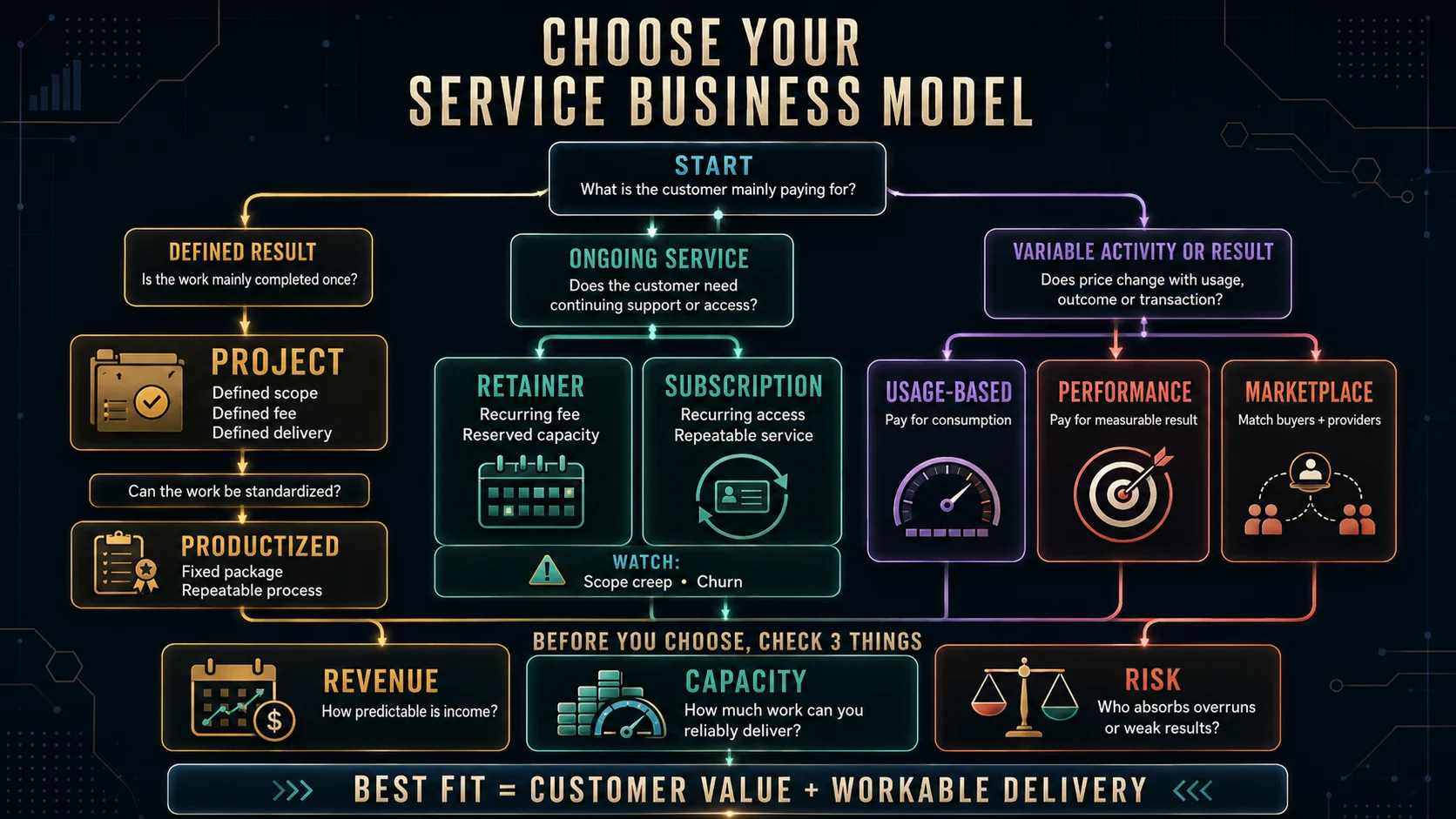
The feature image for this article uses a simple flow based on what the customer is paying for. Once you have narrowed the choices, use a second filter based on the provider’s economics.
1. How Predictable Does Revenue Need to Be?
If the business has significant recurring fixed costs, highly volatile project or performance revenue may create uncomfortable cash-flow pressure.
That does not automatically mean the business should force every customer into a retainer. It means the owner needs to understand how much unpredictable revenue the cost structure can tolerate.
A business with low fixed overhead may be comfortable with project revenue.
A larger team with recurring payroll may value a stronger base of recurring contracts.
The business planning process becomes especially useful here because model choice affects sales assumptions, hiring capacity, cash requirements and the resources the company commits.
2. How Variable Is Delivery?
A highly customized service should be cautious about models promising broad recurring access at a fixed fee.
If every customer requires a different amount of specialist attention, a subscription can create misleadingly attractive recurring revenue while internal delivery costs remain unpredictable.
The more repeatable the process becomes, the easier it is to consider:
- productization
- subscription structures
- standardized retainers
- usage models with defined units
3. Who Carries the Risk When Work Expands?
This question is often overlooked.
Under hourly billing, more work can produce more revenue.
Under fixed project pricing, additional work may reduce the provider’s margin.
Under an unlimited retainer, heavier usage can damage profitability.
Under performance pricing, the provider can deliver substantial effort before knowing the final compensation.
The provider should know where uncertainty lands financially.
4. How Does the Customer Prefer to Buy?
A theoretically elegant model can fail when customers do not want to purchase that way.
Some professional buyers want a defined project because they need budget approval around a clear initiative.
Others want a retainer because they need recurring support.
Small customers may prefer usage pricing because they do not want a large fixed commitment.
Enterprise buyers may prefer predictable fixed contracts because variable bills complicate budgeting.
The business model should reduce buying friction rather than create it merely because the provider prefers the economics.
Service Business Model Finder
Compare how your customer buys value with the way your business delivers it. The tool recommends a primary model, a useful hybrid where appropriate, the main economic warning, and the first real-world test to run.
Service Business Model Decision Matrix
| If Your Service Looks Like This | Model to Examine First | Main Question Before Choosing It |
|---|---|---|
| Clear beginning, clear outcome, reasonably definable scope. | Project | Can you estimate delivery accurately enough to protect margin? |
| Customer repeatedly needs professional judgment or capacity. | Retainer | Can recurring scope and decision boundaries remain controlled? |
| Customers need broadly similar recurring service or access. | Subscription | Can delivery become repeatable enough that cost does not rise too quickly with subscriber count? |
| Customer value and provider cost both change meaningfully with consumption. | Usage-Based | Can usage be measured clearly and can the business tolerate revenue variability? |
| Provider influences a measurable commercial outcome. | Performance / Commission | Is attribution clear, and does the provider control enough of the result to accept the risk? |
| Value comes from connecting many buyers and independent providers. | Marketplace | Can you create enough relevant activity and trust on both sides of the market? |
| A custom service contains a large repeatable core. | Productize the primary model | Which parts can be standardized without damaging the result customers value? |
When the Model Works for the Customer but Fails the Provider
This is one of the most important model-design problems because a commercially attractive offer can still contain poor provider economics.
Consider an agency offering:
Unlimited design requests – $2,000 per month
Customers may love the simplicity.
If average customers use only eight hours of team capacity, the model may work well.
If a growing share of customers uses 40 hours, the same subscription becomes a margin problem.
The customer proposition has succeeded. That mismatch can become more serious when a service company adds payroll, software commitments or other fixed costs around an unproven model. The broader risks of starting a business and how to reduce them become especially relevant when recurring revenue looks attractive but delivery cost, customer concentration or cash requirements remain uncertain.
The business model has not.
Customer Simplicity Can Hide Provider Complexity
A good commercial model often makes buying simple.
That simplicity should not prevent the provider from measuring what happens behind the scenes.
Track:
- delivery hours
- specialist involvement
- revision volume
- support volume
- customer usage
- gross contribution
- acquisition cost
- retention
- payment timing
- capacity consumed
Two customers paying the same fee can have dramatically different economics.
The provider needs to know why.
Common Service Business Model Mistakes
Mistake 1: Choosing Recurring Revenue Because It Sounds More Valuable
Recurring revenue is attractive when the underlying customer need is recurring.
Forcing a one-time problem into a monthly subscription can create weak retention because customers simply do not need to continue.
The provider then spends heavily replacing customers who were never likely to remain.
Mistake 2: Calling a Retainer Unlimited
“Unlimited” can simplify marketing, but the operating model still has a finite amount of capacity.
If the service truly allows unrestricted use, pricing and capacity need to account for heavy users.
If limits actually exist, the customer should understand them.
Mistake 3: Pricing a Fixed Project Before Understanding Scope
A fixed price can be commercially elegant while financially dangerous.
The provider needs enough experience, discovery or contractual change control to manage uncertainty.
Mistake 4: Using Performance Pricing When the Provider Does Not Control the Result
A marketing company cannot fully control whether the customer’s sales staff follows up.
A recruiter cannot completely control whether a candidate accepts.
A consultant cannot guarantee that management implements the recommendation correctly.
Performance models become dangerous when payment depends heavily on variables outside the provider’s influence.
Mistake 5: Treating Subscription as Synonymous With Scale
Recurring billing does not eliminate human delivery cost.
A subscription requiring one-to-one expert time for every customer can remain highly labor-intensive.
Mistake 6: Adding Too Many Revenue Layers
Base fee.
Usage charge.
Setup fee.
Success fee.
Premium support fee.
Transaction fee.
Each may be individually defensible, but the total buying experience can become unnecessarily complicated.
The strongest model is not necessarily the one with the most monetization mechanisms. It is the one where the customer understands what is being purchased and the provider understands the economics of delivering it.
How to Change Business Models Without Breaking Existing Revenue
A business does not need to keep the first model forever.
Services evolve.
A project company may discover that clients need continuous support after implementation.
A custom agency may discover that 70 percent of its work follows the same pattern and can be productized.
A subscription business may discover that a small group of heavy users consumes most capacity and needs a usage component.
A commission-only provider may add a base fee because the delivery cost has become too large to carry entirely at risk.
Changing the model should still be handled deliberately.
Start With the Economic Problem You Are Trying to Fix
Do not begin with:
“We need subscriptions.”
Begin with:
“New sales are too unpredictable.”
or:
“Heavy users are consuming far more capacity than light users.”
or:
“Customers need support after projects finish.”
or:
“We perform too much unpaid work before performance fees arrive.”
Now the model change has a purpose.
Test the New Model Before Migrating Everyone
Where practical, test the revised structure with new customers or a controlled group first.
You may discover that:
- customers misunderstand the new offer
- willingness to pay changes
- the expected capacity benefit does not appear
- sales cycles become longer
- customers prefer another billing structure
- the new model produces stronger retention than expected
That evidence is much more useful than changing every contract based on theory.
Which Service Business Model Should You Test First?
Start with the way customers already appear to value the service.
If they want a defined outcome, test a project.
If they repeatedly need access to expert capacity, test a retainer.
If many customers need the same recurring experience, test whether subscription delivery can be standardized.
If value and cost change clearly with consumption, investigate usage pricing.
If the provider strongly influences a measurable result and can tolerate volatility, performance pricing may deserve testing.
If the primary value lies in connecting buyers and providers rather than performing the service, investigate the marketplace structure.
Then ask the second question:
Can we deliver this model profitably when customer behavior becomes less convenient than our assumptions?
That is where the real choice is made.
A Good Service Model Fits Both Sides of the Transaction
Customers need a buying structure that makes sense for the value they receive.
Providers need a delivery structure that makes sense for the cost, capacity and uncertainty they absorb.
Those interests are related, but they are not identical.
A customer may prefer a low fixed monthly fee with unlimited use.
The provider may need defined capacity.
A customer may prefer pure performance payment.
The provider may need a base fee to fund the work.
A customer may prefer perfectly predictable billing.
The provider may incur highly variable cost.
The strongest service business models find a workable middle ground.
That leads to the final principle for this page:
Choose the model around customer value, then stress-test it against provider capacity and risk.
If both sides work, the business model has a stronger foundation. If the model succeeds only because one side absorbs an unrealistic amount of cost or uncertainty, the structure needs to change before scale makes the weakness more expensive.
Frequently Asked Questions
What is a service business model?
A service business model explains how a service company creates value, what the customer pays for, how often revenue is collected, how the service is delivered and who carries the financial risk when delivery takes more time or resources than expected. The model is broader than a pricing method because it also affects capacity, customer relationships, cash flow and the way the company scales.
What are the main types of business models for service companies?
The main models to compare are project-based, retainer, subscription, usage-based, performance or commission, and marketplace models. Productized services can sit on top of several of these structures by standardizing scope, process, timing and price. Many service companies also use hybrid models that combine two structures when one model alone does not solve the commercial and delivery requirements.
What is the difference between a pricing method and a business model?
A pricing method explains how the fee is calculated, such as hourly billing, a day rate or a fixed fee. A business model describes the wider commercial relationship, including what the customer buys, whether the relationship is one-time or recurring, how much delivery capacity is required and who absorbs the risk when actual work differs from the original estimate. Two companies can therefore use different pricing methods while operating the same underlying business model.
What is a project-based service business model?
A project-based model is built around a defined engagement with an identifiable scope, deliverable or outcome. The customer usually pays once or through milestones, and the relationship may end when the work is completed. This model works best when the provider can estimate delivery reasonably well, because underestimated scope or excessive revisions can reduce the margin even when the selling price remains unchanged.
What is a retainer business model for services?
A retainer model charges a recurring fee for continuing access, support, professional attention or reserved capacity. It can improve revenue visibility and create longer customer relationships, but the provider needs clear boundaries around what is included. A retainer becomes difficult to manage when customers paying the same monthly fee consume very different amounts of team capacity or when the agreement effectively becomes unlimited work for a fixed price.
What is the difference between a retainer and a subscription?
Both can produce recurring revenue, but the delivery architecture is usually different. A retainer often gives a particular client ongoing access to professional judgment or reserved service capacity, while a subscription tends to work better when many customers receive a standardized recurring service or access experience. The distinction matters because a subscription that requires highly customized one-to-one work for every customer may be recurring without being particularly scalable.
What is a usage-based service model?
A usage-based model charges according to measurable consumption, such as transactions, appointments, processed documents, deliveries or another defined service unit. The model can align customer spending with actual use and allow revenue to increase as consumption grows. Its main challenge is variability because customer usage can change significantly from one period to another, which can make revenue and capacity harder to forecast.
When does performance-based pricing make sense for a service business?
Performance pricing can make sense when the desired outcome is measurable, attribution is reasonably clear and the provider has enough influence over the result to accept some financial risk. It becomes more dangerous when payment depends heavily on variables controlled by the customer or other parties. Some providers reduce this exposure by combining a base fee with a performance component rather than making all compensation contingent on the final result.
What is a marketplace service business model?
A marketplace creates value by connecting service buyers with independent providers and making discovery, trust or transactions easier. Revenue may come from commissions, booking fees, subscriptions, lead fees or combinations of these sources. The main challenge is creating enough relevant activity on both sides, because buyers are less interested when suitable providers are scarce and providers are less interested when customer demand is weak.
Is a productized service a separate business model?
A productized service is better understood as a way of standardizing service delivery rather than a completely separate revenue model. The business defines the scope, deliverables, process, timetable and price more clearly so the offer becomes easier to sell and repeat. The underlying model may still be project-based, retainer, subscription or another structure, which means a service can be both productized and recurring at the same time.
Can a service business use more than one business model?
Yes. Hybrid structures are common when the second model solves a specific weakness in the primary one. A company might combine an implementation project with an ongoing retainer, use a subscription plus usage charges, or combine a base retainer with a performance bonus. The important question is whether each layer has a clear economic purpose rather than adding complexity that customers struggle to understand.
Which service business model creates the most predictable revenue?
Retainers and subscriptions generally provide more short-term revenue visibility than relying entirely on one-off projects or contingent performance fees, but predictable billing does not automatically mean predictable profit. If service usage varies greatly or customers require expensive custom work, recurring revenue can still create volatile delivery costs. Revenue predictability should therefore be evaluated together with capacity, retention and provider risk.
Which service business model is easiest to scale?
Scalability depends more on how delivery cost behaves as customer volume grows than on the model name alone. A standardized subscription or usage-based digital service may scale efficiently when additional customers require little extra human work, while a subscription requiring several hours of expert attention for every customer may remain labor-intensive. The more the company can standardize, automate or reuse delivery without reducing value, the more scalable the model may become.
How do I choose the right business model for my service?
Start with what the customer is actually buying. A defined outcome points toward a project model, recurring professional access may fit a retainer, standardized ongoing value may fit a subscription, measurable consumption may fit usage-based pricing, and measurable outcomes may support a performance structure. Then stress-test the choice against revenue predictability, delivery capacity, customer buying preferences and who carries the financial risk when work becomes heavier than expected.
How do I know when my service business model is not working?
Warning signs include rising revenue with falling margins, recurring customers consuming more capacity than expected, excessive scope disputes, high subscription churn, volatile usage revenue, long delays before performance fees are earned or a marketplace struggling to create enough transactions. A model can work for customers while failing the provider, so the business should track delivery cost, capacity, customer retention and contribution rather than judging the model from revenue alone.
Should I change my service business model if recurring revenue is low?
Not automatically. Low recurring revenue is a symptom, not a diagnosis. The business should first determine whether customers genuinely have an ongoing need, whether project work naturally leads to continuing support, whether pricing reflects delivery effort and whether recurring contracts would improve or weaken the economics. Forcing a one-time customer problem into a subscription can create churn rather than a healthier business.