
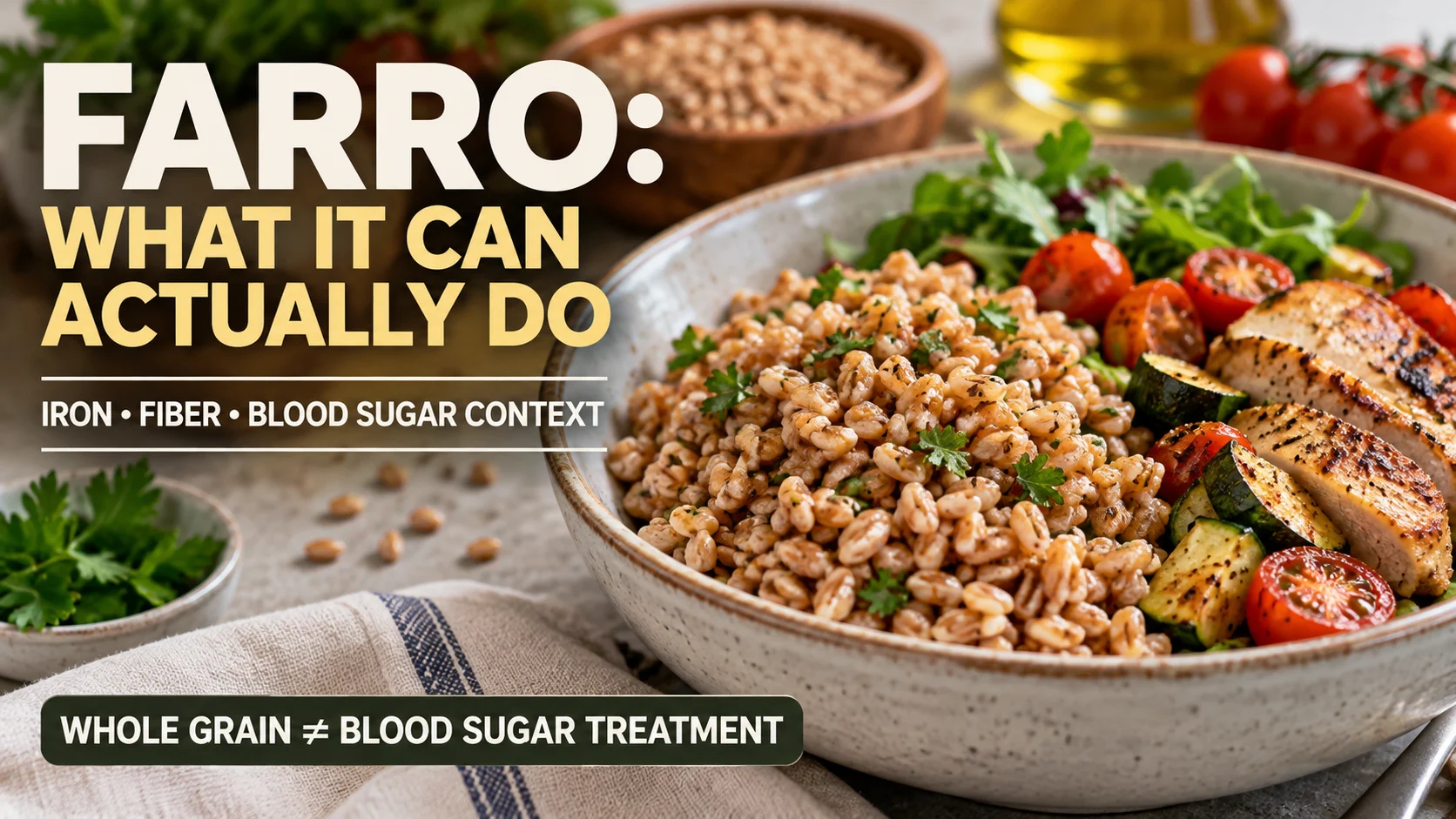

Farro is a chewy wheat grain that can contribute fiber, protein, iron and magnesium, and whole or less-pearled farro can fit a blood-sugar-aware meal. It does not lower blood sugar on its own, and its iron content is not automatically “high” – the product, serving size, degree of pearling, portion and the rest of the meal all change the practical answer. Choose whole farro when available, build the meal around vegetables and protein, and remember that farro contains gluten.
| Common claim | More accurate interpretation | What to do |
|---|---|---|
| “Packed with iron” | Farro can provide nonheme iron, but the amount varies by product and serving. A food is generally considered “high” in a nutrient at 20% Daily Value or more per serving. | Check the Nutrition Facts label instead of relying on a blanket claim. |
| “Supports healthy blood sugar” | Whole grains can fit a glucose-aware eating pattern, but farro is still a carbohydrate food. Grain structure, processing, portion size and meal composition matter. | Favor whole or less-pearled grain, use a sensible portion, and pair it with protein and nonstarchy vegetables. |
| “Farro is a whole grain” | Whole farro retains the full kernel. Semi-pearled and pearled farro have some or more of the bran removed. | Look for “whole farro” when retaining the grain structure is your priority. |
| “Ancient grain means gluten-free” | Farro is wheat. In the United States it is commonly emmer wheat, and it contains gluten. | Avoid farro if you have celiac disease or a wheat allergy; follow individual medical advice for other gluten-related conditions. |
What farro actually is
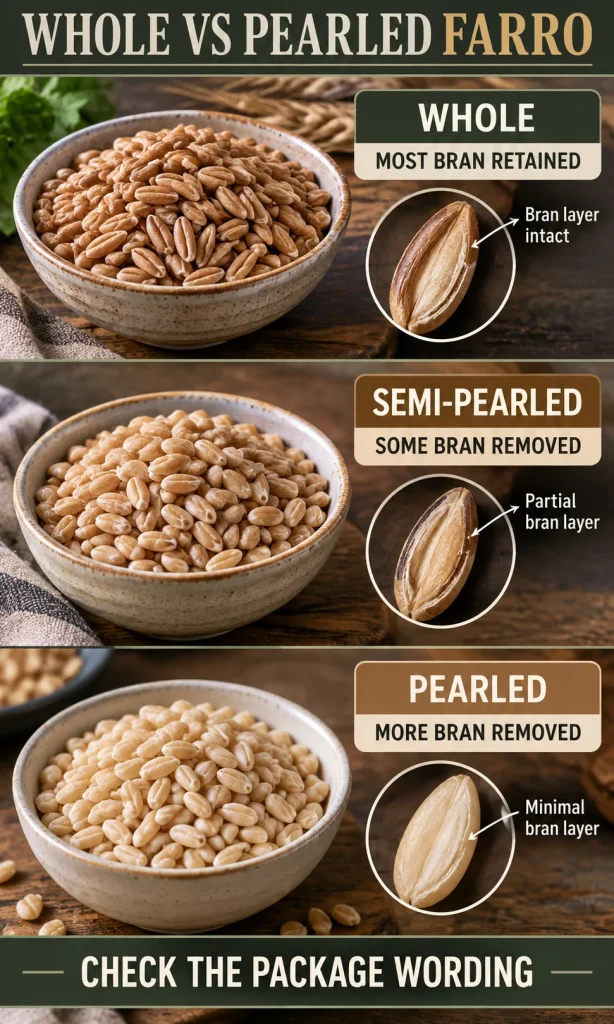
“Farro” is a traditional term used for ancient wheat species; in U.S. retail products it most often refers to emmer. The grain has a firm, chewy texture and nutty flavor that works in soups, salads, grain bowls and side dishes. A current Cleveland Clinic nutrition overview of farro also notes that products may be sold as whole, semi-pearled or pearled, and that the more bran removed, the less intact the original whole-grain structure becomes.
That distinction matters because “farro” on the front of a package does not tell you exactly how much of the kernel remains. Whole farro keeps the bran, germ and endosperm; semi-pearled farro removes part of the bran; pearled farro removes more of it. Pearling shortens cooking time and softens texture, but it also changes the fiber-rich outer layer that makes an intact grain different from a refined one.
Farro provides iron, but “high in iron” depends on the serving
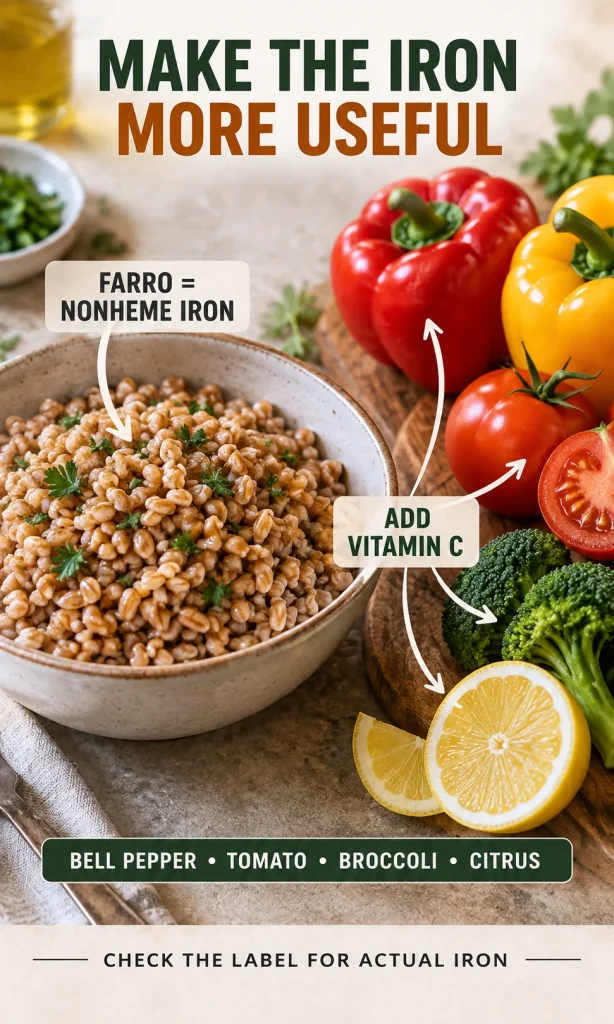
Iron is essential for hemoglobin, the protein in red blood cells that carries oxygen. Farro can contribute iron as part of the diet, but the iron in plant foods and grains is nonheme iron, which is absorbed less efficiently than heme iron from animal foods. The NIH Office of Dietary Supplements iron fact sheet explains that vitamin C improves nonheme iron absorption, while phytate in grains and beans can reduce it.
This is why “packed with iron” is too broad without a label and serving size. The FDA Daily Value guidance uses 20% Daily Value or more per serving as the general threshold for calling a food high in a nutrient; the Daily Value for iron is 18 mg. A farro product may still be useful nutritionally even when it does not meet that “high” threshold.
- Check the label: compare iron per serving rather than assuming all farro is equivalent.
- Add vitamin C: bell peppers, tomatoes, broccoli, citrus or a lemon-based dressing can make an iron-focused farro meal more useful.
- Do not self-treat anemia with one food: low iron can have different causes and may require testing and treatment beyond dietary changes.
What farro can – and cannot – do for blood sugar
Farro can fit a blood-sugar-conscious meal, but it is not a glucose-lowering treatment. The strongest practical advantage is that an intact or minimally processed grain usually preserves more physical structure than a finely milled carbohydrate, and that structure can change how quickly starch is digested. A randomized crossover trial in adults with type 2 diabetes found lower post-meal glucose responses with less-processed whole grains than with finely milled whole grains, showing why the physical form of the grain matters alongside its nutrient label.
That evidence should not be turned into a farro-specific promise. A separate randomized trial of matched whole-grain and refined wheat products found that when food form and particle size were controlled, whole-grain wheat did not automatically produce a lower glycemic response. In other words, “whole grain” is useful information, but processing, particle size, cooking, portion and the full meal still shape what happens after eating.
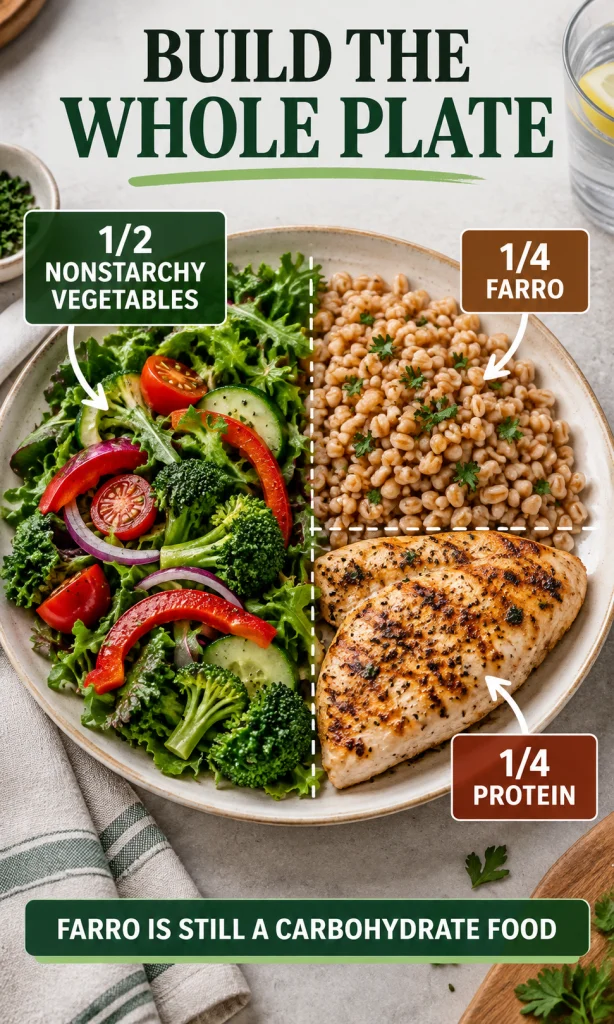
For everyday meal building, the NIDDK plate method is more useful than chasing a single “blood sugar superfood”: about half the plate is nonstarchy vegetables, one quarter is a high-fiber carbohydrate such as a whole grain, and one quarter is protein. The American Diabetes Association Diabetes Food Hub specifically includes farro among whole-grain options that can occupy the carbohydrate quarter of the plate.
A better way to build a farro meal
The best farro meal is not the one with the smallest possible grain portion or the most health claims. It is the one that fits your appetite, medical needs and overall eating pattern while keeping the carbohydrate portion visible and balanced with foods that add protein, volume, fiber and micronutrients.
- Start with the farro form. Choose whole farro when you want the most intact kernel; use semi-pearled or pearled farro when faster cooking and a softer texture matter more.
- Give vegetables the largest share of the plate. Greens, peppers, broccoli, mushrooms, zucchini or tomatoes add volume without turning the meal into mostly starch.
- Add a real protein anchor. Beans, lentils, tofu, eggs, fish, poultry, yogurt or another appropriate protein source can make the meal more satisfying.
- Use vitamin C strategically when iron is the goal. Tomato, red pepper, citrus or lemon dressing is a simple pairing for nonheme iron.
- Check your own response if you manage diabetes. Carbohydrate needs differ with medications, insulin, activity and personal glucose response, so a generic serving cannot replace an individualized plan.
If you are rebuilding your overall eating pattern rather than focusing on one ingredient, the guides on getting healthy eating habits back on track, adding fiber to your diet and common healthy-eating myths provide broader context. Readers managing type 2 diabetes can also use the site’s food choices for type 2 diabetes article as a separate starting point.
How to choose and cook farro without losing the point
Package terminology varies, so let the label do more work than the front-of-pack marketing. If the ingredient list says whole farro or whole emmer, you know the kernel is intended to retain all three grain parts. If it says semi-pearled or pearled, expect some bran removal and a shorter cooking time.
| Farro form | Kernel structure | Best reason to choose it | Watch for |
|---|---|---|---|
| Whole | Bran, germ and endosperm retained | Most intact grain structure and chewy texture | Longest cooking time; follow package directions |
| Semi-pearled | Some bran removed | Middle ground between texture and convenience | Fiber and nutrient values can differ by brand |
| Pearled | More bran removed | Fastest, softest option | Do not assume the same whole-grain advantage as intact farro |
Cook farro until the kernels are tender but still pleasantly chewy, then drain excess water if you used a pasta-style cooking method. Exact times vary enough by variety and degree of pearling that the package instructions are more reliable than a single universal timer. If you are new to higher-fiber foods, increase them gradually and drink enough fluid rather than doubling your usual grain and fiber intake overnight.
Who should not treat farro as a default “healthy grain”
Farro is wheat, so it is not suitable for people with celiac disease and should be avoided with a wheat allergy. People with diabetes can often include whole grains, but the useful portion and carbohydrate plan may differ if insulin or glucose-lowering medication is involved. Anyone with suspected iron deficiency should also avoid using farro as a substitute for diagnosis, because iron needs and the reason for low iron can differ substantially.
Make the grain fit the meal
Farro Meal Balance Studio
Choose your farro form, meal goal and pairings. Get a practical meal framework without fake glucose scores or medical promises.
 Build the whole plate, not a health claim.
The result will explain the grain form, portion and pairings that matter most.
What to change first
Complete the choices, then build the framework.
Why this recommendation
No numeric health score is used. The logic is based on farro form, visible carbohydrate share, meal pairing and gluten suitability.
Medical and label check
Farro contains gluten. Iron values vary by product. Diabetes medication and individual carbohydrate needs can change the right portion.
Need individualized nutrition help?
Find a registered dietitian
Search your location, then compare credentials, diabetes experience when relevant, appointment format and fees. The search supports worldwide locations; the example below is only a demo.
Frequently Asked Questions
1. Is farro good for people with diabetes?
Farro can fit a diabetes meal plan because whole grains can be used as the high-fiber carbohydrate portion of a balanced plate. It is still a carbohydrate food, so portion size, processing, the rest of the meal, medication and your individual glucose response matter.
2. Is farro high in iron?
Farro can contribute iron, but “high in iron” should be based on the Nutrition Facts label for a specific serving. Under FDA guidance, 20% Daily Value or more per serving is generally considered high; farro products and serving sizes vary.
3. Is farro gluten-free?
No. Farro is wheat and contains gluten. People with celiac disease or wheat allergy should avoid it and choose an appropriate gluten-free grain instead.
4. Is whole farro better than pearled farro?
Whole farro retains the full kernel and is the better choice when intact grain structure and bran retention are the priority. Pearled farro cooks faster and is softer, so it can still be a practical food, but some bran has been removed.
5. What should I pair with farro for an iron-conscious meal?
Pair farro with vitamin C-rich foods such as bell peppers, tomatoes, broccoli, citrus or lemon. Vitamin C improves absorption of nonheme iron from plant foods, while the total meal still needs enough overall iron to meet your needs.