
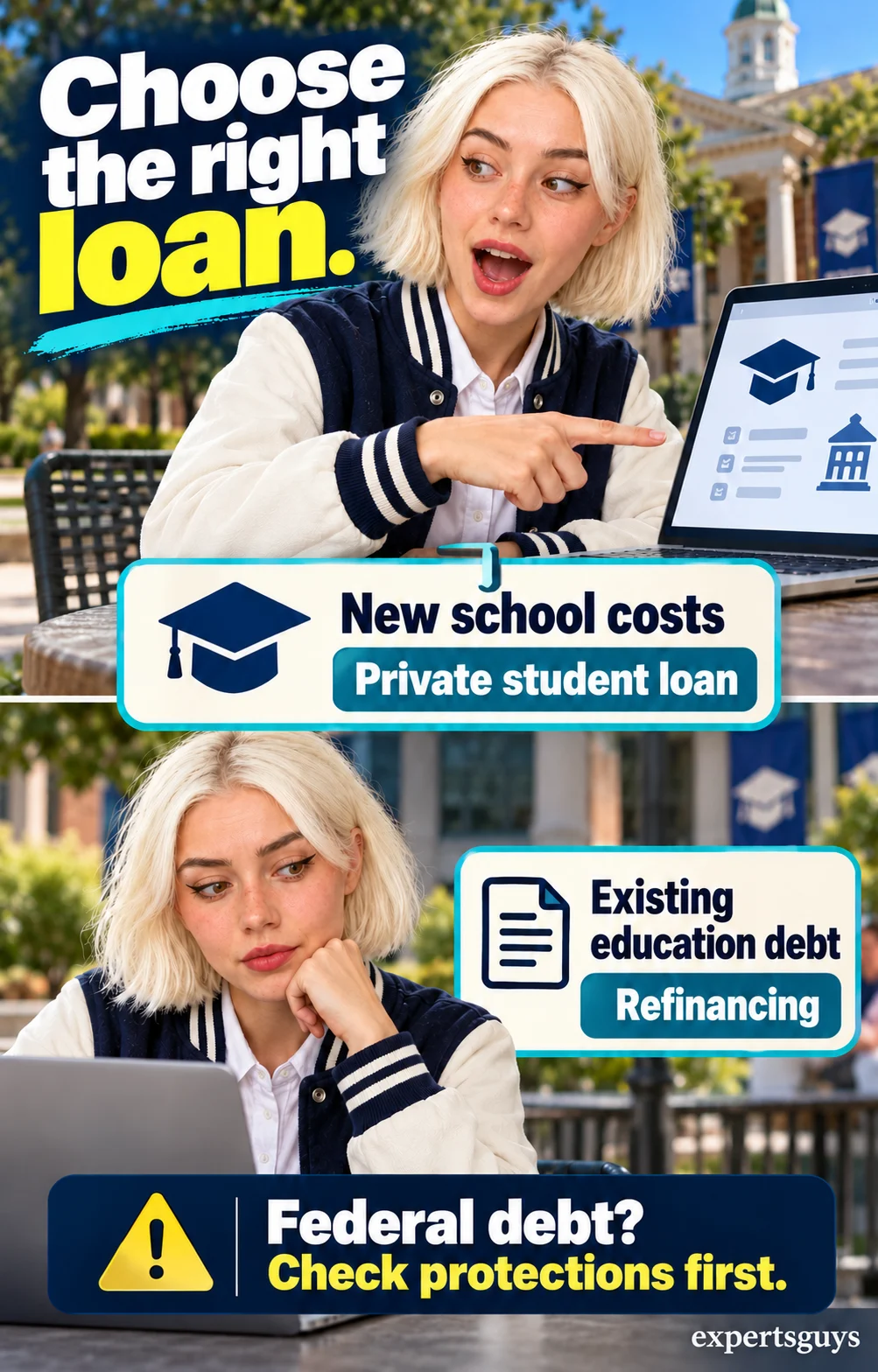
SoFi student loans include private loans for education costs and refinancing for existing student debt. For a new school expense, compare a private loan only after reviewing grants, scholarships and federal aid; the useful test is whether the remaining funding gap, repayment cost and school deadline fit the offer. Refinancing federal loans is a separate decision because it removes those loans from the federal system.
| Your situation | Start here | What decides the next step |
|---|---|---|
| You need money for an upcoming school period | Check a private student loan | The uncovered cost, school eligibility and an affordable repayment arrangement. |
| You want to replace loans you already owe | Evaluate refinancing separately | The actual replacement offer and any benefits you would give up. |
| Your bill is due soon but the loan is only prequalified | Check the funding stage | A rate estimate is not lender approval, school certification or paid tuition. |
This guide focuses on the U.S. private school-funding decision. A competitive offer can be useful when it fills a defined gap, but a low advertised rate or an attractive benefit does not establish that borrowing is affordable.
Are you funding school or replacing existing student loans?
Use the private student-loan route when you need eligible education expenses funded through your school. Use the refinancing route when the goal is to replace existing education debt. The product name matters because the eligibility tests, minimum amount and repayment choices are not interchangeable.
A new private loan does not convert separate federal loans you already hold. Refinancing those federal loans does: the replacement is private debt, and the lost federal benefits cannot simply be restored by changing your mind. The federal-benefit trade-off belongs before the rate comparison. That is a different decision from paying next semester’s bill.
For existing debt, the ELFI versus SoFi refinancing comparison owns the lender-to-lender decision. Here, the central question is narrower: how much new school funding do you actually need, and what will accepting it commit you to?
Calculate the gap before requesting an amount
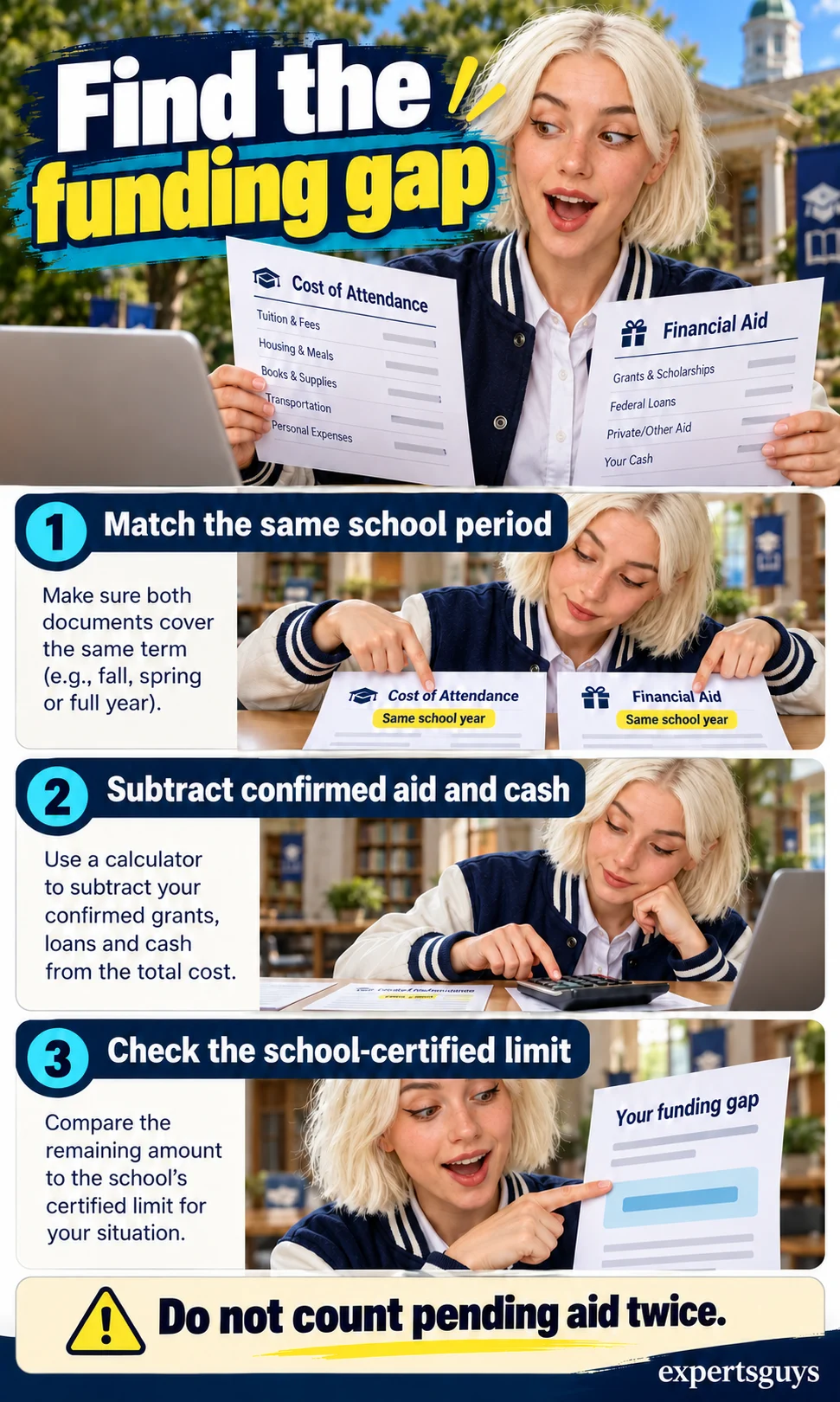
Start with the school’s cost information for the exact period you want to finance. A tuition bill and the full cost of attendance are different: the latter can include eligible living and education expenses beyond the charges on the student account. Count an expense once, and use a realistic spending estimate rather than treating every allowance as a target.
- Match the period. Open the school cost estimate and aid offer for the same semester or academic year. Do not subtract annual aid from one semester’s costs.
- Subtract confirmed resources. Deduct grants, scholarships, accepted federal borrowing and cash you can actually contribute for that period. Work-study earnings arrive through work; do not automatically treat an award ceiling as cash available for today’s bill.
- Check the ceiling. Ask the financial aid office to confirm the remaining school-certified amount. Your planned cash contribution may reduce what you personally need without changing every part of the school’s aid calculation.
Illustrative example: eligible planned costs of $28,000 minus $12,000 of confirmed grants and scholarships, $5,500 of accepted federal loans and $2,500 of available family funds leave an $8,000 funding gap. That arithmetic is a planning estimate, not approval for an $8,000 loan. If a pending $2,000 scholarship becomes confirmed, rerun the gap at $6,000 before borrowing the original amount.
SoFi’s private student-loan guidance describes school certification against education costs after other aid. A lender’s willingness to consider an amount is therefore different from the amount the school can certify. Do not increase your requested debt simply to use the largest advertised borrowing allowance.
If the school portal is difficult to interpret, use the simpler route: ask financial aid for the remaining eligible cost and ask the bursar which charges are due now. Those are different questions. The method is complete when the period, confirmed resources and amount still needed agree; a new spreadsheet or written log is unnecessary.
Who can qualify, and what changes with a cosigner?
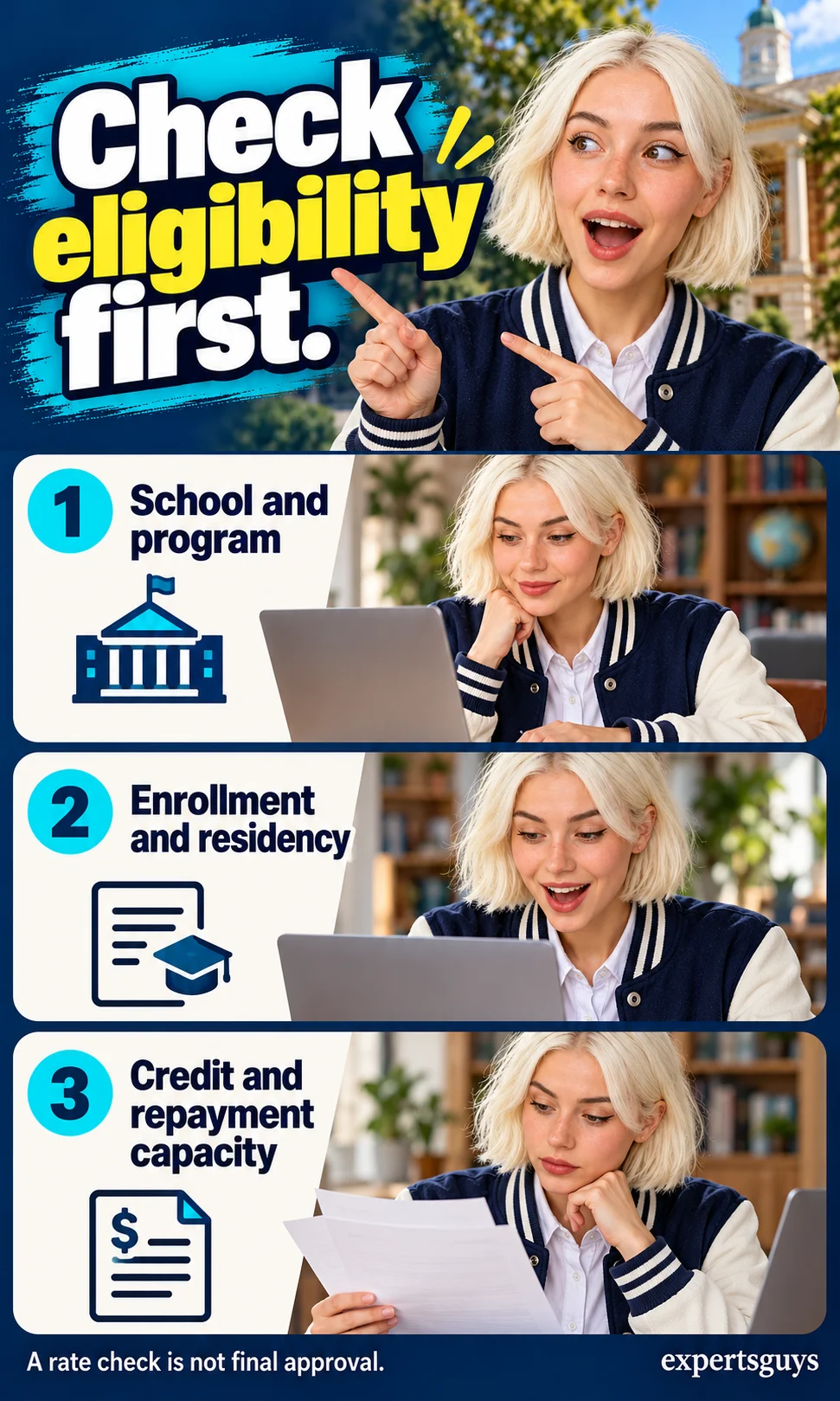
Qualification depends on both the education program and the borrower or cosigner’s financial profile. A single credit-score number cannot establish approval. Use the requirements for the exact product rather than a generic SoFi review or the requirements for a personal loan.
| Check | What to verify | Why it matters |
|---|---|---|
| School and program | The institution and degree are eligible for the selected product. | An applicant with strong credit can still choose an ineligible program. |
| Enrollment | The required enrollment level and any final-semester exception. | A change in course load may affect the available loan or payment choice. |
| Applicant status | Age, residency, identification and applicable immigration documentation. | Requirements differ by applicant and product. |
| Repayment capacity | Income, credit history and existing financial obligations. | Eligibility and the offered rate involve more than one score. |
The published undergraduate criteria generally require at least half-time enrollment at an eligible degree-granting institution, with a final-semester exception. The listed undergraduate product excludes associate-degree study and generally starts at $1,000; state or product conditions can affect availability. Confirm your own program and applicant category before proceeding, especially if you are studying less than half time or applying with immigration documentation.
A soft-pull rate check can show possible terms without affecting your credit score. Continuing the application can involve a hard credit inquiry and document verification. The credit-check disclosure makes that distinction explicit. Neither a quoted estimate nor uploading documents guarantees final approval.
- Confirm the school and program in the lender’s application before spending time comparing a rate you cannot use.
- Check enrollment and applicant-status requirements, then provide the requested income and identification records through the official application.
- Read the resulting decision and outstanding requirements. If declined, address the stated reason instead of repeatedly applying with unchanged information.
For example, a student with an eligible school but little income may need a creditworthy cosigner; a student attending an excluded program has a different problem that a cosigner may not solve. If you cannot identify the blocker, ask which requirement is unmet. The useful result is an understood eligibility issue or an actionable offer, not a guessed approval probability.
Discuss the obligation before sending a cosigner invitation
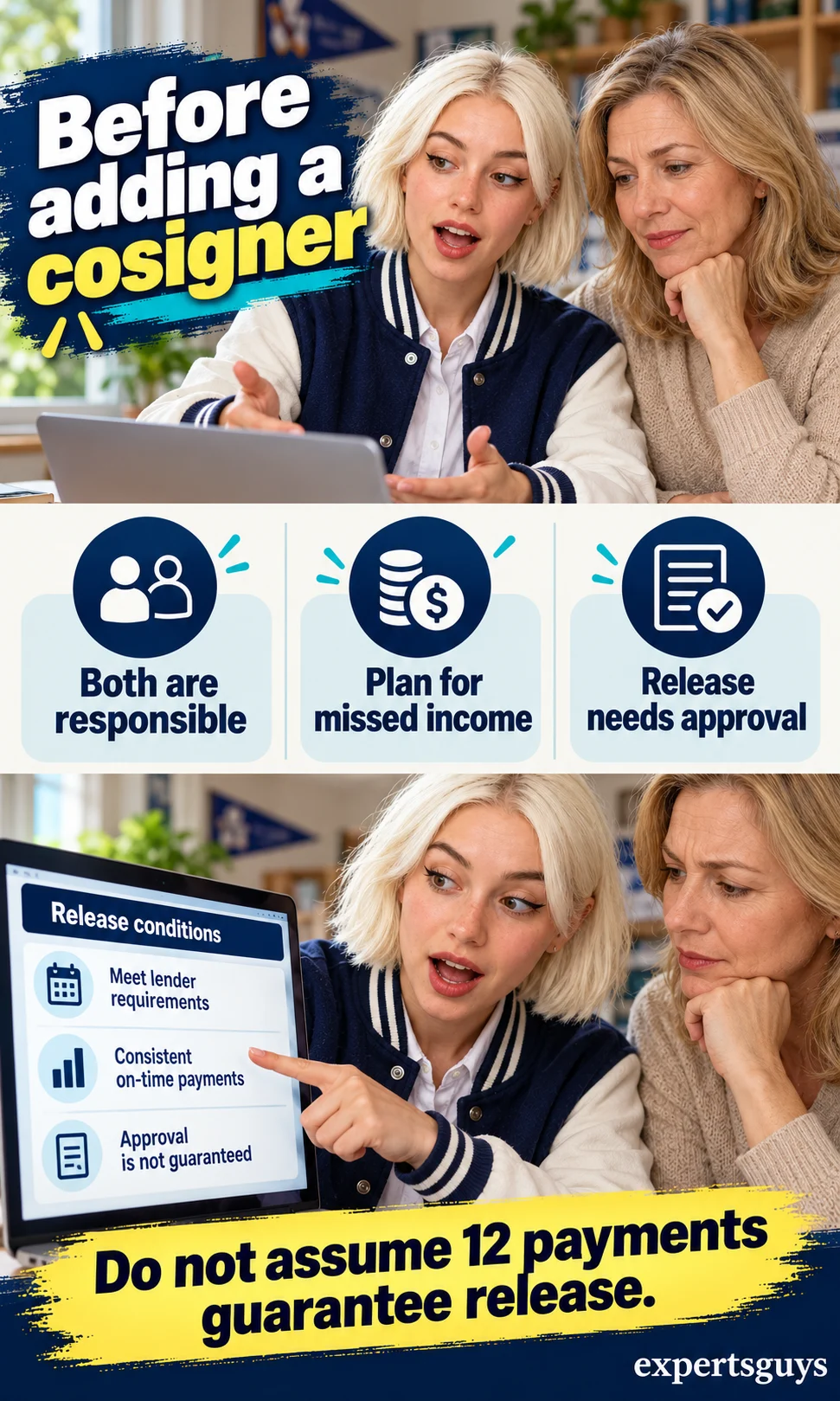
A cosigner accepts repayment responsibility, not merely a reference check. Both people should review the loan amount, scheduled payments, access to statements and what happens if the student’s income is interrupted. The lower-rate possibility needs to be weighed against the obligation the other person is taking on.
Open the proposed terms together and answer three practical questions aloud: who will make the scheduled payment, how will the other person know if it is missed, and could the cosigner carry it if necessary? If the arrangement depends on future release, review the exact release conditions before signing. A simpler alternative is to pause the application while the school checks other funding options; do not add an unwilling cosigner simply to finish the form.
For eligible in-school loans, SoFi’s cosigner-release terms allow an application after the required payment history, generally 12 consecutive on-time principal-and-interest payments or their qualifying equivalent, plus underwriting and other conditions. Release is not automatic, and older loans or other products can have different rules. Do not assume that twelve $25 in-school payments satisfy a full-payment requirement.
A cosigner-release decision is distinct from refinancing a loan into the student’s name. Avoid promising the cosigner either outcome now. The immediate decision should remain workable even if release is delayed or denied; if it is not, the proposed arrangement is too dependent on an uncertain future event.
What will the loan cost during school and afterward?
The cost depends on the amount disbursed, contract rate, payment timing and repayment term. A small payment during school can make today’s budget easier while leaving a larger balance for later. Compare what happens before full repayment as well as the payment shown after graduation.
| Payment approach | During school | Main trade-off |
|---|---|---|
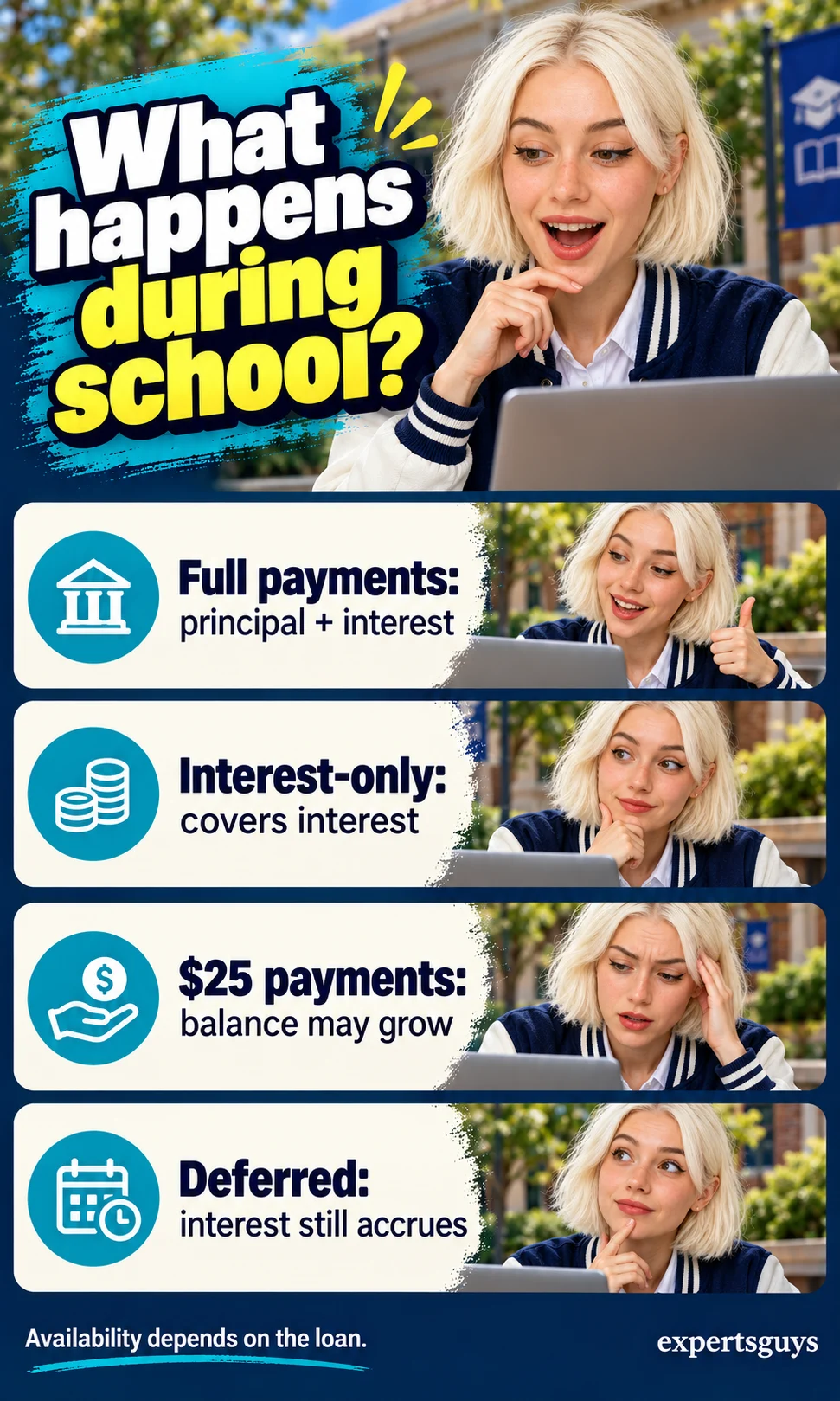
| Immediate repayment | Pay scheduled principal and interest. | More cash needed now; the balance starts amortizing earlier. |
| Interest-only | Cover the interest being charged. | Principal generally remains until full repayment begins. |
| $25 partial payment | Pay the stated small monthly amount. | Unpaid interest can accumulate if the payment does not cover it. |
| Full deferment | No scheduled in-school payment under that option. | Interest still accrues and can increase the later balance. |
These are common in-school options, not a promise that every applicant or product can select all four. Parent loans and some enrollment situations have narrower choices. Check the actual offer before accepting; a payment option that feels manageable today should not be chosen without checking the full-repayment obligation.
Interest accrues on money actually disbursed. When unpaid interest is added to principal, future interest is calculated on that higher principal; this is capitalization. The in-school interest explanation shows why payment deferral is not an interest holiday. Staged disbursements also matter: money sent next semester should not be modeled as though it was sent today.
A worked example: the cost of waiting
Consider a deliberately simplified example: one $10,000 disbursement at a fixed 8% annual interest rate, 24 months before full repayment, and a 10-year repayment term afterward. With no payments during those 24 months, simple interest of $10,000 × 0.08 × 2 equals $1,600. If all of it capitalizes once before repayment, the starting repayment balance is $11,600.
Using monthly amortization, that $11,600 balance costs about $140.74 a month for 120 months, or $16,888.80 in total using the unrounded calculation before display rounding. Paying the interest during the waiting period instead would cost about $66.67 a month for those 24 months, then about $121.33 a month on the $10,000 principal. The combined estimated payments are about $16,159.31. The difference comes from avoiding interest on the capitalized amount; these are examples, not SoFi quotes.
Actual schedules use the contract’s accrual rules, disbursement dates and payment dates. The same stated APR can also describe offers with different assumptions. Use the lender’s total-of-payments disclosure for the actual transaction, and use estimates to understand the trade-off rather than to replace that disclosure.
Compare the complete offer, then test the payment
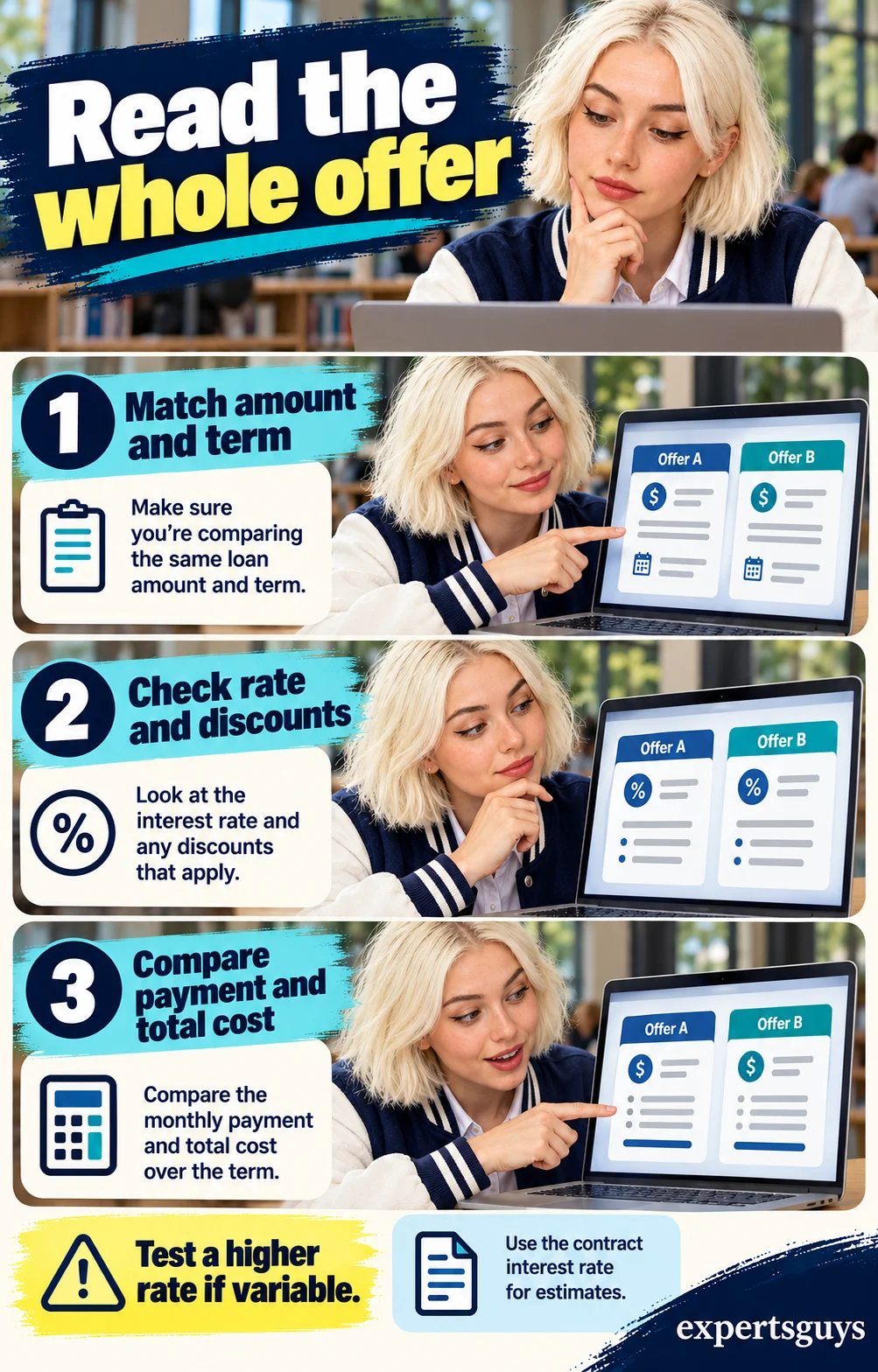
- Match amount and timing. Use the same borrowing amount, disbursement assumption, payment option and term when comparing two offers. Otherwise a lower payment may simply reflect a different structure.
- Inspect the price. Distinguish the contract interest rate from APR. Read which discounts are included, when they apply and what happens if their conditions stop being met.
- Compare the obligation. Look at the in-school payment, full-repayment payment and total of payments. For a variable-rate offer, rerun the estimate at a higher rate as a sensitivity test, not a forecast.
SoFi’s undergraduate rate and payment table separates repayment options and terms. It also describes a 0.25 percentage-point autopay reduction with conditions; its stated treatment does not necessarily lower the scheduled monthly payment. Do not assume an expired promotion, a membership benefit or a discount attached to another product applies to your offer.
The undergraduate disclosures list no application, origination, late or insufficient-funds fees and no prepayment penalty. That does not remove the interest cost or the consequences of missing required payments. If you are comparing lenders, read their fee and repayment terms separately; a zero-fee label does not make two loans equally expensive.
If this feels like too many variables, compare one term and one payment option first, using the same amount in both offers. The School Cost Check below can show a funding gap and simplified payment scenarios. Enter the contract interest rate, include any grace-period months in the waiting period, and compare its result with the lender’s disclosure; a difference is a reason to inspect assumptions, not a reason to discard the official schedule.
School Cost Check
Use the confirmed figures from your school and offer. The comparison holds one interest rate constant to isolate payment timing; real offers may price each repayment option differently. It does not check eligibility, predict approval or determine what you can afford.
From school cost to repayment
School Cost Check
See the funding gap and how payment timing changes a simplified loan cost.

USD. Defaults are illustrative, not a SoFi quote. No account or personal identification needed.
Enter your assumptions, then compare costs.
Save is optional and stores financial inputs only on this browser. Avoid saving on shared devices. Reset deletes the saved inputs. No input values are sent to analytics.
Read the assumptions
The same constant rate is used for all four scenarios to isolate timing. Real offers may price each option differently. This model uses monthly interest, one disbursement, no fees, no rate changes and one capitalization of unpaid interest after waiting. Actual daily interest, staged disbursements, rounding and contract rules can change results. Full payments run for the selected term from the start; other options add the waiting period before that term. For $25 payments, the amount can fall when the debt is nearly repaid. If there is no waiting period, all options start full repayment immediately.
These results are not approval, a lender quote or an affordability assessment. Confirm the actual payment and total-of-payments disclosure before accepting. For a variable loan, change the rate and compare a higher-rate scenario; this is a sensitivity test, not a forecast. If the certified amount or funding date is unclear, ask your school's financial aid office and bursar which step is outstanding.
When will the school receive funds, and what if something changes?
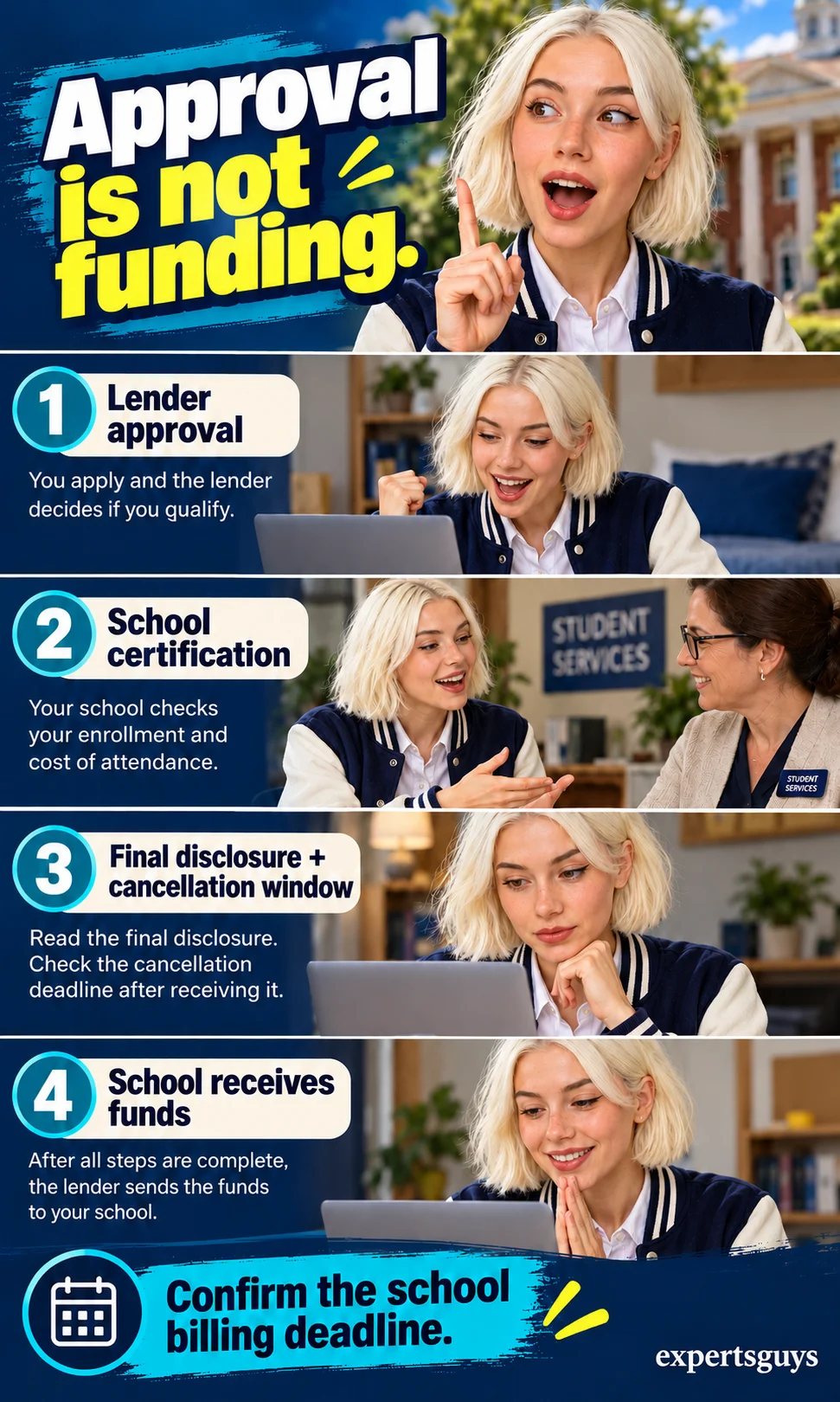
Funding requires more than lender approval: the school must certify the relevant information and provide the funding schedule. An approval message should therefore not be treated as proof that the tuition bill has been paid. Check the student account and the school’s deadline separately.
The SoFi disbursement process distinguishes school certification from scheduled delivery. The school can certify a lower amount than the lender originally approved. If the figures differ, reconcile the certified amount and planned disbursements before assuming money has gone missing.
- Complete the lender’s outstanding approval and acceptance requirements through the official application.
- Confirm that the school has received the certification request and has the correct enrollment period and amount.
- Read the final disclosure, including the cancellation instructions and deadline.
- Check the scheduled school disbursement and then confirm how the bursar has applied the funds.
For covered private education loans, the right-to-cancel rule generally runs until midnight of the third business day after receipt of the final disclosure, and funds cannot be disbursed during that period. Use the deadline and cancellation method in your documents; do not translate the rule into a casual promise of three calendar days or immediate funding afterward.
If you are near a payment deadline, ask the bursar whether pending aid can prevent a registration hold and what evidence it needs. Separately ask financial aid or the lender which funding step is outstanding. A school-approved payment arrangement may address the timing problem, but check its costs and conditions before relying on it. There is no universal number of days that makes every school and application safe.
Resolve a delay or changed amount at the responsible step
| What changed | Check this first | Completion checkpoint |
|---|---|---|
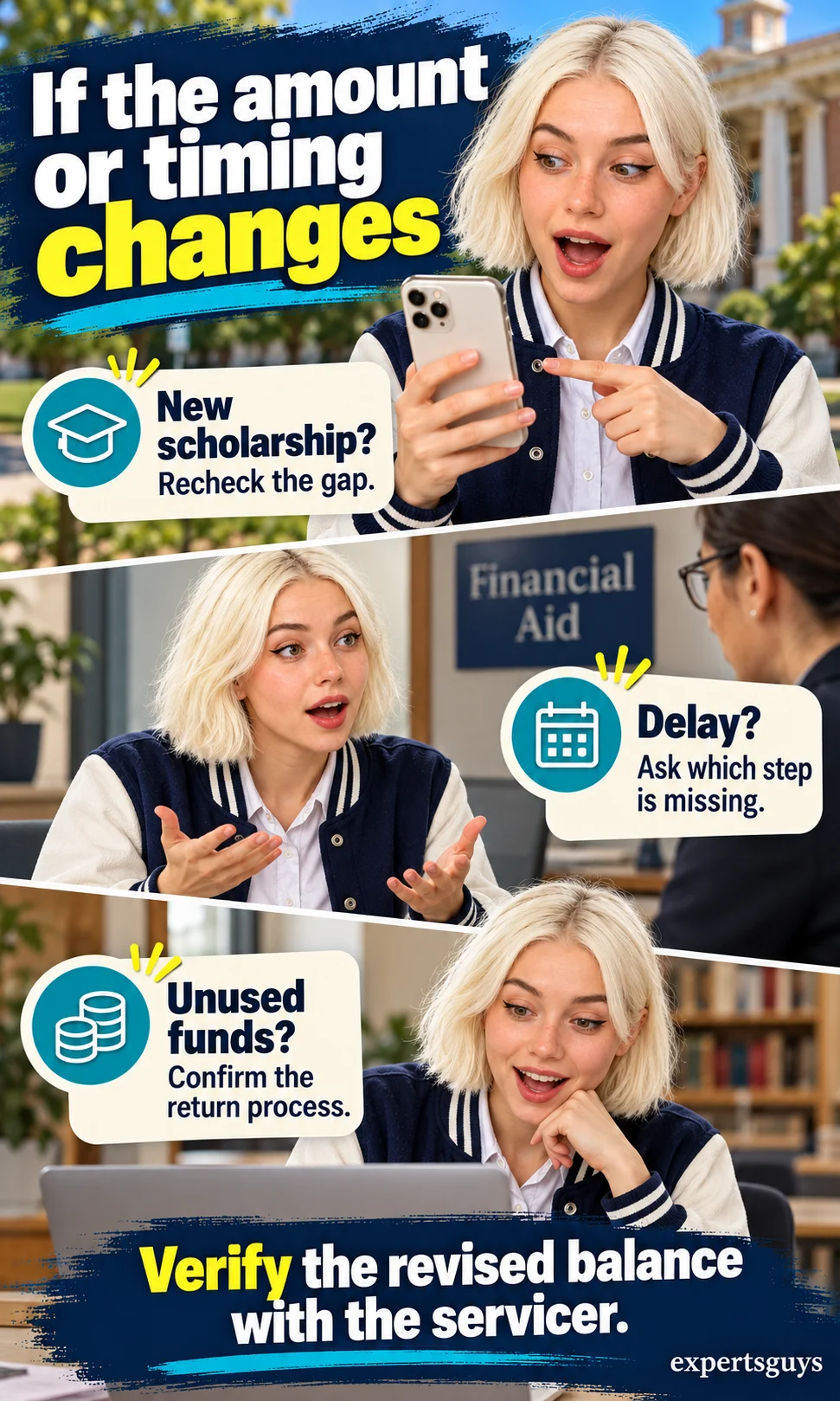
| A new scholarship appears | Ask financial aid whether certification or a future disbursement needs reducing. | The revised gap and scheduled loan amounts agree. |
| The loan is approved but not funded | Ask which certification, document or scheduling step is missing. | The responsible office confirms the next required action. |
| You no longer need part of the loan | Ask about canceling an undisbursed portion or returning funds already sent. | The revised disbursement or servicer balance is confirmed. |
| The student account shows a credit | Ask the bursar whether it is pending, refundable or being returned. | You understand where the money will go before spending it. |
For a delay, work from the status you can verify. If certification is missing, the school’s financial aid office is the starting point. If the school has certified and a disbursement date exists, ask the lender about delivery and the bursar about receipt. Sending the same request to every office without identifying the stage often leaves the underlying mismatch unresolved.
For unused funds, distinguish money not yet sent from money already received. Ask the lender about canceling a future disbursement; if money is at the school, ask the bursar about its return procedure and how it affects your account. If the school has refunded money to you, confirm how to return it or apply an appropriate payment. Do not assume that leaving a refund untouched in a bank account reduces the loan balance.
The completion check is specific: the school account and lender or servicer record should reflect the revised arrangement. If the amount is still wrong, provide the transaction reference through the official support channel and ask for reconciliation. The easier route is a direct conversation with the office responsible for the current stage; you do not need a separate tracking app to resolve it.
Professional perspective
The strongest reason to choose a SoFi private student loan is a suitable actual offer for a verified funding need. The weakest reason is a benefit list detached from the repayment obligation. Treat the decision as a commitment across three stages: funding the right school period, meeting payments while studying and carrying the full payment afterward. If one stage depends on an unconfirmed scholarship, an assumed cosigner release or optimistic future earnings, resolve that dependency before accepting.
If the full payment does not fit a realistic budget, changing the lender may not solve the problem. A lower-cost attendance arrangement, a smaller funding gap or additional confirmed aid can change the amount required. Private hardship assistance, when available, follows the loan’s terms and servicing rules; it should not be treated as guaranteed unemployment insurance or as equivalent to federal repayment protections.
Before You Decide
Proceed only when the need and the obligation are both clear. These checks are decision conditions, not an approval score or a recommendation to borrow.
- The amount covers a confirmed gap for the correct school period.
- The school, program and applicant meet the product’s requirements.
- You understand the rate, discounts, payment timing and total cost.
- Any cosigner understands the obligation without relying on automatic release.
- The certification and disbursement schedule can meet the school’s requirements.
Frequently asked questions
Can a private student loan pay for more than tuition?
Eligible school-certified costs can include education and living expenses beyond tuition, subject to the school’s cost-of-attendance calculation and the loan terms. The permitted ceiling is not a recommendation to borrow the maximum.
Does a SoFi student loan automatically move when I transfer schools?
Do not assume it transfers. SoFi’s in-school guidance requires a new application when you change schools, and the new school must be eligible. Confirm how the existing loan and any undisbursed amount will be handled before the move.
Can I change my repayment choice after accepting the loan?
SoFi’s private-loan guidance says the repayment type can be changed during the application process before signing the final loan acceptance document, but not afterward through that selection process. Resolve the choice before acceptance; later assistance or modification is a separate servicing question.
Is a private parent loan the same as a federal Parent PLUS loan?
No. A private parent loan follows its lender’s contract and eligibility rules. A federal Parent PLUS loan belongs to the federal loan program. Compare the actual borrower obligation and available protections, not just the word parent.
Should I use the advertised minimum rate in a budget?
Use your own offered terms for a borrowing decision. Until you have an offer, label the rate as an assumption and test less favorable outcomes. A headline minimum is not a prediction of the rate you will receive.
Next steps
Start by reconciling the school funding gap, then compare the actual offer for that amount. If your real objective is replacing existing debt, continue to the refinancing comparison instead. Keep a private-loan application focused on the school period, payment obligation and funding checkpoint you need to resolve.