
Ratchet & Clank: Rift Apart is one of those games whose original technical selling point could easily have aged faster than the game around it. When it arrived on PlayStation 5, much of the attention went to dimensional rifts, extremely fast transitions between environments and the way the console’s SSD could support ideas that would have been much harder to present as smoothly on previous hardware. Years later, those demonstrations are no longer surprising simply because fast storage and large-scale streaming have become much more familiar across modern games.
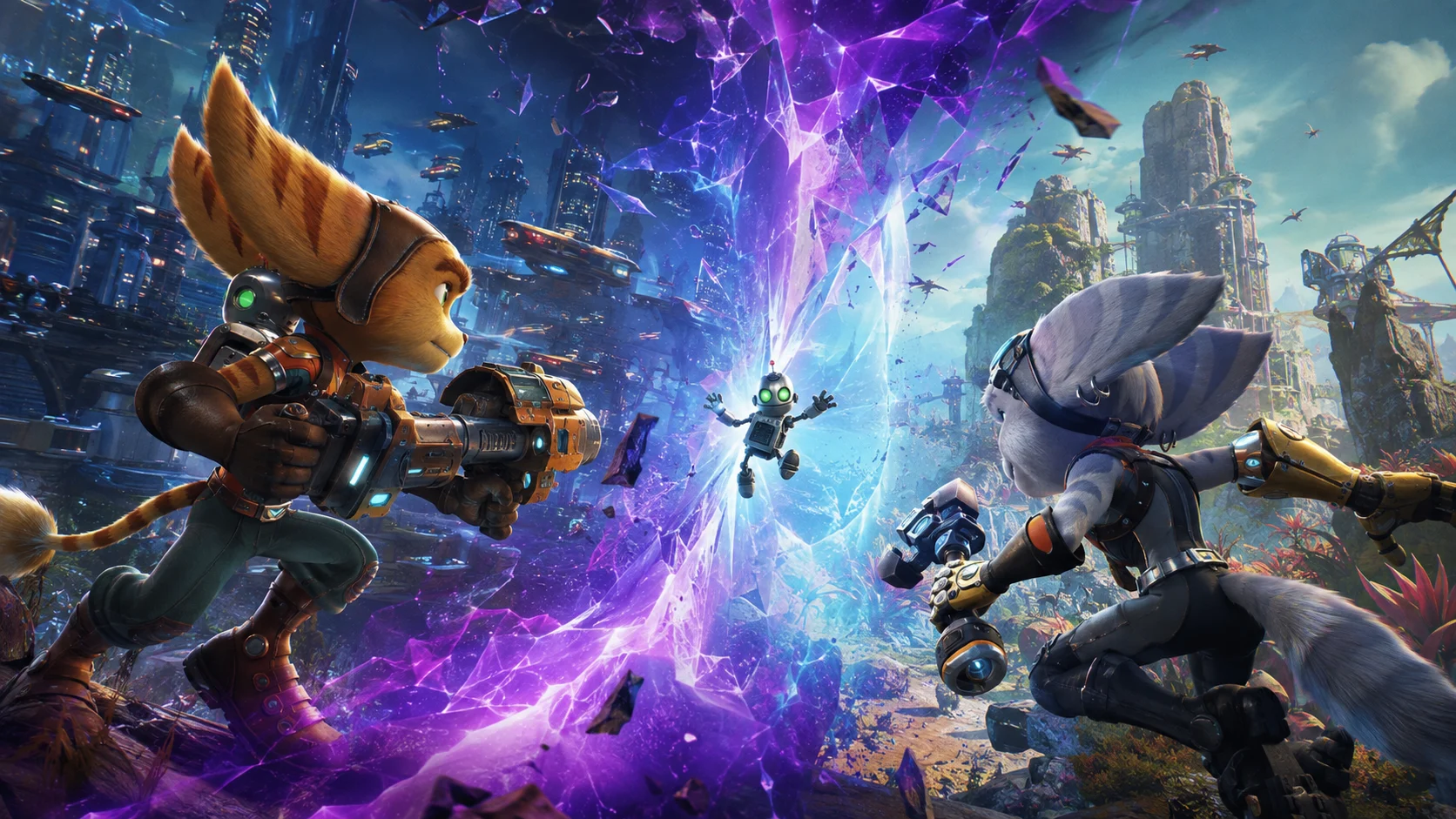
What has aged better is the game built around that technology. Rift Apart remains an unusually polished combination of third-person shooting, platforming, spectacle and character-driven adventure, with Ratchet sharing the spotlight with Rivet, a Lombax resistance fighter from another dimension. The dimensional premise gives the story a reason to revisit familiar ideas from altered perspectives while also supporting some of the game’s most memorable transitions and set pieces.
It is also no longer simply a PS5 showcase. The game arrived on PC in July 2023, with the official PC edition of Ratchet & Clank: Rift Apart adding options such as unlocked frame rates, ultrawide display support, ray-traced visual features and several image-upscaling technologies. That makes the current buying decision more interesting because someone discovering Rift Apart today may be choosing between platforms rather than asking whether they should buy a new PS5 specifically to experience it.
The answer is still favorable for players who enjoy polished single-player action adventures. Rift Apart is relatively easy to understand, visually dense without becoming exhausting, generous with unusual weapons and structured tightly enough that the campaign rarely spends long away from its strongest ideas. Its limitations become more obvious once the technical novelty wears off: the rifts are sometimes more spectacular than mechanically transformative, some side content is light, and players searching for a large exploratory world may find the adventure more controlled than expected.
That combination is exactly why Rift Apart deserves a fresh review rather than another celebration of its launch technology. The useful question today is not whether the dimensional transitions looked impressive in 2021. It is whether the combat, characters, platforming and world design still make the game worth your time now.
What Is Ratchet & Clank: Rift Apart?
Ratchet & Clank: Rift Apart is a single-player third-person action-platformer developed by Insomniac Games. Its story begins when a dimensional crisis separates familiar characters and creates connections with alternate realities. Ratchet and Clank consequently become entangled with Rivet, another Lombax whose life developed under very different circumstances from Ratchet’s own.
The dimensional idea gives the story more purpose than simply providing portals. Familiar locations and concepts can appear in altered forms, characters can encounter counterparts shaped by different histories, and the central conflict can move between worlds without requiring the adventure to remain geographically or visually consistent. Insomniac described Rift Apart as an experience built around the PS5’s fast storage architecture, explaining that the system’s SSD allowed the studio to consider transitions capable of moving players between planets and dimensions at extremely high speed.
That technical foundation matters, although Rift Apart is still recognizably a Ratchet & Clank game. Combat revolves around an expanding collection of imaginative weapons, traversal alternates between platforming and high-speed movement, environmental puzzles interrupt the shooting, and humorous characters keep the tone much lighter than the dimensional-collapse premise might suggest.
Players coming from more cinematic PlayStation adventures should therefore expect something closer to an animated science-fiction action movie than a grim blockbuster. If you enjoy polished PlayStation campaigns such as Marvel’s Spider-Man: Miles Morales but want more platforming, stranger weapons and a much more playful universe, Rift Apart occupies an appealing middle ground.
Is Rift Apart Still Worth Playing?
Yes, especially if you want a focused single-player adventure that values momentum over enormous scale. Rift Apart does not require dozens of hours before its combat becomes interesting, and it does not bury its main attractions beneath a huge checklist of map icons. New weapons arrive regularly, planets tend to have distinct visual identities, and the story keeps moving strongly enough that the campaign rarely feels stranded inside one activity for too long.
Its greatest strength today may actually be restraint. Modern games frequently compete through sheer size, yet an adventure does not automatically become better when every environment is expanded into a large open world. Rift Apart gives some planets room for exploration while keeping others tightly directed around combat, traversal or spectacle. That means it can introduce an idea, develop it and move on before repetition becomes the dominant feeling.
The game also remains unusually accessible to people who are less interested in punishing difficulty. Combat can become energetic and visually chaotic, but the experience is fundamentally designed to keep players moving forward rather than repeatedly blocking progress. PlayStation’s current accessibility information lists features including large text, color alternatives, high-contrast visuals, subtitle options, audio controls and several gameplay-related accommodations through its accessibility suite.
Players who measure value primarily by campaign length may reach a different conclusion. Rift Apart is not designed as a hundred-hour commitment, and somebody who wants a game to occupy an entire season could find its focused structure expensive at full price. The stronger reason to play it is the consistency of the experience rather than the number of hours it can occupy.
The Dimensional Rifts Still Look Impressive – But What Do They Actually Do?
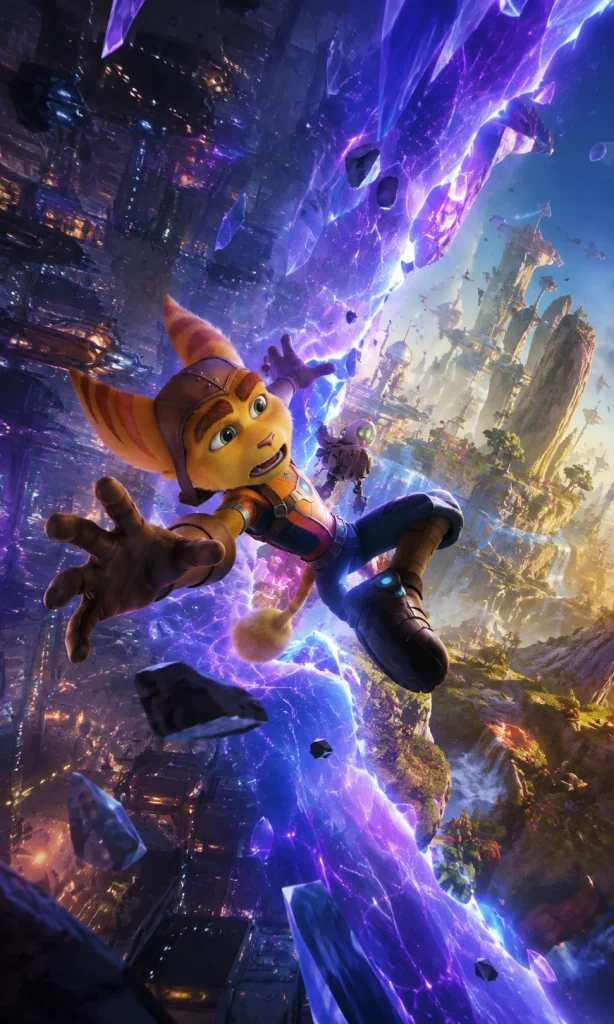
Rift Apart’s defining visual idea is the ability to move between dimensional spaces with very little interruption. Some transitions throw the player through a sequence of radically different environments in seconds, while smaller rifts function as traversal tools during combat. The result creates the impression that environments are unstable and capable of changing around the player at almost any moment.
The technology was important enough that Insomniac specifically connected the game’s design to the PS5’s SSD. The PlayStation explanation of Rift Apart’s development describes how faster storage enabled the studio to consider dimension hopping and portals capable of moving players through worlds rapidly.
From a gameplay perspective, however, not every spectacular dimensional transition represents a completely freeform mechanic. Many of the largest rift sequences are designed set pieces whose routes have been carefully controlled. They create extraordinary pacing and visual surprise, although the player usually is not deciding which arbitrary universe to open or dynamically rewriting the map.
Smaller Rift Tethers are more directly useful. These allow Ratchet or Rivet to pull themselves toward dimensional openings during fights, quickly changing position and creating opportunities to escape dangerous situations or attack from a better angle. That is where the dimensional system becomes part of moment-to-moment combat rather than primarily a demonstration of environmental streaming.
The distinction is worth making because Rift Apart remains impressive without pretending that every portal is a revolutionary gameplay system. Its strongest achievement is the way technical transitions, environmental design and cinematic direction combine to make movement through the adventure feel unusually seamless.
Ratchet and Rivet Make the Story Stronger Together
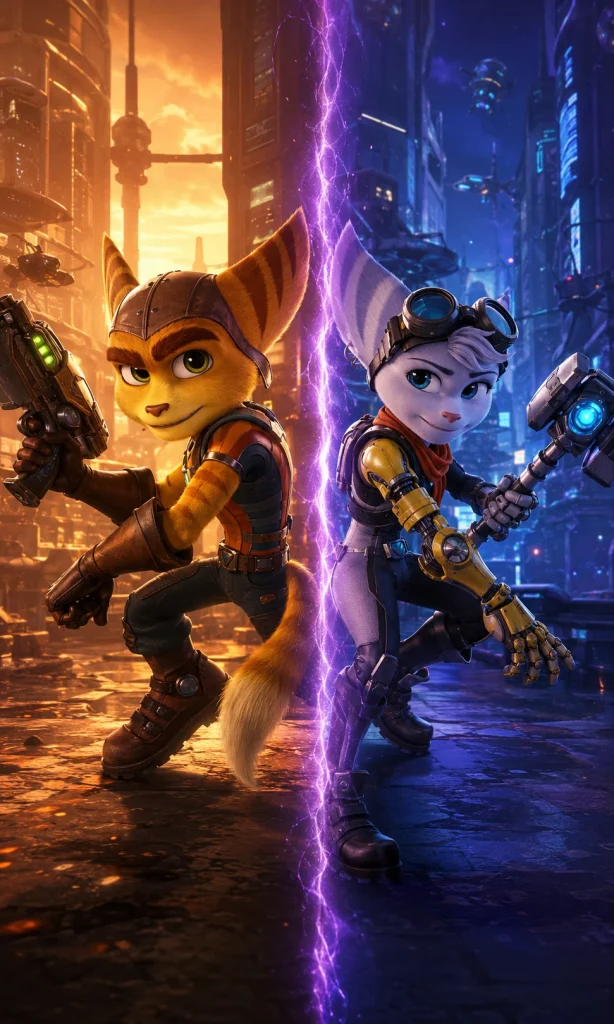
Introducing Rivet could easily have felt like a novelty designed to support the alternate-dimension concept, but she becomes one of the reasons the story works. Her circumstances parallel Ratchet’s without simply reproducing his personality, and the differences between their experiences give the dimensional story an emotional purpose beyond providing alternate versions of familiar locations.
Rivet is a Lombax resistance fighter from another reality, and the official Rift Apart description places her alongside Ratchet and Clank as one of the central characters in the interdimensional conflict. She shares most of the core combat and traversal systems with Ratchet, which prevents switching protagonists from requiring the player to relearn the game every time the story changes perspective.
That similarity could be viewed as a missed opportunity for more mechanically distinct protagonists. Rivet does not transform Rift Apart into two separate games with completely different control systems. The advantage is consistency: weapon progression and general combat knowledge remain useful regardless of which Lombax the story currently follows.
More importantly, the shared mechanics prevent the narrative from creating an obvious “preferred” character whose sections feel substantially better to play. The difference between Ratchet and Rivet comes primarily from personality, relationships and perspective, allowing the game to switch protagonists without turning one side of the story into downtime.
Combat Is Still the Real Reason to Play Rift Apart
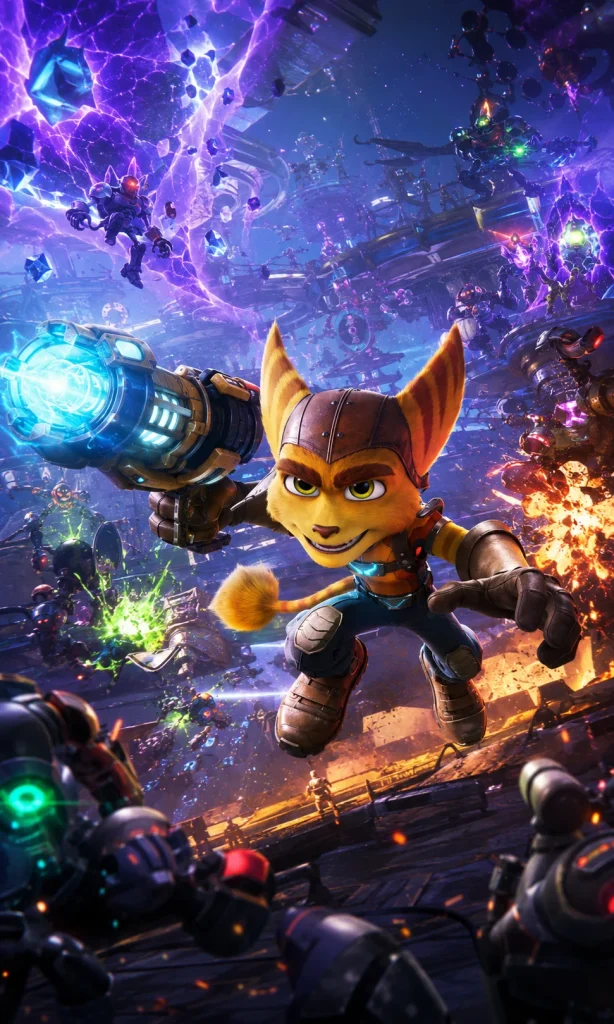
The dimensional technology attracts attention, but the weapon design gives Rift Apart its long-term gameplay personality. Ratchet & Clank has always treated weapons as entertainment rather than merely different statistical versions of a rifle, and Rift Apart continues that tradition with tools designed to change the shape of an encounter.
The Burst Pistol begins as a relatively straightforward option, while weapons such as the Topiary Sprinkler can temporarily control enemies in far stranger ways. Explosive weapons provide area damage, close-range options reward aggressive positioning, and later upgrades encourage players to keep rotating through the arsenal instead of relying on one universally optimal gun.
Weapons also improve through use. That creates a productive reason to experiment because frequently used equipment develops rather than simply becoming obsolete the moment a higher-numbered replacement appears. The system gives players enough progression to make the arsenal feel increasingly powerful without converting the game into a complicated loot-management exercise.
Combat works especially well when movement, enemy pressure and dimensional traversal overlap. Rift Tethers can pull the player across the arena, Phantom Dash helps avoid attacks and reposition quickly, while aggressive enemies force constant movement. The experience therefore feels strongest when the player treats the battlefield as a space to move through rather than a place to stand behind cover and exchange fire.
Players coming from a substantially heavier combat experience such as Demon’s Souls should expect a very different philosophy. Rift Apart wants combat to feel energetic, expressive and entertaining rather than punishing every poorly timed decision.
The Weapons Feel Different Because the Controller Is Part of the Design
On PS5, the DualSense controller contributes more than ordinary vibration. Adaptive triggers can create different resistance points during weapon use, while haptic feedback adds physical texture to actions that would otherwise be represented only through sound and animation.
The implementation varies by weapon, which helps the arsenal feel more distinct. A trigger can communicate stages of firing behavior or provide tactile feedback before an attack is fully committed. These differences are subtle compared with the visual spectacle surrounding them, yet they add another layer to the reason changing weapons remains satisfying.
PC players can also use DualSense features when connected appropriately. The current PC description notes support for haptic feedback and dynamic trigger effects when using a DualSense controller through the supported connection arrangement, while mouse-and-keyboard controls remain available for players who prefer them.
This is one area where the PS5 experience remains unusually coherent. Hardware, controller feedback, visual presentation and fast transitions were designed as parts of the same package, so the console version still feels like a particularly natural home for the game even though the PC edition offers more configurable visual performance.
Platforming Has More Energy Than the Shooting Alone Suggests
Calling Rift Apart a third-person shooter misses too much of its movement system. The game regularly asks players to jump, wall-run, grind, swing, dash and move across environments where spatial timing matters almost as much as aiming.
The Phantom Dash improves the rhythm considerably because it allows characters to pass through some attacks and hazards while maintaining momentum. Wall-running creates faster traversal sequences, while dimensional anchors can pull the player across gaps or reposition them during more complex environmental sections.
Some planets open the movement system further. Speed-focused traversal and larger spaces prevent every location from feeling like a corridor connecting combat arenas, while platforming challenges provide a break from constant shooting without slowing the story excessively.
The controls also remain forgiving enough that movement usually feels fluid rather than technical. Players interested in much more platforming-focused PlayStation adventures can compare that balance with Sackboy: A Big Adventure, where platforming itself becomes the primary challenge rather than one part of a broader action system.
The Planets Feel Bigger Than They Actually Are
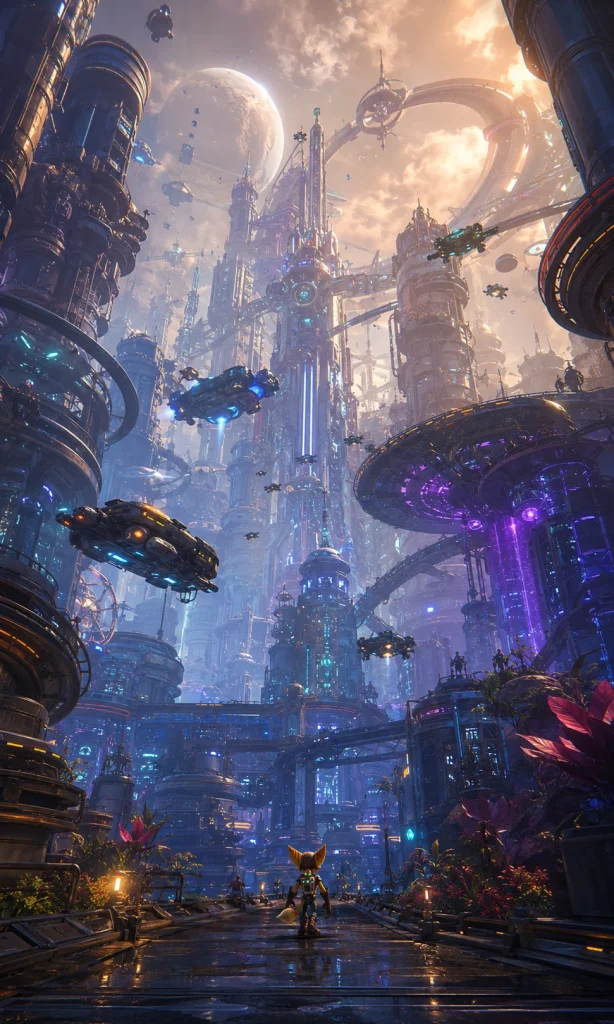
Rift Apart uses a useful trick: several environments communicate scale without forcing the player to manually traverse every part of that scale. Cities stretch into the background, enormous structures surround relatively focused routes, and dimensional events can suddenly reveal environments that feel much larger than the playable path.
That approach helps the planets feel expensive and cinematic without turning each one into another open-world region. The player gets enough freedom to investigate optional routes, collect certain items and explore wider spaces in selected areas, but the overall adventure remains curated.
Some players will see this as one of the game’s greatest strengths because almost every location has deliberate pacing. Others may wish the worlds supported deeper exploration and more substantial optional activities. Rift Apart sits between linear action and open exploration rather than fully committing to either extreme.
The visual density makes that compromise easier to accept. Environments frequently contain background animation, crowds, vehicles, strange wildlife and layers of architecture that make the world appear more active than the player’s actual route. It is one of those games where stopping to inspect the environment reveals considerably more detail than the fast campaign pace requires.
Rift Apart Still Looks Remarkably Good
The visual presentation remains one of the easiest reasons to recommend the game. Character animation, fur detail, reflective surfaces, particle effects and environmental density combine with extremely clean art direction, creating a look that holds up even as later games have pushed hardware further.
The strongest scenes resemble high-budget animated cinema without losing the responsiveness expected from a game. Facial animation carries character emotion well, while transitions between cinematics and gameplay are often smooth enough that the boundary becomes difficult to notice immediately.
Ray-traced reflections were one of the notable PS5 visual features, and the PC version expands the available configuration with ray-traced reflections and supported exterior shadow options depending on hardware. PC also supports ultrawide formats including 21:9, 32:9 and even triple-monitor configurations according to the official PC listing.
None of those features are required to appreciate the art direction. Rift Apart succeeds because its visual identity is coherent long before the player begins counting reflections. Dense futuristic cities, colorful alien environments and exaggerated characters all belong to the same stylized universe.
PS5 vs PC – Which Version Should You Play?
| Decision | PS5 | PC |
|---|---|---|
| Setup simplicity | Very straightforward and designed around a fixed hardware target. | Performance depends on hardware, settings and storage configuration. |
| DualSense experience | Native haptic feedback and adaptive trigger integration. | DualSense features supported under the required connection conditions, or use mouse and keyboard. |
| Display flexibility | Optimized console presentation with several graphics modes depending on display support. | Unlocked frame-rate options, ultrawide support and broader graphics configuration. |
| Ray tracing | Integrated into selected console visual modes. | Configurable ray-traced reflections and supported exterior shadow features on capable hardware. |
| Best fit | Players who want a polished plug-and-play experience. | Players with capable hardware who value visual configuration, high frame rates or ultrawide displays. |
There is no universal winner because the content itself is substantially the same adventure. PS5 provides the more controlled experience and integrates naturally with the controller features around which the original release was designed. PC allows substantially more flexibility if your system can take advantage of it.
The PC version’s storage requirements are worth noticing because Rift Apart’s design depends heavily on rapid environmental streaming. The current PC listing specifies approximately 75 GB of available storage and recommends an SSD at minimum configurations while requiring one at the recommended tier. Anyone installing it on an older gaming PC should therefore check storage as carefully as GPU performance.
If you already own a PS5, there is little reason to avoid that version merely because PC now exists. If you have a powerful gaming PC and an ultrawide monitor, the PC release can make one of Rift Apart’s strongest qualities – its dense environments – even more visually impressive.
Do You Need to Play Earlier Ratchet & Clank Games First?
You can understand Rift Apart without completing the entire series. The game assumes familiarity with some established relationships and history, yet the central dimensional crisis and Rivet’s storyline are clear enough for new players to follow.
Long-term fans naturally gain more from returning characters and alternate versions of familiar ideas. Ratchet and Clank’s relationship also carries greater emotional weight when you already understand how many adventures they have experienced together.
New players should not allow that history to become a barrier. Rift Apart spends enough time establishing the immediate problem that it works as an accessible entry point rather than behaving like the final chapter of a story whose earlier volumes are mandatory homework.
The tone helps considerably. Character motivations are relatively direct, villains are easy to identify, and the story prioritizes emotional clarity over complicated lore. You may miss references, but you should not become lost.
Is Rift Apart an Open-World Game?
No. Rift Apart contains larger explorable areas and optional objectives, but it is fundamentally a structured adventure that moves between planets rather than one enormous continuous open world.
That distinction affects expectations significantly. You cannot simply choose a direction from the opening area and travel indefinitely across a single galaxy-sized map. Instead, individual planets provide different degrees of freedom, with story progression determining when new locations become available.
Some areas allow broader exploration and collectible hunting, while others are closer to tightly directed action sequences. The variety gives the campaign more pacing control because Insomniac can alternate between large spaces, combat arenas, puzzles and cinematic sequences without requiring every activity to exist inside the same world structure.
Players tired of oversized open worlds may find this refreshing. Players whose enjoyment depends on discovering hundreds of optional locations may find Rift Apart comparatively limited.
How Difficult Is Ratchet & Clank: Rift Apart?
Rift Apart is designed to support a broad range of players rather than enforcing one uncompromising difficulty level. Difficulty settings change how demanding combat becomes, while accessibility options can alter aspects of navigation, visual presentation, speed and control.
This flexibility suits the game’s personality. The weapon system is fun because it encourages experimentation, and excessively punishing combat would work against the pleasure of switching between absurd pieces of equipment simply to see what happens.
Higher difficulty can still make movement and resource decisions more important. Enemies survive longer, mistakes become more expensive and staying mobile becomes essential when several threats occupy the arena simultaneously.
The ideal difficulty is therefore the one that leaves enough pressure for weapon choices and movement to matter without forcing you into the same conservative strategy during every encounter.
Where Rift Apart Shows Its Age
The phrase “shows its age” sounds harsher than the reality because Rift Apart remains technically attractive. What has changed most is the context surrounding it.
Instantaneous-looking transitions are no longer as unfamiliar as they were near the beginning of the PS5 generation. Ray tracing has become common across premium PC and console releases, high-speed SSDs are standard equipment in modern systems, and other games have produced equally spectacular transitions.
That removes some of the surprise but exposes the quality of the underlying design. A technology showcase that relied entirely on novelty would become much less interesting once the technology became ordinary. Rift Apart remains enjoyable because the shooting, movement, animation and characters function independently of the original hardware demonstration.
Its more noticeable limitations are structural. Optional content is modest compared with much larger modern games, enemy variety can feel familiar during extended sessions, and several dimensional effects operate as controlled spectacle rather than systems players can manipulate freely.
None of those weaknesses undermine the core campaign, although they explain why Rift Apart works better as a focused adventure than as a game intended to become somebody’s long-term hobby.
Who Should Play Rift Apart Now?
Play it if you want a polished single-player PS5-style adventure
Rift Apart is especially easy to recommend to players who value strong production quality but do not want another enormous open-world commitment. Its campaign moves quickly between shooting, movement, humor and spectacle, giving almost every session a clear sense of progress.
The game is also visually friendly enough to work for families and younger players while retaining enough mechanical depth to keep experienced players entertained. Difficulty and accessibility flexibility make that broad audience possible without flattening the entire experience into one level of challenge.
Play it if unusual weapons are more exciting than realistic guns
The arsenal remains one of the strongest reasons to choose Ratchet & Clank over a conventional third-person shooter. Weapons are built around personality and experimentation rather than military authenticity, which keeps encounters entertaining even when the enemy types themselves become familiar.
Players who enjoy finding one optimal rifle and using it for the entire campaign may not get as much from the system. Rift Apart rewards curiosity more than efficiency.
Consider it on PC if you have strong hardware
PC is particularly appealing for players with high-refresh displays, ultrawide monitors or hardware capable of using the more demanding ray-traced options. The flexibility extends a game already known for visual presentation.
Older PCs need more consideration. Storage, CPU, GPU and memory requirements matter because the game’s fast transitions and dense environments were originally designed around hardware with rapid asset streaming.
Wait for a discount if campaign length determines value for you
Rift Apart’s concentrated design is a strength, but players who equate price directly with dozens of hours may find the value proposition less convincing at full price. The campaign is intended to remain energetic rather than stretch its systems across an enormous checklist.
A lower purchase price changes that equation substantially because the quality per hour is high even when the overall commitment is moderate.
What Rift Apart Does Better Than Many Bigger Games
Rift Apart understands that spectacle works best when the player is still doing something meaningful. Huge dimensional transitions may be directed, yet they rarely force the campaign into long periods where the player simply watches events happen without participating.
It also changes environments frequently enough to preserve curiosity. New planets, altered dimensions, unusual traversal ideas and escalating weapons arrive before the visual identity can become too comfortable.
Most importantly, the game knows what it wants to be. It does not attempt to become a crafting survival game, role-playing epic, multiplayer service, procedural sandbox and cinematic adventure simultaneously. The narrower ambition allows almost every system to reinforce movement, combat or presentation.
That focus has aged well. As increasingly large games compete for hundreds of hours of attention, a polished adventure that can be completed and remembered has a different kind of value.
Frequently Asked Questions About Ratchet & Clank: Rift Apart
Is Ratchet & Clank: Rift Apart still worth playing?
Yes. Rift Apart remains a strong single-player action adventure because its combat, imaginative weapons, platforming, characters and tightly paced planets have aged better than the original novelty of its fast dimensional transitions. It is particularly easy to recommend to players who want a polished campaign without committing to a very large open world.
Is Ratchet & Clank: Rift Apart only on PS5?
No. Rift Apart originally launched for PlayStation 5, but a PC version was released in July 2023. The PC edition supports features such as unlocked frame rates, ultrawide resolutions, several upscaling technologies and configurable ray-traced visual options on compatible hardware.
Do I need to play the older Ratchet & Clank games first?
No. Familiarity with earlier games adds context to established characters and relationships, but Rift Apart explains its central dimensional conflict clearly enough for a newcomer to follow. It works well as an entry point for someone who has never completed a previous Ratchet & Clank adventure.
Is Rift Apart open world?
Rift Apart is not a traditional open-world game. It moves between separate planets, and some of those locations contain larger explorable areas and optional objectives. The overall campaign remains structured, allowing the game to control pacing more tightly than a single enormous open world.
Should I play Rift Apart on PS5 or PC?
PS5 is the simpler choice and provides the controller experience around which the original game was designed. PC is particularly attractive for players with capable hardware who want unlocked frame rates, ultrawide display support and more configurable graphics options. The main adventure is the same, so the better version depends primarily on your hardware and display preferences.
Is Rivet playable in Rift Apart?
Yes. Rivet is a playable Lombax resistance fighter from another dimension and shares a substantial portion of the adventure with Ratchet. Their core combat and movement abilities remain similar, allowing weapon progression and player knowledge to transfer naturally between the two protagonists.
Final Verdict
Ratchet & Clank: Rift Apart no longer needs to prove that fast SSD technology can produce spectacular dimensional transitions. That argument belonged to a particular moment in the beginning of the PlayStation 5 generation, and modern hardware has made rapid asset streaming much less unusual.
The more useful discovery is that Rift Apart survived the fading novelty of its own showcase feature. The weapons remain imaginative, combat benefits from constant movement, Rivet adds genuine personality to the story, the planets are visually distinctive, and the campaign understands when to abandon one spectacle and move toward the next.
Its limitations are easier to see now as well. Dimensional rifts are sometimes more directed than the marketing fantasy might suggest, exploration is modest compared with large open-world games, and players demanding an extremely long campaign may question the full-price value. Those weaknesses describe the kind of game Rift Apart is rather than evidence that it has become obsolete.
For PS5 owners, it remains one of the cleaner examples of a game where hardware, controller feedback and art direction feel designed together. For PC players with capable hardware, the additional frame-rate, display and graphics flexibility creates another excellent way to experience the same adventure.
If you want a focused science-fiction action game with playful weapons, strong animation and almost no interest in wasting your time between major ideas, Ratchet & Clank: Rift Apart is still worth playing. Its portals may no longer be the future of gaming on their own, but the adventure built around them has held up considerably better than a technology demonstration should.