



Introduction
Life occasionally reaches moments where practical solutions alone no longer feel sufficient. A difficult diagnosis, the loss of someone important, uncertainty about the future, or simply feeling disconnected from yourself can leave you searching for something deeper than everyday advice.
For many people, spiritual help becomes a source of comfort, clarity, and resilience during these moments. Spiritual support does not necessarily require belonging to a particular religion. It can involve personal reflection, meaningful relationships, mindfulness, prayer, time in nature, or simply reconnecting with values that provide hope and direction.
Finding spiritual help is not about escaping reality or ignoring professional healthcare when it is needed. Instead, it often complements emotional wellbeing by helping people process difficult experiences, rediscover purpose, and develop inner strength during challenging periods.
This guide explores ten meaningful ways to seek spiritual help, explains when each approach may be beneficial, and introduces practical methods that can support long-term personal wellbeing.
What Does Spiritual Help Really Mean?
Spiritual help refers to practices, relationships, and experiences that strengthen a person’s sense of meaning, purpose, hope, and inner peace. Although spirituality is often associated with religion, many people experience spirituality outside organised faith through reflection, compassion, gratitude, meditation, creativity, or connection with nature.
Learning how to express spirituality in the modern world can help many people discover practical ways to integrate spiritual wellbeing into everyday life instead of viewing it as something reserved only for times of crisis.
Rather than offering quick solutions, spiritual practices often encourage individuals to slow down, reflect on their experiences, and reconnect with what matters most to them. This process can be particularly valuable during periods of grief, major life transitions, illness, or prolonged uncertainty.
Importantly, spiritual support should never be viewed as a replacement for professional medical or mental health care. When emotional distress becomes overwhelming or persistent, spiritual practices can work alongside appropriate healthcare rather than replacing it.
When People Commonly Seek Spiritual Help
People rarely begin searching for spiritual guidance without a reason. More often, they reach a point where life feels uncertain or emotionally overwhelming, prompting them to look for deeper meaning and support.
Common situations include:
- Grieving the loss of a loved one.
- Recovering from illness or major surgery.
- Coping with anxiety or prolonged stress.
- Navigating relationship or family difficulties.
- Questioning life purpose or personal identity.
- Adjusting to retirement or significant life changes.
- Recovering after personal setbacks.
- Looking for greater inner peace despite external success.
Although each person’s experience is unique, these moments often create opportunities for reflection, personal growth, and renewed perspective.
The Spiritual Support Compass™
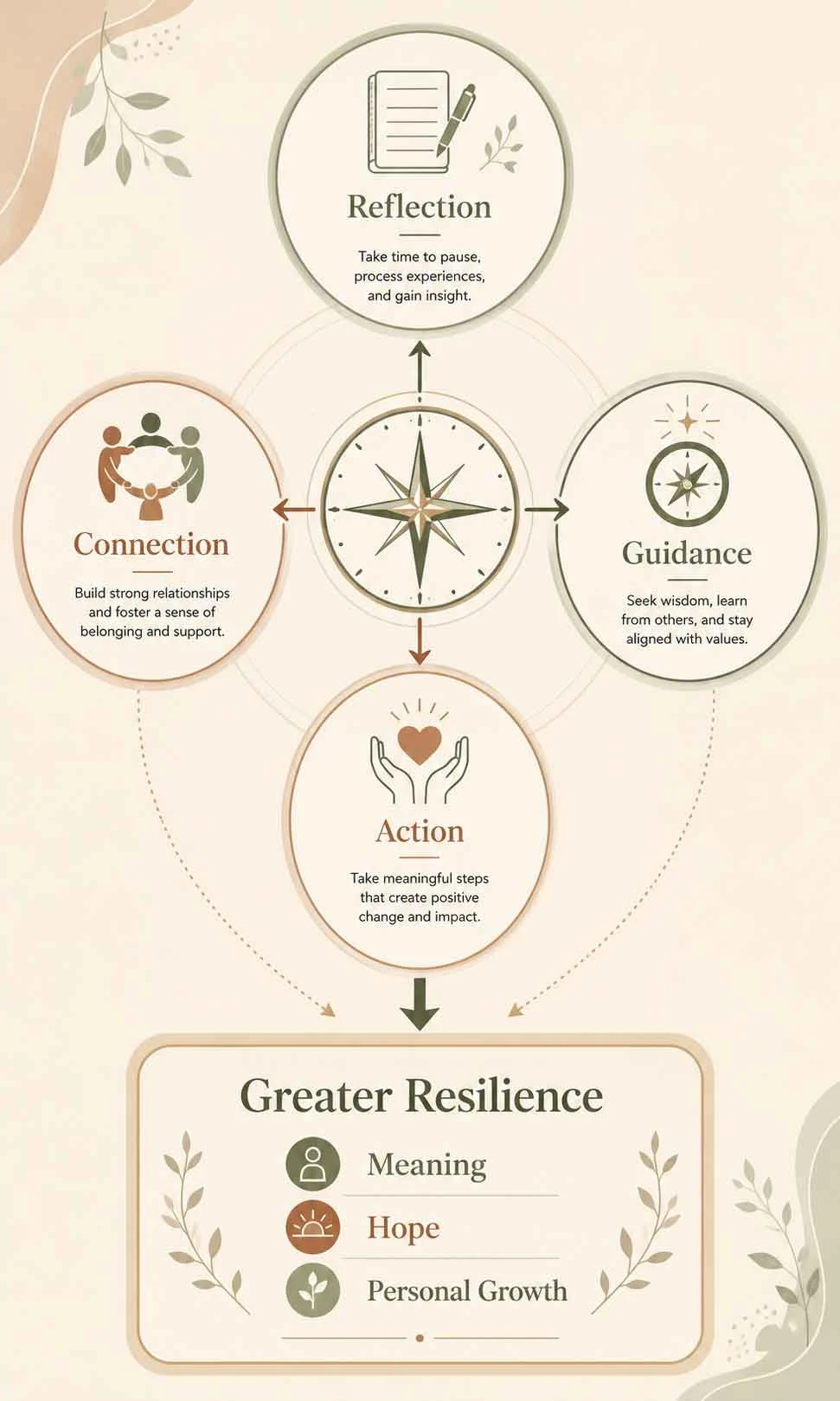
One observation appears repeatedly among people who successfully navigate difficult seasons of life. They rarely rely on a single spiritual practice. Instead, they gradually strengthen several different sources of support that work together over time.
We refer to this approach as the Spiritual Support Compass—a simple framework that illustrates how different forms of spiritual support can work together to promote resilience, meaning, and personal growth.
| Element | Purpose |
|---|---|
| Connection | Building supportive relationships with trusted people, communities, or faith groups. |
| Reflection | Creating space for journaling, meditation, prayer, or quiet self-examination. |
| Guidance | Learning from trusted teachers, spiritual leaders, counsellors, or meaningful literature. |
| Action | Living according to personal values through kindness, service, gratitude, and daily habits. |
Rather than searching for a single life-changing moment, this framework encourages gradual progress across all four areas, helping spirituality become an ongoing source of resilience instead of a temporary response to crisis.
10 Meaningful Ways to Find Spiritual Help
1. Spend Time in Honest Self-Reflection

Many people begin searching for spiritual help by looking outward for answers, yet meaningful change often starts by looking inward. Self-reflection creates an opportunity to slow down, recognise emotions without judgement, and understand what truly matters during difficult periods.
Reflection does not require complicated techniques. Some people find clarity through quiet contemplation, while others prefer writing in a journal, taking a peaceful walk, or simply sitting without distractions for a few minutes each day. The goal is not to solve every problem immediately but to become more aware of your thoughts, values, and emotional responses.
Questions such as “What am I struggling with?”, “What gives my life meaning?”, or “What kind of person do I want to become?” often encourage deeper insights than searching for immediate solutions.
2. Develop a Regular Prayer or Meditation Practice

Prayer and meditation are among the most widely recognised spiritual practices across many cultures and belief systems. Although their methods differ, both encourage individuals to pause, focus their attention, and create space for reflection.
For people with religious beliefs, prayer may strengthen their relationship with God or provide comfort during uncertainty. Others may find similar benefits through mindfulness meditation, breathing exercises, or silent contemplation. These practices cannot remove life’s challenges, but they often help people respond with greater calm, patience, and perspective.
Consistency is usually more beneficial than duration. Even ten minutes of intentional practice each day can become a meaningful part of a healthy spiritual routine. Readers seeking a faith-based approach may also appreciate learning practical ways to grow spiritually closer to God through consistent daily habits and personal reflection.
3. Seek Guidance from Trusted Spiritual Mentors

No one needs to navigate life’s deepest questions alone. Throughout history, people have turned to trusted mentors, faith leaders, experienced teachers, or wise community members for guidance during periods of uncertainty.
A trustworthy mentor does not provide all the answers. Instead, they listen carefully, ask thoughtful questions, and encourage personal growth without creating unhealthy dependence. Their role is to support your journey rather than direct every decision.
Choosing someone whose values align with your own and who demonstrates compassion, integrity, and respect can make these conversations significantly more meaningful.
4. Find Strength Through a Supportive Community

Spiritual growth is often strengthened through meaningful relationships rather than complete isolation. Many people discover encouragement by participating in local faith communities, meditation groups, volunteer organisations, or discussion circles where shared values create a sense of belonging.
Community provides more than emotional support. Listening to others’ experiences often reminds us that challenges such as grief, uncertainty, or self-doubt are common parts of being human. These shared experiences can reduce feelings of loneliness while offering practical encouragement and hope.
Healthy communities should always respect individual beliefs, encourage open discussion, and avoid fear-based or manipulative approaches.
5. Reconnect with Nature

Nature has long been associated with spiritual reflection across many cultures. A quiet forest, the rhythm of ocean waves, or the stillness of an early morning sunrise often encourages people to slow down and notice the present moment.
Spending time outdoors may not answer life’s biggest questions directly, but it frequently creates the mental space needed to process emotions and gain perspective. Many people find that regular walks in natural environments help reduce mental clutter and increase their appreciation for life’s simple experiences.
Rather than viewing nature as an escape, it can become a place for gratitude, reflection, and renewed purpose.
6. Practise Gratitude Even During Difficult Seasons

Gratitude is often misunderstood as ignoring hardship or pretending that everything is fine. In reality, gratitude acknowledges that challenges exist while recognising that moments of hope, kindness, and meaning can still be found alongside them.
Research has consistently shown that practising gratitude can support emotional wellbeing by encouraging people to focus on positive experiences without denying genuine difficulties. Spiritually, gratitude also reminds us that life’s value is often found in ordinary moments rather than extraordinary achievements.
A simple way to begin is by writing down three things you appreciate at the end of each day. They do not need to be significant events. A meaningful conversation, a peaceful walk, good health, or the support of family and friends can gradually shift attention away from constant worry towards a greater appreciation of everyday life.
7. Read Books That Encourage Spiritual Growth

Books have guided people through personal and spiritual challenges for centuries. Reading allows us to learn from the experiences of others, discover different perspectives, and reflect on questions that may be difficult to answer alone.
Some readers prefer religious texts, while others explore philosophy, mindfulness, biographies, or books focused on resilience and personal growth. The most valuable books rarely provide simple answers. Instead, they encourage thoughtful reflection and help readers examine their own beliefs, values, and priorities.
Rather than reading quickly, consider spending time reflecting on a single chapter or idea before moving forward. Applying one meaningful insight is often more valuable than finishing several books without personal reflection.
8. Serve Others Through Acts of Kindness

One of the most overlooked forms of spiritual growth is serving others. Acts of kindness remind us that spirituality is not only about personal reflection but also about how we contribute to the wellbeing of those around us.
Helping a neighbour, volunteering within the community, supporting someone through a difficult period, or simply offering genuine encouragement can strengthen our sense of purpose while creating meaningful human connections. Many people discover that giving their time and compassion helps reduce feelings of isolation and renews their appreciation for life.
Service does not need to involve large commitments. Small, consistent acts of kindness often have a lasting impact on both the person giving and the person receiving support.
9. Learn to Let Go Through Forgiveness
Forgiveness is one of the most challenging spiritual practices because it requires confronting painful experiences rather than avoiding them. It is important to recognise that forgiveness does not excuse harmful behaviour or require immediate reconciliation. Instead, it allows individuals to release the emotional burden that unresolved resentment can place on their own wellbeing.
Holding on to anger or bitterness may feel justified after being hurt, yet over time these emotions can continue affecting relationships, emotional health, and personal peace. Forgiveness is often a gradual process that develops through reflection, compassion, and, in some situations, professional support.
Learning to forgive yourself can be equally important. Many people carry guilt over past mistakes long after those experiences have passed. Recognising that growth often begins with self-compassion allows individuals to move forward while accepting that perfection is neither realistic nor necessary.
10. Make Spiritual Reflection Part of Everyday Life
Spiritual wellbeing is rarely built through occasional moments of inspiration. Instead, it develops through small daily habits that gradually shape how we respond to life’s successes, disappointments, and uncertainties.
This may include beginning each morning with a few moments of quiet reflection, ending the day with gratitude, taking regular breaks from digital distractions, spending time in nature, or setting aside time each week for personal reflection. These simple practices create opportunities to reconnect with personal values even when life becomes busy.
Many people assume spirituality requires dramatic life changes. In reality, lasting spiritual growth usually develops through consistent habits that become part of everyday living rather than extraordinary experiences that happen only occasionally.
Common Misunderstandings About Spiritual Help
Many misconceptions prevent people from exploring spiritual practices that could positively influence their wellbeing. Understanding these misunderstandings allows individuals to make more informed decisions while maintaining realistic expectations.
| Common Misunderstanding | A More Balanced Perspective |
|---|---|
| Spirituality is only for religious people. | Many people explore spirituality through reflection, purpose, gratitude, mindfulness, or connection with nature, regardless of religious beliefs. |
| Spiritual help replaces healthcare. | Spiritual practices may complement professional healthcare but should never replace appropriate medical or mental health treatment. |
| There is one correct spiritual path. | Healthy spirituality is deeply personal and often reflects individual beliefs, values, culture, and life experiences. |
| Spiritual growth happens quickly. | Like emotional resilience or personal growth, spiritual development is usually gradual and shaped by consistent daily practice. |
When Spiritual Help Should Be Combined With Professional Support
Spiritual practices can provide comfort, meaning, and emotional resilience, but they are not intended to replace evidence-based healthcare. If feelings of sadness, anxiety, hopelessness, or emotional distress become persistent, interfere with daily life, or are accompanied by thoughts of self-harm, seeking support from a qualified healthcare professional is essential.
Many people find that spiritual wellbeing and professional healthcare work best together rather than in opposition. Some individuals also explore how spiritual healing for depression may complement evidence-based mental healthcare while recognising that spiritual practices should never replace professional treatment. Counsellors, psychologists, psychiatrists, family physicians, and spiritual leaders often play complementary roles in supporting different aspects of a person’s wellbeing. Seeking professional help is not a sign of weak faith or personal failure. It is a responsible step towards caring for both your emotional and physical health.
Key Takeaways
If you only remember a few ideas from this guide, let them be these:
- Spiritual help is not limited to religion. Many people experience spirituality through reflection, gratitude, compassion, meaningful relationships, nature, or acts of service.
- Lasting spiritual growth usually develops through small, consistent daily habits rather than dramatic life-changing moments.
- Healthy spirituality encourages hope, purpose, and personal growth while respecting different beliefs and life experiences.
- Seeking professional healthcare for emotional or physical concerns does not conflict with healthy spiritual practices. Many people benefit from combining both forms of support.
- Every spiritual journey is personal. The most meaningful practice is often the one you can continue consistently rather than the one that appears most impressive.
- Which Spiritual Practice Might Be Right for You?
- Choosing where to begin can feel overwhelming, particularly if you are exploring spirituality for the first time. The table below offers simple starting points based on common life situations.
| If You’re Experiencing… | A Good Place to Start | Why It May Help |
|---|---|---|
| Feeling overwhelmed | Quiet reflection or breathing meditation | Creates space to slow racing thoughts and regain perspective. |
| Feeling lonely | Join a supportive community | Meaningful relationships often strengthen hope and belonging. |
| Searching for purpose | Journaling and personal reflection | Encourages greater self-awareness and clarity. |
| Carrying guilt or regret | Forgiveness and self-compassion | Supports emotional healing and personal growth. |
| Constantly busy | Daily gratitude practice | Helps reconnect with the positive moments that are often overlooked. |
Common Mistakes When Seeking Spiritual Help
Spiritual growth is deeply personal, yet many people unknowingly create unnecessary obstacles during their journey. Recognising these common mistakes can help you develop healthier expectations while avoiding frustration.
- Expecting immediate answers to life’s biggest questions.
- Comparing your spiritual journey with someone else’s experiences.
- Believing there is only one “correct” spiritual practice.
- Depending entirely on one teacher or community without thinking independently.
- Ignoring physical or mental health while focusing only on spiritual wellbeing.
- Consuming large amounts of spiritual content without applying any of it in everyday life.
- Looking for dramatic experiences instead of appreciating gradual personal growth.
Meaningful spiritual development is usually measured in months and years rather than days or weeks.
A Healthy Spiritual Practice Checklist
Healthy spirituality should support your overall wellbeing rather than create unnecessary fear, guilt, or isolation.
Before continuing your spiritual journey, consider whether your current practices encourage the following:
✅ Greater compassion towards yourself and others
✅ Personal responsibility rather than dependence
✅ Hope during difficult situations
✅ Respect for different beliefs and perspectives
✅ Honest self-reflection
✅ Healthy relationships
✅ Emotional resilience
✅ Continued learning and personal growth
✅ Appropriate medical and mental healthcare when needed
If most of these statements describe your experience, your spiritual practices are likely contributing positively to your overall wellbeing.
Pause and Reflect
Before continuing with another article or beginning a new spiritual practice, spend a few quiet moments considering the questions below.
- What has challenged me most during the past few months?
- When do I feel most peaceful?
- Which relationships strengthen my sense of hope?
- What values do I want my daily decisions to reflect?
- What is one small habit I could begin this week to strengthen my spiritual wellbeing?
There is no need to answer every question immediately. Sometimes the greatest value comes from simply creating space to reflect honestly without expecting instant solutions.
Your Spiritual Journey Begins With One Small Step
Many people imagine that spiritual growth begins with a life-changing experience. In reality, it often starts much more quietly.
It may begin with a single conversation that offers hope during a difficult week. It might be the decision to spend five uninterrupted minutes in reflection before the day becomes busy, or the simple act of writing down one thing you are grateful for before going to sleep. For others, it begins by choosing kindness when frustration feels easier or by reaching out to someone they trust instead of carrying every burden alone.
Over time, these small decisions shape the way we respond to life’s uncertainties. They help us become more patient, more compassionate, and more resilient—not because our problems disappear, but because our perspective gradually changes.
You do not need to have every answer today. You do not need a perfect routine or a dramatic moment of transformation. Lasting spiritual wellbeing is usually built through consistent, thoughtful steps that reflect the person you hope to become.
Wherever you are on your journey, allow yourself the freedom to begin with one small step. That single decision may become the foundation for meaningful personal growth in the months and years ahead.
Professional Perspective
Spirituality often becomes most important when life feels uncertain rather than when everything is going well. During periods of grief, illness, relationship difficulties, or major life transitions, many people begin asking questions that cannot always be answered through practical solutions alone. Questions about meaning, hope, forgiveness, purpose, and personal values naturally become part of the healing process.
One important observation is that healthy spirituality rarely encourages people to ignore reality or suppress difficult emotions. Instead, it provides a way to acknowledge pain while continuing to search for hope, compassion, and direction. This balance allows individuals to face challenges honestly without feeling that they must have every answer immediately.
It is equally important to recognise that spirituality looks different for every individual. Some people experience it through prayer and faith communities, while others find a sense of peace through meditation, quiet reflection, nature, creative expression, or acts of service. There is no universal path that suits everyone, and meaningful spiritual growth usually develops gradually through consistent daily practice rather than dramatic moments of transformation.
When emotional struggles become overwhelming or begin affecting daily life, seeking support from qualified healthcare professionals should never be viewed as a contradiction to spiritual wellbeing. Many people find that combining professional healthcare with healthy spiritual practices creates a more balanced and sustainable approach to overall wellbeing.
Final Thoughts
Searching for spiritual help is not necessarily a sign that something is wrong. More often, it reflects a natural desire to understand life’s challenges, strengthen personal values, and reconnect with what brings lasting meaning. Every person’s journey is different, and there is no single practice that provides all the answers.
Whether you begin with quiet reflection, prayer, meditation, supportive relationships, time in nature, or simple acts of kindness, the most meaningful progress usually comes through small, consistent steps rather than dramatic changes. Spiritual wellbeing is less about reaching a destination and more about developing habits that help you navigate both joyful and difficult seasons with greater resilience, compassion, and perspective.
If emotional distress becomes persistent, interferes with your daily life, or leaves you feeling unable to cope, consider speaking with a qualified healthcare professional. Spiritual practices and professional care are not opposing choices. For many people, they work together to support a healthier and more balanced life.
Frequently Asked Questions
What does it mean to receive spiritual help?
Spiritual help refers to guidance, practices, relationships, or experiences that strengthen a person’s sense of meaning, hope, purpose, and inner peace. It may involve prayer, meditation, personal reflection, supportive communities, time in nature, spiritual reading, or conversations with trusted mentors.
Do I need to be religious to seek spiritual help?
No. Although many people experience spirituality through religion, others find spiritual meaning through mindfulness, nature, compassion, creativity, gratitude, personal values, or service to others. Spiritual wellbeing can be deeply personal and does not require belonging to a particular faith.
When do people commonly look for spiritual guidance?
People often seek spiritual guidance during grief, illness, relationship difficulties, career uncertainty, loneliness, retirement, major life changes, or periods when they feel disconnected from their sense of purpose. Others explore spirituality even when life is going well because they want greater meaning or personal growth.
How can I begin a spiritual practice at home?
Begin with a small and realistic practice, such as ten minutes of prayer, meditation, journaling, gratitude, or quiet reflection each day. Choose an approach that feels compatible with your beliefs and lifestyle. Consistency is generally more valuable than attempting a long or complicated routine that is difficult to maintain.
What is the Spiritual Support Compass?
The Spiritual Support Compass is a practical framework built around four interconnected areas: Connection, Reflection, Guidance, and Action. It shows how supportive relationships, personal reflection, trusted guidance, and values-based action can work together to strengthen resilience, meaning, hope, and personal growth.
How do I find a trustworthy spiritual mentor?
Look for someone who listens carefully, respects your beliefs, maintains appropriate boundaries, welcomes questions, and does not pressure you into decisions. A trustworthy mentor should support your personal growth rather than demand obedience, create fear, guarantee healing, or discourage appropriate medical and mental health care.
Can spiritual practices help with depression or anxiety?
Spiritual practices may provide comfort, connection, hope, and a sense of meaning for some people, but they are not substitutes for evidence-based mental healthcare. Persistent depression, anxiety, hopelessness, or difficulty functioning should be discussed with a qualified healthcare professional. Spiritual support and professional care can often be used together.
How can I tell whether a spiritual group is healthy or harmful?
Healthy groups respect personal choice, encourage thoughtful questions, maintain appropriate boundaries, and do not isolate members from family, friends, healthcare, or outside information. Be cautious of groups that use fear, shame, secrecy, financial pressure, guaranteed outcomes, or excessive control over personal decisions.
How long does spiritual growth take?
Spiritual growth usually develops gradually rather than through one dramatic experience. Small practices repeated over time—such as reflection, gratitude, prayer, service, or participation in a supportive community—can gradually influence how a person responds to uncertainty, relationships, setbacks, and important life decisions.
Explore What May Support You Right Now
Complete the reflection below and submit it once. This simple version does not use Continue, Previous, Save, or Clear buttons, so it works without JavaScript.