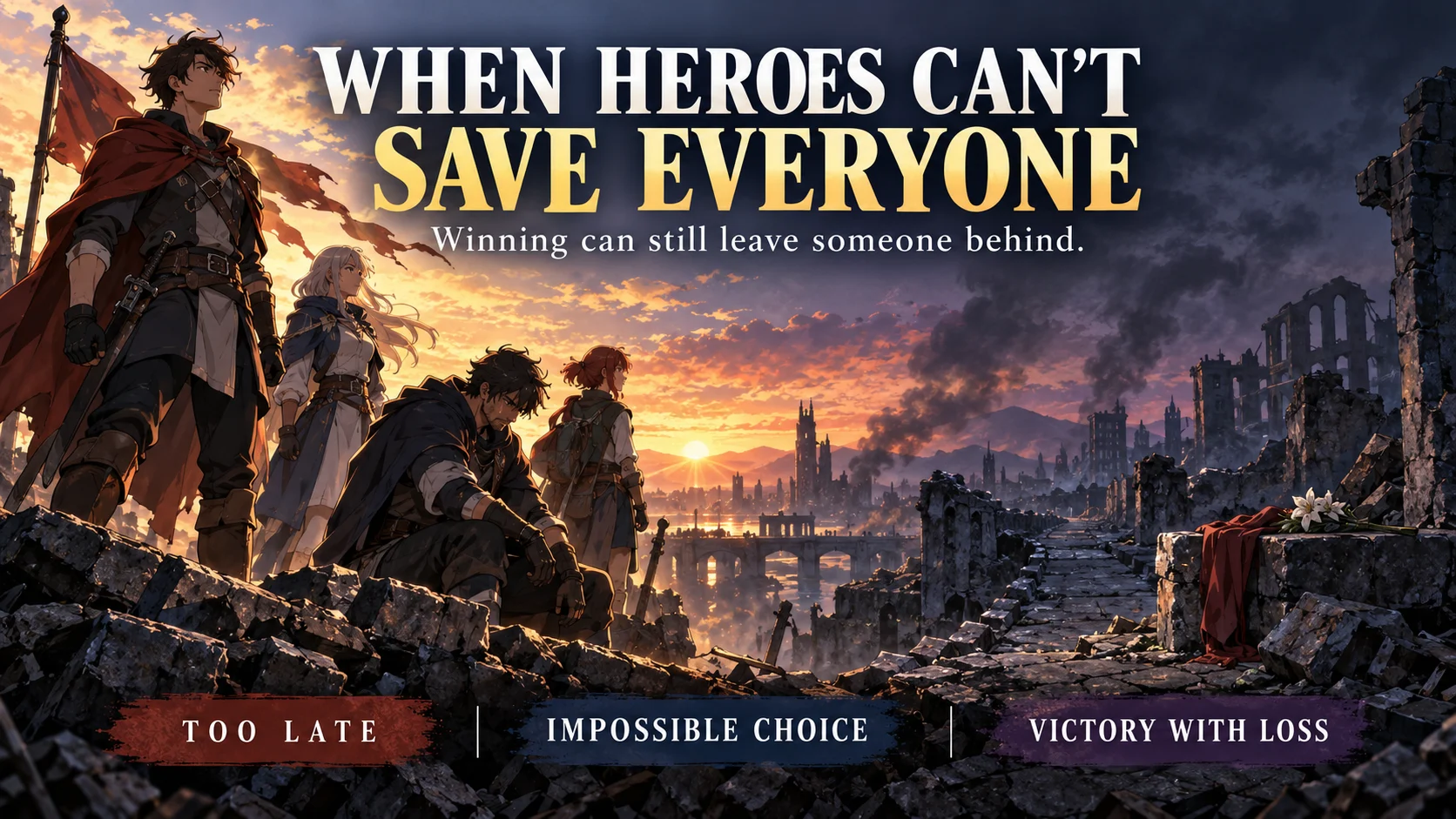

Some anime heroes win the final battle and still fail the promise that mattered most: saving everyone. The losses below are not proof that these heroes were weak; they are the moments that expose each story’s limits on power, timing, sacrifice, and choice. Major spoilers follow.
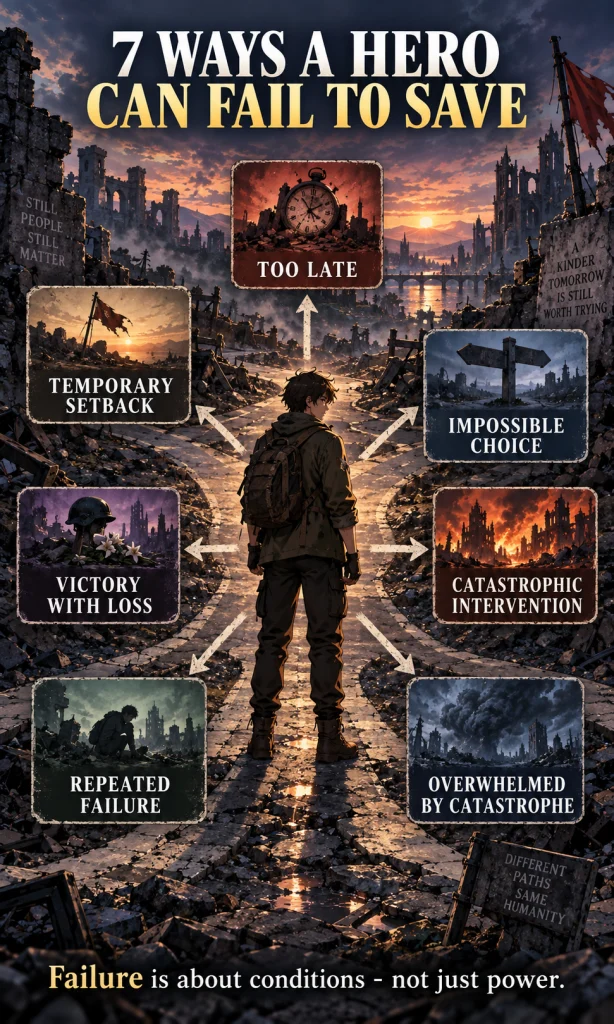
The most interesting failures are not all the same. One hero arrives too late, another creates the disaster while trying to help, another is forced into an impossible choice, and another wins on the largest possible scale while still losing one person they desperately wanted beside them.
| Hero | What they could not save | Failure pattern |
|---|---|---|
| Izuku Midoriya | Tomura Shigaraki | Victory with loss |
| Tanjiro Kamado | Kyojuro Rengoku | Too late |
| Yuji Itadori | Junpei Yoshino | Too late |
| Naruto Uzumaki | Sasuke, at first | Temporary setback |
| Edward Elric | His attempt to restore his mother | Catastrophic intervention |
| Homura Akemi | Madoka across repeated timelines | Repeated failure |
| Vash the Stampede | His no-kill ideal and his friends at the same time | Impossible choice |
| Emiya Kiritsugu | The people caught in the Fuyuki catastrophe | Victory with loss |
| Guts | The Band of the Hawk | Overwhelmed by catastrophe |
| Simon | Nia | Victory with loss |
Narrative consequence explorer
Heroic Failure Reality Check
Explore how ten anime heroes fail in different ways, then classify another story without turning character tragedy into a fake score.
Explore the case files
Filter by what actually failed: timing, a forced trade-off, a rescue attempt, repeated resets, a temporary setback, a catastrophe, or a victory that still leaves someone behind.
Izuku Midoriya
He reaches Tomura Shigaraki as a person, but winning the final conflict does not mean keeping Shigaraki alive.
Tanjiro Kamado
He survives the Mugen Train crisis with the passengers, yet he cannot prevent Kyojuro Rengoku from dying after the battle with Akaza.
Yuji Itadori
He gets through to Junpei emotionally, but Mahito destroys that rescue window almost immediately.
Naruto Uzumaki
He fails to bring Sasuke back during their first Valley of the End fight, although the wider relationship is not permanently lost.
Edward Elric
Trying to restore his mother through human transmutation produces a disaster that costs the brothers their bodies and defines their journey.
Homura Akemi
She keeps returning to the same problem - saving Madoka - and each reset reveals another limit of control.
Vash the Stampede
Legato engineers a moment where Vash cannot protect Meryl and Milly while preserving his absolute refusal to kill.
Emiya Kiritsugu
Rejecting the corrupted Grail prevents one kind of disaster, but the Fuyuki fire still leaves mass casualties and a rescue measured in one surviving child.
Guts
During the Eclipse, he cannot stop Griffith’s sacrifice of the Band of the Hawk and is forced to survive the collapse of his entire world.
Simon
He helps save humanity on a cosmic scale, but that victory cannot prevent Nia from disappearing afterward.
Classify another hero’s failure
Answer six checkpoints about the story. The result follows a decision path; there is no score, power ranking or invented probability.
What “failed to save everyone” actually means
A rescue failure should be judged by what the hero could realistically control, not just by whether someone died. That distinction separates a temporary defeat from a permanent loss, and it separates a bad decision from a situation where the story deliberately makes every available option costly.
That is why this list is not a power ranking. The stronger character is not automatically the better rescuer, because saving people also depends on information, timing, consent, distance, competing duties, and whether an enemy can force the hero to choose between incompatible outcomes.
1. Izuku Midoriya reaches Shigaraki – but cannot bring him back alive
Izuku Midoriya’s final conflict with Tomura Shigaraki is built around a harder goal than simply defeating a villain. Izuku recognizes the damaged child buried inside Shigaraki and tries to reach that part of him, which turns the fight into a rescue attempt as much as a battle.
He succeeds in making contact with Shigaraki’s humanity, but that does not produce the clean rescue Izuku wants. Shigaraki still dies by the end of the conflict, leaving Izuku with a victory that stops the larger threat without fulfilling the more personal promise to save the person inside it.
2. Tanjiro Kamado cannot save Kyojuro Rengoku after Mugen Train
Tanjiro and the Demon Slayer Corps prevent the Mugen Train disaster from becoming an even larger massacre, but the danger does not end when the train fight does. Akaza’s arrival turns the aftermath into a second crisis, and Kyojuro Rengoku is mortally wounded while protecting the people around him.
Tanjiro’s failure is mainly about timing and limits. He can witness Rengoku’s resolve, rage at Akaza, and carry the lesson forward, but none of those things give him the power to reverse a fatal wound after the decisive damage has already been done.
3. Yuji Itadori reaches Junpei emotionally – then loses him to Mahito
Junpei Yoshino is one of the clearest examples of a rescue window slamming shut just as the hero reaches it. Yuji connects with Junpei as a person and briefly creates the possibility that Junpei can step away from Mahito’s manipulation.
Mahito destroys that possibility almost immediately by transfiguring Junpei. Yuji is left facing a brutal lesson that becomes central to Jujutsu Kaisen: empathy can matter enormously and still be insufficient when an enemy controls the timing, the body, and the terms of the encounter.
4. Naruto Uzumaki fails to bring Sasuke home the first time
Naruto’s first major attempt to stop Sasuke from leaving the village ends in failure at the Valley of the End. Naruto has the emotional commitment and the fighting ability to push Sasuke to his limit, but he cannot make Sasuke abandon the path he has chosen.
This loss matters because it is not permanent. Naruto gets another chance years later, which makes the first failure a useful contrast: sometimes a hero cannot save someone because the other person is not ready to accept that rescue yet.
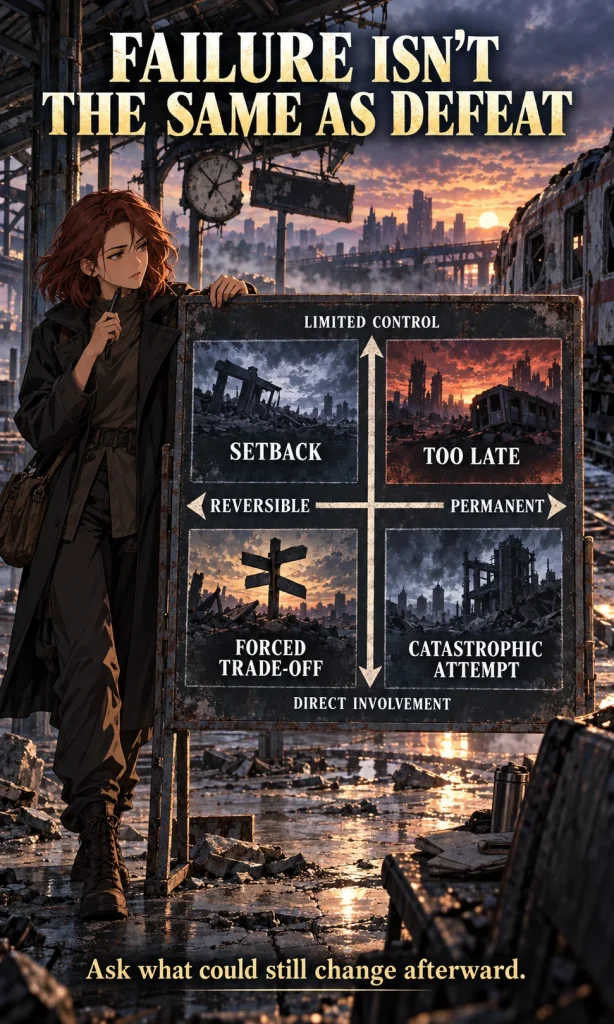
5. Edward Elric’s attempt to save his mother creates the catastrophe
Edward Elric’s defining failure happens before his larger adventure truly begins. Edward and Alphonse try to use human transmutation to bring their mother back, but the attempt fails catastrophically: Alphonse loses his body, Edward loses a leg, and Edward sacrifices an arm to bind Alphonse’s soul to armor.
This is a different kind of heroic failure because the rescue attempt itself causes the damage. Edward’s later maturity comes from accepting that love and intelligence do not exempt anyone from consequences, and that some losses cannot be repaired by forcing reality to give back what it has taken.
6. Homura Akemi keeps resetting time and still cannot secure Madoka’s safety
Homura’s story turns failure into repetition. She does not simply lose Madoka once; she keeps returning to the problem, changing tactics and accumulating knowledge, while the outcome continues to escape her.
That repetition makes her one of anime’s sharpest examples of the difference between more information and more control. Knowing what happened before can improve the next attempt, but it does not guarantee a world in which every condition can be satisfied at the same time.
7. Vash the Stampede is forced into a choice that breaks his ideal
Vash’s commitment to preserving life is not a slogan he follows only when it is convenient. That is precisely why Legato’s final trap is so effective: Vash is placed in a situation where refusing to kill Legato would allow Meryl and Milly to die.
Vash kills Legato to save them, and the result devastates him because he survives by violating the principle that defined how he wanted to survive. The failure is philosophical as well as personal – he saves people, but cannot save everyone and preserve every moral rule at the same time.
8. Emiya Kiritsugu saves Shirou, but not the city around him
Kiritsugu spends Fate/Zero chasing an ideal built around saving the greatest number of people. When he discovers that the Holy Grail cannot deliver that ideal without reproducing the same violent logic he has always used, rejecting it becomes the only defensible choice left to him.
The choice still ends in catastrophe. The Fuyuki fire leaves enormous destruction, and Kiritsugu’s desperate search through the ruins ends with him saving Shirou while being unable to undo the mass suffering around them. It is a grim inversion of his dream: one life becomes precious precisely because he cannot save them all.
9. Guts survives the Eclipse but cannot save the Band of the Hawk
Some failures are not choices at all. During the Eclipse in Berserk, Guts is trapped inside a supernatural catastrophe created by Griffith’s sacrifice of the Band of the Hawk, and individual courage is nowhere near enough to protect the group.
Guts survives, and Casca survives, but survival is not victory in any ordinary sense. The event permanently changes both of them and turns the idea of “saving everyone” into something impossible before Guts even has a meaningful chance to attempt it.
10. Simon saves humanity, then loses Nia
Simon reaches the kind of scale where many stories would reward the hero with a completely triumphant ending. He helps defeat the Anti-Spiral and protects humanity’s future, but the victory cannot preserve Nia, whose existence is tied to the power that has just been destroyed.
The crucial choice comes afterward. Simon does not use overwhelming power to force the dead back into existence, and the story treats that restraint as growth rather than weakness. He accepts that saving the future does not grant ownership over life and death.
The pattern behind these losses
These ten stories use failure for different reasons, but the strongest versions all change the hero. A rescue that goes wrong forces the character to confront a limit: strength cannot beat timing, love cannot erase another person’s agency, knowledge cannot control every timeline, and winning the war cannot guarantee a painless peace.
The useful question is therefore not “Was the hero strong enough?” but “What did the story make impossible at that moment?” That framing explains why Naruto’s first failure can later be reversed while Rengoku’s death cannot, and why Simon’s final restraint carries a different meaning from Edward’s earlier attempt to override a permanent loss.
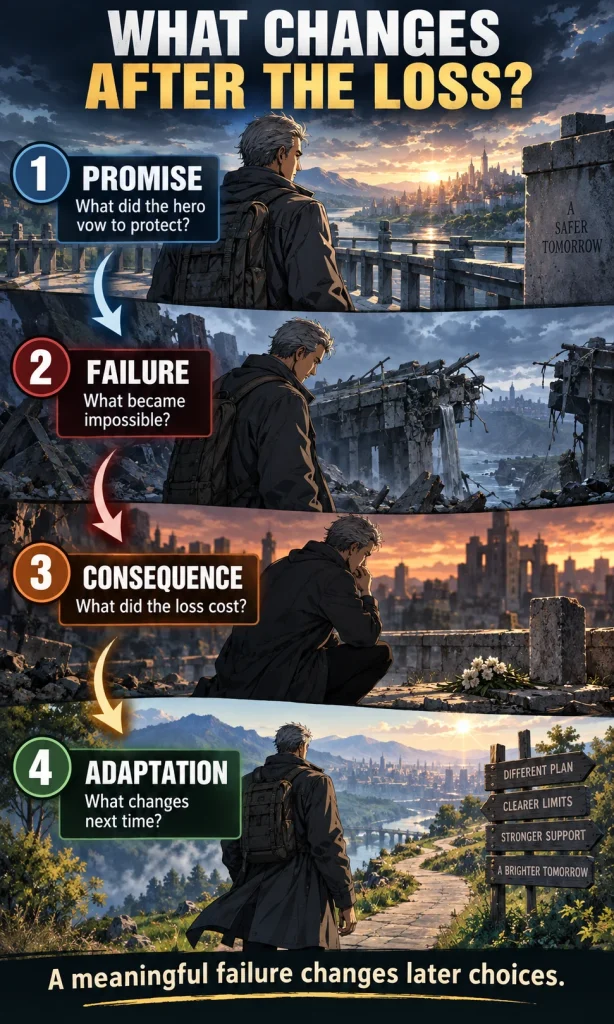
Why anime heroes do not need perfect rescue records
A hero who saves everyone every time can become dramatically flat because the story never forces a meaningful trade-off. Failure creates consequence, but more importantly it reveals what the hero does after consequence: deny it, repeat the mistake, harden, compromise, adapt, or keep the ideal while becoming more realistic about its limits.
That is the bittersweet truth behind these characters. Their losses hurt because the desire to save people remains sincere, yet the story refuses to guarantee that sincerity will always be enough.
Frequently Asked Questions
Does failing to save someone mean an anime hero failed completely?
No. A hero can stop a larger disaster while still failing one rescue, or lose one battle and later repair the relationship or objective. The important distinction is what was lost, whether the loss was reversible, and how much control the hero actually had.
Which failure on this list is temporary rather than permanent?
Naruto’s first failure to bring Sasuke home is the clearest temporary setback here. It has serious consequences, but later events give Naruto another chance to resolve the conflict.
Why is Vash’s failure different from simply losing a fight?
Vash is forced into a moral trade-off. He saves Meryl and Milly by killing Legato, so the practical rescue succeeds while his absolute no-kill ideal fails in that moment.
Why include Simon if he wins the final battle?
Because the article distinguishes winning from saving everyone. Simon helps secure humanity’s future but still cannot keep Nia alive, making his ending a clear example of victory with personal loss.
Are these ten heroes ranked from best to worst?
No. The list compares different failure patterns rather than ranking the heroes. Power, morality, timing and narrative circumstances differ too much for a single fair score.