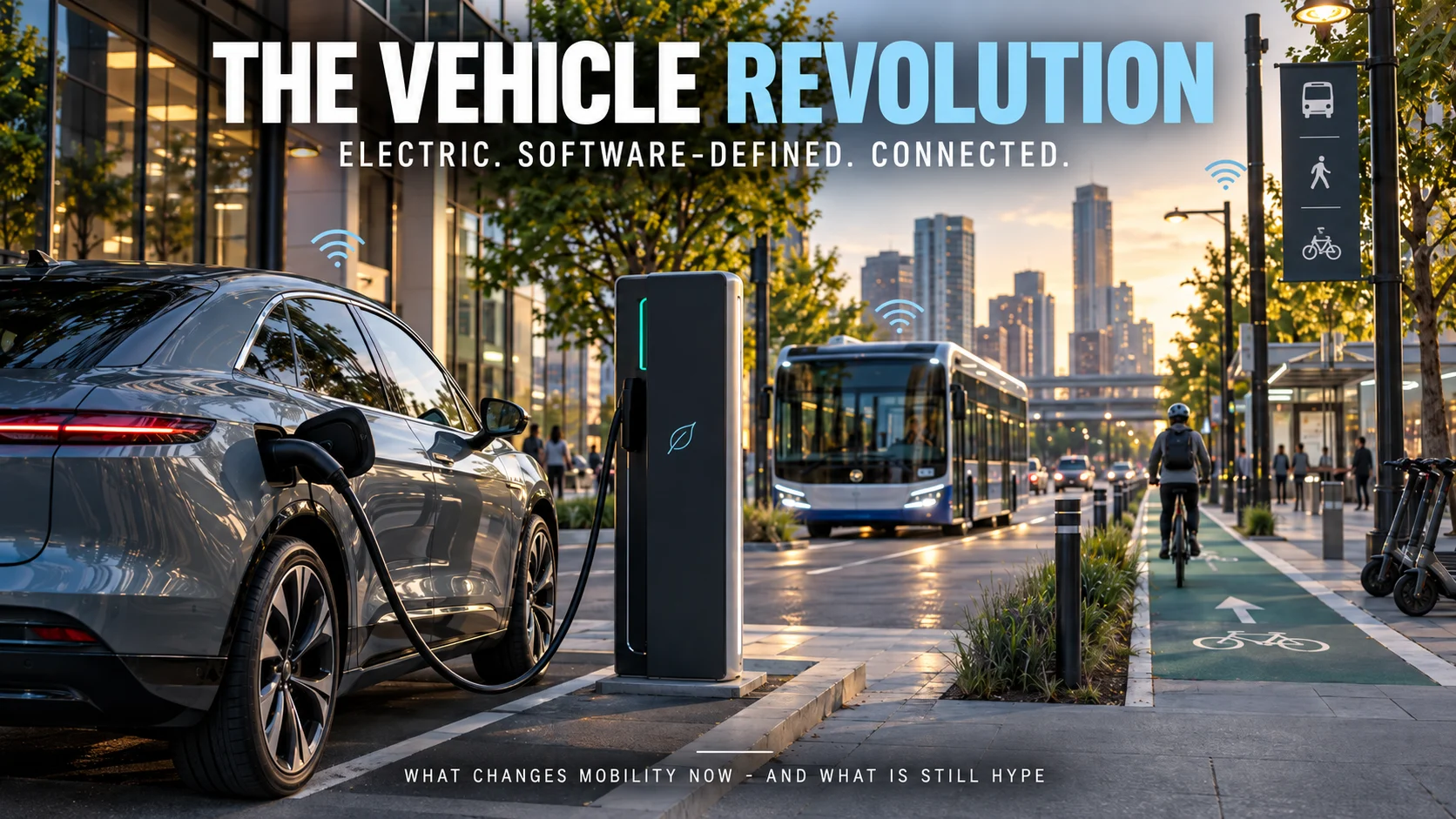

The vehicle revolution is real, but it is not one invention replacing everything at once. The biggest near-term changes come from electrification, charging access, software-defined vehicle functions, connected infrastructure, and increasingly capable driver-assistance systems – while fully driverless consumer cars remain far more limited than the marketing language around them can suggest.
For drivers, the useful question is no longer simply “electric or gasoline?” It is whether the whole mobility system around a vehicle – charging, software support, repairability, connectivity, driver responsibility, route coverage, and local infrastructure – fits the way that vehicle will actually be used.
| Mobility shift | What is already real | What it changes for drivers | Main constraint |
|---|---|---|---|
| Electrification | Battery-electric and plug-in hybrid sales are now a major share of the global new-car market. | Energy cost, charging routine, range planning and powertrain maintenance all change. | Charging access and local economics vary sharply. |
| Software-defined vehicles | More vehicle functions are controlled, updated and maintained through software. | Updates, subscriptions, cybersecurity and long-term software support become ownership issues. | Support life, repair access, data governance and update quality matter. |
| Driver assistance and automation | Level 0-2 assistance is common; higher automation exists only in narrower conditions and services. | The driver must understand exactly when supervision is still required. | Operational limits and human responsibility are often misunderstood. |
| Connected mobility | Vehicles increasingly exchange data with apps, cloud services and some road infrastructure. | Navigation, safety alerts, fleet management and maintenance can become more dynamic. | Coverage, interoperability, privacy and cyber risk remain uneven. |
Electrification is the most visible part of the vehicle revolution
Electric vehicles have moved well beyond early-adopter status. The International Energy Agency reported that global electric-car sales exceeded 20 million in 2025, representing about one-quarter of new-car sales worldwide, with very different adoption rates across China, Europe, the United States and emerging markets. The same IEA electric-car market analysis also shows that the transition is not uniform: price, policy, model availability and infrastructure continue to shape adoption country by country.
That matters because “the future is electric” is too broad to help a buyer. A battery-electric vehicle can be extremely convenient for a driver who has predictable daily mileage and overnight charging, while the same vehicle can require much more planning for someone who parks on the street, drives long rural routes, tows frequently, or depends almost entirely on public charging.
If you want the broader background on the shift, the site’s guide to electric autos on the highway gives useful context, while lithium-ion batteries in present-day EVs goes deeper into the energy-storage side of the change.
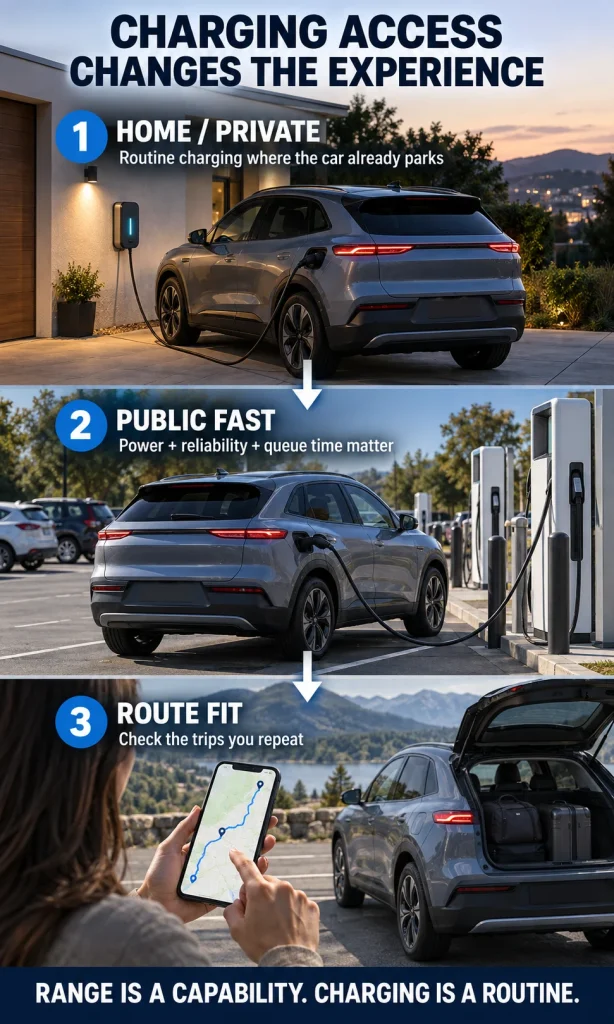
Charging access matters more than headline range
Range still matters, but a vehicle’s charging pattern often determines whether that range feels easy or restrictive. The IEA estimates that more than 43 million private light-duty charging points were in use globally in 2025 and that home charging remains the preferred option where drivers have access to it. At the same time, the global public network grew to more than 7 million charging points, with faster public charging expanding quickly according to the IEA’s latest charging analysis.
For a household with a driveway, garage or dedicated parking bay, the car can often begin most days charged without a special refueling trip. For an apartment resident without private parking, the same ownership experience depends on workplace charging, curbside infrastructure, destination charging, route reliability and local pricing. The U.S. Department of Energy makes the same distinction in its guidance on home charging and public charging.
Charging compatibility also deserves attention because a charger’s physical connector, maximum power and the vehicle’s own charging curve are separate issues. The site’s electric car connector guide is a useful next read if you are comparing charging standards rather than only advertised peak kilowatts.
The car is becoming a software product as well as a machine
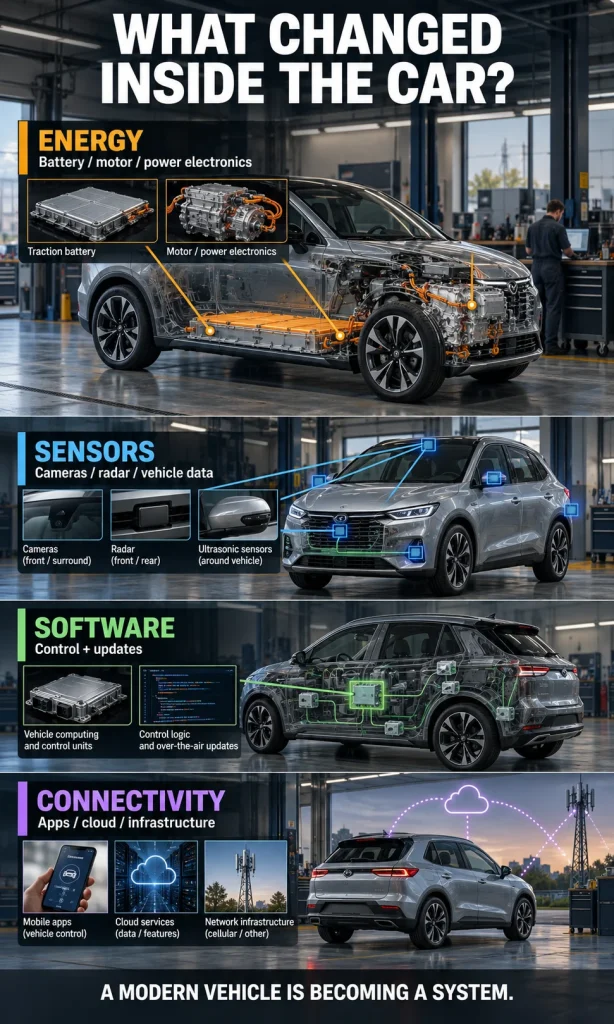
Modern vehicles increasingly separate physical hardware from software-controlled behavior. That can improve a vehicle after delivery through bug fixes, feature improvements and security patches, but it also changes what buyers need to evaluate: how long the manufacturer supports software, whether critical functions depend on subscriptions or cloud connectivity, what data leaves the vehicle, and how an update affects compatibility with repair and diagnostic systems.
This is not merely a convenience issue. UNECE vehicle regulations address both cybersecurity management and software-update management, including over-the-air updates, because connected and software-defined vehicles create lifecycle risks that did not exist in the same way for older cars. The UNECE describes UN Regulation No. 155 on cybersecurity and No. 156 on software updates as part of the international framework for safer connected vehicles.
A useful ownership question is therefore: what still works when the software service, subscription, network connection or manufacturer support period changes? A vehicle can have excellent hardware and still become frustrating if core functions are tied to software policies the owner did not understand at purchase.
Driver assistance is improving faster than driverless availability
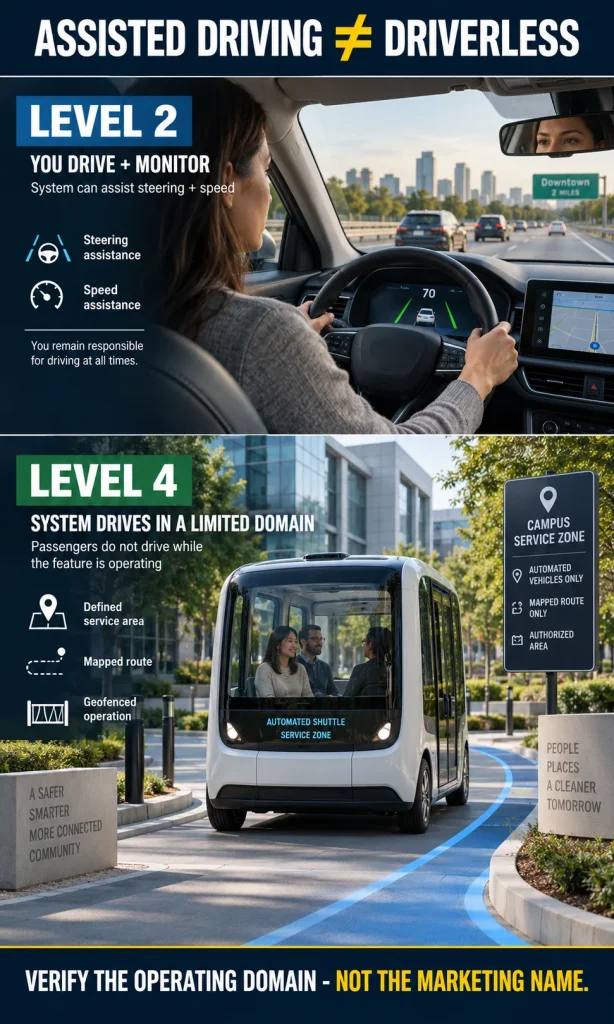
The language around automation is one of the easiest places to become confused. SAE J3016 defines six levels from Level 0 to Level 5, but the practical dividing line for most drivers is responsibility: at Levels 0-2, the human driver is still driving and must supervise the system; higher levels can shift more of the dynamic driving task to the system under defined conditions.
NHTSA’s current consumer guidance is especially clear that even the most advanced automation available to ordinary consumers still requires careful attention to the feature’s limits, and it states that Level 4 and Level 5 systems are not available as general consumer-purchase vehicles today. See the agency’s automated vehicle safety guide and the SAE J3016 taxonomy for the formal distinction.
The practical lesson is simple: never judge an assistance system by a marketing name alone. Ask who is responsible for monitoring the road, where the feature can operate, what conditions make it disengage, what the driver must do after a warning, and whether the system is assistance, conditional automation or a geographically limited driverless service.
If you want a more focused discussion of the AI layer, the site’s article on artificial intelligence in automobiles covers how perception, prediction and decision systems are being applied inside vehicles.
Connected vehicles extend the revolution beyond the car itself
A modern vehicle can exchange information with phones, cloud services, fleet systems and – in some deployments – road infrastructure. Vehicle-to-everything communication is designed around the idea that a vehicle may receive useful information that is not visible to its own onboard sensors, such as signal timing, work-zone data, hazard warnings or messages from other road users and infrastructure.
That does not mean every road is already “smart.” Deployment remains uneven and depends on compatible infrastructure, spectrum policy, standards and local investment. The U.S. Department of Transportation maintains information on connected-vehicle deployments, which shows why connected mobility should be treated as an ecosystem rather than a feature that exists equally everywhere.
Connectivity also creates another trade-off: data can improve navigation, maintenance and safety functions, but it also increases the importance of cybersecurity, privacy controls, account security, long-term server support and clear ownership of vehicle-generated data.
What should a buyer check in 2026?
The most useful way to evaluate a “future-ready” vehicle is to ignore the futuristic label and test the complete ownership system. These checks matter more than whether a dashboard looks advanced.
- Charging reality: Where will the vehicle get energy on an ordinary Tuesday, not only on a road trip?
- Real use range: Account for climate, speed, payload, towing, route elevation and the buffer you are comfortable keeping.
- Software support: Ask how updates are delivered, how long support is expected, and whether important functions depend on a paid service.
- Automation responsibility: Identify the actual SAE/NHTSA level and the driver’s monitoring duties for each feature.
- Repair and diagnostics: Check specialist availability, battery or high-voltage service access, calibration requirements and parts support.
- Connectivity and privacy: Review app permissions, data collection, account security and what happens if a connected service is discontinued.
- Total ownership fit: Compare insurance, energy, maintenance, depreciation, charging installation and any recurring software fees instead of looking only at purchase price.
Use the interactive experience below to turn those questions into a vehicle-fit checklist based on how you actually drive.
Vehicle ownership fit
Mobility Reality Check
Match the mobility shift to how you actually drive, charge and use a vehicle.
Build your practical vehicle-fit profile
Choose the conditions that describe your real use. The result does not rank vehicles or invent a score; it highlights the ownership constraints you should verify before buying.
Your practical fit
Ready to review
Powertrain direction
Charging priority
Automation reality
Software ownership check
Your next checks
Check charging near your real routes
Open live search results rather than relying on a hard-coded station list.
The report opens in a dedicated print window to avoid blank WordPress print output.
Hero photo: Shixart1985 / Wikimedia Commons, CC BY 2.0.
General decision support only. Vehicle capability, charging access, software support, incentives and automated-driving availability vary by model, market and location. Verify the exact vehicle and local conditions before purchase.
Five mistakes that make the mobility transition harder than it needs to be
Buying range instead of charging access. A very large battery can be less useful than reliable home or workplace charging if the driver’s normal trips are short. Range is a capability; charging access is a routine.
Treating every “autonomous” label as the same thing. Supervised assistance, conditional automation and a driverless service operating in a limited area place very different responsibilities on the person in the vehicle.
Ignoring software life after the warranty period. Hardware durability is only part of modern ownership. A vehicle with poor update support, discontinued cloud functions or difficult account dependencies can age badly even when the mechanical components remain sound.
Assuming public infrastructure is uniform. Charger availability, uptime, connector access, payment methods, power levels and queueing can differ by region and corridor. Check the routes you actually use rather than a national total.
Focusing only on the private car. The broader mobility revolution also includes electric buses, two- and three-wheelers, shared fleets, connected public transport, micromobility and better route coordination. In dense cities, the biggest improvement may come from moving between modes more easily rather than making every private vehicle more complex.
What is likely to change next?
The direction of travel is clearer than the exact speed. Electrification is likely to keep expanding, but the mix of battery-electric, plug-in hybrid and other powertrains will continue to differ by region. Charging networks will add more capacity and faster equipment, while access for apartment residents, fleets and long-distance routes becomes a larger planning issue as adoption broadens.
Software-defined functions will make update quality, cybersecurity and support policy more important parts of vehicle ownership. Driver-assistance systems will continue to improve, but higher automation will still need to be understood through its operating domain rather than a universal “self-driving” label. Connected infrastructure will expand where public and private systems can agree on standards, communications and safety requirements.
The vehicle revolution is therefore less like a single switch and more like several systems converging. A good mobility decision in 2026 comes from matching those systems to the driver’s real life – where the vehicle parks, where it gets energy, who remains responsible for driving, how long software support lasts, and which services still work when the novelty wears off.
Frequently Asked Questions
Is the vehicle revolution mainly about electric cars?
No. Electrification is the most visible change, but software-defined functions, connected services, advanced driver assistance, charging infrastructure and new mobility services are changing the ownership and transport system at the same time.
Are Level 2 vehicles self-driving?
No. Under the SAE/NHTSA framework, Level 2 can control steering and acceleration/braking together, but the human driver still drives, monitors the road and must intervene when needed.
Is home charging necessary for an electric vehicle?
Not always, but it can make ownership much easier and often cheaper. Drivers without private charging should check workplace, destination and public fast-charging coverage on their normal routes before choosing an EV.
Why do software updates matter in a car?
Updates can fix bugs, improve features and address security issues, but they also make long-term software support, cybersecurity, compatibility and manufacturer policy part of the ownership decision.
What is the best way to judge whether a future-ready vehicle fits me?
Start with your actual driving pattern, parking and charging access, long-trip frequency, local service support and the level of automation you expect. Then compare total ownership conditions instead of choosing by one headline specification.