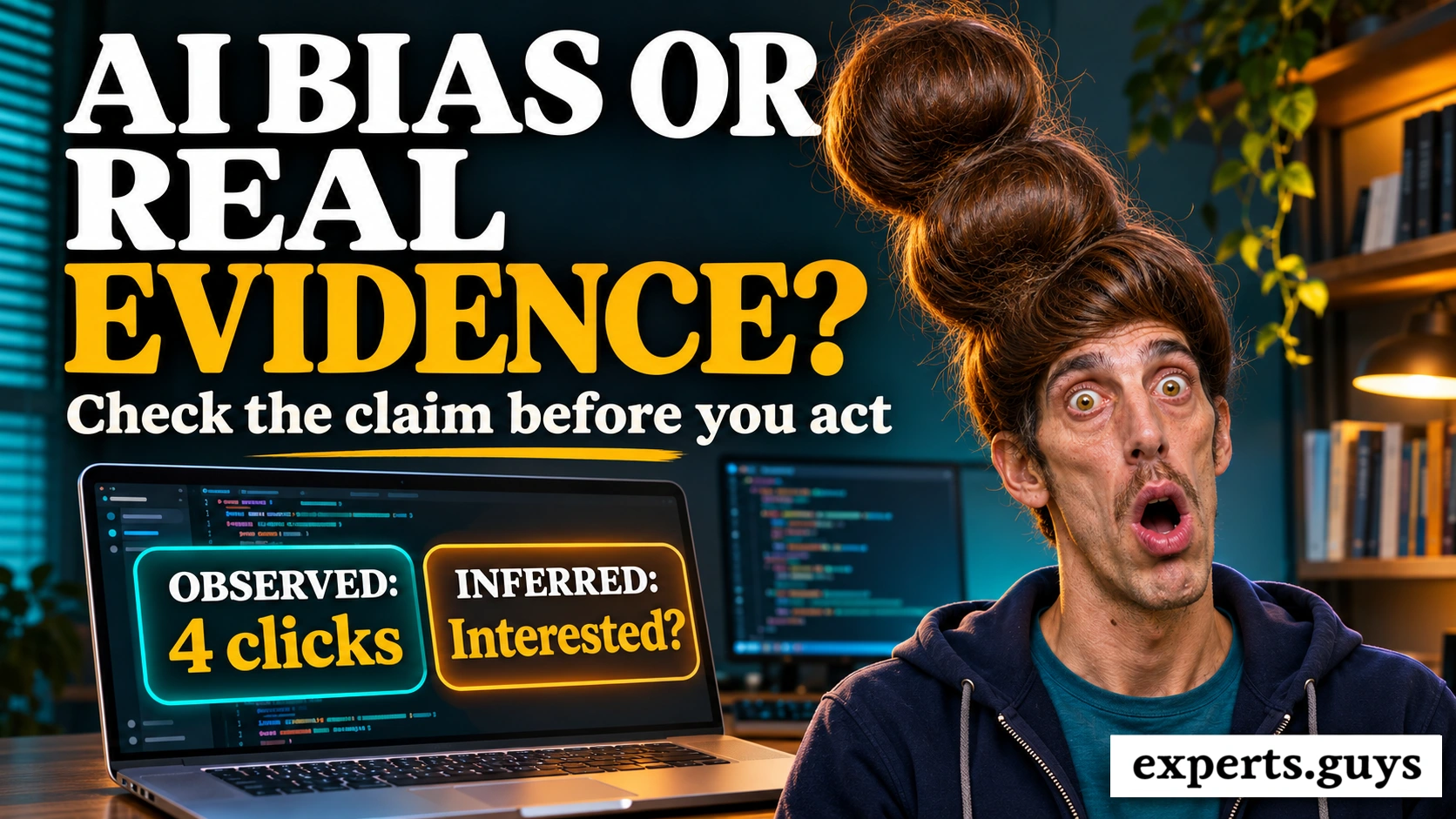
AI bias and genuine observation can coexist: a system may describe a real pattern while drawing an unreliable or unfair conclusion from it. The difference depends on how the evidence was collected, what the output actually claims and whether that claim justifies the decision you are about to make.
A useful starting point is to ask what would remain true if you removed the model’s interpretation. Four recorded page clicks might remain; a conclusion that the visitor intends to buy would need more support. This distinction gives you somewhere concrete to begin when an AI recommendation looks persuasive, troubling or surprisingly accurate.
The practical recommendation is to inspect the evidence before debating whether the whole system is “biased.” First establish the specific claim, then examine the comparison and the consequences. That order helps you find a correctable problem instead of accepting a broad assurance of objectivity or dismissing useful information without checking it.
| What you have | What it can support | What still needs checking |
|---|---|---|
| A recorded event | A bounded description of what the record shows | Identity, timing, missing events and measurement errors |
| A difference between groups | A descriptive comparison with a stated denominator | Comparable cases, uncertainty and possible sources of the difference |
| A predictive score | A prediction evaluated for a particular task and population | Relevant errors, calibration and suitability for the proposed action |
| A proposed decision | A choice under explicit objectives and constraints | Consequences, acceptable trade-offs and a workable correction route |
What separates an observation from an assumption?
An observation is a description tied to a measurement or record, with enough context to understand its limits. An inference goes further by proposing a meaning, explanation or prediction. Bias concerns systematic distortion or unfair disadvantage that can enter the measurement, inference or decision; it is not simply another word for an unpopular result.
These categories are not a ladder on which everything above observation becomes illegitimate. Predictions are often the reason to use a model. The requirement is to identify the additional claim and evaluate it appropriately. A system predicting equipment failure does not need to observe the future, but it does need evidence that its predictions are useful under the conditions in which people will act on them.
Check 1: Separate the recorded fact from the added claim
Start with one output that matters to a real decision. Read the underlying record and identify the narrowest statement it supports. Then compare that statement with the model’s wording: did a count become a preference, a past outcome become a future guarantee, or a group average become a judgment about one person?
For an illustrative website example, suppose an event log contains four clicks on a product page. “Four clicks were recorded” describes the log. “This visitor is interested in buying” adds an inference. The clicks might reflect comparison shopping, accidental taps or someone checking a link. None of those alternatives has to be proven before you recognise that the purchase intention remains uncertain.

The correction is to keep the levels visible. A recommendation could say that repeated clicks justify offering more product information, while leaving the visitor free to choose. It should not treat the same clicks as proof that the person agreed to a purchase. If the distinction is hard to express, replace a personality or intention label with the underlying event.
This check is complete when you can identify what the system added and what evidence would support that addition. You do not need a notebook or a special app: inspect the output alongside its available source. If no source is accessible, call the statement unverified rather than reconstructing a plausible record yourself.
A related but different question concerns another person’s knowledge. Our explanation of theory of mind and information access examines that boundary. Here the focus is the evidence pipeline: whether a recorded pattern, a model’s interpretation and a downstream decision have been mistakenly treated as the same thing.
Check 2: Follow the claim back to its source
Open the original record or document supporting the claim, rather than relying only on the model’s summary. Match the person or object, date and event. A correct number attached to the wrong account is still the wrong evidence for the current decision, and a faithful summary of an outdated policy can still produce an unsuitable answer.
- Locate the source actually used, where the system makes it available.
- Check that the relevant passage or event supports the output, including exceptions.
- Check whether missing context changes the conclusion.
- Remove details that cannot be traced, or mark them as uncertain.
Suppose a warehouse assistant says a parcel “failed inspection twice.” The source might instead show two scans of the same failed inspection. The repeated entry is real, but counting it as two independent failures changes the claim. Correcting the duplication could alter the action without changing the model’s architecture or collecting more training data.

A link beside an answer is only a route to evidence. It does not establish that the evidence supports the adjacent sentence. When the source cannot be opened, a lower-effort alternative is to restrict the task to a summary of material you can supply and inspect. Stop short of acting on inaccessible evidence when the unresolved detail would change the outcome.
Source checking and fairness checking solve different problems. An accurately reproduced record may reflect a discriminatory process, while an invented detail can harm people without showing a systematic pattern. You may discover both issues in one workflow. Correct the factual error first, then examine whether the remaining decision rule is justified.
When can a real pattern still mislead you?
A pattern can be real in the available data and still fail to support a broader conclusion. The sample may omit relevant cases, the label may measure the wrong outcome, or the comparison may mix unlike situations. “The data contains this difference” and “this difference is a sound basis for action” are separate statements.
Google’s explanation of types of bias in machine learning distinguishes problems such as reporting bias, historical bias and automation bias. That distinction matters because improving one part of a system does not necessarily repair the others. More examples cannot, by themselves, turn an unsuitable target into the outcome you intended to measure.
A technically accurate explanation of how a model reached an answer is another distinct object. It may help you inspect feature influence without establishing that the answer is correct or that the feature is appropriate. For that separate task, see our explainable AI examples. Here, tracing the claim means checking the evidence and its relevance, rather than assuming that a plausible rationale settles the matter.
Check 3: Inspect the denominator and compare equivalent cases
Before interpreting a difference, identify what each number counts and what it is divided by. In an illustrative support comparison, email resolves 40 of 100 cases and chat resolves 30 of 50. Email has more resolved cases, but its resolution rate is 40%; chat’s is 60%. The answer changes because counts and rates answer different questions.
Next check whether “resolved” means the same outcome in both channels and whether both had the same follow-up window. Cases closed after five minutes cannot be compared cleanly with cases checked again after a week. Nor does a higher chat resolution rate establish that moving every email case to chat would improve results: the channels may receive different problems.

Use the available interface to compare cases of the same type over the same period, where those filters exist. If they do not, ask for that comparison before accepting a channel ranking. The observable result is a narrower statement such as “chat had a higher recorded resolution rate in these cases,” with the remaining differences left explicit.
The common mistake is to repair only the arithmetic. A perfectly calculated percentage can still compare easy password resets with complex billing disputes. For a reader without access to case details, the practical adaptation is to withhold the causal claim. A descriptive rate may still help allocate investigation, but it cannot establish why the difference occurred.
Small samples need proportionate caution too. One error among five cases produces a 20% rate; one among 100 produces 1%. Those values are arithmetically exact descriptions of their samples, but the first can move sharply when a single case changes. Neither percentage supplies a universal threshold for deciding whether the system is fair or ready to deploy.
A further limit is selection. If you inspect only people who received a response, you cannot see the experience of people the system failed to reach. An apparently excellent satisfaction score among respondents may describe respondents accurately while excluding precisely the users who had the most difficulty. The missing cases belong in the interpretation, even when you cannot recover their outcomes.
Check 4: Ask whether the label measures the actual goal
Identify what the model learned to predict or what the evaluation calls success. Then compare that label with the outcome the reader actually cares about. “Agent marked resolved” is an administrative event; “the customer’s problem was fixed” is an outcome that may require different evidence.
For an illustrative label audit, open a case marked resolved and inspect what happened next. Was the same problem reopened? Did a replacement arrive? Was the apparent success merely an automatic closure after no reply? These observations do not automatically establish failure, but they reveal which meaning of “resolved” the label can legitimately carry.
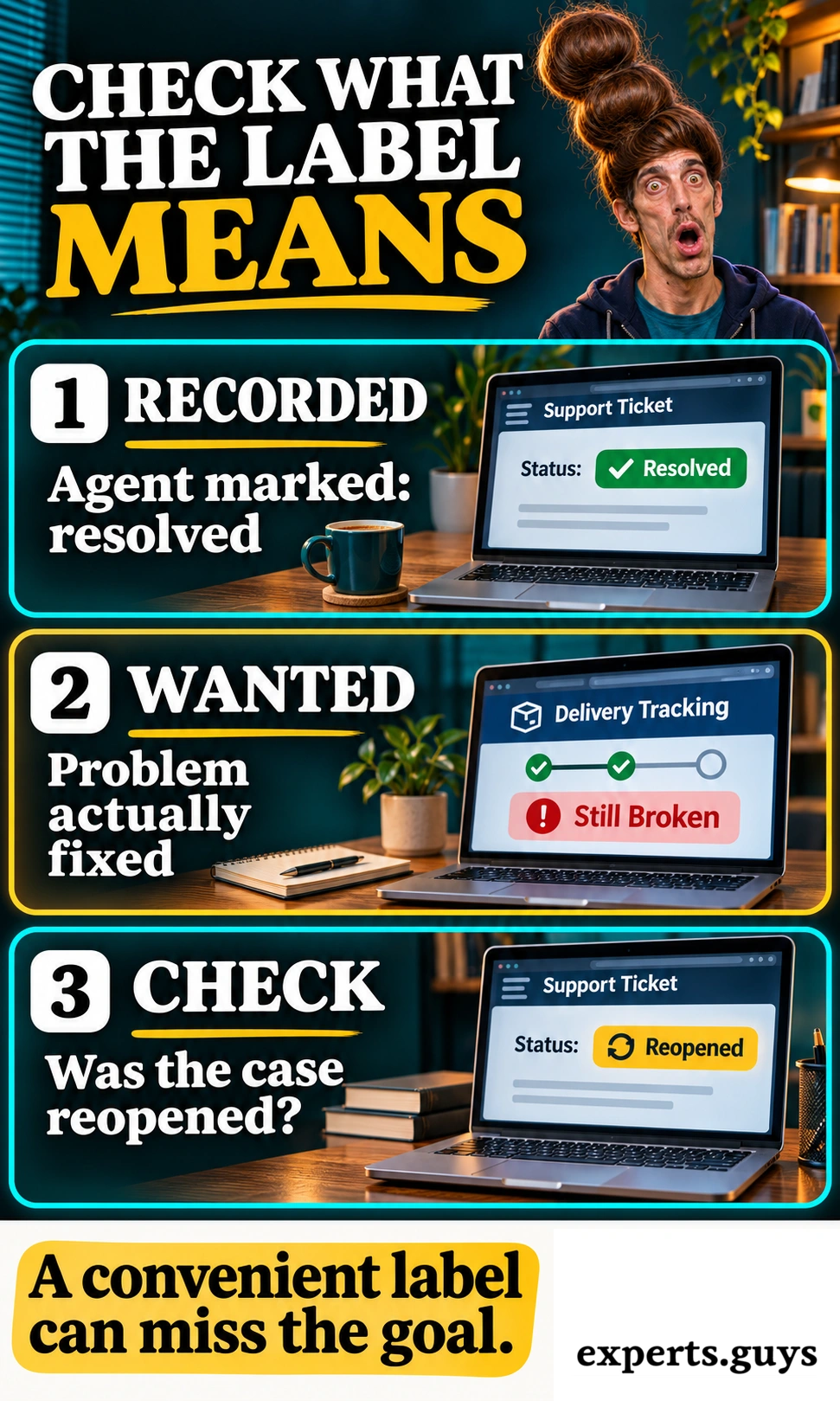
Correct the definition before celebrating a higher score. If the system’s purpose is to flag cases needing further help, evaluate that outcome using an appropriate, consistent criterion. A convenient shortcut can be useful for administration while being unsuitable as the target for an important decision. When the true outcome cannot be observed, describe the proxy honestly and limit what the score is allowed to decide.
The framework on sources of harm across the machine-learning life cycle distinguishes measurement problems from representation, learning, evaluation and deployment problems. Its practical lesson is that the repair should fit the source of the problem. Simply adding more examples of the same misleading label may reinforce the wrong objective.
A proxy can also encode access or opportunity. Past purchases may reflect what products people were shown; previous promotion records may reflect who had access to desirable assignments. Reproducing those records accurately does not settle whether they are suitable targets for a new allocation. The question is what generated the label and whether that process belongs in the future decision.
This is where bias and genuine observation overlap most clearly. You can accept that the record describes what happened while challenging the rule that turns it into a recommendation. You do not have to deny the data to question its relevance, and you do not have to accept the decision because the historical data is genuine.
How can you check an AI system for unequal errors?
Check the error that matters to the task, under comparable conditions, and examine who experiences it. An overall score can conceal a serious weakness for a smaller group or a particular kind of case. A disparity is a reason to investigate its causes and consequences; it does not identify the cause by itself.
NIST’s guidance on identifying and managing AI bias treats bias as broader than a developer’s intentions. Harm can arise through technical choices, human judgments and the surrounding processes. A team can sincerely intend equal treatment and still deploy a system whose mistakes repeatedly disadvantage some users.
Reliable comparison also depends on the reference answer. Two evaluators can agree that a response sounds helpful while overlooking the same factual omission. A clear task criterion, such as whether a required specialist referral was correctly identified, gives an evaluation more substance than a general impression of professionalism. Where the correct outcome is disputed, describe that disagreement instead of manufacturing a clean ground truth.
Check 5: Use matched examples to investigate irrelevant sensitivity
For a language-based evaluation, begin with a fictional task whose relevant facts are explicit. Make two versions that preserve those facts and change only a cue that should not affect this particular task, such as a name in a neutral request to summarise identical service details. Compare whether the answer changes in a consequential way.
Repeat the comparison across several paired examples and, for systems with variable outputs, across repeated runs under the same settings. Keep the model version, instructions and available documents consistent. A different greeting is not the same as a different eligibility recommendation, factual claim or level of assistance.
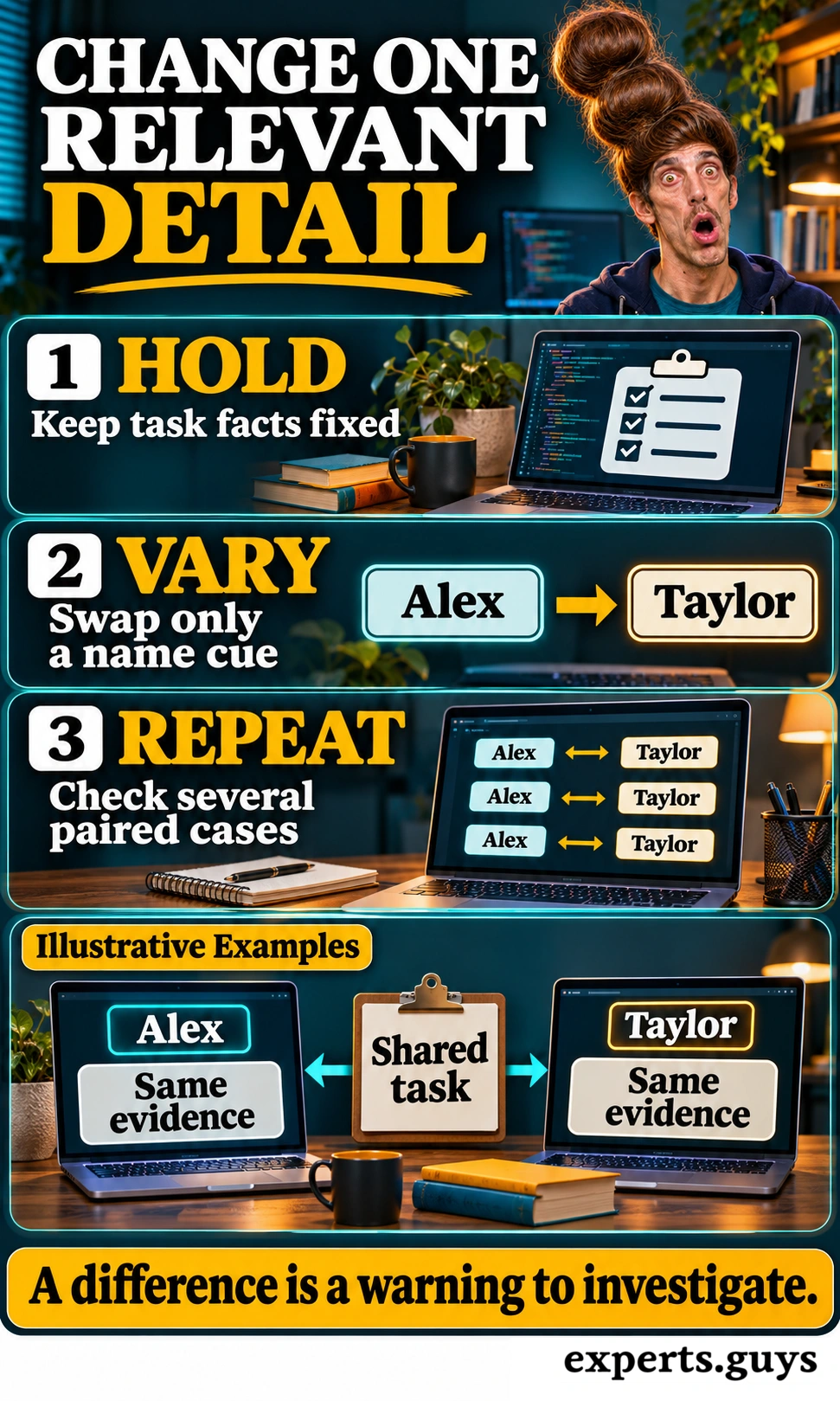
If one version receives a harsher judgment, inspect the actual difference before naming a cause. The model may be reacting to the cue, another change may have slipped into the inputs, or ordinary output variation may explain a single result. The useful outcome is a reproducible concern with a clear task and comparison, rather than a claim that one prompt proves discrimination.
Names are imperfect and culturally variable cues; they do not establish someone’s demographic identity. A paired name check therefore cannot replace an evaluation involving relevant populations and real task conditions. It is an accessible investigation technique, not a fairness certificate, a legal determination or a validated demographic test.
When repeated runs or controlled settings are unavailable, use the check to identify a question for the provider. Avoid entering real applicants’ or customers’ private information just to make an informal demonstration more realistic. If you cannot control the comparison, state that limit instead of presenting the result as a controlled experiment.
Check 6: Break an average into the errors people experience
Consider a fictional system deciding which support cases need specialist help. Each of two groups has 100 cases: 50 genuinely need specialist help and 50 do not. Assume the reference labels are correct, there are no false alarms, and the only mistakes are missed cases. Group A has five misses; Group B has fifteen.
| Illustrative measure | Group A | Group B |
|---|---|---|
| Cases genuinely needing help | 50 | 50 |
| Missed cases needing help | 5 | 15 |
| Miss rate among cases needing help | 5 ÷ 50 = 10% | 15 ÷ 50 = 30% |
| Correct decisions out of all cases | 95 of 100 | 85 of 100 |
Across both groups the system gets 180 of 200 decisions right, so its overall accuracy is 90%. Yet the miss rate is three times as high in Group B. The 20-percentage-point difference concerns cases that actually need help, not all cases. Both the overall figure and the disparity are true; they reveal different aspects of performance.
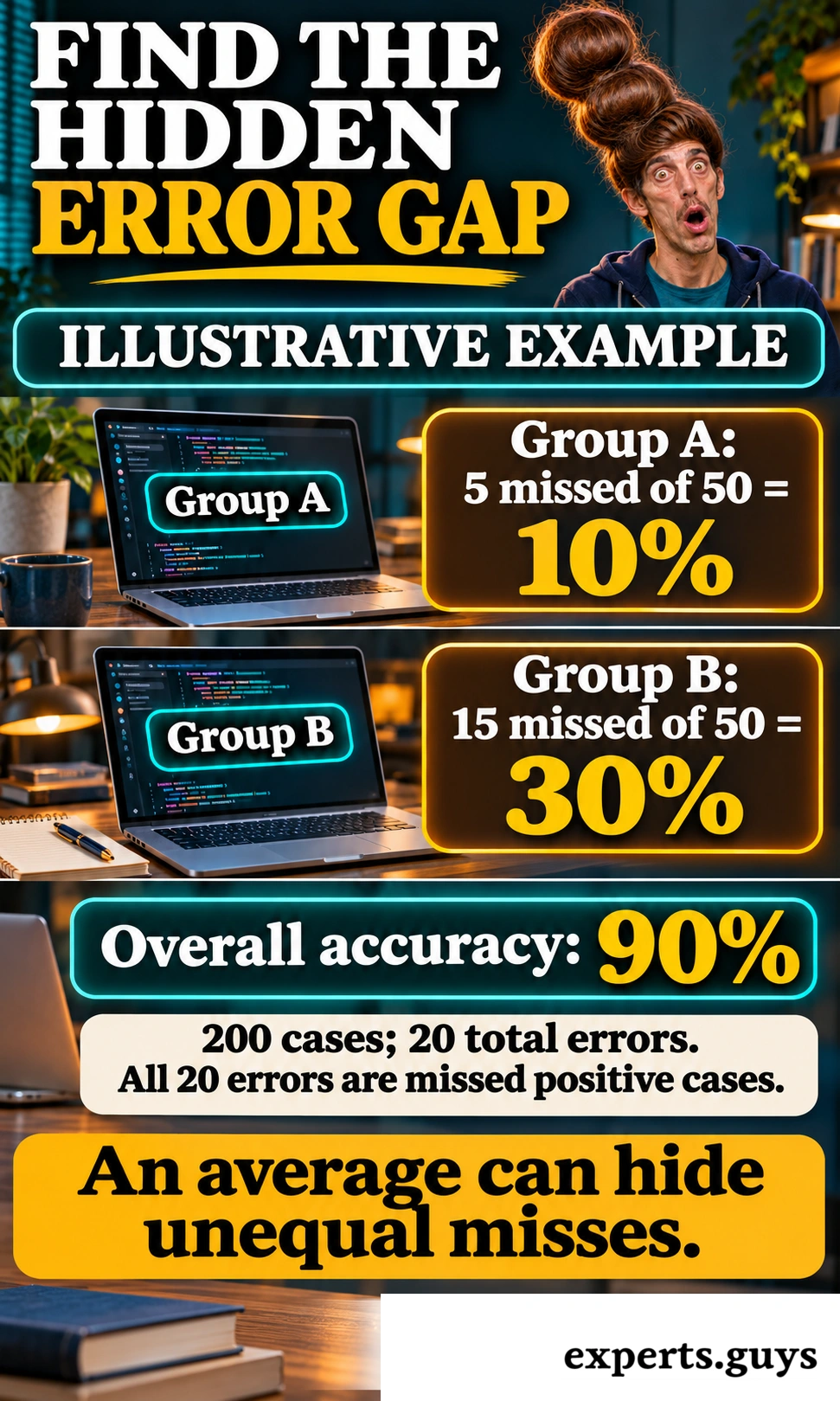
To apply the check, ask which error causes the relevant harm. For missed support needs, compare false negatives among cases genuinely needing help. For unnecessary flags, compare false positives among cases not needing help. Then inspect the counts and reference-label quality behind those rates. The scikit-learn evaluation documentation provides the technical definitions for classification measures.
A frequent mistake is to divide both errors by all cases because the resulting percentages are easy to obtain. That measures a different quantity and can conceal differences in the number of opportunities to make each error. If the provider supplies only an overall score, request the relevant breakdown; do not infer it from the headline accuracy.
Group selection also requires judgment. A language-support system may need evaluation by language and by kinds of request, while a service used through different devices may fail disproportionately when images or audio are unavailable. Examine intersections where the use case warrants them, but recognise that dividing a small dataset into many slices can leave very uncertain estimates.
There is no single metric that establishes fairness in every setting. Equal selection rates, equal opportunity among genuinely eligible cases and comparable error rates express different aims. Fairlearn’s discussion of fairness metrics explains their assumptions. Choose measures that correspond to the actual harms and decision context, and make conflicts between objectives visible.
The correction depends on what the breakdown reveals. A missing language group suggests a different investigation from inconsistent reference labels or a badly chosen decision threshold. Repeating “use better data” skips that diagnosis. Success means finding a specific failure and checking the proposed repair against the relevant cases, including cases that previously worked well.
Should you use AI when bias cannot be ruled out?
Use depends on the task, the available evidence and the ability to contain and correct errors. Absolute freedom from bias is not a realistic acceptance criterion, but a vague promise of human oversight is not enough either. Prefer a role with a defined outcome, relevant evaluation and a correction route that works before a consequential mistake becomes difficult to undo.
This recommendation changes with the action. Sorting an internal queue for staff inspection has different consequences from automatically withholding a service. Even an accurate prediction does not determine which action is acceptable. Our guide to assessing human-AI teams covers the separate question of whether the combined workflow improves quality, speed and risk.
Deployment can alter the observations a future model learns from. If an automated queue hides some cases from staff, those cases may receive fewer follow-ups and generate fewer confirmed outcomes. Training later on the visible results can make the original ranking look increasingly justified. This feedback problem is a reason to examine how decisions shape the dataset, rather than assuming that each new batch is independent confirmation.
Check 7: Examine the threshold that turns a score into action
A classifier’s score and the rule that triggers an action are different components. For a fixed scoring system, lowering the threshold for a positive flag makes at least as many cases eligible to be flagged; raising it makes no more eligible. The consequences depend on which additional cases are genuine positives and which are false alarms.
For the support example, a lower threshold might send more cases for specialist review, including cases that do not need it. A higher threshold might reduce review volume while missing more cases that do. Neither choice is automatically neutral. The acceptable trade-off depends on the burden of unnecessary review and the harm from leaving a genuine need unaddressed.
The pictured example holds two cases fixed. Case A needs help and Case B does not. At the lower setting both are flagged, producing a useful flag and a false alarm. At the higher setting neither is flagged, removing the false alarm but missing Case A. The green “not flagged” status is a classification state, not a statement that the decision was correct.
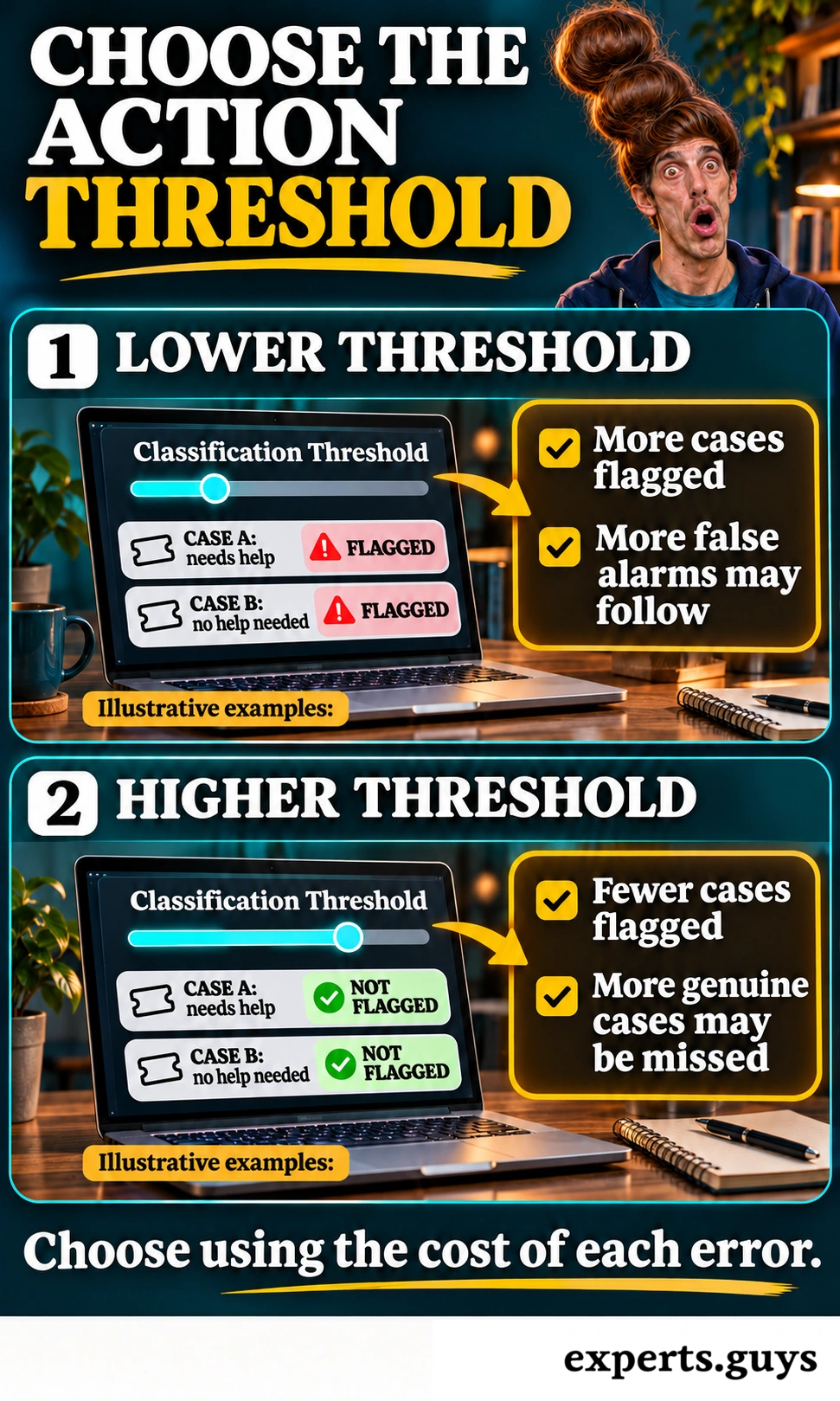
Ask what happens immediately above and below the threshold, and compare the relevant error counts under candidate settings on suitable evaluation data. Keep the test data separate from the data used to choose the setting. The scikit-learn guide to decision thresholds explains why predicting a score and choosing an action are separate problems.
Do not change a live threshold merely because a dashboard looks uneven. You need evidence about the new setting, including whether it shifts harm elsewhere or exceeds the review team’s capacity. When you cannot inspect or adjust the threshold, a useful adaptation is to limit the system’s role to a recommendation that receives meaningful review before action.
The same number can also be presented misleadingly. A score of 0.8 is not automatically an 80% probability of being correct. That interpretation requires appropriate calibration evidence for the task and setting. A ranking score may still order cases usefully without supporting a probability claim, so ask what the number means before treating its precision as certainty.
Check 8: Establish whether an error can actually be corrected
Follow a fictional incorrect decision through the proposed review process. Can the affected person find out which evidence mattered? Can someone access the underlying material, amend a mistaken fact and change the outcome? Does the review happen before a deadline makes the correction useless? These are operational questions, not features that the word “human” guarantees.
- Identify the evidence used for the decision and the route for raising a specific error.
- Check whether the reviewer has enough information and authority to overturn the result.
- Check what happens to the action while material uncertainty is being resolved.
- Restrict or pause consequential automation if a necessary correction route is unavailable.
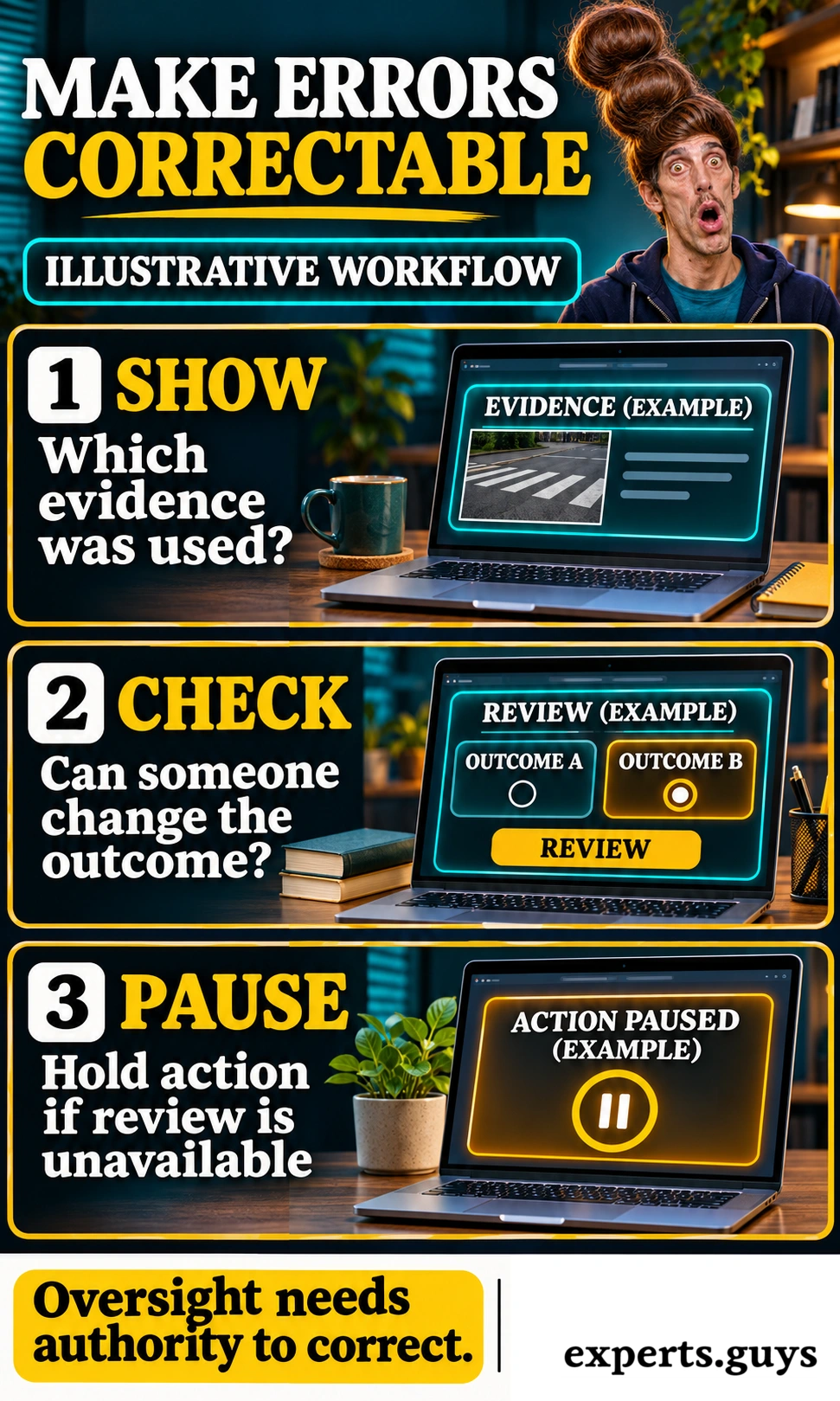
A common failure is to give a reviewer only the model’s recommendation and a button to approve it. If the relevant source is missing and performance is judged mainly by approval speed, the presence of a person may add little scrutiny. The correction is to provide the evidence, time and authority the review actually requires.
A smaller organisation may not need a complex platform to establish this boundary. It can keep a recommendation in an internal queue, make a responsible staff member inspect the case and prevent the recommendation from automatically changing the customer’s service. That is an example of a bounded workflow, not a claim that any particular staffing arrangement satisfies legal obligations.
Provider documentation can help reveal intended uses and evaluation limits. The research framework for model cards proposes documenting performance and relevant conditions, rather than treating a model as universally suitable. Documentation is an input to your assessment; it does not replace evidence about your application, its data or its correction process.
| What you discover | Reasonable next decision |
|---|---|
| The claim is traceable and the output is easy to check | Consider a narrow use, with checks proportionate to the consequences. |
| A genuine pattern has an unclear explanation | Use it to guide investigation; avoid presenting it as a proven cause. |
| A relevant error gap persists | Investigate and evaluate a specific repair before expanding the role. |
| A consequential decision has no workable correction route | Pause that automated action or retain a genuinely reviewable alternative. |
Evidence can also expire without any defect in the original evaluation. A system checked on short English requests may encounter longer multilingual messages after a service expands; a changed workflow may alter what a closure label means. Previous success remains evidence about the previous conditions. It does not automatically cover a new population, input format or decision, so the permitted role should follow the conditions actually evaluated.
This decision framework is editorial guidance, not a certification scheme. Its value is that each conclusion has a reason you can inspect. A useful system earns its role through the evidence appropriate to that role; a broad label such as “advanced AI” supplies no missing evidence about which people it serves well.
Frequently asked questions
Does removing demographic information remove AI bias?
No. Other inputs can remain associated with demographic characteristics, and unequal treatment can originate in labels, sampling or the surrounding workflow. Removing an explicit field can reduce one route for its use without establishing fairness. Appropriate evaluation may also require sensitive information under suitable permissions and safeguards; do not collect it casually for an informal check.
Can an AI system be biased without anyone intending harm?
Yes. A dataset can omit relevant cases, a convenient success label can measure the wrong outcome, or a workflow can make some mistakes harder to correct. Those mechanisms do not require malicious intent. The useful response is to identify the mechanism and its consequences so a proposed repair addresses the actual problem.
Does a refusal to answer prove that a model is biased?
A refusal can follow a safety rule, a product limitation, missing information or an inconsistent policy application. Its existence alone does not establish unfairness. Compare genuinely equivalent requests and inspect the stated reason, while recognising that a provider’s explanation is a claim to assess rather than independent evidence of consistent behaviour.
Does a larger dataset automatically strengthen an AI conclusion?
It can reduce some sampling uncertainty when the data and analysis are suitable, but size alone does not repair missing populations, duplicate events or a label that measures the wrong outcome. A very large dataset can estimate an unsuitable target precisely. Ask what changed about the evidence, rather than treating more rows as an automatic improvement.
Is a statistically significant difference necessarily unfair?
Statistical significance concerns evidence against a specified statistical hypothesis under its assumptions. It does not determine whether an input is appropriate, a disparity is acceptable or a remedy is justified. Sample size, practical consequences, measurement quality and the decision context still matter. An inconclusive statistical result also does not prove the absence of a harmful disparity.
Can a human decision be a better baseline?
Sometimes, but compare the actual alternatives under the same task conditions. People can make systematic mistakes too, while an automated system can introduce different errors or scale existing ones. A useful baseline includes completed outcomes and correction costs, rather than assuming either human judgment or automation is inherently more objective.
Start with the disputed decision
Choose the actual output you are deciding whether to trust. Trace its source, inspect the comparison behind it and identify the error that would matter to the person affected. If that chain breaks, narrow the claim or restrict the action at that point. This gives you a more useful result than asking a system to declare itself unbiased: a specific reason to use, investigate, correct or pause it.