



Poker is not one game with one fixed deal; it is a family of card games built around different ways of distributing information, forming a five-card hand, and deciding when players act. For casual recreation, the most useful distinction is structural: Texas Hold’em and Omaha use shared community cards, Five-Card Draw lets players replace private cards, Seven-Card Stud exposes part of each hand, and mixed formats rotate several rule sets.
If your group is choosing what to play, start with the amount of rules everyone wants to learn and the kind of information they want to manage. Hold’em is usually the easiest community-card starting point, Five-Card Draw is familiar and private, Omaha creates more combinations, Stud rewards attention to exposed cards, and split-pot or lowball games add another layer of hand-reading.
| Variant | Core structure | Hand-building rule | What changes for the player |
|---|---|---|---|
| Texas Hold’em | 2 private cards + 5 shared cards | Best five from any combination of the seven available cards | Simple deal, shared board, four betting rounds |
| Omaha | 4 private cards + 5 shared cards | Exactly 2 private cards + exactly 3 board cards | More combinations and more rule mistakes if players import Hold’em habits |
| Five-Card Draw | 5 private cards, then a draw | Final private five-card hand | Less public information; discards and replacements matter |
| Seven-Card Stud | 7 cards per player, some face up | Best five of the seven | No shared board; exposed cards make observation more important |
| Razz | Stud-style deal | Lowest qualifying hand under the declared lowball rules | Hand ranking reverses from normal high poker |
| Mixed games | Several variants in rotation | Changes with each round or block | Players must switch rule sets instead of mastering one format only |
The Three Core Poker Structures
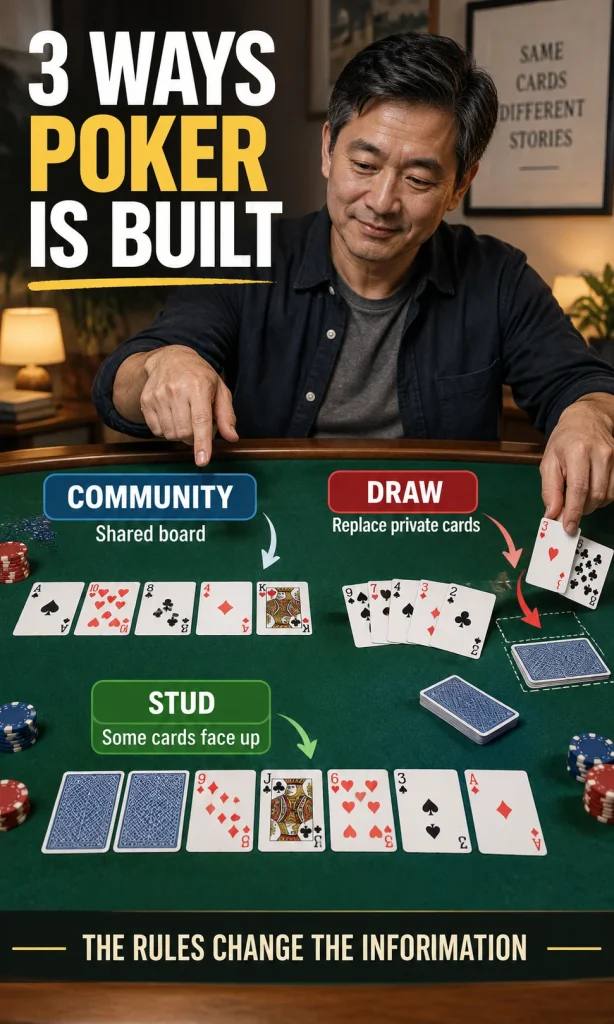
Most familiar poker variants can be understood by asking one question: where does the useful information come from? Community-card games place shared cards in the center, draw games keep hands private but allow replacements, and stud games reveal part of each player’s hand as the deal develops.
That structural difference changes more than the appearance of the table. It determines what players can see, what they must remember, when a hand can improve, and which rule mistakes are most likely when someone moves from one variant to another.
Community-card poker: Hold’em and Omaha
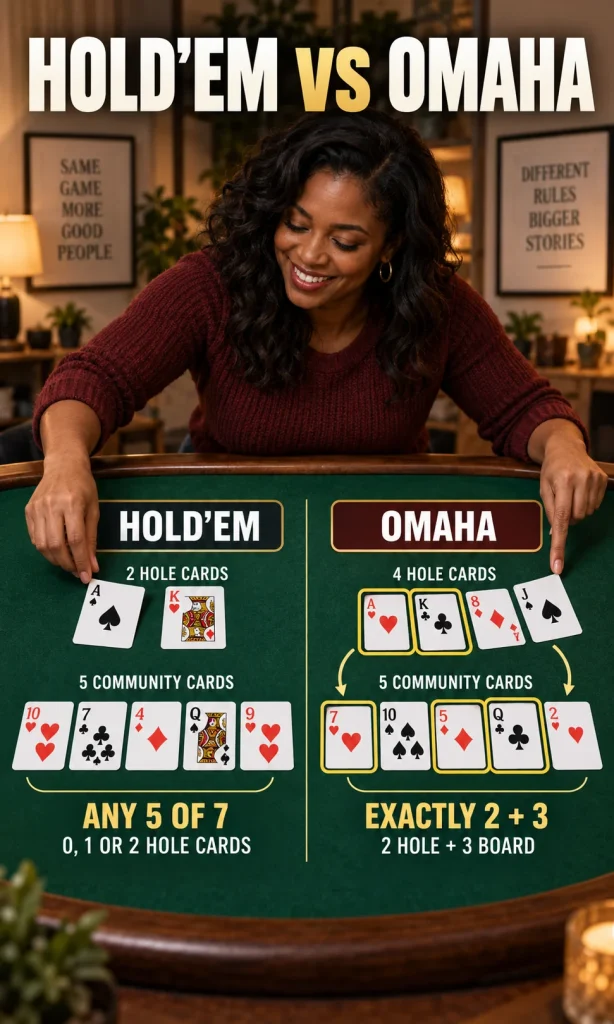
In Texas Hold’em, each player receives two private hole cards and five community cards are eventually exposed. A player may use both hole cards, one, or neither, because the final hand is simply the best five-card combination available from the seven cards.
Omaha looks similar on the table but its construction rule is stricter. According to the Omaha rules, players receive four private cards and must use exactly two of them together with exactly three board cards; treating Omaha like Hold’em is one of the fastest ways to misread a showdown.
Draw poker: change the hand instead of sharing a board
Five-Card Draw starts with a complete private hand. After the initial action, players may discard cards and receive replacements, so the visible information is not a common board but the number of cards each person chooses to exchange. The Five-Card Draw rules also show why many home-game variations grew from this structure: opening conditions, wild cards, and draw rules can be changed without turning the game into a community-card format.
Stud poker: part of every hand is visible
Seven-Card Stud removes the shared board entirely. Players receive seven cards over several streets, with some cards exposed and others concealed, then use the best five cards at showdown. The standard Seven-Card Stud sequence gives each surviving player four face-up and three face-down cards by the end of the deal.
How the Major Poker Variants Differ
The name of a variant usually tells you less than its hand-building rule. Before a casual game starts, everyone should be able to state how many private cards are dealt, whether cards are shared or exposed, how the final five-card hand is formed, and whether the game is high-only, low-only, or split between high and low.
Texas Hold’em
Hold’em uses two private cards and a five-card board dealt as flop, turn, and river. Its key rule is flexibility: the final five-card hand can use two hole cards, one hole card, or the board alone, which is why two players can sometimes tie even when their private cards differ.
Omaha and Omaha Hi-Lo
Omaha gives each player more private cards but less freedom in constructing the final hand. Exactly two private cards and exactly three board cards must be used; Omaha Hi-Lo keeps that same construction rule while allowing separate high and qualifying low hands to compete for portions of the pot.
For recreational groups, the important practical point is not the extra card count by itself. Four private cards create many possible two-card combinations, so Omaha asks players to evaluate more candidate hands while still obeying a rigid final-hand formula.
Five-Card Draw
Five-Card Draw is direct: five private cards, a chance to replace some of them, then a final comparison among the players still in the hand. It works well when a group wants familiar poker hand rankings without learning a shared-board sequence or tracking several face-up cards around the table.
Seven-Card Stud
Stud develops one card at a time and changes which player acts first as visible boards change. Because exposed cards belong to individual players rather than to everyone, the table contains useful public information without a single shared board.
Razz and other lowball forms
Razz uses a stud-style deal but changes the objective from making a high hand to making a low hand. Lowball rules are not universal, so a casual group should never announce only “low poker” and assume everyone means the same ranking system; the exact lowball convention must be stated before play begins.
Mixed formats such as H.O.R.S.E.
Mixed poker rotates through multiple variants instead of playing the same format all evening. H.O.R.S.E., for example, cycles through Hold’em, Omaha Hi-Lo, Razz, Seven-Card Stud, and Seven-Card Stud Hi-Lo, making the format better suited to groups already comfortable switching rules.
Betting Structure Is Separate From the Poker Variant
“No-limit,” “pot-limit,” and “fixed-limit” describe how betting is constrained; they do not by themselves define the card game. Hold’em is often played no-limit, Omaha is commonly associated with pot-limit, and Stud is frequently seen in fixed-limit form, but the underlying variant is still defined by the deal and hand-construction rules.
- Fixed-limit: bet and raise sizes are set for each stage.
- Pot-limit: the maximum wager is tied to the current pot under the table’s rules.
- No-limit: a player may generally wager up to the chips available to that player at the table, subject to the house rules.
For points-only recreation, those structures can be simplified without using money at all. Chips can represent score, and a group can cap the amount used in each hand so the evening stays focused on learning the variants rather than on stake size.
How to Choose a Variant for a Casual Group
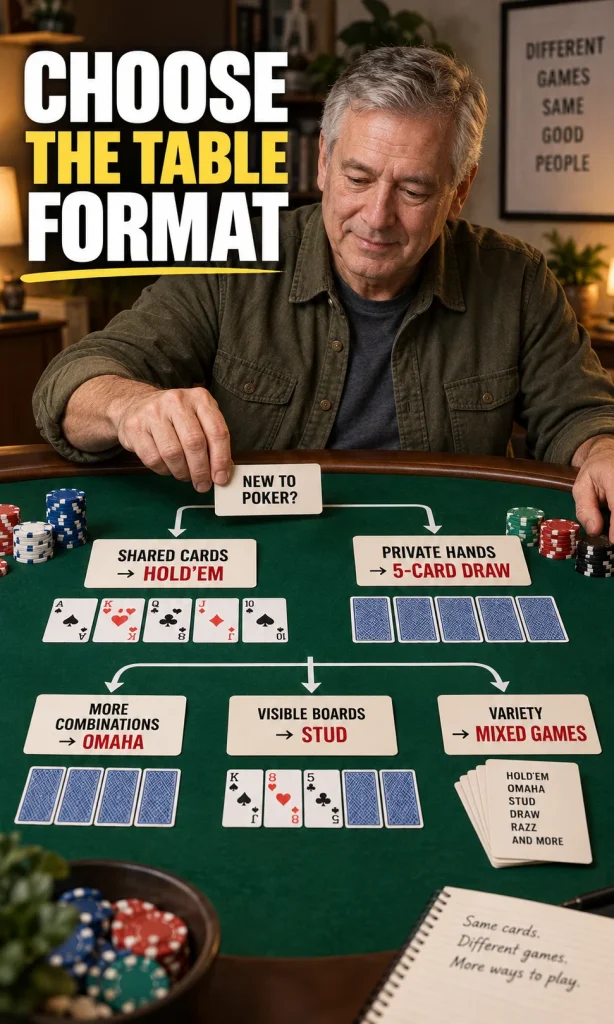
A good recreational choice matches the group rather than the reputation of the game. The number of players matters, but so do familiarity, desired pace, tolerance for rule detail, and whether the group enjoys shared information, private draws, or visible individual boards.
- New group that wants a shared board: start with Texas Hold’em.
- New group that wants private hands: Five-Card Draw is easier to explain than most stud or split-pot formats.
- Experienced Hold’em group wanting more combinations: Omaha creates a meaningful change without abandoning community cards.
- Players who enjoy observing exposed information: Seven-Card Stud makes each player’s board part of the decision.
- Players comfortable with alternate hand rankings: Razz or another clearly defined lowball game changes the objective rather than just the deal.
- Experienced group that wants variety: a mixed rotation prevents one structure from dominating the entire session.
Try the Poker Night Format Studio
If you are choosing a game for friends rather than studying every poker format, the useful decision is narrower: what kind of table experience fits this group? The interactive experience below uses group size, experience, pace, information style, complexity, split-pot interest, and whether you want one game or a rotation to suggest a format without inventing odds, win rates, or a fake skill score.
Choose the structure before the complexity
Poker Night Format Studio
Match your group to a manageable poker format using experience, pace, information style and rule complexity.
Recommended starting format
Texas Hold'em
Why this fits your group
One rule to make explicit
Two alternatives worth considering
Simple recreation setup
Set the House Rules Before the First Deal
Most casual-game arguments come from rules that were assumed rather than stated. Decide the hand rankings, betting or scoring structure, dealer rotation, what happens after an irregular deal, and exactly how the variant forms its final hand before anyone starts.
- Name the exact variant. “Omaha” and “Omaha Hi-Lo” are not interchangeable, and “lowball” is incomplete without the ranking convention.
- State the hand-building rule. Hold’em allows any five of seven; Omaha requires exactly two hole cards and three board cards.
- Choose the betting or points structure. For purely recreational play, chips can be points with no cash value.
- Agree on the deal sequence. Write down the order of streets, draws, or exposed cards if anyone is new.
- Use one hand-ranking reference. Do not resolve a dispute by comparing several different house-rule websites mid-hand.
If your group also plays digitally, the site’s guide to online poker games can be treated as a separate format discussion rather than as a substitute for understanding the underlying rules.
Common Rule Mistakes When Switching Variants
| Mistake | Why it happens | Rule to remember |
|---|---|---|
| Using one Omaha hole card | Hold’em habits carry over | Omaha uses exactly 2 private + exactly 3 board cards |
| Forgetting that the board can play in Hold’em | Players assume a private card must be used | Hold’em may use 0, 1, or 2 hole cards |
| Treating Stud cards as community cards | Several cards are face up | Each exposed card still belongs to one player |
| Starting a lowball game without defining rankings | Different lowball systems exist | Declare the low-hand convention before dealing |
| Changing games without changing the cheat sheet | Mixed sessions create rule carryover | Show the active variant and its one critical rule each round |
Frequently Asked Questions
Is Texas Hold’em the same as poker?
No. Texas Hold’em is one poker variant. Poker also includes Omaha, draw poker, stud poker, lowball games, high-low split games, and mixed formats.
What is the easiest poker variant to teach a casual group?
Texas Hold’em is usually straightforward for a group that wants community cards, while Five-Card Draw is a simple alternative for players who prefer fully private hands. The better choice depends on which structure feels more familiar to the group.
What is the biggest rules difference between Hold’em and Omaha?
Hold’em lets a player use any five-card combination from two hole cards and five board cards. Omaha requires exactly two hole cards and exactly three board cards.
Does Seven-Card Stud use community cards?
No. Each player receives an individual seven-card layout, with some cards exposed and some concealed. The exposed cards are visible to everyone but still belong only to that player.
Can poker be played only for recreation?
Yes. Chips can represent points rather than money, and the group can play simply to learn the rules and enjoy the social card game. If money or prizes are introduced, applicable local laws and venue rules can vary by jurisdiction.
Choose the Structure Before You Choose the Complexity
The fastest way to understand poker variants is to ignore the long list of names at first and identify the information structure: shared board, private draw, exposed stud cards, lowball objective, split pot, or mixed rotation. Once that is clear, the individual rules stop feeling like unrelated games and start looking like deliberate variations on a common five-card-hand framework.
For a recreational group, clarity matters more than novelty. Pick a format everyone can explain in one sentence, write down the one rule most likely to be confused with another variant, and only add split pots, lowball rankings, or mixed-game rotation when the table actually wants the extra decisions.