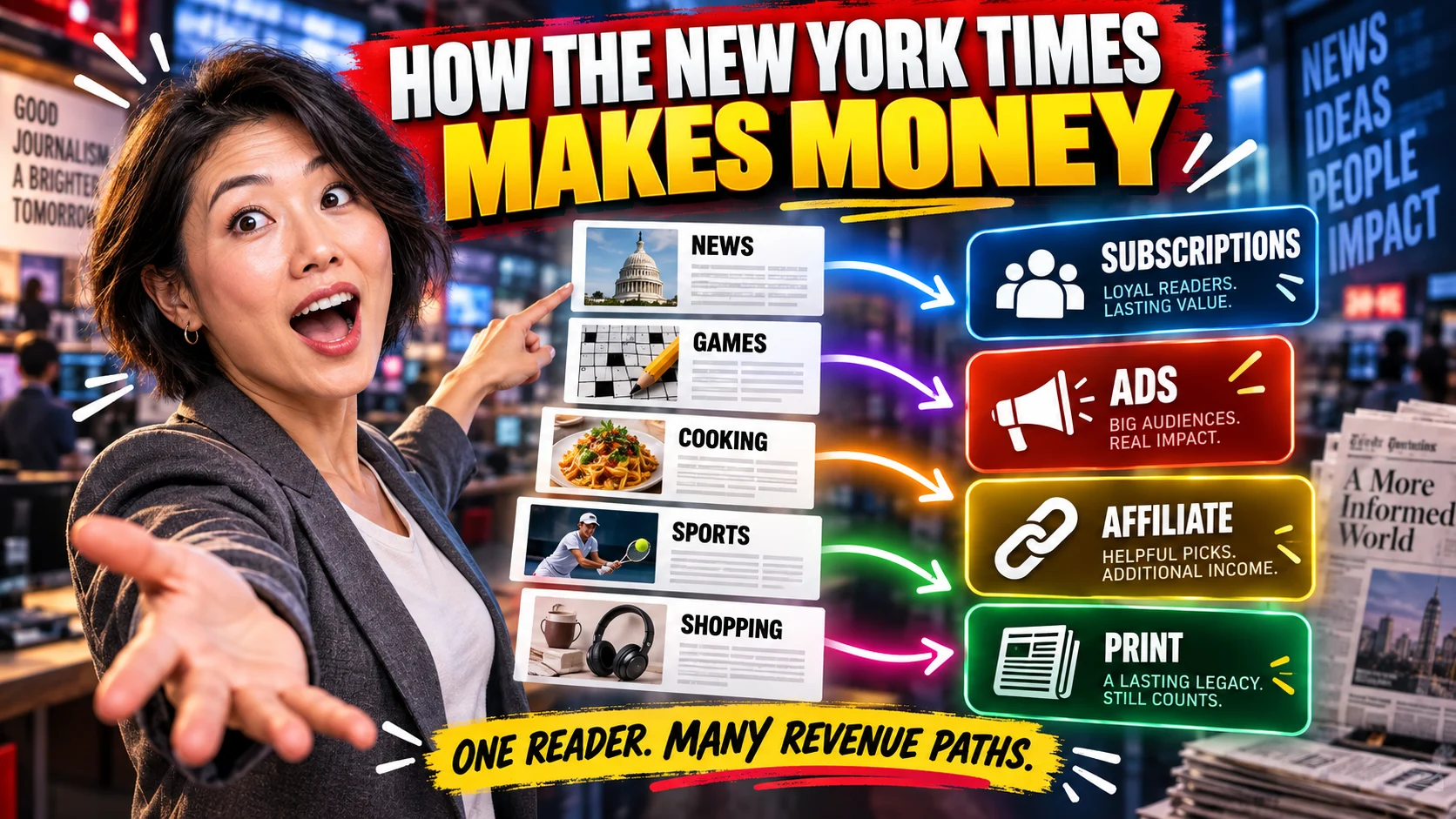

The New York Times makes money primarily by charging people for ongoing access to its products, then supplements that relationship through advertising, commerce referrals, print circulation and other commercial activity. The more interesting part of the business is how News, Games, Cooking, sports coverage and shopping guidance give the same reader different reasons to return, subscribe and remain subscribed.
A useful way to understand the company is therefore to stop thinking of it as a newspaper with several side businesses. It operates a collection of reader experiences that capture different kinds of attention and intent, then connects those experiences to several ways of generating revenue.
The Simple Answer: It Makes Money From Access, Attention and Intent
Most explanations of The New York Times business model begin by listing revenue streams. That identifies where money appears, although it does not fully explain why such different products belong together.
The underlying economics become clearer when the reader’s behavior comes first. A person who wants news can be sold access. A person who repeatedly visits free content can be shown advertising or eventually converted into a subscriber. Someone researching a purchase through Wirecutter can generate commerce revenue if a recommended retailer receives the sale. A puzzle player may use a free experience for a long time before deciding that paid Games features or a broader subscription are worthwhile.
These paths are different because the reader arrives with a different intention each time.
| Reader activity | Part of the ecosystem | How it can create value |
|---|---|---|
| Reads journalism regularly | News | Paid subscription, advertising and stronger retention within a broader bundle |
| Plays puzzles | Games and Wordle | Habit formation, Games subscriptions and additional reasons to keep broader access |
| Looks for recipes | Cooking | Paid access and recurring usefulness that extends beyond the news cycle |
| Follows teams and competitions | The Athletic | Sports-focused subscription value and another recurring reason to use the bundle |
| Researches a purchase | Wirecutter | Affiliate commerce when a reader follows a retailer link and completes a qualifying purchase |
| Reads without subscribing | Free digital audience | Advertising, registration opportunities and possible future conversion |
| Buys the physical newspaper | Circulation revenue and print advertising |
The table reveals an important distinction: the company can earn money from access, from attention and from purchase intent. Those mechanisms can coexist around the same person. A subscriber may pay for access, see advertising in eligible contexts, use Wirecutter before buying something and regularly play a game that makes the overall relationship more useful.
The Part Most Explanations Miss: Free Can Still Have Business Value
A free product does not have to produce an immediate payment to contribute economically. It can attract people who would never begin their relationship with The New York Times by purchasing a conventional news subscription.
Wordle is an especially clear illustration. Someone can encounter the puzzle casually, play it repeatedly and build a daily routine around the experience without paying for that individual session. The business value begins with frequency: the person now has a recurring reason to return to a New York Times property.
Repeated use creates opportunities that a single anonymous visit does not. A regular player may discover additional Games products, create an account, encounter paid features or eventually see greater value in a broader subscription. Even when conversion never occurs, a free experience can expand familiarity with the brand and keep the company present in a reader’s routine.
This is why asking, “How much does Wordle charge each player?” misses much of the commercial logic. A better question is, “What does a daily free habit make possible later?”
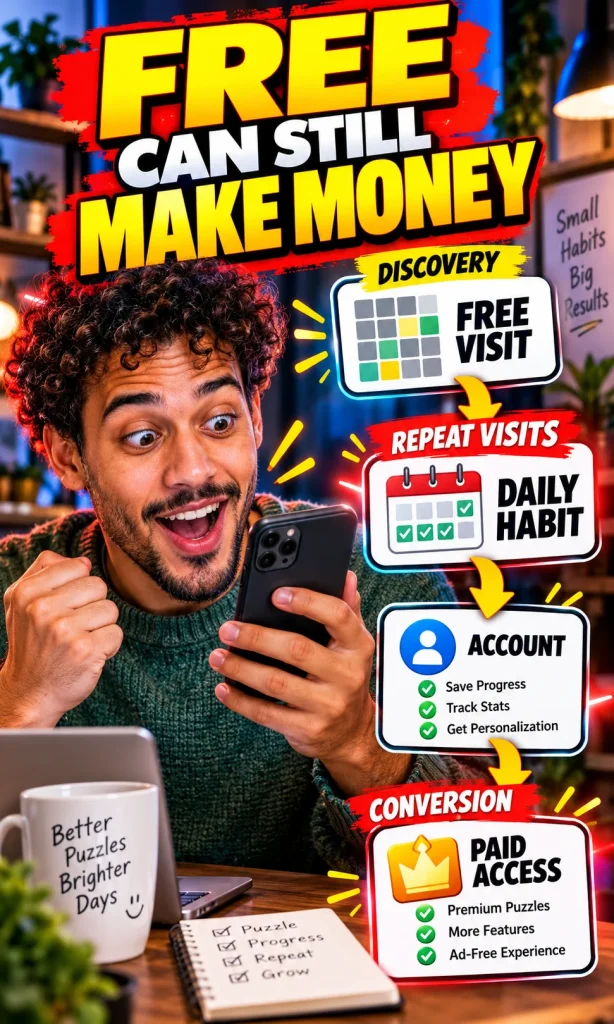
How One Reader Moves Through the New York Times Money System
The most useful way to see the model is as a sequence rather than a collection of unrelated revenue boxes.
A reader might first arrive through a search result, a shared article, Wordle, a recipe, a product recommendation or sports coverage. That first interaction may generate little or no direct revenue. Its immediate job is to solve the reader’s problem well enough that another interaction becomes likely.
Over time, the relationship can deepen:
- Discovery: The person encounters one New York Times product.
- Repeat use: The product becomes useful often enough to create a habit.
- Recognition: The reader begins to associate several needs with the same ecosystem.
- Paid conversion: A subscription becomes worthwhile because access solves more than one recurring need.
- Cross-product use: The subscriber begins using additional included products.
- Retention: Canceling would now remove several useful experiences rather than a single one.
This last step matters more than it first appears. A person who uses News, Games and Cooking has three separate reasons to consider the subscription useful. Their news consumption does not have to increase for the subscription itself to become more valuable to them.
That is one of the central ideas behind the whole business model: revenue can grow by increasing the number of useful relationships surrounding one reader, rather than requiring that reader to consume more of one product.
Why Games, Cooking and Sports Belong Beside the News
At first glance, crossword puzzles, recipes and sports journalism can look like unrelated expansions surrounding a newspaper. Their roles make more sense when viewed through usage frequency.
News demand can vary sharply. Major events may produce intense reading, while quieter periods may reduce the number of reasons a casual subscriber opens the product. Games can create a predictable daily ritual. Cooking becomes relevant whenever someone plans a meal. Sports creates recurring interest around teams, matches, seasons and major competitions.
Each product therefore occupies a different moment in the reader’s life.
That creates a broader habit surface. A subscriber who does not feel like reading politics on a particular evening may still open a crossword. Someone who has finished the morning news may return later for a recipe. A sports follower may engage deeply during a season even when their general news consumption is light.
The commercial advantage is straightforward: different products can keep the subscription useful on different days and for different reasons.
Why the Bundle Is More Important Than It Looks

A bundle is easy to describe as several products sold together for one price. Its more important role is to reduce dependence on any single usage habit.
Imagine two subscribers. The first only reads general news. The second reads news, plays Games several times a week and regularly saves Cooking recipes. Both may technically hold the same type of broader subscription, yet the second person has more independent reasons to notice what would disappear after cancellation.
This creates what can be thought of as retention depth. The company does not need every subscriber to love every product. It needs enough of the portfolio to become personally useful that the relationship remains worthwhile.
That changes how the economics should be interpreted. Games, Cooking and sports coverage are not valuable only when they produce standalone subscription payments. They can also strengthen the economics of a broader subscriber relationship by making the overall package harder to replace.
How Wirecutter Makes Money Differently
Wirecutter sits in a different part of the reader journey because the person usually arrives with purchase intent rather than a desire to consume journalism, solve a puzzle or follow a team. The reader may be comparing laptops, mattresses, kitchen equipment, headphones or another product and is already closer to spending money somewhere.
That changes the revenue mechanism. If the reader follows a qualifying retailer link and completes a purchase, the resulting transaction can generate an affiliate commission. The economic event is therefore tied to a shopping decision rather than to selling the reader access to Wirecutter itself.
This distinction matters because it shows how broadly The New York Times can monetize reader intent. A news subscriber produces value mainly through access and retention. An advertiser values exposure to an audience. A Wirecutter visitor can create value at the moment a purchase decision is being made.
The model can therefore serve people at several economic stages:
- Information intent: “What happened?”
- Habit intent: “I want to do today’s puzzle.”
- Utility intent: “What should I cook?”
- Passion intent: “What is happening with my team?”
- Purchase intent: “Which product should I buy?”
The business becomes stronger when those intentions do not have to be acquired from completely separate audiences.

Advertising Still Matters Even in a Subscription Business
A subscription-led company does not have to choose between charging readers and selling advertising. The two models can operate around different parts of the audience and different kinds of inventory.
Advertising is particularly useful because not every reader will subscribe. Some people arrive through search, social sharing, newsletters or occasional direct visits and may consume content without becoming paying customers. Those visits can still have commercial value when advertisers pay to reach that audience.
Subscribers can also encounter advertising in appropriate products and formats, which means a paying relationship does not automatically eliminate every advertising opportunity. The important point is that subscription revenue reduces the need to make advertising carry the entire business.
That changes the incentives compared with a publisher almost completely dependent on page views. A subscription business benefits when a reader finds the product useful enough to keep paying, so engagement quality, trust and repeat usefulness become economically important alongside audience size.
Advertising and subscriptions solve different problems
Advertising answers:
How can an audience be monetized even when the individual reader does not directly pay?
Subscriptions answer:
How can recurring value from the reader relationship become more predictable?
A strong media business can use both without treating them as interchangeable.
Why Print Can Still Make Sense in a Digital Business
Print can look contradictory inside a company increasingly organized around digital subscriptions, but the physical newspaper can still serve readers who value delivery, routine, format and the experience of reading a printed edition.
The correct question is therefore not whether print is more modern than digital. It is whether the print product still produces enough reader and advertiser value to justify the costs required to create, manufacture and distribute it.
Print also serves a different consumption pattern. A physical newspaper is finite, curated and delivered as a complete edition. Digital products are continuously updated, searchable and capable of connecting readers immediately with Games, Cooking, sports coverage, audio and other experiences.
For some readers, those formats are substitutes. For others, they are complementary.
This is why a digital-first strategy does not automatically require the immediate disappearance of print. A mature business can allow an older product to continue serving a valuable audience while newer products become increasingly important to growth and retention.
One Reader Can Be Worth More Without Reading More News
This is one of the most useful ways to understand the economics of the modern New York Times.
Imagine a subscriber who reads the same number of news articles every week for several years. From a traditional newspaper perspective, that person’s engagement appears almost unchanged. But suppose the reader gradually starts using Games every morning, Cooking on weekends and The Athletic during the sports season.
Their news usage has not increased.
Their relationship with the company has deepened considerably.
That matters because economic value does not come only from extracting more consumption from one product. It can also come from increasing the number of situations in which the overall subscription feels useful.
Consider what happens at renewal or cancellation time.
A news-only subscriber asks:
“Do I still read enough news to keep paying?”
A multi-product subscriber may instead be weighing:
“Do I want to lose the news, my puzzles, the recipes I use and the sports coverage I follow?”
The second decision has more components.
This does not guarantee retention, and it would be too simplistic to assume that every additional product automatically makes a subscriber more profitable. Yet the strategic logic is strong: more independently useful products can create more reasons for the same person to maintain the relationship.
The Real Difference Between Revenue and Strategic Value
One reason business-model explanations become confusing is that every product is often treated as though it must earn money in exactly the same way.
It does not.
A useful distinction is to ask whether a product primarily creates direct revenue, audience acquisition, habit, retention, transaction value, or some combination of these.
| Product or activity | Immediate economic role | Broader strategic role |
|---|---|---|
| News subscription | Direct recurring payment | Core relationship, trust and bundle anchor |
| Free Games use | May produce little direct payment initially | Acquisition, habit and potential paid conversion |
| Cooking | Paid access within relevant subscriptions | Adds utility beyond news and strengthens frequency |
| The Athletic | Subscription value | Broadens audience and adds passion-driven retention |
| Wirecutter | Affiliate commerce | Captures high-value shopping intent |
| Free journalism | Advertising potential | Discovery, reach and future conversion |
A product can therefore be strategically important even when its direct revenue contribution is smaller than another part of the company. Measuring everything only by the cash it generates at the first interaction ignores how media ecosystems actually create long-term value.
What Would Happen If One Revenue Stream Disappeared?
A useful way to test any business model is to remove one component and ask what breaks.
If advertising disappeared
The company could still make money from subscriptions, print circulation, commerce and other paid relationships, but free and lightly monetized audiences would become less economically productive. The business would also lose one way of monetizing attention from people who never become subscribers.
If print disappeared
The digital subscription system could continue, and the broader product ecosystem would remain intact. The main losses would be circulation revenue, print advertising and the value provided to readers who specifically prefer a physical newspaper.
If Games disappeared
Direct Games revenue would be affected, although the larger strategic cost could be the loss of a highly repeatable habit. Fewer readers would have a reason to interact with the ecosystem every day when they are not actively seeking news.
If Wirecutter disappeared
The company would lose a distinct way to monetize readers near the point of purchase. That would narrow the business back toward access and attention rather than transaction intent.
If the bundle disappeared
Individual products could still survive, but the company would lose much of the cross-product retention logic. A reader would have fewer reasons to treat several different habits as one ongoing relationship.
If subscriptions disappeared
This would change the business most fundamentally. Advertising, commerce and print could still generate money, but the recurring digital relationship that connects much of the wider ecosystem would be severely weakened.
The exercise reveals the hierarchy clearly: subscriptions are the commercial center, while the surrounding products diversify acquisition, frequency, utility, intent and retention.
The Quiet Revenue Streams Around the Core Business
The New York Times also has commercial activities that sit outside the most visible reader-facing paths. These can include licensing arrangements, group or institutional access, syndication, commercial partnerships and other forms of paid distribution or usage.
They matter, but they should not distract from the main architecture.
If someone wants to understand the company quickly, the order of importance is better thought of as:
- Build a direct reader relationship.
- Give that reader several reasons to return.
- Convert enough of those relationships into recurring paid access.
- Monetize non-paying attention where appropriate.
- Capture transaction value when readers arrive with buying intent.
- Keep additional commercial activities around the edges where they strengthen the whole system.
That sequence explains the business far better than a long list of miscellaneous revenue categories.
What The New York Times Is Really Selling
The New York Times still sells journalism, but the business model is broader than charging people to read articles. It sells ongoing access to a collection of useful habits and interests that can include understanding the news, solving puzzles, preparing meals, following sports and making purchase decisions.
That distinction explains why the company can own products that appear unrelated on the surface. They do not have to cover the same subject. They need to create recurring value around the same reader relationship.
The strongest version of the model is therefore not:
publish more articles → get more page views → sell more ads
It is closer to:
solve more recurring reader needs → create more reasons to return → deepen the relationship → increase the chance of paid conversion and retention
That is a fundamentally different way to think about a newspaper business.
What Other Publishers Can – and Cannot – Copy
The visible parts of the model are easy to imitate. A publisher can launch puzzles, recipes, newsletters, product reviews or a bundled subscription. The difficult part is making each component useful enough that readers would miss it independently.
A weak bundle does not become strong merely because several products are packaged together. Adding low-value features can actually make an offer feel more complicated without increasing its usefulness.
The more transferable lesson is to start with reader needs that recur at different moments and ask whether the publication has the credibility, product quality and operating capability to serve them well.
For another publisher, that might mean:
- adding a utility readers use every morning;
- creating a specialist product for an adjacent high-interest audience;
- developing a buying guide where readers already seek purchase advice;
- converting a one-time visit into a repeat habit;
- bundling only after several products are genuinely valuable on their own;
- measuring whether additional products improve retention, rather than assuming they do.
The New York Times model is difficult to reproduce because the strength comes from the interaction between products, not simply from having many of them.
The Business Model in One Sentence
The New York Times makes money by turning different reader needs into recurring relationships, then monetizing those relationships through subscriptions, advertising, commerce, print and supporting commercial activity.
The unusual part is not the number of revenue streams. It is how several different products can make one reader relationship more frequent, more useful and potentially harder to replace.
Frequently Asked Questions
What is the main way The New York Times makes money?
Subscriptions are the commercial center of The New York Times business model. Readers can pay for access to journalism and other products, while advertising, affiliate commerce, print circulation and additional commercial activities provide complementary sources of revenue. The exact mix can change, but the recurring subscriber relationship is what connects much of the wider product ecosystem.
How does The New York Times make money from Wordle?
Wordle does not have to charge every player directly to create business value. A free daily puzzle can bring people into The New York Times ecosystem, encourage repeat visits and introduce them to other Games products. Some users may later choose paid Games access or a broader subscription, while others remain valuable because they increase reach, familiarity and recurring engagement.
Why does The New York Times give some content away for free?
Free access can serve as the beginning of a customer relationship rather than the end of the revenue opportunity. A person may discover an article, puzzle, recipe or other experience without paying, return several times and eventually decide that paid access is worthwhile. Free audiences can also support advertising and expand awareness among people who might never start by purchasing a subscription.
How does Wirecutter make money?
Wirecutter can earn affiliate revenue when a reader follows a qualifying retailer link and completes an eligible purchase. This is different from the subscription model because the economic value is connected to purchase intent. A reader can therefore create revenue while deciding what to buy even if that individual visit is not itself behind a paid subscription.
Does The New York Times still make money from advertising?
Yes. Advertising remains another way to monetize audience attention, including people who do not become paying subscribers. It complements rather than replaces subscriptions: one model monetizes access to products, while the other allows advertisers to pay for exposure to relevant audiences and environments.
Why does The New York Times own Games, Cooking and The Athletic?
These products give readers reasons to return that do not depend on the general news cycle. Games can create a daily habit, Cooking provides recurring practical utility, and The Athletic serves sustained sports interest. When several products become useful to the same subscriber, the overall relationship can become more valuable and potentially more resilient to cancellation.
Does The New York Times make money from every visitor?
No. Some visits may generate no immediate payment or advertising value at all. Their importance can lie further along the customer journey: discovery may lead to repeat use, registration, a subscription, use of another product or a later commerce transaction. That is why evaluating the model only by the money generated during a single visit can be misleading.
Why is The New York Times subscription bundle valuable to the business?
A bundle can give one subscriber several independent reasons to keep paying. Someone may value News for current affairs, Games for a daily routine, Cooking for meal planning and sports coverage for a favorite team. The business benefit comes from making the overall relationship useful across more moments, rather than simply placing several products under one price.
Does The New York Times still make money from printed newspapers?
Print can still produce circulation and advertising revenue as long as enough readers and advertisers value the physical edition. Its economic role is different from the digital ecosystem because printing and distribution carry substantial physical costs, but a digital-first business does not automatically have to abandon a print product that continues to serve a viable audience.
Is The New York Times business model just a paywall?
No. The paywall is one conversion mechanism inside a much larger system. The broader model combines free discovery, recurring habits, paid access, multiple products, advertising, shopping intent and retention. The commercial strength comes from how those pieces interact around the same reader rather than from the paywall alone.
Key Takeaways
The simplest description of The New York Times business model is subscriptions supported by several complementary ways of monetizing reader attention and intent. What makes the model more interesting is the way the products reinforce one another.
- News provides the core paid information relationship.
- Games can create frequent habits and introduce people to paid access.
- Cooking adds practical usefulness outside the news cycle.
- The Athletic adds recurring sports interest.
- Wirecutter can monetize shopping intent through affiliate commerce.
- Advertising creates value from audiences who may never subscribe.
- Print serves a distinct paying audience while it remains commercially viable.
- Bundling connects several different reader needs to one recurring subscription relationship.
The deeper lesson is that a media company does not necessarily need to persuade one person to consume more and more of the same content. It can become more useful by solving different recurring problems for the same person.
That is why the modern New York Times business model is better understood as a reader-relationship system than as a newspaper with a paywall.