

The best home loan refinance rate in Singapore is not automatically the lowest advertised percentage. The better deal is the package that leaves you with the lowest reasonable financing cost over the period you expect to keep it, after accounting for fees, lock-in restrictions, rebates, possible clawbacks and what happens when the promotional rate ends.
Before moving to another bank, compare three choices on the same loan balance and remaining tenure: keep your present package, reprice with your existing bank, and refinance with another bank. Changing the tenure while comparing offers can make a new monthly instalment look cheaper even when the underlying deal is not.
The Quick Decision: Stay, Reprice or Refinance?
For many homeowners, asking “Which bank has the lowest rate?” comes one step too early. First establish which type of move is worth considering.
| Your Situation | Start With | Why | Main Check |
|---|---|---|---|
| Your current rate is still competitive | Stay | Switching costs may exceed the additional interest saved. | Compare total cost until your next realistic review date. |
| Your existing bank offers a competitive new package | Reprice | You may avoid the legal and valuation work involved in moving the mortgage. | Include any repricing or conversion fee. |
| Another bank offers materially better all-in terms | Refinance | The additional rate saving or flexibility may justify moving the loan. | Calculate fees, rebates, penalties and break-even time. |
| You expect to sell or repay a large amount soon | Prioritise flexibility | A slightly lower rate can be overwhelmed by redemption or partial-prepayment restrictions. | Check the lock-in and prepayment clauses before comparing rates. |
This is why getting a repricing quotation from your current bank is useful even when you think you will refinance. It establishes a low-friction benchmark against which competing banks have to justify the additional expense and effort of moving the mortgage.
What Actually Makes a Refinance Rate “Best”?
A home loan rate is only one component of the package. Two loans displaying similar percentages can produce different outcomes once their rate structures and restrictions are examined.
Before accepting an offer, compare:
- The initial interest rate. Check exactly how long it applies rather than treating a first-year or promotional rate as the permanent cost.
- The rate after the initial period. A package that becomes significantly more expensive after its promotional period may require another refinancing decision sooner than expected.
- Fixed or floating structure. A fixed package gives payment certainty for its stated period, while a SORA-linked package changes with its benchmark according to the loan’s review schedule.
- Bank spread. For a SORA package, distinguish the market benchmark from the margin added by the lender.
- Effective Interest Rate. Use the EIR and repayment schedule in the property loan fact sheet to compare the package more realistically.
- Lock-in period. Check what happens if you sell, refinance, redeem the loan or make a large partial payment while the lock-in is active.
- Repricing rights. Some packages provide a conversion or repricing option during or after a specified period. The conditions matter as much as the existence of the feature.
- Legal and valuation costs. These usually matter far more when moving between banks than when changing package inside the same bank.
- Cash rebates and subsidies. Treat these as offsets to switching costs, while checking whether they can be clawed back if you leave too soon.
- Your expected holding period. The package that wins over thirty years may not be the one that wins if you intend to sell, prepay or refinance again in three years.
Singapore’s MoneySense guidance on home loans specifically recommends reviewing the repayment schedule, advertised rate and EIR rather than comparing only the headline rate.
Do Not Compare Monthly Payments Until the Tenure Matches
One of the easiest ways to make a refinance offer look attractive is to compare two different repayment periods.
Suppose your existing mortgage has 18 years remaining. If a new quotation shows its monthly instalment using a fresh 25-year tenure, the payment may fall even without a meaningful improvement in borrowing cost. Part of that reduction simply comes from spreading principal repayment across another seven years.
For a fair comparison, hold the major variables constant:
same outstanding balance → same remaining tenure → same comparison period → then compare rates and costs.
Only extend the tenure deliberately, after deciding that lower monthly cash-flow pressure is worth potentially paying interest for longer.
That distinction is especially useful when using a mortgage refinance calculator. The calculation should answer whether the refinancing structure saves money, rather than merely demonstrating that a longer repayment schedule produces a smaller instalment.
Fixed Rate or SORA: Compare the Risk You Are Taking
Most borrowers understand that fixed rates provide more certainty while floating rates can move. The harder question is how much uncertainty your household can reasonably absorb.
A Singapore SORA-linked mortgage is generally expressed as a compounded SORA benchmark plus the lender’s spread. SORA itself is transaction-based and published by MAS, while the spread and other loan conditions are set by the bank. SIBOR is no longer the current benchmark to use when evaluating a new home loan package.
A fixed package is easier to budget during its fixed period. It can be attractive when preserving a predictable monthly commitment is more valuable to you than participating immediately in possible declines in floating rates.
A floating package deserves more than a prediction about where rates are heading. Examine the effect on your actual household budget if the benchmark moves against you.
For example, ask yourself whether a higher repayment would force you to reduce emergency savings, increase reliance on CPF Ordinary Account withdrawals, postpone other financial goals, or create difficulty if household income temporarily falls. If a relatively modest increase would make the mortgage uncomfortable, the apparent saving from taking more rate risk deserves less weight.
The comparison therefore becomes:
Which package gives you the best balance of expected cost, payment stability and freedom to change course?
That is a more durable question than trying to forecast the exact direction of SORA.
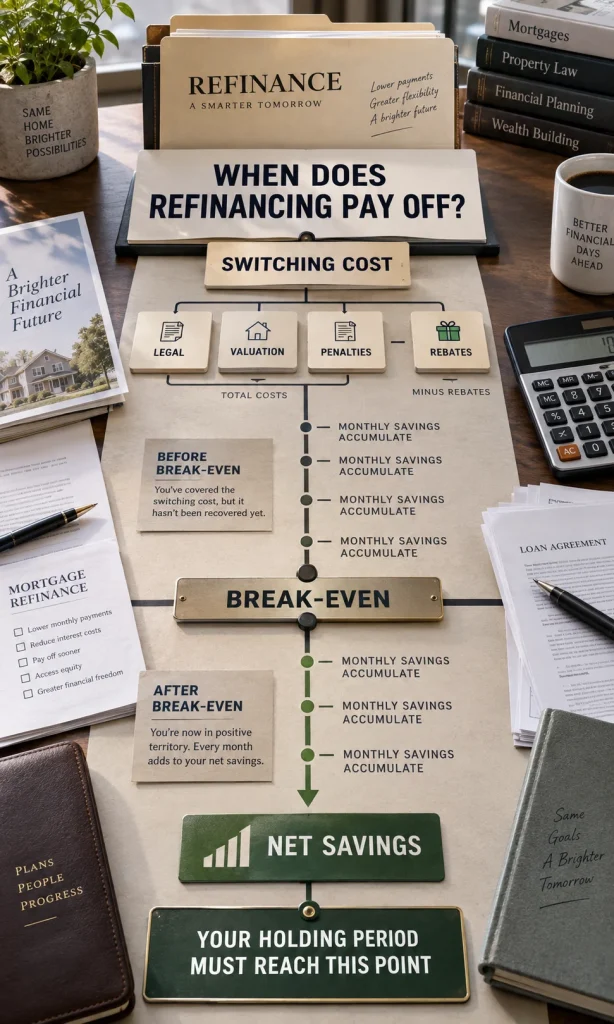
Calculate the Real Break-Even Point Before You Refinance
A refinance becomes worthwhile only when the benefit you expect to receive exceeds the cost of moving the loan. The headline interest-rate difference can look impressive while producing very little practical saving if your outstanding balance is small, your remaining tenure is short, or you expect to sell before the switching costs have been recovered.
A useful first calculation is:
Net refinancing cost = legal fees + valuation and administrative costs + penalties + clawbacks – subsidies or rebates
Then compare that figure with the financing cost you expect to save over the period you are realistically likely to keep the new package.
Do Not Use the Monthly Instalment Difference as Your Only Saving
The monthly payment is useful for cash-flow planning, but it is not the same thing as refinancing profit. A lower instalment can be created simply by extending the repayment period, which leaves more principal outstanding for longer.
For a proper comparison, keep these variables aligned:
- The same outstanding loan amount.
- The same remaining loan tenure.
- The same comparison period.
- The same assumed prepayment behaviour.
- All switching costs included.
- Any rebate or legal subsidy included only if you will satisfy its conditions.
- The rate after the promotional or fixed period considered when your comparison horizon extends beyond it.
If one offer has a three-year fixed structure and another has a floating structure, comparing only today’s first-month payment also misses the risk difference between the two.
A Simple Break-Even Formula
For an initial screening, you can estimate:
Break-even period = net refinancing cost ÷ estimated monthly financing saving
Suppose refinancing would cost you a net S$3,000, after accounting for applicable subsidies, and you estimate that the new package reduces your financing cost by approximately S$250 per month.
Your rough break-even point would be:
S$3,000 ÷ S$250 = 12 months
If you expect to keep the mortgage for another three years, that may be worth investigating. If you expect to sell the property in eight months, the same refinancing offer becomes much less compelling.
This shortcut is useful for screening, although a full amortisation comparison is better because the interest portion of a mortgage payment changes as the loan balance falls.
Why a Small Rate Difference Can Still Matter on a Large Mortgage
The rate gap should be interpreted together with the outstanding balance.
Consider a purely illustrative example involving a S$600,000 mortgage with 18 years remaining. If every other condition were equal, a loan at 3.00% would produce a monthly payment of roughly S$3,598, while 2.50% would be approximately S$3,452.
That is a difference of around S$146 per month.
The important observation is not that everyone should refinance for a 0.50 percentage-point reduction. It is that the same percentage-point difference has a larger dollar effect when more money remains outstanding.
A homeowner with S$150,000 left on the mortgage will therefore reach a very different decision from someone carrying S$800,000, even if both are offered exactly the same reduction in interest rate.
This is one reason percentage-based refinancing rules such as “switch whenever rates fall by X%” are unreliable.
The Better Comparison Is Total Cost Over Your Likely Holding Period
Instead of asking how much the new loan saves over its full remaining life, choose a realistic decision horizon.
For many borrowers, this could be:
- Until the next lock-in expires.
- Until the fixed-rate period ends.
- Until an intended property sale.
- Until a planned large CPF or cash repayment.
- Until retirement or another expected income change.
- Until you expect to reassess the mortgage again.
You can then compare both loans over the same period.
| Cost to Compare | Current Loan | New Loan | Why It Matters |
|---|---|---|---|
| Interest during comparison period | Calculate | Calculate | Measures the financing cost rather than payment appearance. |
| Repricing or conversion charge | If applicable | Usually not applicable | The existing bank may still be cheaper despite a slightly higher rate. |
| Legal and valuation costs | Usually minimal for staying | Include actual quotation | These costs can delay the refinancing break-even point. |
| Penalty or clawback | Check current agreement | Check new agreement for future exit | Leaving at the wrong time can erase much of the apparent saving. |
| Cash rebate or legal subsidy | Usually none | Subtract only if conditions are met | A subsidy is valuable only when you will not later have to repay it. |
| Outstanding balance at end of period | Compare | Compare | Prevents a lower payment from hiding slower principal reduction. |
The final column in your own comparison should be net advantage, not simply “monthly payment saved.”
Lock-In Period and Clawback Period Are Not Necessarily the Same Thing
This distinction catches borrowers surprisingly often.
A mortgage package can contain several different time restrictions. The interest-rate lock-in may end on one date, while a subsidy or legal-fee clawback remains relevant under different conditions.
Before refinancing, look separately for:
Lock-in penalty. This can apply when you redeem, refinance or sometimes make a large partial repayment during the specified period.
Legal subsidy clawback. A bank that subsidised the cost of your previous refinancing may require repayment if you leave within the period written into the agreement.
Cash-rebate clawback. A cash incentive can have its own retention conditions.
Notice requirements. Even when a penalty-free refinancing window is approaching, your current lender may require advance notice before redemption.
That means “my lock-in is ending” should trigger a contract review rather than an automatic refinancing application.
If your existing mortgage contract contains an early-exit provision you do not fully understand, the same principle discussed in breaking a mortgage contract applies here: determine the actual exit cost before evaluating the replacement loan.
When Should You Start Looking for a Refinance Package?
Do not wait until the day your lock-in expires.
Refinancing involves quotation, approval, documentation, legal work, redemption of the existing mortgage and completion with the new lender. Starting early gives you time to compare your present bank’s repricing proposal with outside offers without being forced into a rushed decision.
A practical sequence is:
- Find the exact lock-in expiry and redemption conditions.
- Request a repricing quotation from your existing bank.
- Collect comparable refinancing offers from other lenders.
- Normalise the balance, tenure and comparison horizon.
- Check penalties, legal fees, subsidies and clawback terms.
- Calculate the likely break-even point.
- Proceed early enough for legal completion to match your intended switch date.
For an HDB housing loan being refinanced to a financial institution, HDB indicates that the refinancing process takes about six to eight weeks from the application stage. That makes timing particularly important where you are trying to coordinate redemption with another financial milestone.
Refinancing an HDB Loan Requires One Extra Decision
An HDB borrower should consider more than the difference between the HDB rate and a bank’s quoted rate.
You can refinance an HDB housing loan with a financial institution regulated by the Monetary Authority of Singapore. However, after moving the HDB housing loan to a financial institution, you cannot later refinance that same loan back to HDB.
That makes the initial move structurally different from refinancing one bank loan to another.
Before switching, consider:
- Whether the bank package still looks suitable if interest rates later rise.
- Whether the new lock-in terms fit your likely sale or repayment plans.
- Whether you are comfortable remaining in the financial-institution mortgage market thereafter.
- How CPF will be used for future instalments.
- Whether Home Protection Scheme arrangements require attention.
- Whether the expected saving is large enough to justify giving up the option of remaining with HDB financing.
The official HDB refinancing process is worth checking directly before proceeding because it explains the documentation and redemption process for the transfer.
If You Use CPF for the Mortgage
Refinancing does not mean your existing CPF payment arrangement simply transfers itself to the new lender unchanged.
For a refinancing application involving CPF, your lawyer handles the required application and supporting documentation. CPF states that the current monthly CPF instalment to the existing financier will stop once the refinancing application has been approved, so the new payment arrangement should be checked as part of completion rather than left until afterward.
For HDB flat owners, refinancing can also affect Home Protection Scheme administration. If you are using CPF for the property, check the applicable housing withdrawal limits and your post-refinancing CPF arrangement before signing the new offer.
A Lower Rate Can Still Be the Wrong Refinance
The most expensive refinancing mistakes usually happen because one attractive number dominates the decision.
Watch for these situations:
- The rate is lower, but the loan restarts on a much longer tenure. Your payment falls while lifetime interest may not.
- You will sell before reaching break-even. The saving never has enough time to recover the switching cost.
- You trigger an existing penalty. Refinancing a few months too early can cost more than waiting.
- The attractive rate lasts only briefly. Evaluate what the package becomes afterward.
- A rebate distracts you from a weaker loan. Treat incentives as one component of total cost rather than the reason to refinance.
- You assume floating rates must fall. The mortgage needs to remain affordable if that forecast proves wrong.
- You ignore partial-prepayment plans. A restrictive package may be unsuitable if you expect to reduce the loan aggressively.
- You compare different tenures. This can make the cheaper-looking payment fundamentally misleading.
- You fail to obtain your current bank’s repricing offer. You may incur the cost of moving when a sufficiently competitive in-bank option already exists.
The decision becomes much easier once every offer is translated into the same question:
What will this mortgage cost me, and what flexibility will I retain, over the period I realistically expect to keep it?
How to Compare Two Refinance Offers Properly
Once you have quotations from your current bank and competing lenders, put every option into one comparison sheet. Do not compare one bank’s headline rate with another bank’s monthly instalment, or one fixed package with another package’s first-year promotional rate. The terms need to be normalised before the comparison means anything.
For each offer, record the following:
- Outstanding loan balance
- Remaining tenure
- Fixed or floating structure
- Initial interest rate
- How long that rate applies
- Rate or formula after the initial period
- Lock-in period
- Partial-prepayment restrictions
- Full-redemption restrictions
- Repricing or conversion options
- Legal and valuation costs
- Cash rebate or legal subsidy
- Clawback period
- Monthly instalment
- Estimated interest during your comparison period
- Outstanding principal at the end of that period
The last two figures are especially important. A package may appear cheaper because it reduces today’s instalment, while another package may leave you owing less principal after the same number of years.
Read the Property Loan Fact Sheet Before the Sales Summary
A promotional comparison normally compresses the mortgage into a few attractive numbers. The property loan fact sheet is more useful because it shows how the loan is actually structured.
Look specifically for the Effective Interest Rate, repayment schedule, interest-rate basis, lock-in conditions and fees. The EIR is useful because it gives you another way to compare financing costs, although it should still be interpreted together with your actual holding period and any costs that occur outside the advertised rate.
For a floating-rate package, make sure you can identify two separate components:
benchmark rate + bank spread
If the quotation states a SORA-linked structure, determine which compounded SORA convention is used, when the rate resets and whether the bank spread changes later in the package.
For a fixed-rate package, determine exactly what “fixed” covers. The fixed period may be shorter than the mortgage’s lock-in or overall tenure, so you still need to know what happens afterward.
Test Every Refinance Offer Against Three Scenarios
A mortgage comparison becomes much more useful when you stop assuming that everything will unfold exactly as expected.
Scenario 1: You Keep the Loan as Planned
This is your base case. Compare the financing cost over the period you currently expect to keep the package.
For example, if you expect to review the mortgage again after three years, compare both loans over three years rather than pretending you will necessarily hold either package for the next twenty years.
Scenario 2: You Need to Exit Early
Now assume that you sell the property, refinance again or make a major repayment before the intended date.
Check:
- Whether an early-redemption penalty applies.
- Whether a cash rebate must be returned.
- Whether subsidised legal costs can be clawed back.
- Whether partial repayment is restricted.
- Whether advance notice is required.
- Whether the package provides any penalty-free repayment allowance.
A package that performs beautifully in the base case can become poor when early flexibility matters.
Scenario 3: Floating Rates Move Against You
For a SORA-linked mortgage, estimate what your payment would look like if the applicable benchmark were higher than today’s level.
You do not need to predict the exact future rate. The purpose is to test household resilience.
Ask whether the higher payment would still allow you to:
- Maintain an emergency reserve.
- Meet insurance and household commitments.
- Continue retirement or investment contributions.
- Avoid relying on revolving debt.
- Absorb a temporary reduction in household income.
If the mortgage becomes uncomfortable under a plausible adverse scenario, the cheaper floating-rate quotation may be taking more financial risk than you intended.
Fixed Versus Floating Is Really a Budget-Risk Decision
The fixed-versus-floating debate is often presented as a forecast about interest rates. For a homeowner, it is more useful to frame it as a decision about who carries the rate risk.
With a fixed package, you pay for greater payment predictability during the fixed period. If market rates fall quickly, you may temporarily pay more than a new floating package, but your household budget remains easier to forecast.
With a floating package, you retain greater exposure to the benchmark. You may benefit when the applicable benchmark falls, but your repayment can also increase when it moves upward.
Neither structure is automatically better.
| Your Priority | Fixed May Suit Better | Floating May Suit Better |
|---|---|---|
| Stable household budgeting | Strong fit during the fixed period | Payment can change with the benchmark |
| Tolerance for rate movement | Lower short-term rate uncertainty | Requires more tolerance for changing repayments |
| Expectation of declining benchmark rates | May not benefit immediately | Can benefit when the package resets lower |
| Need for early flexibility | Check lock-in carefully | Still depends on package restrictions |
| Preference for certainty over optimisation | Often stronger fit | Better suited to borrowers comfortable with variability |
The correct comparison therefore combines rate, risk and flexibility rather than treating the lowest opening percentage as the winner.
How Much of a Rate Drop Is Enough to Refinance?
There is no universal percentage-point reduction that automatically makes refinancing worthwhile.
The required rate improvement depends mainly on:
- Your outstanding mortgage balance.
- Your remaining loan tenure.
- The cost of switching.
- How long you expect to keep the new package.
- Whether you are still exposed to a penalty or clawback.
- Whether the new loan materially changes your repayment flexibility.
- Whether you are comparing the same tenure.
- Whether the replacement loan changes from fixed to floating or vice versa.
A relatively small rate reduction can create meaningful savings on a large mortgage held for several years. The same reduction can be almost irrelevant on a small balance that you plan to repay shortly.
That is why a break-even calculation is more useful than rules such as “refinance whenever rates fall by 0.5%.”
When Repricing Can Beat Refinancing
Refinancing attracts more attention because another bank may advertise a lower rate. Repricing can nevertheless produce the better outcome when the rate difference is modest.
With repricing, you remain with the same lender and switch to another package offered by that lender. The process can involve less legal work and fewer third-party costs than transferring the mortgage elsewhere.
Suppose your existing bank offers a package that is slightly more expensive than a competitor’s refinance rate. The competitor does not automatically win.
If moving banks costs several thousand dollars while repricing costs only a small conversion fee, the existing bank can remain cheaper over your realistic holding period.
You should therefore calculate:
additional interest paid by repricing
against
additional switching cost required to refinance
If the refinance does not recover that difference comfortably before your next likely mortgage decision, moving banks adds work without producing enough financial benefit.
When Refinancing Usually Deserves Serious Consideration
Refinancing becomes more compelling when several favourable conditions occur together.
You may have a stronger case when:
- Your existing promotional or fixed period is ending.
- Your current rate has become meaningfully less competitive.
- Your outstanding mortgage remains substantial.
- You expect to keep the property long enough to recover switching costs.
- You are outside major penalty and clawback periods.
- The replacement package gives you better prepayment or conversion flexibility.
- The break-even period is comfortably shorter than your expected holding period.
- The new repayment remains affordable under a reasonable adverse-rate scenario.
No single item proves that refinancing is the right move. Together, they indicate that a full comparison is worth doing.
Situations Where Staying Put May Be Better
Sometimes the financially disciplined decision is to leave the mortgage alone.
Staying can make sense when the saving is small, you expect to sell soon, the remaining balance is modest, or refinancing would trigger costs that take too long to recover.
It can also make sense when your current mortgage contains valuable features that are difficult to replace. A flexible partial-prepayment arrangement, a favourable conversion option or a short remaining lock-in period can be worth more than a small headline-rate advantage elsewhere.
The important question is therefore not:
“Can I find a lower rate?”
It is:
“Does changing the loan improve my financial position enough to justify the cost, restriction and effort of changing it?”
A Practical Refinance Decision Checklist
Before accepting a new home loan package, work through the entire decision once without looking at the promotional headline.
Current mortgage
- Confirm the outstanding balance.
- Confirm the remaining tenure.
- Find the lock-in expiry.
- Check full and partial redemption penalties.
- Check existing subsidy or rebate clawbacks.
- Request a repricing offer.
New mortgage
- Record the initial rate.
- Record how long it applies.
- Identify the post-promotional rate formula.
- Check fixed versus SORA exposure.
- Check the lender spread.
- Check lock-in and prepayment restrictions.
- Check conversion or repricing options.
- Confirm legal, valuation and administrative costs.
- Record rebates and their clawback conditions.
Comparison
- Use the same balance.
- Use the same remaining tenure.
- Choose the same comparison period.
- Compare interest paid.
- Compare remaining principal.
- Include switching costs.
- Calculate the break-even period.
- Stress-test a floating package.
- Consider your likely sale or repayment plans.
Decision
- Stay if the current package remains competitive.
- Reprice if your existing bank provides enough improvement without substantial switching cost.
- Refinance when the additional benefit comfortably exceeds the cost and constraints of moving.
A refinance should leave you with a mortgage that works better after the paperwork is forgotten, not merely one that looks better on the first page of the quotation.
Before You Sign the New Loan
Treat the Letter of Offer as the final decision document rather than a formality. Read the conditions you would care about most if your plans changed unexpectedly.
Pay particular attention to the sections dealing with:
- Lock-in.
- Early redemption.
- Partial prepayment.
- Rate resets.
- Repricing.
- Cash rebates.
- Legal subsidies.
- Clawbacks.
- Sale of the property.
- Insurance requirements.
- Fees payable after completion.
If something important in the sales discussion does not appear clearly in the written loan terms, clarify it before accepting the offer.
The strongest refinance is rarely the package with the most attractive first number. It is the one whose rate, fees, restrictions, risk and likely holding period work together in your favour.
Frequently Asked Questions About Home Loan Refinancing in Singapore
Is refinancing the same as repricing a home loan?
No. Refinancing normally means moving your mortgage to another financial institution, while repricing means switching to another package with your existing lender. Repricing can be attractive when your current bank offers a competitive rate because the switching process may involve fewer legal and administrative costs. Compare the repricing quotation with outside refinancing offers on the same balance, tenure and holding period before deciding.
How much lower should the new mortgage rate be before refinancing?
There is no single percentage-point reduction that makes refinancing worthwhile for everyone. A smaller rate reduction can matter on a large outstanding mortgage held for several years, while a bigger reduction may still be unattractive if your loan balance is small or you will sell soon. Calculate the expected financing savings, subtract refinancing costs, and check whether you reach break-even comfortably before your next likely mortgage decision.
Can I refinance before my lock-in period ends?
It may be possible, but leaving during the lock-in period can trigger an early-redemption penalty or other charges under your existing mortgage agreement. A rebate or legal subsidy may also have separate clawback conditions. Obtain the actual redemption figure first and compare the cost of leaving early with the additional interest you would pay by waiting.
Should I refinance as soon as my lock-in period expires?
Not automatically. The expiry of a lock-in removes one potential barrier to switching, but the current loan may still be competitive. Ask your existing bank for a repricing quotation, compare competing packages, include all switching costs and then calculate the break-even period. If the saving is small, staying or repricing can produce the better outcome.
Is a fixed-rate home loan always safer than a SORA-linked loan?
A fixed rate reduces interest-rate uncertainty during its fixed period, which can make household budgeting easier. A SORA-linked package can move as its benchmark changes and may become cheaper or more expensive over time. The better choice depends on your tolerance for changing repayments, your need for certainty, the package restrictions and how long you expect to keep the loan.
Can I refinance an HDB loan with a bank?
Eligible HDB homeowners can refinance an HDB housing loan with a financial institution. This deserves more consideration than an ordinary bank-to-bank switch because once an HDB housing loan has been refinanced to a financial institution, that loan cannot subsequently be refinanced back to HDB. Compare the expected savings with the long-term financing flexibility you are giving up before making the move.
Can I continue using CPF after refinancing my mortgage?
CPF savings may continue to be used for an eligible property after refinancing, subject to the applicable CPF housing rules and withdrawal limits. The refinancing process requires the new financing arrangement to be properly reflected, so confirm how future CPF instalments will be handled as part of the legal completion rather than assuming the previous payment instruction simply continues unchanged.
Does a cash rebate make a refinance package cheaper?
A rebate can reduce the initial cost of switching, but it should be treated as one component of the overall package. Check how long you must keep the loan to retain the rebate and whether it is repayable if you refinance, redeem or sell earlier. A larger rebate does not compensate for an expensive rate, restrictive lock-in or poor long-term loan structure.
Should I extend my mortgage tenure when refinancing?
Extending the tenure can reduce the required monthly instalment, but it can also leave principal outstanding for longer and increase the period over which interest is paid. First compare the new loan using your existing remaining tenure. If you later choose a longer tenure for cash-flow reasons, treat that as a separate financial decision rather than counting the lower instalment as refinancing savings.
How do I know whether a refinance offer is genuinely better?
Put the current loan, your bank’s repricing offer and competing refinance packages into the same comparison. Use the same outstanding balance, remaining tenure and holding period, then include interest, legal and valuation costs, penalties, rebates, clawbacks, lock-in restrictions and the principal remaining at the end. The strongest offer is the one that improves your overall financial position without introducing restrictions or rate risk you are uncomfortable carrying.
Your Final Refinance Decision

A good refinancing decision should survive more than one favourable assumption. The package should still make sense if you keep it for the period you expect, if your plans change earlier than expected, and – for a floating mortgage – if rates move in the wrong direction for a while.
Before signing, make sure you can answer these questions without relying on the bank’s promotional headline:
- What will I pay to leave my existing loan?
- What will I pay to enter the new one?
- How much interest am I realistically likely to save?
- How long does it take to recover the switching cost?
- What happens after the introductory or fixed-rate period?
- What happens if I sell, prepay or refinance early?
- Will I owe back any rebate or subsidy?
- How much principal will remain after my chosen comparison period?
- Can my household comfortably absorb a higher payment if the loan floats?
- Does repricing with my current bank achieve enough of the same benefit with less friction?
If those answers favour the new package by a comfortable margin, refinancing may improve both the cost and structure of your mortgage. If the advantage disappears once fees, restrictions or a short holding period are included, the lower advertised rate is probably not enough reason to move.
The most useful way to approach Singapore home loan refinancing is therefore simple: compare the whole mortgage, not the headline rate.