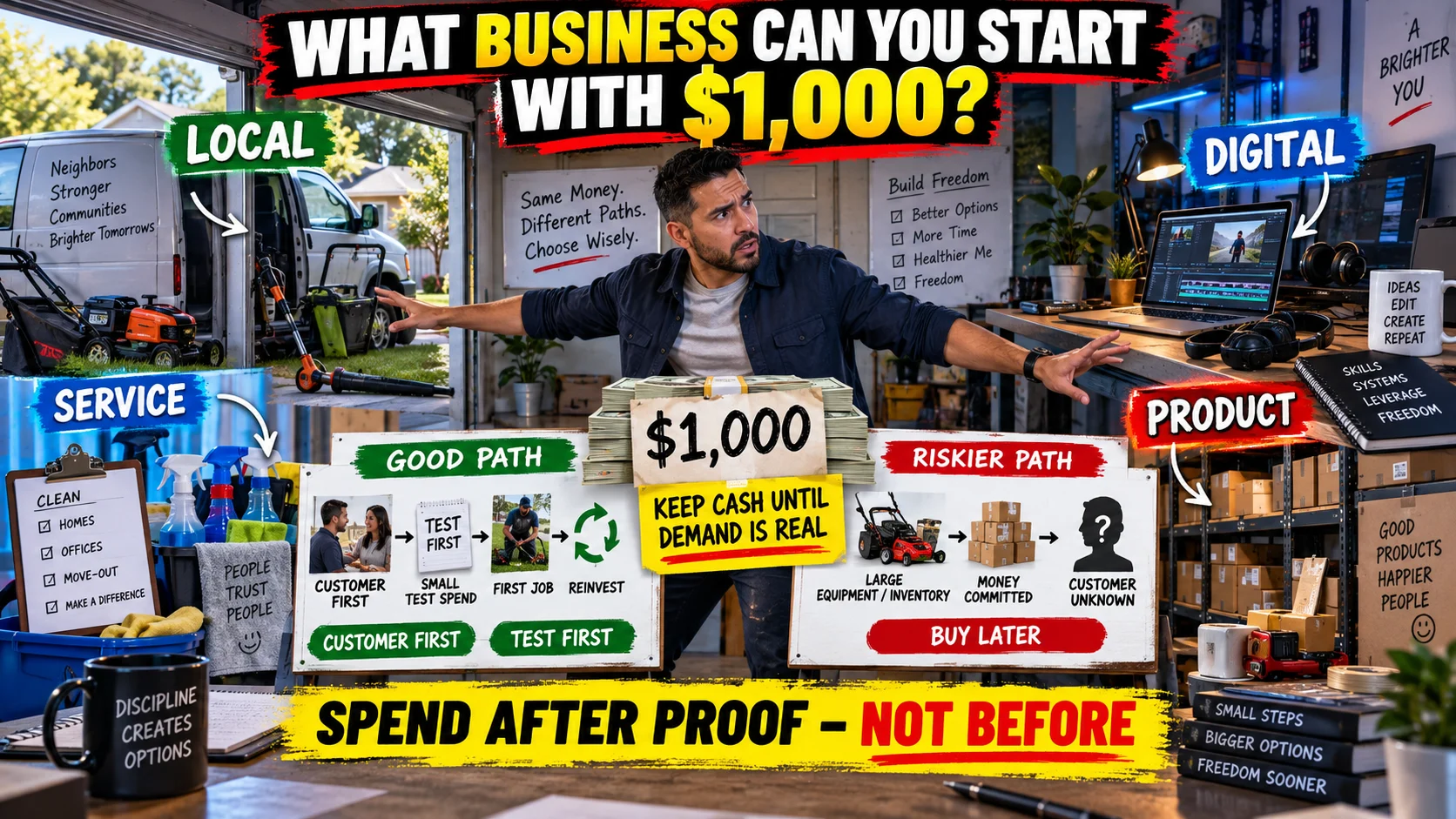

For most beginners with about $1,000, a service business is usually the strongest place to start because it can often be sold before much money is committed to inventory, premises or specialized equipment. The best choice is the business that uses capabilities you already have, gives you a believable route to the first customer and leaves most of your cash available until demand is proven.
A thousand dollars can open several doors, but the amount itself is less important than when the money has to be spent. A business that requires $800 before you know whether anyone will buy is operationally very different from one where you can speak to potential customers first, secure a job and then spend $100 fulfilling it.
That difference should guide the entire decision.
What Makes a Good Starter Business With $1,000?
A good beginner business should allow you to learn about the market without making an expensive commitment. You want enough capability to deliver a credible first job, but you do not need a fully developed company before anyone has shown a willingness to pay.
I would judge a small-budget business through six operational questions:
- How much cash must be spent before the first sale? Lower upfront commitment gives you more room to adjust if the idea is weak.
- Can you identify the first potential buyers? A cheap business is still difficult if you have no practical way to reach customers.
- Do you already own useful assets? Skills, a laptop, a vehicle, tools, equipment or an existing professional network can change the economics substantially.
- Can one customer lead to another? Repeat work, recurring service and referrals make a small operation easier to build.
- How complicated is fulfillment? Inventory, storage, scheduling, transport, staffing and specialized equipment increase operating friction.
- What happens if demand is poor? The less cash trapped in unusable inventory, long commitments or specialist equipment, the easier it is to stop or change direction.
These questions matter more than whether someone online claims a particular business can be “started for $300.” A headline startup cost tells you very little if it ignores customer acquisition, insurance, transport, replacement tools, software, supplies and the amount of money that becomes unrecoverable before the first sale.
Quick Comparison: Starter Businesses Under $1,000
The businesses below can fit a small starting budget in the right circumstances, but their attractiveness changes sharply depending on what you already own and how easily you can reach customers.
The table should not be read as a universal ranking. The same lawn-care business may be inexpensive for someone who already owns a mower, suitable vehicle and basic tools, yet completely unrealistic for another beginner who must buy all three before accepting a single job.
That brings us to the first principle I would use when choosing among these businesses.
The Same Business Can Be Cheap for One Person and Expensive for Another
Startup cost is personal because your starting position matters. Two people can choose exactly the same business and face completely different cash requirements because one already owns the essential equipment, has relevant experience and knows potential buyers while the other is beginning from zero.
Suppose one person wants to offer basic lawn maintenance and already owns a reliable mower, trimmer and vehicle. Their initial spending might be concentrated on consumables, simple customer acquisition and the operating requirements relevant to their location. Someone without those assets could consume most or all of a $1,000 budget just assembling basic capacity, leaving almost nothing for repairs, fuel, customer acquisition or unexpected problems.
The better question is therefore not:
“Can this business be started for less than $1,000?”
It is:
“What would I personally have to spend before I could responsibly complete the first paid job?”
That distinction immediately eliminates many attractive-looking ideas.
A video-editing service can be extremely inexpensive for someone with editing ability, a capable computer and an existing portfolio. The same idea may be a poor starter business for someone planning to use the $1,000 to buy software, equipment and training while hoping customers appear later.
Your budget should buy the missing pieces of an already plausible offer, rather than attempt to purchase an entire profession from scratch.
Cheap to Start Is Different From Cheap to Test
This is where many beginner business decisions go wrong. People often estimate what it costs to create the finished version of a business when they should first estimate what it costs to discover whether customers want the offer at all.
A business is cheap to test when you can approach credible potential customers, describe a specific offer and measure genuine buying interest before making a large irreversible purchase. That makes professional services, tutoring, cleaning, pet care and some local services particularly useful starting points because the offer can often be tested with relatively little infrastructure.
A product business can look inexpensive on paper while behaving very differently. If you spend most of your budget on materials, packaging and stock before validating demand, your money has already been converted into inventory. The business may technically have “started,” but your freedom to change direction has become much smaller.
Operational rule: With a limited budget, protect your ability to change your mind. Spend heavily only after the market gives you a reason to become more committed.
1. Freelance or Professional Services
Freelancing is one of the strongest low-capital starting models when you already possess a skill somebody pays for. Writing, editing, design, bookkeeping, administrative support, translation, video editing, technical work and certain forms of consulting can begin with little additional equipment when the founder already owns the necessary computer and software.
The limitation is important: knowing how to perform a task is only half of the business. You still need an offer narrow enough for a customer to understand, evidence that you can deliver it and a realistic way of getting in front of potential buyers.
“Marketing consultant” is vague. “I manage monthly email campaigns for independent online retailers” is much easier for a buyer to evaluate because the customer, activity and scope are visible.
For a beginner with limited cash, the strongest freelance offer usually has these characteristics:
- the required skill already exists;
- the work can be demonstrated through past experience or a small portfolio;
- the buyer can understand the deliverable before hiring you;
- the first project requires little additional equipment;
- scope can be defined clearly enough to prevent endless unpaid revisions;
- one successful project can produce a testimonial, referral or repeat assignment.
The danger is spending the first month designing a brand, purchasing software and building an elaborate website while having no conversations with potential clients. A service business becomes real when somebody wants the service, not when the visual identity is finished.
2. Virtual Assistance and Administrative Support
Virtual assistance can be a strong starter business because the underlying need is straightforward: businesses and professionals often have administrative work they would rather delegate than perform themselves. Scheduling, inbox management, document preparation, customer follow-up, research, data organization and routine operational tasks can all fit within the model when the founder is genuinely capable of handling them.
The best starting approach is usually narrower than advertising yourself as someone who “does everything.” A defined offer makes workload easier to estimate and makes the decision easier for the client. For example, administrative support for appointment-based businesses has a clearer operating shape than a general promise to perform any task a client sends.
The hidden risk is scope expansion. A low hourly rate can look attractive until one customer expects immediate availability, multiple software systems, weekend communication and duties that were never part of the original agreement.
Before taking the first client, define:
- what tasks are included;
- how work will be requested;
- expected response times;
- the number of hours or deliverables covered;
- what requires additional approval;
- which systems and accounts you are willing to access;
- what work falls outside your competence.
A simple operating boundary can protect a beginner’s time more effectively than an elaborate business plan.
3. Tutoring or Skills Instruction
Tutoring has unusually low capital requirements when you already possess the knowledge being taught. Lessons can often begin online, in the customer’s home, in an appropriate shared location or through another low-overhead arrangement, which keeps equipment and premises from consuming the starting budget.
The real asset is credibility. Parents, students and adult learners are paying for competence, communication and dependable progress rather than for expensive equipment.
That makes tutoring particularly attractive when you already have a clear subject advantage – mathematics, language learning, music, exam preparation, software, professional skills or another area where you can demonstrate useful expertise.
The mistake is assuming expertise automatically creates customers. A technically excellent tutor still needs a specific audience and a way to earn trust. Early growth often comes more effectively from referrals, local networks and a narrowly defined specialty than from spending heavily on broad advertising.
For a $1,000 starter budget, that is exactly the pattern we want: most of the capital remains available while the founder proves whether people will actually book and return.
4. Residential Cleaning
Residential cleaning is attractive as a starter business because the first version does not require an office, inventory room or large equipment package. If you already have reliable transportation and can begin with a limited set of professional-quality supplies, the cash required before the first customer can remain relatively modest.
The operational advantage is that the service can be sold in a defined unit: a one-time clean, recurring weekly or biweekly service, move-out cleaning, or another clearly bounded job. That makes the offer understandable and gives you a practical way to estimate labor before committing to the work.
The strongest version of this business usually begins with a narrow service scope. Trying to offer routine cleaning, carpet extraction, exterior windows, pressure washing and specialty restoration from the first day pushes a low-capital operation toward equipment purchases and service complexity before demand has justified them.
The less obvious cost is time between jobs. A schedule containing three customers in the same neighborhood can be operationally efficient, while three equally valuable customers spread across a wide area can consume hours of unpaid travel. Your customer geography therefore matters almost as much as the advertised price.
Before spending heavily, establish:
- which cleaning tasks are included in the base service;
- what requires an additional charge or separate appointment;
- whether clients or you supply particular consumables;
- how travel affects the minimum job size you can accept;
- how keys, access codes and customer property will be handled;
- what insurance or local operating requirements apply;
- how cancellations and rescheduling will work.
Those details may look administrative, but they determine whether a small cleaning business remains manageable once several customers begin requesting the same time slots.
5. Pet Sitting and Dog Walking
Pet sitting and dog walking require little equipment compared with many local service businesses, which makes them appealing when capital is tight. The real entry barrier is trust: customers are allowing you to care for an animal and, in some cases, enter their home while they are away.
That means credibility should receive more attention than branding. Clear communication, dependable scheduling, sensible procedures for emergencies and good references can matter more than an expensive website at the beginning.
The economics also depend heavily on route density. A dog walker with several compatible customers within a small area can use an hour productively. The same number of clients scattered across town may produce much weaker economics because travel sits between every billable appointment.
There is another important distinction between a low-cost service and a low-risk service. Caring for animals creates responsibility even though the equipment bill is small. Appropriate insurance, clear information about animal behavior, emergency contacts and realistic limits on which animals you can safely handle should be treated as operating requirements rather than optional polish.
A sensible first version of the service might therefore be narrower than expected: one neighborhood, certain appointment windows and a clearly defined type of pet care. Expansion can come after you understand how many bookings your actual route can support.
6. Local Technology Help
Local technology assistance is often overlooked because people associate technology businesses with software startups or expensive equipment. There is a simpler market around everyday problems: setting up devices, organizing digital files, configuring printers, helping with backups, explaining common software, transferring data between devices and solving basic connectivity problems.
This can be an inexpensive business for someone who already understands the technology involved and owns the normal equipment needed to diagnose straightforward issues. It can also generate referrals because trust matters strongly when somebody allows another person to handle their computer, phone or personal files.
The operating boundary needs to be unusually clear. A beginner should not accept data recovery, cybersecurity, electrical repair or other high-consequence work simply because a customer describes it as a “computer problem.” The low startup cost does not reduce the damage that can occur when someone works beyond their competence.
A well-defined offer is safer and easier to sell:
Home Technology Setup
rather than:
I Fix Anything With Technology
The first can include device installation, basic software configuration, printer setup, account organization and straightforward user training. The second creates an open-ended promise that may eventually put you in front of problems you are not equipped to solve.
This is another recurring pattern in good starter businesses: narrow capability is usually easier to operate than broad possibility.
7. Lawn and Simple Outdoor Maintenance
Lawn and outdoor services demonstrate why a universal “startup cost” is so misleading. Someone who already owns appropriate equipment, a vehicle and basic maintenance tools may be able to test demand with very little new spending. Someone starting without those assets can consume a $1,000 budget before completing the first job.
The better starting question is therefore what services your existing equipment already allows you to perform reliably. Basic mowing, edging, leaf cleanup or simple garden maintenance may be practical, while tree work, large-scale landscaping, pesticide application or specialist machinery can introduce substantially different equipment, safety and regulatory requirements.
Outdoor work also creates operating costs that are easy to underestimate. Fuel, blades, line, repairs, transport, weather disruptions and the time required to move equipment between customers all affect the economics.
A beginner should pay particular attention to customer concentration. Ten small jobs in a compact neighborhood may form a much stronger route than ten individually profitable jobs spread over a large area.
That suggests a useful operating sequence:
- Start with services your existing equipment already supports.
- Target a compact service area rather than chasing every inquiry.
- Track how much non-billable travel occurs between jobs.
- Upgrade equipment when repeated demand exposes a real bottleneck.
- Add specialist services only when the capability, risk controls and local requirements are understood.
Buying a commercial-grade machine before you have a route is speculation. Buying one because a full schedule has made the current machine the obvious constraint is an operating decision.
8. Basic Mobile Vehicle Cleaning
Mobile vehicle cleaning can fit a limited budget if you already have transportation and begin with a restrained service rather than attempting to reproduce a fully equipped professional detailing operation immediately.
The distinction between basic cleaning and specialist detailing matters. Interior vacuuming, wipe-downs, glass cleaning and straightforward exterior washing can have relatively simple requirements. Paint correction, machine polishing, ceramic coatings, stain extraction and other specialist services demand additional skill, equipment, chemicals and risk control.
A beginner often gets into trouble by marketing the advanced service before building the advanced capability.
The first offer should match the tools and experience you already have. If customers consistently request a service that requires additional equipment, you then have evidence that an upgrade may earn its way into the business.
Location also affects the model. Access to water and power, environmental rules, weather, parking conditions and customer premises can change what is practical. A mobile service is only convenient when the operating environment actually allows the job to be completed efficiently.
For a limited starting budget, the strongest version is therefore usually small service menu, compact territory, controlled equipment purchases and clear expectations.
9. Editing, Design and Content Services
Editing, design, video production and related content services can have extremely low cash requirements when the founder already has the skill, equipment and software. That makes them look almost ideal for a $1,000 budget.
The challenge is rarely equipment. It is differentiation and customer access.
Thousands of people can describe themselves as writers, designers or video editors. A starter business becomes easier to understand when the service is tied to a particular client problem: presentation design for sales teams, short-form video editing for property agents, newsletter editing for professional firms, or product-page copy for small online retailers.
That specificity affects operations as much as marketing. When the client type and deliverable are defined, you can estimate turnaround time, create repeatable templates, set revision limits and improve the workflow from one project to the next.
Broad creative offers often produce the opposite effect. Every customer wants something different, proposals take longer, pricing becomes inconsistent and each project begins from zero.
For a beginner, the goal is not simply to obtain creative work. It is to discover a repeatable unit of creative work that customers understand and that you can deliver profitably.
10. Specialized Small-Business Services
Bookkeeping support, marketing assistance, administrative operations and other business-to-business services can be attractive because one client may generate recurring work rather than a single transaction. They can also be started with relatively little physical equipment.
However, this category deserves more caution than the phrase “low-cost business” usually receives. Some services involve professional qualifications, regulated activity, confidential information, financial access or decisions that can materially affect the client.
The correct rule is simple: offer only what your competence and any applicable professional requirements allow you to perform responsibly.
A capable bookkeeper with relevant experience is in a different position from a beginner who has never maintained business records but sees bookkeeping on a “cheap businesses to start” list. The same applies to paid advertising, tax work, financial advice, legal services, cybersecurity and other areas where poor work can create significant consequences.
Low startup capital should never be confused with low professional responsibility.
For someone who does have the necessary capability, a narrow business-to-business service can be operationally strong because the customer problem is often recurring. Monthly bookkeeping, routine reporting, scheduled administrative support or defined marketing production can produce a more predictable workload than constantly selling one-off jobs.
Service Businesses Usually Protect a Small Budget Better Than Product Businesses
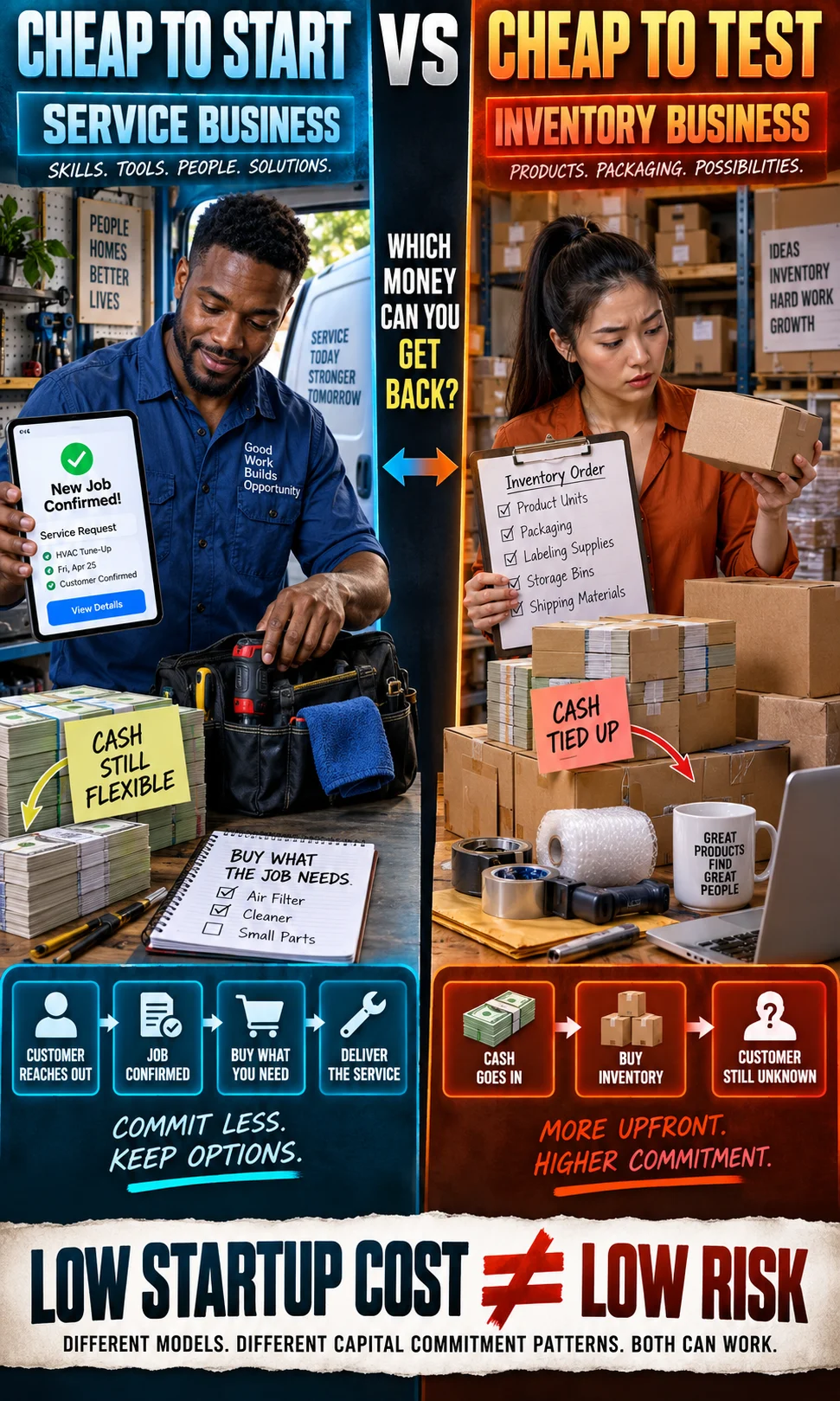
A service business and a product business may both be advertised as costing $1,000 to start, yet the cash behaves differently.
With a service, a substantial share of your starting money can often remain untouched until a customer agrees to buy. With a physical product business, money may have to be converted into materials, stock, packaging and fulfillment capacity before you know how quickly anything will sell.
| Operating Question | Service Business | Inventory-Based Product Business | Why It Matters With $1,000 |
|---|---|---|---|
| Can you test before major spending? | Often yes | Sometimes, but stock or samples may still be required | Preserves cash while demand is uncertain |
| Cash tied up after purchase | Usually lower when using existing skills and tools | Can be substantial because money becomes inventory | Limits your ability to change direction |
| Unsold capacity | Mostly unused time | Physical stock may remain | Unsold stock can trap scarce capital |
| Scaling requirement | More time, systems, subcontractors or staff | More inventory, fulfillment and working capital | Growth consumes cash differently |
| Easy to reverse? | Often relatively easy | Depends on whether stock and equipment can be resold | Reversibility is valuable while you are still learning |
This does not mean product businesses are bad starter businesses. A maker with existing equipment, proven local demand and the ability to produce only after receiving orders can operate very differently from someone buying hundreds of units on speculation.
The deciding factor is how much capital must be committed before demand becomes visible.
Do Not Spend the Whole $1,000 Just Because You Have It
A startup budget should be treated as a limit, not a spending target. If you can obtain your first customer after spending $120, spending the remaining $880 merely to make the business look more complete does not automatically improve the operation.
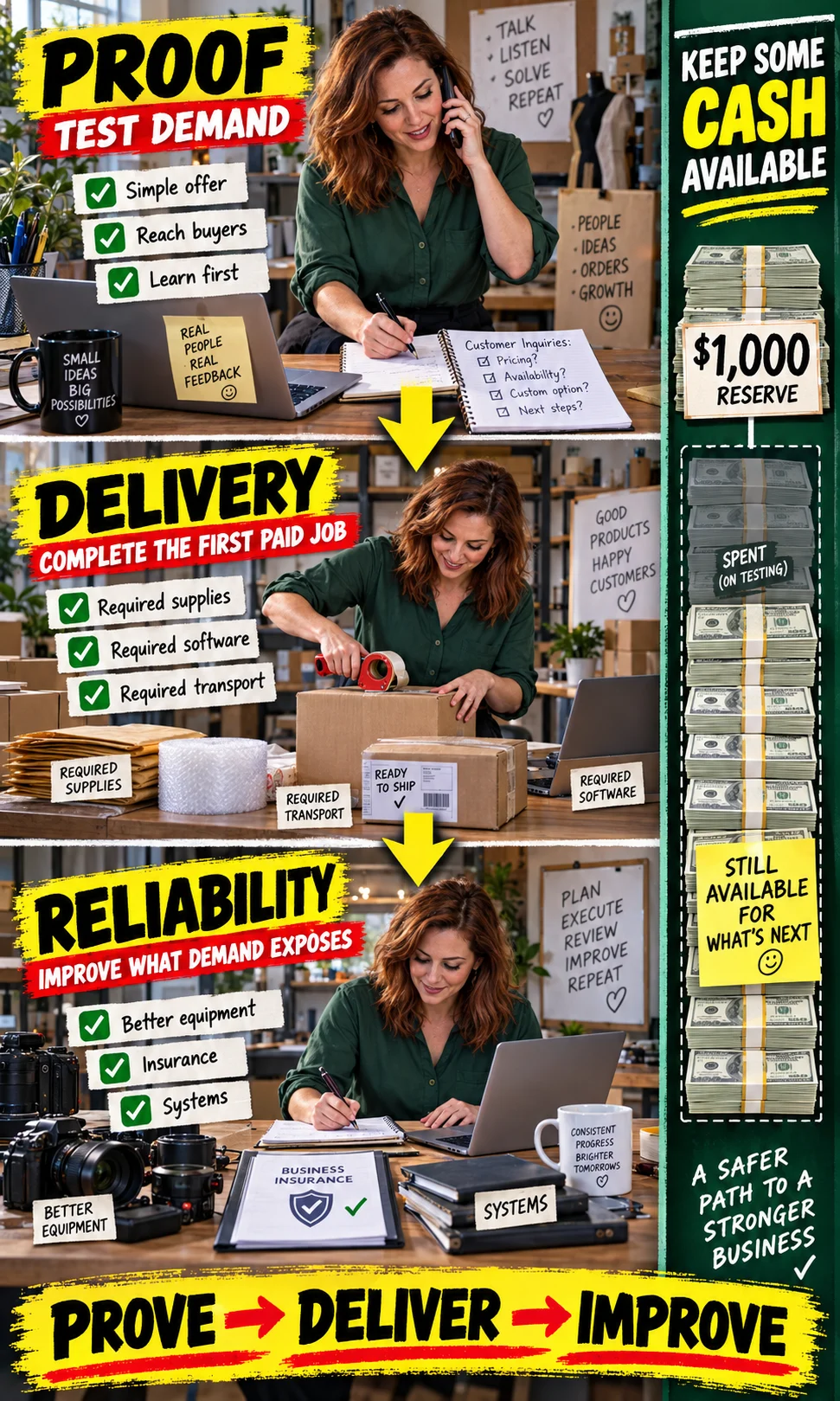
A better approach is to separate expenditure into three stages.
Proof Spending
This is money used to determine whether real customers will consider the offer. It might include a basic domain, simple printed materials, a small quantity of supplies, transportation to prospective customers or another modest cost directly connected to testing demand.
The objective is information, not appearance.
Delivery Spending
Once someone agrees to buy, you may need additional supplies, software, equipment or transportation to complete the job properly. This spending is easier to justify because a specific revenue opportunity now exists on the other side of it.
Reliability Spending
After the business has begun producing repeat demand, money can be used to make delivery more dependable. Better equipment, insurance, improved scheduling, backup tools, accounting systems and more professional customer processes often belong here.
The sequence matters:
prove → deliver → improve
rather than:
buy → build → decorate → hope
The $1,000 Test: What Happens If Nobody Buys?
Before committing money to any starter business, imagine that the first month produces no customers.
What are you left with?
If most of the budget remains in cash and the few things you purchased are reusable, the failed test is uncomfortable but manageable. You can change the offer, choose another customer group or abandon the idea without having destroyed your entire starting position.
If the money is now sitting in customized stock, nonrefundable software contracts, specialist equipment or prepaid commitments, you have fewer choices.
That gives us a practical measure of beginner risk:
The better starter business is often the one that is easiest to stop.
This may sound negative, but reversibility is valuable. Your first business idea contains assumptions about price, customer demand, competition, workload and your own willingness to perform the work repeatedly. Some of those assumptions will be wrong. A reversible model lets you learn without paying heavily for every mistake.
Before You Choose an Idea, Identify the First 10 Buyers
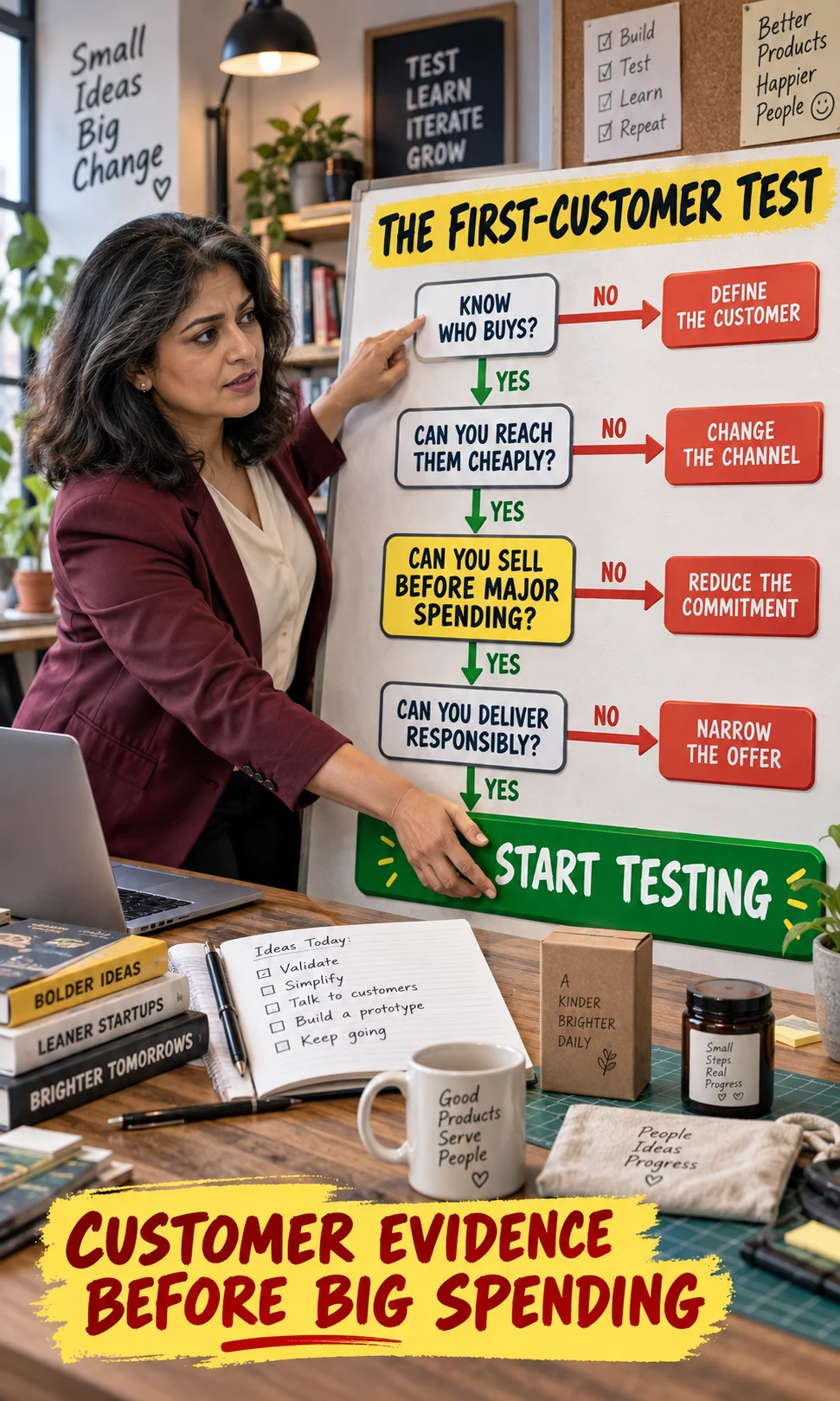
Many starter-business articles end the decision at “choose something you enjoy.” Enjoyment matters, but it does not establish demand.
Before buying equipment, write down ten realistic people or businesses that could purchase the service. They do not need to promise anything. The purpose is to determine whether the customer group is concrete enough for you to approach.
If you cannot identify where ten plausible buyers can be found, the first problem is not funding. It is customer access.
Ask yourself:
- Who specifically has the problem I want to solve?
- Where can I reach those people without a large advertising budget?
- What are they using instead right now?
- Can I explain the offer in one or two sentences?
- What would make someone comfortable trying a new provider?
- Can the first job be small enough to reduce the buyer’s risk?
- If the customer is satisfied, is there a natural reason to buy again or recommend me?
This exercise quickly separates an operational idea from a fantasy.
“Start a digital agency” is an aspiration.
“Offer monthly social-media content production to independent fitness studios within my city” is an offer with a buyer, a service and a route to outreach.
Your First Customer Should Influence What You Buy Next
The first customer is valuable for more than the revenue. They expose what the business actually needs.
Perhaps customers repeatedly ask for evening appointments, which means scheduling flexibility matters more than another piece of equipment. Perhaps every cleaning customer requests the same additional service. Perhaps your editing clients send large video files and expose a genuine storage bottleneck. Perhaps dog-walking customers cluster in one neighborhood, showing you where further outreach should be concentrated.
Those are operational signals.
A beginner who purchases everything in advance loses the opportunity to let customers shape the business. A beginner who keeps some cash uncommitted can respond to what the first few jobs reveal.
That is one of the strongest advantages of starting small: you are allowed to build the operation around evidence instead of prediction.
How to Use the First $1,000 Without Forcing a Fake Budget
There is no sensible universal formula that says a beginner should spend 40% on equipment, 30% on marketing and the rest on administration. A tutoring business, cleaning service and mobile vehicle-cleaning business have completely different operating needs, so imposing the same percentages on all three can encourage unnecessary spending.
A better approach is to protect the cash until a specific business requirement earns the right to use it.
Start by identifying four categories.
Money Required to Become Legally and Operationally Ready
Some businesses require registration, permits, insurance or other local requirements before trading. Those expenses belong near the front of the budget because they determine whether you can operate properly at all.
The exact requirements depend on the business and jurisdiction, so do not assume a low-cost idea is automatically free of regulatory obligations. Food preparation, childcare, financial services, certain trade work, transport-related activities and other regulated services can become considerably more complicated than an ordinary low-overhead freelance activity.
Money Required to Complete the First Job Properly
This is the minimum equipment, material, software or transportation cost needed to deliver what you have actually sold.
If a cleaning customer books a specific service, buy what that service requires rather than stocking every chemical and attachment you might eventually use. If a freelance client needs a software capability you genuinely lack, that purchase has a clearer justification than subscribing to a large software stack before prospecting begins.
Money That Protects Reliability
A business eventually needs enough resilience that one small problem does not stop all delivery. Spare consumables, equipment maintenance, insurance, a backup storage system or another reliability expense can become justified once actual work exposes the need.
This category is important because extreme frugality can become expensive. Saving money by using unreliable equipment that causes missed appointments or damaged work is different from avoiding unnecessary upgrades.
Money That Should Remain Unspent
Cash itself is an operating asset.
You may need it when a tool fails, a customer pays late, demand changes, an unexpectedly effective marketing channel appears or a better opportunity requires a modest investment. A beginner who spends the entire budget before the business has learned anything loses that flexibility.
With only $1,000 available, unused cash should not be treated as wasted opportunity.
Starter Businesses That Look Cheap but Can Become Expensive Fast
Some business ideas regularly appear on low-cost lists because the first visible purchase is inexpensive. That does not mean the complete operating model fits a small budget comfortably.
Inventory-Heavy Online Stores
Opening an online storefront can cost very little. Acquiring products, storing them, handling returns, packaging orders, paying transaction costs and generating enough traffic to produce purchases may not.
The financial risk increases when you must buy stock before knowing which products customers actually want. A preorder, made-to-order or very small-batch model can reduce that exposure, but buying a large range because “the website is ready” reverses the sequence we want.
Food Businesses
A home-based food idea may appear inexpensive because the founder already owns a kitchen. The actual operating requirements can involve food-safety rules, permits, packaging, storage, ingredient management, labeling, delivery and suitable insurance depending on the jurisdiction and product.
This does not make food businesses unsuitable. It means they should not automatically be grouped with simple freelance services merely because the first batch of ingredients costs less than $1,000.
Equipment-Led Service Businesses
Pressure washing, professional detailing, photography, landscaping and similar businesses can sometimes start inexpensively when suitable equipment is already owned.
They become very different propositions when the founder must purchase the entire equipment set from the startup budget.
This is where the phrase “you can start with $1,000” becomes misleading. It may actually mean “you can start with $1,000 if several thousand dollars of useful assets are already sitting in your garage.”
Craft and Handmade Product Businesses
Handmade products can begin on a small scale, particularly when production happens after the customer orders. Problems arise when the founder buys materials, packaging and many variations before discovering which designs people want.
Inventory risk can exist even when the inventory is raw material rather than finished goods.
A better first test may be a limited collection, a made-to-order offer or a small number of prototypes used to secure actual orders.
Businesses That Depend on Paid Advertising From Day One
A low-overhead business can still burn through a small budget quickly when customer acquisition depends entirely on buying traffic.
Paid advertising is not inherently a bad channel, but a beginner with $1,000 has little room for expensive experimentation. If the economics only work once you have mastered advertising platforms, landing pages and conversion optimization, the business may require more testing capital than the headline startup cost suggests.
Whenever possible, your first version should have at least one customer-acquisition path you can execute through direct outreach, referrals, local presence, existing relationships, marketplaces or organic discovery.
A Better Way to Compare Two Business Ideas
Suppose you are deciding between two ideas:
Idea A: a home-based product business that requires $700 of materials, packaging and stock before launch.
Idea B: a service business requiring $150 of basic supplies, while the rest of the equipment is already owned.
It would be too simplistic to declare Idea B automatically superior. The product business might have strong preorder demand while the service business may have no reachable buyers.
The better comparison asks what happens next.
If one idea wins four of those five questions, that tells you considerably more than a generic profitability ranking.
The Best First Business Often Uses Something You Already Have
When capital is limited, existing assets matter more than novelty.
Those assets can include:
- a marketable professional skill;
- an established reputation in a particular field;
- access to a useful network;
- a reliable vehicle;
- specialist tools;
- a computer capable of the work;
- photography or video equipment;
- an existing workshop or workspace;
- language fluency;
- teaching experience;
- knowledge of a particular industry;
- familiarity with a local customer group.
This is why somebody else’s “best business under $1,000” may be a poor choice for you.
A person who has spent years in payroll administration may have a stronger starting position offering a tightly scoped business-support service than opening an unfamiliar online store. Someone who already owns appropriate outdoor equipment may have an operational advantage in local property maintenance. An experienced designer may be able to sell a service with almost no new capital.
You do not have to build your first business around your existing career forever. The point is that existing capability gives you leverage while your budget is small.
Do Not Confuse Buying a Course With Starting the Business
Training can be useful when it closes a specific, realistic skill gap. It becomes a problem when education replaces contact with the market.
A beginner can spend the entire budget on courses, memberships, templates, software and certifications while remaining no closer to a paying customer.
Before paying for training, ask:
What exact problem prevents me from selling or delivering the service today?
If the answer is clear – for example, a necessary technical skill, professional qualification or software competency – training may be justified.
If the answer is “I still do not know what business I want,” another course may simply delay the decision.
Learning should create capability. It should not become a substitute for testing whether anyone wants what you intend to sell.
Do Not Build the Website Before You Build the Offer
A website can support credibility, explain services and help customers find you. It cannot rescue an unclear offer.
Before spending heavily on one, you should be able to answer four questions in plain language:
- Who is the customer?
- What problem are you solving?
- What exactly does the customer receive?
- What should they do if they want to buy?
If those answers are unclear, the website will simply publish the confusion more professionally.
For many starter businesses, an early website can be deliberately small: a clear service description, evidence of capability, contact method, basic terms and whatever additional information customers genuinely need to make the decision.
You can add complexity when actual customers reveal what they want to know.
Your First Offer Should Be Smaller Than Your Future Business
Beginners often describe the eventual company rather than the first transaction.
They imagine a cleaning company with several packages, a creative agency with multiple disciplines, a landscaping company offering everything outdoors, or an online shop with dozens of products. Building that full range from day one creates more decisions, more equipment requirements and more ways for delivery to fail.
A stronger first offer is narrow enough that you can perform it repeatedly.
For example:
Too broad:
“Complete digital marketing for small businesses.”
Better first offer:
“Monthly email newsletter production for independent professional firms.”
Too broad:
“All household cleaning services.”
Better first offer:
“Recurring routine cleaning for two-bedroom apartments within a defined service area.”
Too broad:
“Custom gifts for every occasion.”
Better first offer:
“A small made-to-order collection with limited personalization.”
The narrower offer is not a permanent ceiling. It is an operating starting point.
Once customers repeatedly request adjacent services and you understand the economics, expansion becomes an evidence-based decision.
Watch for the Point Where a Cheap Business Stops Being Cheap
Successful low-capital businesses can eventually require substantial investment.
A solo cleaner may need another vehicle and staff. A freelance editor may need contractors and workflow software. A lawn service may require commercial equipment. A maker may need production space and inventory. A tutor may open a dedicated classroom.
That is normal.
The goal is not to remain a $1,000 business forever. The goal is to ensure that later spending is funded by evidence that the business deserves more capacity.
Expansion should normally follow a constraint you can identify:
- customers are being turned away because capacity is full;
- existing equipment causes delays or reliability problems;
- a recurring service request justifies a specialist tool;
- travel time makes another service area operationally sensible;
- current systems cannot handle the volume reliably;
- demand is consistent enough to justify staff or contractors.
If you cannot identify the constraint, the upgrade may be aspirational rather than necessary.
Common $1,000 Startup Mistakes
A limited budget is surprisingly forgiving when it remains liquid and surprisingly unforgiving when it is committed too early. Most avoidable problems come from spending as though the business has already proved itself.
Buying the Professional Version of Everything
Professional equipment should solve a professional workload. If a modest setup can safely and competently deliver the first jobs, there may be little reason to buy the commercial upgrade before that workload exists.
Ordering Inventory for Imagined Demand
Stock feels productive because you can see it. Unsold inventory is still cash that has lost flexibility.
Spending Heavily on Branding Before Customer Conversations
A polished identity can improve presentation, but it should support a clear offer rather than precede one.
Choosing a Business Because the Gross Margin Sounds High
A high selling price means little without considering labor, acquisition, travel, supplies, rework, refunds, insurance and non-billable time.
Ignoring Time as a Cost
A business requiring little cash can still be economically weak if each sale consumes excessive travel, administration or unpaid preparation.
Taking Every Customer You Can Find
Early revenue feels valuable, but badly located, badly scoped or chronically difficult jobs can train the operation in the wrong direction.
Expanding the Service Menu Too Soon
Every additional service creates new pricing, equipment, scheduling and quality-control decisions. Add complexity when customers provide a reason.
Treating the $1,000 Limit as a Challenge to Spend Exactly $1,000
The objective is to reach a viable customer relationship, not to empty the startup account.
A Simple Decision Rule for Choosing Your Starter Business
If you are comparing several ideas, I would prioritize the one where you can answer yes to most of these questions:
- Can I competently deliver the first job with skills I already have?
- Can I identify specific potential customers today?
- Can I approach those customers before committing most of my budget?
- Can I begin without a lease or large inventory purchase?
- Can I explain exactly what the customer receives?
- Can I keep the first service area, product range or project scope narrow?
- Can one successful customer reasonably lead to repeat work or referrals?
- If demand is weak, can I exit without losing most of the $1,000?
- Can I keep enough cash available for mistakes and unexpected costs?
- If the idea works, can I reinvest gradually rather than funding the full operation immediately?
A business that passes eight of these tests is usually a stronger beginner candidate than one that sounds exciting but requires several optimistic assumptions to survive.
What I Would Do With $1,000 and No Existing Business
I would begin with the asset inventory rather than the business-idea list.
Write down the skills, equipment, qualifications, network access and practical advantages you already possess. Then identify problems people already pay to solve that overlap with those assets.
From there, choose one narrow offer and attempt to reach real potential customers before committing heavily to equipment, branding or inventory.
The objective of the first stage would be simple:
Can I get evidence that someone will pay for this?
If the answer becomes yes, spend enough to deliver properly and learn from the job.
If the answer remains no after a genuine test, preserve the remaining cash and change the offer, customer group or business idea.
That ability to change course is the real advantage of starting with a small, disciplined operation.
The Best Starter Business Is the One That Earns the Next Investment
A $1,000 budget does not need to finance the final version of your business. It needs to finance enough capability and enough testing to discover whether the next investment is justified.
That is why a simple service with an obvious buyer can be more attractive than a sophisticated concept with larger theoretical upside. The first business has a short path between problem, customer, delivery and payment.
When that path works repeatedly, the company can become more sophisticated.
When it does not, you still have the financial room to try something else.
Frequently Asked Questions
What is the best business to start with $1,000?
For many beginners, the strongest options are service businesses that use skills, tools or equipment they already have because most of the budget can remain available until a customer is secured. Freelance services, tutoring, cleaning, pet care, virtual assistance and some local services can fit this pattern, but the best choice depends on your existing capability and how easily you can reach real buyers.
Can you realistically start a business with only $1,000?
Yes, but $1,000 is more realistic for a lean service business or a small demand test than for a business requiring premises, large inventories, expensive equipment or employees. The budget works best when it funds only the missing pieces needed to sell and complete the first few jobs rather than trying to build the finished company immediately.
Should I spend the full $1,000 when starting?
Usually not. Treat $1,000 as your maximum available capital rather than a spending target. If you can test demand and complete the first job after spending only a small portion of it, keeping the rest in cash gives you flexibility for equipment failures, insurance, supplies, customer-acquisition experiments or a change in direction.
Are service businesses better than product businesses for beginners?
They can be easier to test with limited capital because a service can often be offered before large amounts of money are committed. Product businesses may require materials, stock, packaging and fulfillment capacity before demand is certain. A made-to-order or preorder product model can reduce that difference, so the real issue is how much money becomes committed before the customer proves interest.
What business should I start if I have no special skills?
Start by identifying ordinary capabilities you can already perform reliably rather than assuming you need a highly specialized profession. Cleaning, pet care, basic administrative support, simple outdoor maintenance or other practical local services may be possible depending on your experience and local requirements. Avoid accepting work that requires expertise, licensing or risk controls you do not yet have.
How do I know whether a low-cost business idea is actually good?
Look beyond the advertised startup price. A stronger idea lets you identify potential buyers, test the offer before major spending, use assets you already own, keep operating complexity manageable and exit without losing most of your capital if demand is weak. A business that looks cheap but requires speculative inventory or specialized equipment can carry more risk than a slightly more expensive but reversible service.
Should I create a website before looking for customers?
A basic website can support credibility, but it should not come before defining the offer. You should first know who the customer is, what problem you solve, what they receive and how they can buy. For many starter businesses, a simple page or profile is enough initially, and the website can become more sophisticated after real customer questions show what information is actually needed.
How should I find my first customer without spending much on advertising?
Begin where the buyer is easiest to identify: existing professional contacts, neighborhood groups, local businesses, referrals, relevant marketplaces, community networks or direct outreach. A narrow offer makes this easier because you can approach a specific group with a specific problem instead of paying to advertise a vague business to a broad audience.
When should I buy better equipment for a starter business?
Upgrade when the current equipment creates a repeated operational constraint, such as slower delivery, reliability problems, customer requests you can responsibly serve or insufficient capacity. Buying equipment because future growth might require it ties up capital before the need exists. Let recurring work provide evidence that the upgrade can improve delivery or create additional revenue.
Next Steps: Turn One Idea Into a Real Test
Do not leave this article with a list of ten businesses and begin researching another fifty. The next useful step is to take the strongest one or two ideas and put them through a small operating test.
Start with this sequence:
- List what you already own. Include skills, qualifications, tools, software, vehicle access, equipment, workspace and useful professional relationships.
- Choose one customer problem. Avoid building the entire company around a vague industry such as “marketing,” “cleaning” or “e-commerce.”
- Define one first offer. Make the deliverable, customer and scope understandable in a sentence or two.
- Identify ten plausible buyers. If you cannot locate them, solve the customer-access problem before spending heavily.
- Estimate cash required before the first sale. Separate this from what the mature business might eventually need.
- Check the downside. Ask what equipment, stock or commitments remain if nobody buys.
- Talk to potential customers. Pay attention to objections, requested changes and whether anyone shows genuine willingness to pay.
- Spend only enough to deliver responsibly. Do not purchase future capacity until current demand begins to justify it.
- Review the first few jobs. Track travel, preparation, supplies, unpaid administration, rework and the actual time required.
- Reinvest where the evidence points. The next dollar should solve a real constraint rather than make the business look more established.
The strongest beginner business is rarely the one with the most impressive revenue promise. It is the one that allows you to reach a customer, deliver competently, learn from the result and still have enough cash and flexibility to make the next decision well.
With $1,000, protecting that flexibility is part of the business model.