




The somatic consequences of depression are the ways bodily symptoms and reduced physical capacity can affect daily life. Fatigue, disturbed sleep, appetite changes and discomfort may be part of depression, but those experiences can also have other explanations. The most useful response is to support what is difficult now while keeping the cause open to assessment.
That means you do not have to prove a symptom is “purely physical” before making a task easier, and you do not have to accept depression as the explanation for every new complaint. Support and investigation can happen together. This guide focuses on making that two-track approach concrete, rather than adding another long symptom checklist.
What somatic does-and does not-tell you
“Somatic” refers to the body. It does not mean imaginary, fabricated or unimportant, and it is not a diagnosis by itself. A person can use the word to describe a bodily experience without claiming to know the mechanism behind it.
The NIMH depression overview includes physical changes among the experiences that can accompany depression. That establishes that the overlap is real; it does not establish that any particular headache, digestive problem or episode of weakness belongs to depression.
The distinction matters because the same word can describe different limitations. “Tired” might mean sleepiness, a lack of energy, difficulty beginning a task or a loss of strength. Those are not interchangeable, and a useful conversation starts by identifying what the person means.
Someone who says they cannot manage the stairs should not have to give a perfect medical explanation before being helped with a practical alternative. At the same time, the new limitation should not be dismissed simply because depression is already on the medical history. Both responses can be appropriate at once.
Keep physical assessment and practical support connected
The site’s physical symptoms of depression guide explains the range of bodily experiences in more detail. Here, the question is what to do with a symptom that has already begun interfering with life. Repeating a list is less helpful than clarifying the change and arranging a usable next step.
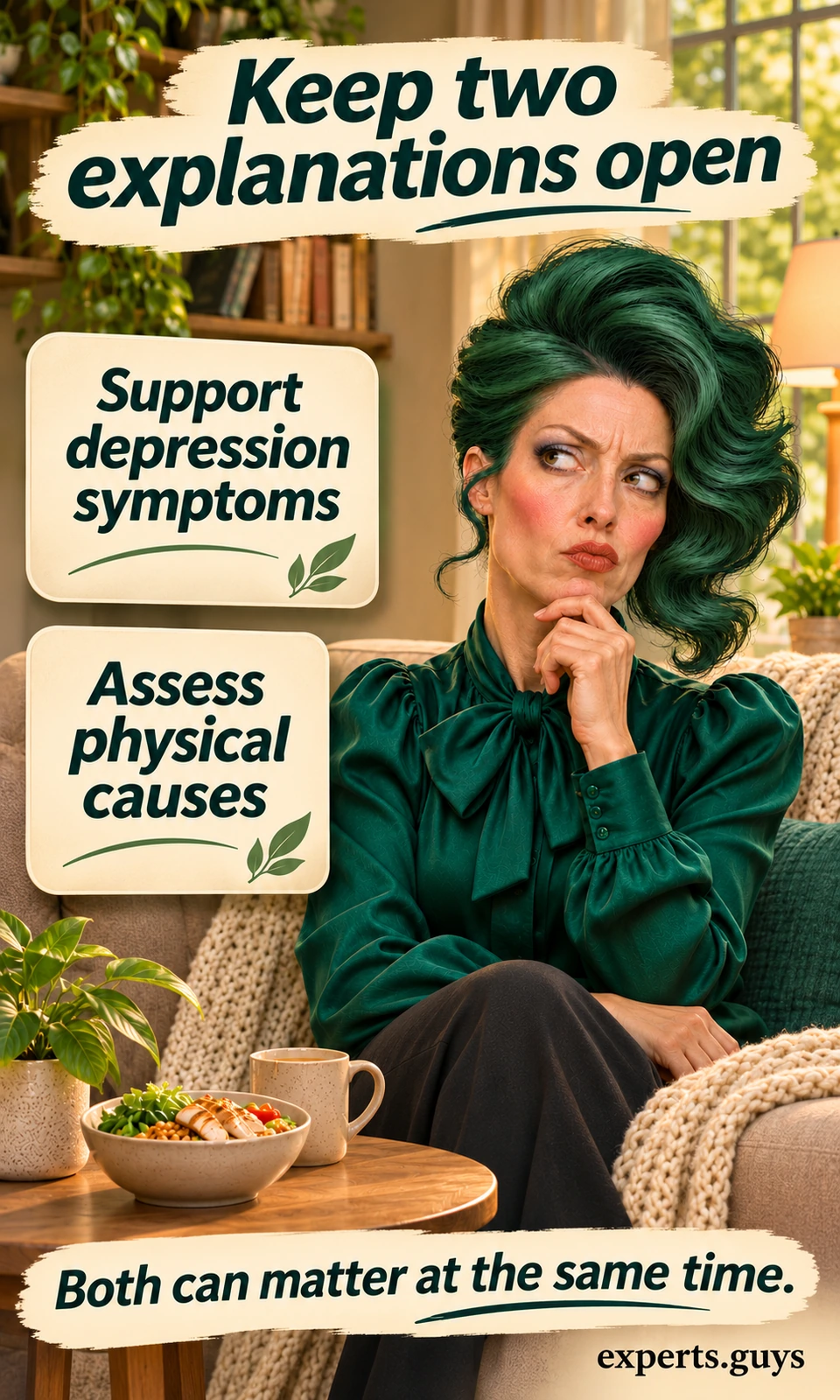
A two-track approach avoids a false choice. One track asks what can make eating, resting, washing or getting through necessary responsibilities more manageable. The other asks whether a physical condition, a medicine effect or another explanation needs attention alongside mental health care.
Neither track should be used to cancel the other. A practical accommodation is not proof of a diagnosis, and an assessment is not a reason to withhold help until every question has been answered. This is especially relevant when someone is waiting for an appointment or trying to explain a persistent limitation.
The NHS description of depression assessment includes discussion of both mental and physical effects and the possible use of tests for other explanations. There is no single physical test that establishes depression, and there is no universal test panel every reader should demand.
Use the table as a language aid. Its purpose is to make the next conversation more specific; it is not a home diagnostic tool and cannot decide whether a symptom is safe to watch.
| What is difficult | More useful description | Question to keep open |
|---|---|---|
| Exhaustion | I now need to sit after an ordinary task that used to be manageable. | What changed in sleep, health, medicines or daily demands? |
| Pain | This pain is new, has changed, or interferes with a specific activity. | Does it need a separate physical assessment? |
| Appetite or digestion | Eating or keeping fluids down has become difficult. | What support and assessment are needed now? |
| Feeling slowed down | Getting started or moving through a familiar task takes much more effort. | Is this subjective effort, observed slowing or actual loss of strength? |
| Medicine timing | The change appeared after a medicine was started, stopped or adjusted. | What should be reviewed without changing treatment independently? |
| Persistent symptoms despite initial help | This specific limitation remains or is worsening. | What is the agreed reassessment point and route? |
Describe one change in a way someone else can understand
Start with what is different from your usual functioning. “I feel awful” may be completely accurate, but “I have stopped halfway through preparing dinner because I cannot stay standing comfortably” gives another person a clearer picture of the limitation.
Then give a rough time frame and the activity affected. You do not need a perfect date, a daily diary or a long symptom score. If you do not know exactly when the change started, say so. An honest approximation is more useful than an invented timeline.

Include whether the symptom is new, worsening or different from previous episodes. A familiar label should not conceal a changed pattern. For example, a longstanding tired feeling and a sudden loss of strength should not be compressed into the same sentence merely because both make activity difficult.
If speaking is difficult, a short phone message can do the same job. “The problem is physical fatigue; the change is new; it is stopping me from preparing food” is enough to begin a conversation. You do not need to produce an essay before asking for support.
- Say what changed from your usual self.
- Name one ordinary activity that is now harder.
- Give the best time frame you can without guessing.
- Mention relevant medicine changes or a new illness.
- Ask what needs assessment and what help is practical today.
Remove one effort barrier instead of redesigning your life
A useful accommodation is small enough to use on a difficult day. Put an ordinary meal and water within reach, choose an easier preparation option, or ask another person to take over one specific task. The aim is to reduce friction around an essential need, not to create an elaborate recovery routine.
For example, if cooking is the barrier, help with an appropriate ready-to-eat meal may be more useful than a lecture about making everything from scratch. If a household task is the barrier, a clear handover such as “Could you handle the laundry today?” is easier to act on than “I need to get my life together.”

Choose the change with the person, rather than arranging their environment as though they have lost all agency. One person may want quiet assistance; another may want company while doing a task. Ask which part is difficult before deciding what the help should look like.
The same approach can apply to work or study. A specific discussion about a deadline, a task handover or a quieter place to complete necessary work is more concrete than an instruction to be resilient. What can be arranged depends on the setting; this is not a promise of a particular workplace entitlement.
Do not turn an accommodation into an escalating challenge. If the person completes a small task, that does not prove they can immediately manage a full day at their previous pace. Capacity can vary, and practical support should respond to what is possible rather than reward performance with more demands.
Heaviness and weakness need different descriptions
The site’s physical heaviness guide distinguishes the feeling of unusual effort from other movement problems. That distinction is useful here because “my body feels heavy” should not automatically become “my muscles have lost strength.”
If there is a clear new loss of strength, difficulty walking, repeated falls or another worsening physical limitation, describe it plainly when seeking care. A metaphor about heaviness can communicate distress, but it should not hide the specific change that needs attention.
Make the next care conversation a handoff, not a debate
A productive handoff brings the physical change, the mood context and the functional impact into the same discussion. You do not need to argue in advance that one explanation must win. The question is what the combined picture requires and what should happen if it does not improve.
Mention medicine timing where relevant: a symptom may have appeared after a treatment was started, stopped or changed. Timing can be useful information without proving causation. Do not stop a prescribed medicine or alter a dose solely to test an idea from an article.

Ask what the initial plan is intended to address and what should trigger reassessment. “If this limitation remains, how should I get back in touch?” is a concrete question. It helps prevent an uncertain explanation from becoming a permanent dismissal.
A normal result can be reassuring about the particular thing tested, but it is not a universal account of every remaining symptom. Equally, a lack of an immediate explanation does not establish that the symptom is dangerous. The point is to keep follow-up attached to the actual course of the problem.
Where someone has both depression and a long-term physical condition, the support plan should take both into account. NICE’s guidance on depression with a chronic physical health problem addresses that combined context. Avoid treating separate appointments as though the conditions cannot affect the same person’s daily capacity.
Know when a routine plan is not enough
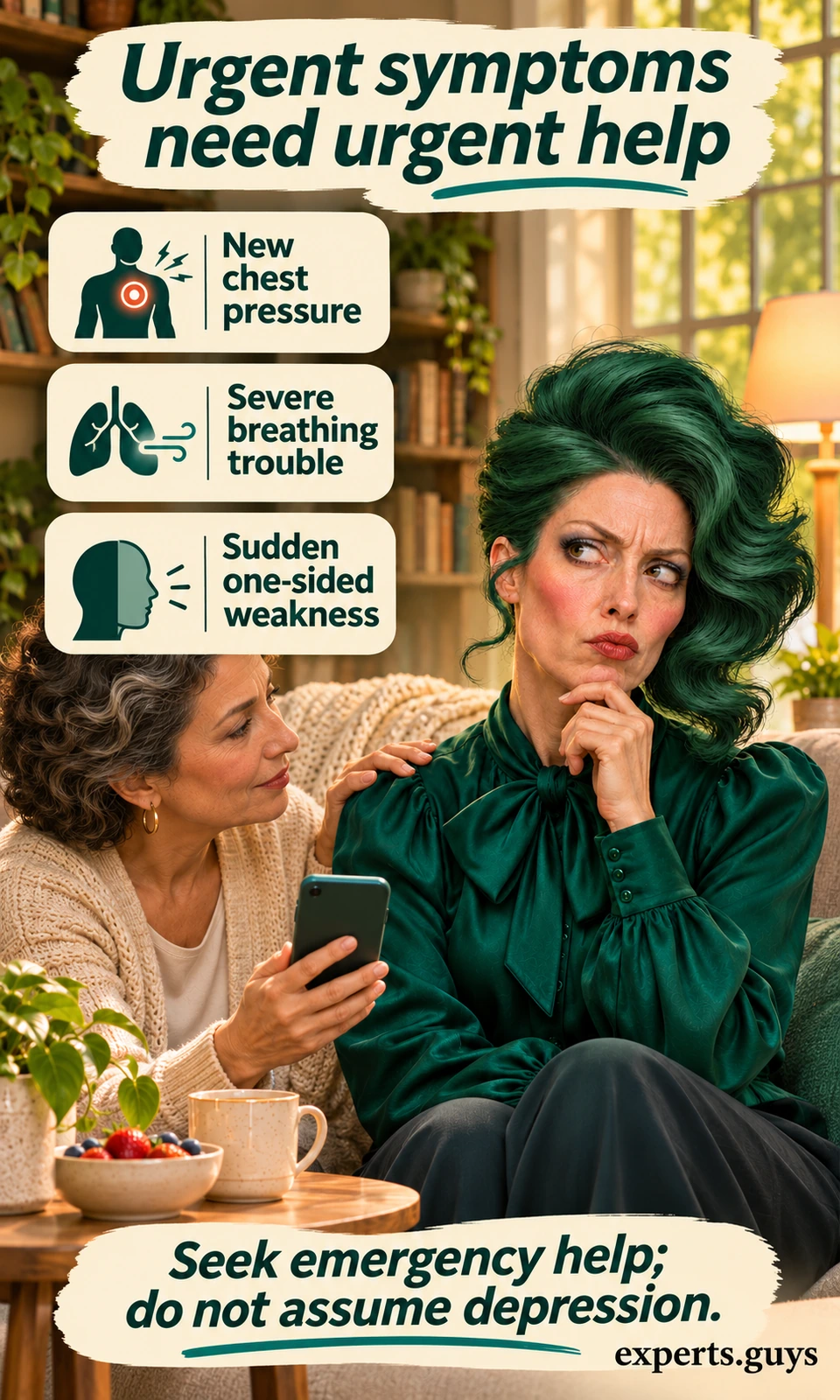
New chest pressure or discomfort with concerning associated symptoms, severe breathing difficulty, and sudden one-sided weakness are not symptoms to explain away as an ordinary depressive day. Seek local emergency help for those urgent changes. Do not wait for a routine mental health appointment to decide whether they deserve attention.
The NHS chest-pain guidance and CDC stroke-warning guidance describe urgent situations in more detail. These examples are not an exhaustive list. A severe, rapidly worsening or otherwise alarming new problem needs an appropriate urgent response.
Immediate danger to personal safety also changes the plan. If someone has an immediate intention to harm themselves or cannot stay safe, seek local emergency help and involve a trusted person where possible. A task adjustment or a future appointment is not sufficient for an immediate crisis.
This boundary should be clear without making every ordinary symptom frightening. Most readers are trying to understand ongoing discomfort and reduced capacity, not perform emergency diagnosis. The purpose is to prevent a known depression label from delaying help when the situation is clearly different.
What progress can look like without a false promise
Progress may be easier to notice in function than in a single symptom word. Someone may still feel tired but find eating easier because a task has been handed over. That is a useful change, even though it does not establish that the underlying cause has resolved.
Conversely, a better mood does not make persistent physical symptoms irrelevant. A care plan can be adjusted when one part improves and another does not. Avoid judging the entire process by whether every symptom moves at the same speed.
There is no need for a commercial symptom dashboard to make this approach work. One clear description, one practical accommodation and an agreed route for reassessment can be useful without creating another task the person has to maintain.
Frequently asked questions
What does somatic mean in depression?
Somatic refers to bodily symptoms or experiences. In depression, this can include changes in energy, sleep, appetite, pain or digestion. The term does not establish the cause of a particular symptom.
Are physical symptoms imaginary if depression contributes?
No. A symptom can be physically distressing and functionally limiting even when mental health is part of the explanation. Taking it seriously does not require choosing between a physical and psychological account.
Does a normal blood test prove symptoms are caused by depression?
No. A test answers the question it was designed to investigate. Assessment also considers the history, examination, course and other findings; a normal result is not an automatic explanation for every persistent symptom.
Should I force myself through ordinary chores?
A more useful response is to match the task to current capacity and remove one avoidable barrier. New weakness, severe symptoms or a worsening problem needs appropriate assessment rather than a push-through challenge.
Can medicine effects resemble physical depression symptoms?
Some medicines can contribute to symptoms or changes that overlap with depression. Mention the timing of starts, stops or dose changes to the prescriber, and do not stop or adjust treatment on your own.
When should routine support give way to urgent help?
New chest pressure, severe breathing trouble, sudden one-sided weakness or immediate danger to safety need urgent action. Seek local emergency help rather than assuming these are ordinary depression symptoms.
Next steps
Choose one physical limitation to describe clearly, make one essential task easier, and keep the assessment question open. If a symptom is new, worsening or urgent, respond to that change rather than assuming depression explains it. Practical help can begin before every cause is settled.










