



Artificial intelligence can create meaningful business value when it reduces the time, cost, delay or error rate inside a workflow that already matters to the company. The benefit is not “having AI”; it comes from changing the economics or reliability of a specific process while keeping the output measurable and controllable. The best starting point is therefore a real business bottleneck, not a model looking for something to do.
The older phrase “synthetic intelligence” is sometimes used loosely, but the business technologies discussed here are better described as artificial intelligence, including machine learning, predictive systems and generative AI. Those technologies can support automation, analysis, forecasting, content production, customer service and knowledge work, but the size of the benefit varies sharply by task. A workflow with high volume, clear inputs and measurable outputs can respond very differently from a low-volume decision that depends on deep judgment, incomplete context or irreversible consequences.
The Main Benefits of AI in Business
The strongest business case for AI usually falls into a small number of economic mechanisms. AI can increase capacity by shortening task time, reduce avoidable rework by detecting or preventing some errors, improve decision speed by organizing information faster, support revenue by improving customer response or targeting, and expand access to knowledge that was previously difficult to retrieve. These mechanisms are more useful than a generic list of “AI advantages” because each one can be tied to an operational baseline and checked after deployment.
Recent evidence also argues against treating every AI use case as equally productive. An NBER survey of nearly 750 corporate executives found that more than half of firms had already invested in AI, while reported and expected productivity effects varied substantially across sectors and firm types. Stanford’s AI Index similarly summarizes task-level studies showing larger gains in structured, measurable work and smaller or more uncertain gains in work requiring deeper reasoning, which is why a company should test the workflow rather than assume a universal percentage improvement.
1. More Capacity Without Automatically Adding More Headcount
One of AI’s clearest benefits is the ability to reduce the labor time required for repeatable information work. Drafting a first-pass document, classifying inbound requests, extracting fields from routine records, summarizing long material, preparing standard reports or routing a request can all consume small blocks of time that add up across a team. If AI removes part of that handling time while the final output still meets the required standard, the company gains capacity even when nobody is removed from the organization.
Capacity is not the same as payroll savings, and treating the two as identical can distort an AI business case. Ten hours saved on paper creates value only if the business can actually redirect those hours into useful work, shorten a queue, avoid overtime, postpone a new hire or increase throughput. This is why a good implementation measures what happened to the released capacity rather than converting every saved minute into a guaranteed cash return.
This distinction also helps explain how AI transforms business in practice. The change is often less dramatic than a full process replacement and more valuable than a flashy demo: a previously slow workflow becomes faster, employees spend less time collecting information, and managers can handle more work before the process becomes a bottleneck. That is an operating-model improvement, not merely a software feature.
2. Faster Access to Information and Better Decision Support
Many business decisions are delayed because the information needed to make them is scattered across documents, systems, emails, tickets or reports. AI can help search, classify, summarize and surface patterns from that material so a person reaches the relevant evidence faster. The real benefit is lower decision latency, especially when employees previously spent more time finding the information than interpreting it.
AI does not automatically make the resulting decision correct. A model can omit context, misclassify an unusual case or generate a confident answer from weak evidence, so a high-value decision process needs a clear boundary between information retrieval and final authority. The more expensive, regulated or irreversible the decision, the more important it becomes to preserve traceable sources, review steps and escalation paths.
This is also where governance becomes an operating requirement rather than a policy document. NIST’s AI Risk Management Framework is built around managing AI risk throughout design, development, use and evaluation, which is a useful way to think about business deployment: a model is not “finished” when it launches. It needs ownership, monitoring and a response when the system behaves differently from what the workflow expects.
3. Lower Rework and More Consistent Routine Processing
AI can improve consistency when the task has recognizable patterns and the organization can define what a correct output looks like. Examples include document classification, anomaly screening, duplicate detection, transcription cleanup, product-data normalization, routine quality checks and first-pass review. The benefit comes from reducing preventable variation and catching some problems earlier, before they become expensive downstream rework.
That does not mean machines “do not make mistakes.” AI systems can produce their own failure modes, including hallucination, false positives, false negatives, stale output and systematic errors that repeat at scale. A company therefore needs to compare the old error pattern with the new one instead of assuming automation converts an imperfect process into a perfect process.
A useful measurement is the total cost of rework before and after the pilot. That cost can include employee time, refunds, expedited shipping, customer support, manager review, compliance correction or other consequences that the company can defend with real data. If the AI system reduces one type of error but creates a new review burden of similar size, the apparent efficiency gain may disappear.
4. More Scalable Customer Service
Customer-service operations often combine high request volume with repetitive questions, predictable routing and a need for quick access to account or policy information. AI can help summarize prior conversations, suggest responses, classify intent, retrieve approved knowledge and handle simple self-service requests. When the system is designed around a reliable knowledge base and clear escalation rules, it can shorten handling time without forcing every customer through the same automated path.
The benefit becomes weaker when the system creates extra friction for unusual, emotional or high-value cases. A customer who must repeatedly re-explain a problem to an automated agent can generate more cost rather than less, especially when the issue eventually requires a human anyway. Service design therefore needs a deliberate “escape hatch” that moves the customer to a person when uncertainty, dissatisfaction or exception complexity passes the chosen threshold.
Customer experience should be measured with more than response speed. Resolution rate, repeat contact, escalation volume, refund or complaint behavior and customer effort can reveal whether the AI layer actually solved the problem. A faster answer that creates another contact tomorrow is not a productivity improvement.
5. Better Forecasting and Operational Planning
Machine-learning systems can help businesses detect patterns in demand, inventory, maintenance, fraud, cash flow, staffing or other time-series data. The business benefit is not that the model can “predict the future” with certainty; it is that a probabilistic signal may improve a planning decision compared with the previous method. That can matter when a small improvement in forecast quality changes ordering, staffing, maintenance timing or risk review across a large operation.
Forecasting value depends heavily on data quality and on whether the operating team can act on the forecast. A demand signal is not useful if purchasing lead times, supplier constraints or approval rules prevent the business from responding. The model therefore has to be evaluated together with the process it is meant to change, not as a separate analytics project.
Companies should also monitor model performance after deployment because conditions change. Customer behavior, product mix, pricing, economic conditions and operational rules can all shift the data away from the environment in which the model was first tested. A forecast that was useful six months ago can become misleading if the business keeps trusting it after the underlying pattern changes.
6. Faster Product, Marketing and Sales Work
Generative AI can accelerate parts of product research, campaign development, sales preparation and content production by creating drafts, variants and structured summaries quickly. The practical benefit is shorter iteration time: teams can explore more options before committing expensive production resources. That is especially useful when the human work is not eliminated but moved from blank-page creation toward selection, editing, testing and refinement.
Speed creates a new risk when output volume rises faster than quality control. A marketing team can generate more assets than it can properly review, a sales team can produce more outreach while weakening relevance, and a product team can create more concepts without improving the evidence behind them. The correct performance measure is therefore not how much AI produced but what changed in conversion, cycle time, customer response, launch quality or contribution margin.
That distinction matters when companies evaluate AI success metrics. Model usage, prompt counts and generated words are activity measures; they do not prove that the business is better off. The measurement system should connect the AI activity to the operational or commercial outcome the company originally wanted to improve.
7. Better Knowledge Access Inside the Company
A large organization can possess useful knowledge that employees struggle to find. Policies, proposals, technical documents, customer histories, project decisions and operating procedures may exist, yet searching across them can take longer than asking another person or recreating the answer. An AI-assisted knowledge layer can reduce that friction when it retrieves from controlled sources and makes the evidence behind the answer visible.
This benefit is strongest when the source material is current, well-governed and permission-aware. It becomes dangerous when a system mixes obsolete and current policies, exposes information to the wrong user or creates an answer without showing where it came from. Knowledge retrieval therefore needs content ownership and access control just as much as it needs a capable model.
The implementation can also reveal a non-AI problem: the company’s knowledge may be poorly maintained. If employees cannot agree which document is authoritative, adding a conversational interface can make confusion faster rather than solve it. AI works better when the underlying information architecture has a clear source of truth.
Where the Business Benefits of AI Usually Break Down

AI projects often fail for reasons that have little to do with model intelligence. The workflow may not have enough volume to justify integration, the baseline may be unknown, employees may need to review every output so carefully that no time is saved, or the surrounding systems may be too fragmented to support reliable automation. In those cases, a technically impressive model can still produce weak business economics.
The hidden costs of AI adoption matter because licensing is only one part of the expense. Integration, data preparation, security review, employee training, workflow redesign, monitoring, exception handling and ongoing quality assurance can all consume resources after the first demonstration works. The cost model should include the people and process needed to operate the system, not just the subscription price.
Risk can also compound as AI reaches more parts of the organization. A small error inside an internal draft may be easy to correct, while the same error in an automated customer, credit, safety, legal or compliance workflow can have much larger consequences. That is why a business should understand enterprise AI failure patterns and decide when enterprises should not use AI before expanding an early success into a fully automated process.
How to Estimate AI Value Before You Buy
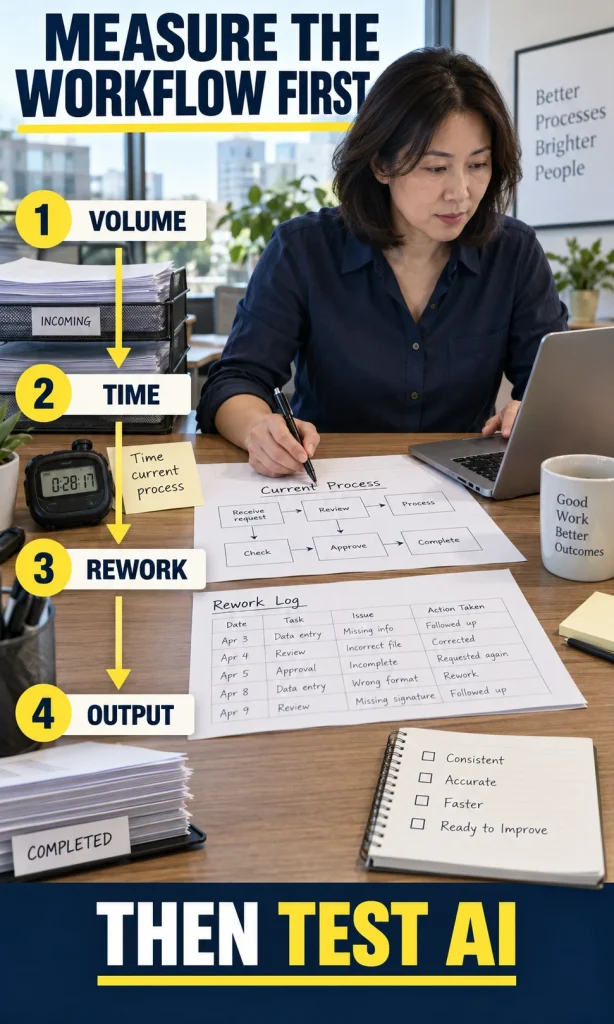
A defensible AI business case begins with a single workflow and a baseline. Measure how often the work happens, how long it takes, what rework or error events cost, what the current queue or service level looks like, and what systems or employees are involved. Then model the benefit using conservative assumptions that can be replaced with pilot data later.
A useful capacity equation is: annual time value = workflow executions per week × minutes per execution × expected time reduction × 52 ÷ 60 × blended hourly labor cost. Rework value can be modeled separately from the number of avoidable events and their average cost, while revenue benefits should be included only when the company can defend the attribution. Keeping these categories separate prevents a weak revenue assumption from disguising a strong operational case—or the reverse.
The interactive experience below follows that structure. It does not assign a generic “AI readiness score” or assume a universal productivity percentage. It uses the numbers you provide to build a transparent scenario, then flags control gaps that could make a financially attractive use case difficult to pilot safely.
AI Value Reality Check
Separate capacity, rework and attributable value from the full cost of implementation.
Define the workflow
Model one repeated activity, not an entire department.
Add quality and cost assumptions
Keep capacity, rework and revenue effects separate.
Check the operating controls
These do not create a score. They change the pilot recommendation.
Complete the inputs
What the economics say
What the controls say
AI Value Reality Check
Workflow
This one-page report reflects only the assumptions entered in the browser. It is a scenario, not a forecast or guarantee.
Control check
Decision note
What Makes an AI Use Case a Strong Pilot Candidate?
A strong first use case has a clear owner, a measurable baseline and enough repetition for an improvement to matter. The input data should be available, the output should be reviewable, and a mistake should be detectable or reversible before it creates a serious consequence. Those conditions make learning cheaper because the business can test the system without betting a critical process on an unproven workflow.
High-risk decisions require a different standard. If the output can materially affect safety, legal rights, employment, financial access, regulated obligations or another consequential outcome, the company needs stronger controls and domain-specific review before automation expands. The benefit of speed does not cancel the cost of a harmful or noncompliant decision.
This is one reason sustainable AI oversight matters after the pilot. The organization needs someone who owns model changes, quality drift, incidents, access, vendor updates and retirement decisions. Governance that exists only at approval time leaves the operating risk unmanaged after the system becomes routine.
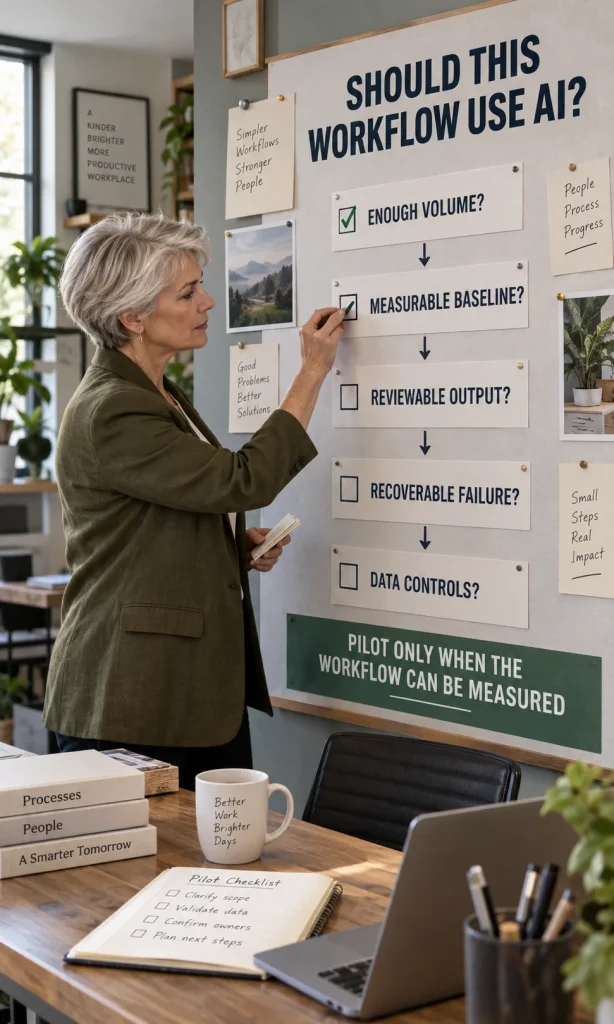
A Practical 90-Day AI Pilot Structure
The first phase should establish the baseline and define the boundary of the experiment. Choose one workflow, document the existing time and quality measures, identify the people affected, list the data sources, and decide which outputs must be reviewed. This creates a comparison point before the team becomes accustomed to the new process.
The second phase should run the AI system beside the existing workflow or with limited authority. Track task time, exception volume, rework, review effort, user behavior and any customer or operational effects that matter to the use case. The aim is not to prove that the model can produce output; it is to learn whether the complete workflow performs better after the costs of checking and operating the system are included.
The final phase should decide whether to expand, redesign or stop. A pilot that produces no net value is still useful if it exposes a bad assumption before the company scales the expense. That discipline is central to preventing enterprise AI failure: treat evidence from the workflow as more important than enthusiasm for the technology.
AI and the Workforce: Augmentation Is Not the Same as Elimination
AI can remove parts of a job without removing the job itself. An employee may spend less time drafting, searching, transcribing or sorting and more time reviewing, resolving exceptions, negotiating, managing relationships or making decisions. The resulting productivity gain depends on whether the organization redesigns the role around the new division of work.
Headcount reduction is therefore a weak default assumption for an AI business case. Some companies may eventually need fewer hours for a particular activity, but others will use the capacity to increase output, improve service or handle growth without adding staff at the same rate. The economic outcome depends on what happens after the time is released.
Training also has to change with the workflow. Employees need to know what the system is good at, what evidence it uses, when they are expected to verify it and how to escalate an uncertain result. A workforce that blindly accepts AI output can turn a productivity system into a new source of operational risk.
The Bottom Line
The biggest benefit of artificial intelligence in business is not automation by itself. AI is valuable when it changes a measurable business constraint—time, rework, delay, throughput, service capacity, forecast quality or another outcome—without creating a larger hidden cost or unacceptable risk. That makes workflow selection, measurement and control more important than simply choosing the most advanced model.
Start with a process you can observe, put real numbers around the current state, and run a pilot that keeps the assumptions visible. If the improvement survives the cost of integration, review and oversight, the business has evidence for expansion. If it does not, the company has learned where AI does not belong before the mistake becomes expensive.
Frequently Asked Questions
What are the main benefits of artificial intelligence in business?
The main benefits are usually higher workflow capacity, faster information access, lower rework, more scalable service, better forecasting and faster iteration in knowledge work. The benefit becomes meaningful only when the company can connect the AI system to a measurable business outcome and include the cost of integration, review and ongoing operation.
Does AI always reduce business costs?
No. AI can reduce labor time or rework in one part of a process while adding software, integration, quality-control, training and monitoring costs somewhere else. Compare the complete workflow before and after deployment rather than treating a faster individual task as proof of lower total cost.
How can a small business benefit from AI?
A small business can use AI to reduce repetitive administrative work, organize information, draft first-pass content, improve customer-response workflows or analyze routine data. Small firms should favor narrow use cases with low integration burden and clear review because a complicated deployment can consume more management time than the benefit is worth.
What is the best business process to automate with AI first?
A good first process is repetitive, measurable, supported by accessible data and safe to test with human review. It should happen often enough that a time or quality improvement matters, while mistakes remain detectable or reversible during the pilot.
How do you measure the ROI of AI?
Start with a baseline for time, volume, rework, service level or another outcome the AI is supposed to change. Compare the measured improvement with software, integration, data, training, review and oversight costs, and keep capacity savings separate from cash savings unless the business can show how the released time changed spending or output.
Can AI replace employees?
AI can automate parts of some jobs, but that does not automatically remove the full role. Many deployments change how work is divided between people and software, so the workforce effect depends on task mix, demand, process redesign, growth plans and how the company uses the capacity released by automation.