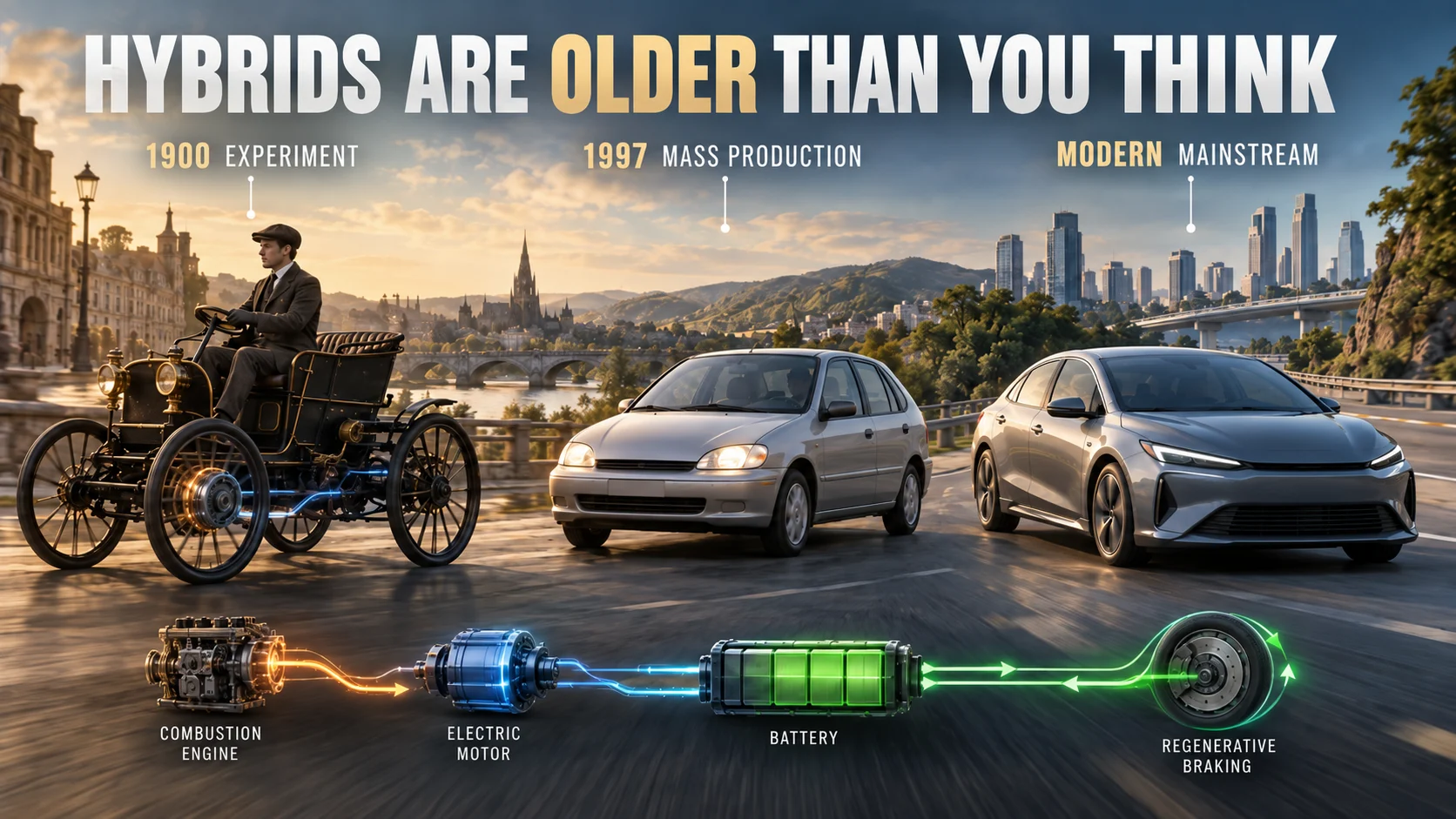

Hybrid electric vehicles are not a recent stepping stone between gasoline cars and battery EVs; the basic idea is more than a century old. What changed was not the concept of combining combustion and electric drive, but the batteries, electronics, controls, manufacturing scale and market conditions that finally made the concept practical. The history makes more sense when you follow those enabling technologies rather than treating every hybrid as the same machine.
A modern hybrid electric vehicle, or HEV, combines an internal-combustion engine with one or more electric machines and an energy-storage system. A conventional HEV does not need to be plugged in; it recovers energy through regenerative braking and manages engine operation to reduce fuel use, while a plug-in hybrid electric vehicle, or PHEV, adds a larger battery that can be charged externally. If you need the basic drivetrain concepts first, see our hybrid automobile fundamentals guide.
The short answer: hybrids were invented early, but the market arrived late
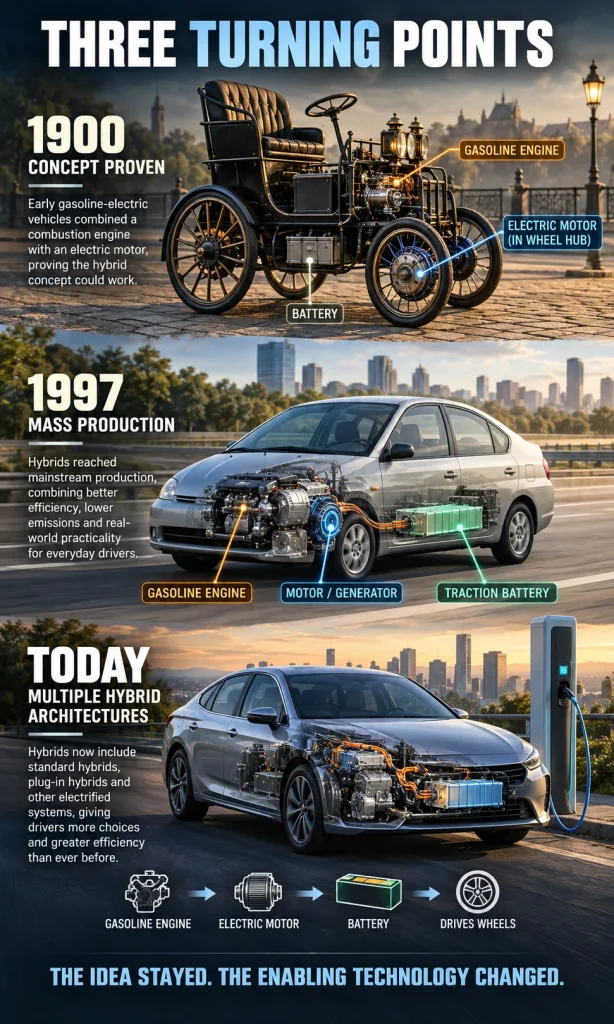
The first workable gasoline-electric hybrids appeared around 1900, when inventors were still experimenting with steam, gasoline and electric propulsion at the same time. Porsche’s historical archive describes Ferdinand Porsche’s 1900 Semper Vivus as the first functional full-hybrid car, followed by the production-ready Lohner-Porsche Mixte in 1901. That early system was essentially a series hybrid: combustion engines generated electricity and electric wheel-hub motors provided propulsion.
The early idea was technically clever but economically awkward. Batteries were heavy, electrical equipment was expensive, roads and fueling infrastructure were changing quickly, and gasoline cars became easier to start and cheaper to mass-produce. The U.S. Department of Energy’s electric-vehicle history notes that Ford’s Model T, cheap gasoline and the electric starter helped gasoline vehicles dominate by the 1910s and 1920s.
| Milestone | What changed | Why it mattered |
|---|---|---|
| 1900-1901 | Functional gasoline-electric series-hybrid concepts appeared. | Proved that combustion and electric drive could complement each other. |
| 1970s | Oil shocks and emissions concerns revived alternative-powertrain research. | Efficiency became a strategic engineering problem again. |
| 1997 | Toyota launched the Prius in Japan as the first mass-produced hybrid passenger car. | Hybrid control became a consumer product rather than a laboratory demonstration. |
| 1999-2000 | Honda Insight and Toyota Prius reached U.S. buyers. | Competing hybrid architectures entered a major mass market. |
| 2010s | Plug-in hybrids and broader hybrid lineups expanded the idea. | Electrification spread beyond dedicated economy cars. |
| 2020s | Mild, full and plug-in hybrids are offered across many vehicle classes. | “Hybrid” now describes a family of architectures, not one drivetrain. |
Why the first hybrid era faded
The earliest hybrids solved a real engineering problem: batteries alone offered limited range and charging infrastructure barely existed. A combustion engine driving a generator could keep the electric drive supplied with energy, but the system added weight, cost and mechanical complexity to vehicles that were already expensive. Those penalties were difficult to justify once gasoline cars became cheaper, more powerful and easier to use.
That does not mean hybrid development stopped completely. The 1917 Woods Dual Power is one of several historical examples showing that engineers continued to combine electric and combustion propulsion. What disappeared was not the idea, but the business case for mass-market hybrid passenger cars.
The 1970s brought the efficiency problem back
Fuel shortages, oil-price shocks and air-quality concerns changed the engineering priorities of the 1970s. In the United States, the Electric and Hybrid Vehicle Research, Development, and Demonstration Act of 1976 authorized federal support for research into electric and hybrid vehicles, according to the Department of Energy. The period did not immediately create a mass-market hybrid, but it kept research moving while electronics, motors and batteries improved.
By the 1980s and early 1990s, the missing ingredient was increasingly control rather than concept. A useful hybrid must decide, often many times per second, when the engine should run, when the motor should assist, when the battery should charge and how braking energy should be recovered. That job became far more practical as power electronics, microprocessors and battery-management systems improved.
- Better battery power: nickel-metal hydride batteries could accept and deliver power repeatedly without the mass of early lead-acid systems.
- Better power electronics: inverters and motor controls could manage high-voltage energy precisely.
- Better software: the car could blend engine and motor operation without asking the driver to manage the process.
- Regenerative braking: energy that would normally become brake heat could be converted back into electricity.
- Production scale: hybrid-specific motors, generators, batteries and control units could be engineered as one integrated system.
1997: the Prius turned hybrid theory into mass production
Toyota began its G21 project in 1993 and launched the first-generation Prius in Japan in December 1997. Toyota describes it as the world’s first mass-produced hybrid passenger vehicle, using a gasoline engine, electric motor, battery and a power-split device to coordinate propulsion and generation. The achievement was not simply putting two power sources in one car; it was making the transitions smooth enough, durable enough and manufacturable enough for ordinary drivers.
The first Prius also established a pattern that still defines many full hybrids. The electric motor can help move the vehicle, regenerative braking can recover part of the vehicle’s kinetic energy, and the engine can be shut off when it is not needed. Toyota’s later Hybrid Synergy Drive refined this power-split approach and made the drivetrain more powerful, compact and familiar.
1999-2000: Honda and Toyota showed that hybrids could be built differently
Honda introduced the Insight in Japan in 1999 and began U.S. sales in December that year, making it the first hybrid sold in the United States. Honda’s Integrated Motor Assist system used a different architecture from Toyota’s power-split design, with the electric motor assisting the engine through a more direct mechanical path. The contrast is useful because it shows why “hybrid” has never meant a single technical layout.
Toyota brought the Prius to North America and Europe in 2000, broadening the audience for a full hybrid that could use the motor more independently. The two cars pursued the same high-level goal – lower fuel use – but made different engineering compromises around motor size, battery use, drivetrain layout and vehicle packaging. That distinction is still visible today in the difference between mild hybrids, parallel hybrids, power-split full hybrids and plug-in hybrids.
Where a hybrid actually saves energy
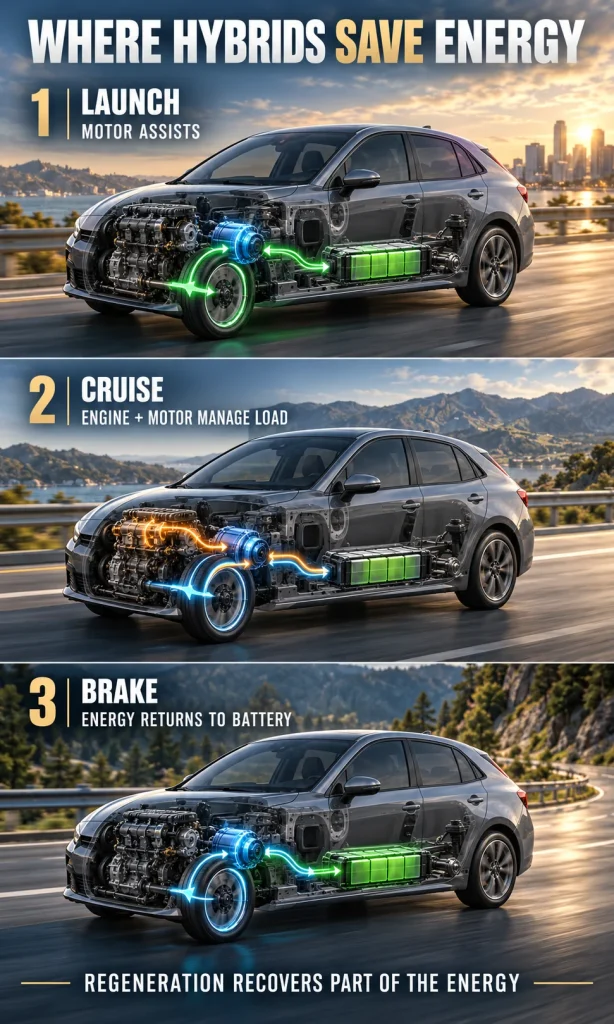
A hybrid does not create energy; it reduces waste and gives the engine more favorable operating conditions. The motor can provide torque when the engine would otherwise operate inefficiently, the engine can shut off at idle or low-load moments, and regenerative braking can recover part of the kinetic energy that a conventional vehicle converts into heat. The Department of Energy’s vehicle technology overview describes regenerative braking as a primary reason conventional HEVs can improve fuel efficiency.
Regeneration is especially valuable in stop-and-go driving because there are repeated opportunities to slow the vehicle and reuse part of that energy. Highway driving offers fewer braking events, so the benefit depends more on efficient engine operation, aerodynamic drag, rolling resistance and the hybrid system’s ability to keep the engine near an efficient load point. This is why a hybrid’s advantage can vary significantly by drive cycle even when the hardware is unchanged.
The battery in a conventional hybrid is also used differently from a large EV battery. It is usually sized for frequent power exchange rather than long electric-only range, and the control system often keeps it within a relatively narrow state-of-charge window. If you want the battery side in more detail, our guide to how a lithium-ion battery works explains the underlying cell behavior used in many modern electrified vehicles.

Interactive history + architecture comparison
Hybrid Evolution Studio
Move through the turning points, compare two eras, and see what changed technically - not just chronologically.
Step 1
Choose an era
Select a milestone to see the drivetrain idea, enabling technology and market significance.
1900
Semper Vivus proves the full-hybrid idea
Step 2
Compare two milestones
The comparison focuses on architecture and enabling technology, so different dates do not collapse into one generic timeline.
Historical labels are simplified for reader orientation. Use the linked article and primary sources for model-specific engineering details.
The 2000s made hybrids ordinary instead of experimental
The second-generation Prius, introduced in 2003, was an important step because hybrid technology became less of a technical curiosity and more of a complete vehicle proposition. Toyota’s official history shows that the company expanded hybrid technology into additional body styles and continued reducing the cost and size of core components. At the same time, Honda moved hybrid assistance into familiar models such as the Civic and Accord.
This broader adoption mattered more than any single fuel-economy number. Hybrid systems had to survive years of ordinary use, operate across climates, integrate with air-conditioning and braking systems, and be serviceable by dealer networks. As those systems accumulated real-world operating history, buyer uncertainty about the basic concept began to fall.
The 2010s added plug-in capability and performance
Plug-in hybrids changed the energy balance by adding a battery large enough to accept meaningful energy from the grid. Unlike a conventional HEV, a PHEV can begin a trip with electricity supplied externally and then use its combustion engine when the battery reaches its normal hybrid operating range. The result is not simply “a bigger hybrid”; charging access and daily driving distance now influence how much gasoline the vehicle actually uses.
The 2010s also broke the association between hybrids and slow, economy-focused cars. Manufacturers applied electric torque to SUVs, luxury cars and high-performance vehicles, using the motor not only for efficiency but also for acceleration and response. That shift helped establish electrification as a drivetrain strategy rather than a niche body style.
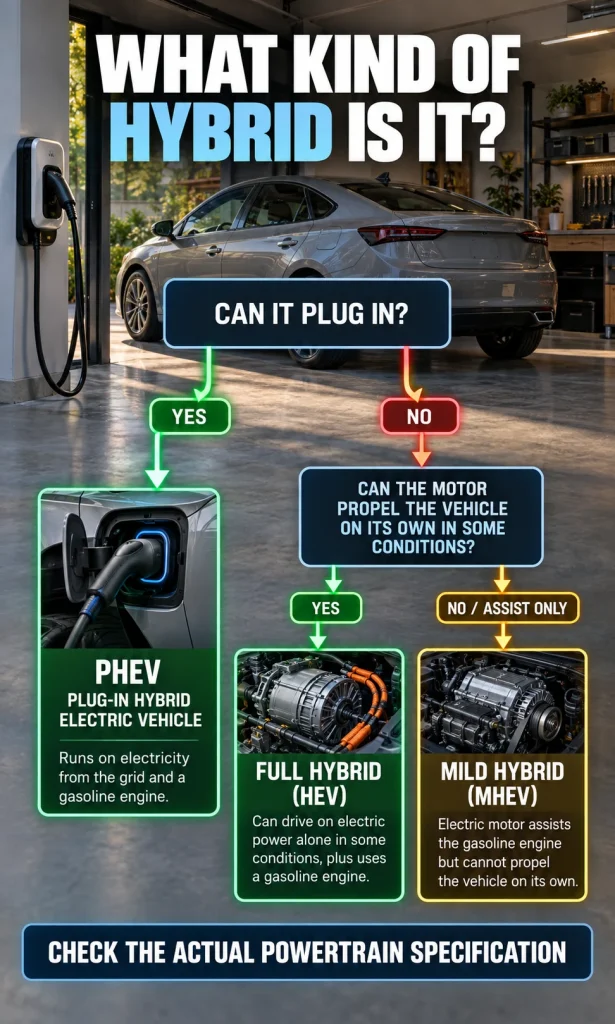
| Hybrid type | Can the vehicle be plugged in? | Typical electric role | Historical significance |
|---|---|---|---|
| Mild hybrid (MHEV) | No | Assist, restart and energy recovery; typically not sustained electric-only propulsion. | Expanded electrification with smaller batteries and lower system complexity. |
| Full hybrid (HEV) | No | Motor can propel the vehicle in some conditions and recover braking energy. | The architecture that made the Prius-era mass market possible. |
| Plug-in hybrid (PHEV) | Yes | Larger battery supports meaningful electric driving before hybrid operation. | Connected grid charging with the long-distance flexibility of an engine. |
Why hybrids are prominent again in the 2020s
Hybrid demand has risen again as manufacturers and buyers balance fuel economy, emissions requirements, charging availability, battery cost and everyday convenience. In the United States, the EPA’s 2025 Automotive Trends Report says hybrids reached 15% of new light-duty vehicle production in model year 2024, the highest share in the report’s historical series at that point. That is a U.S. production measure, not a global market share, but it illustrates how far hybrids have moved from their late-1990s niche.
The technology is also less visually distinctive than it once was. A hybrid may now be a sedan, crossover, pickup, luxury vehicle or performance model, and some systems are marketed as a powertrain option rather than a separate “hybrid car.” The useful question has shifted from “Is this a hybrid?” to “What kind of hybrid system is this, and what job is the electric side doing?”
- City-heavy driving: full hybrids can exploit repeated low-speed operation and regenerative braking.
- Long mixed trips without routine charging: conventional HEVs preserve gasoline refueling convenience.
- Regular short trips with reliable charging: a PHEV can shift more daily driving to grid electricity.
- Small efficiency gain with minimal behavior change: a mild hybrid may reduce some fuel use without changing the fueling routine.
- Battery-electric driving: a BEV removes the combustion engine entirely, so its charging, range and efficiency questions are different from hybrid history.
What the history explains about today’s hybrid choices
The century-long story shows that hybrid technology survives when its added complexity earns back a practical advantage. Early systems could not overcome the cost and weight gap versus improving gasoline cars; modern systems use compact motors, high-power batteries, sophisticated controls and regenerative braking to make the electric side work almost invisibly. That is the real path from perplexity to prominence.
It also explains why no single hybrid architecture is automatically best. A power-split full hybrid, a parallel hybrid, a 48-volt mild hybrid and a plug-in hybrid may all carry a hybrid label while behaving very differently. Compare the actual system, the driving pattern and the charging situation before treating the badge as a technical specification.
For ownership decisions, history is only the starting point. Battery condition, cooling systems, brake blending, warranty coverage and service procedures matter on a used or aging hybrid, so review our guide to hybrid servicing and the practical benefits of driving a hybrid. For broader electrified-vehicle context, see electric and hybrid cars and trucks.
Frequently asked questions
Who invented the first hybrid car?
There is no single clean “first” for every definition, because late-19th-century inventors experimented with mixed power systems in different ways. Porsche’s historical record identifies Ferdinand Porsche’s 1900 Semper Vivus as the first functional full-hybrid car and the 1901 Lohner-Porsche Mixte as its production-ready development. The safest wording is that Porsche created one of the earliest functional gasoline-electric hybrid systems at the turn of the 20th century.
Was the Toyota Prius the first hybrid vehicle?
No. Hybrid concepts existed roughly a century before the Prius, but Toyota’s 1997 Prius was the world’s first mass-produced hybrid passenger car. Its importance is mass production, integrated control and market adoption, not invention of the basic hybrid idea.
What was the first hybrid car sold in the United States?
The Honda Insight became the first modern hybrid sold in the United States in December 1999. The Toyota Prius followed in the U.S. market in 2000. This market-specific timeline is different from the Prius’s original 1997 launch in Japan.
What is the difference between an HEV and a PHEV?
A conventional HEV is fueled with gasoline and recharges its traction battery through the engine, regenerative braking and vehicle energy management. A PHEV has a larger battery that can also be charged from an external power source, allowing meaningful electric driving before it operates as a hybrid. The plug changes both the energy source and the way daily driving patterns affect fuel use.
Why did hybrids take almost 100 years to become popular?
The early concept was ahead of the supporting technology and economics. Modern hybrids became practical only after batteries, electric motors, power electronics, computer controls, manufacturing and emissions or fuel-economy pressures developed far enough to justify the added hardware. The modern success is therefore a systems-engineering story rather than one isolated invention.
Do all hybrids use regenerative braking?
Most modern HEVs and PHEVs use regenerative braking because the electric machine can operate as a generator during deceleration. The amount of energy recovered depends on system design, battery limits, vehicle speed, braking demand and road conditions. Friction brakes are still required for stronger stops, low-speed control and situations where regeneration is limited.
Bottom line
Hybrid vehicles became prominent because several mature technologies finally made an old idea work at scale. The decisive milestones were not merely 1900, 1997 or 2010; they were the gradual improvements in energy storage, motors, power electronics, software, manufacturing and regulation that made each generation more practical than the last. Read a modern hybrid by its architecture and use case, not just by the word “hybrid” on the specification sheet.